WHITE COLUMNS IN NEW YORK: KAMARI CARTER, PRECOG, AND SYSTEMS OF SOUND AND VISIBILITY IN A SHIFTING AMERICA
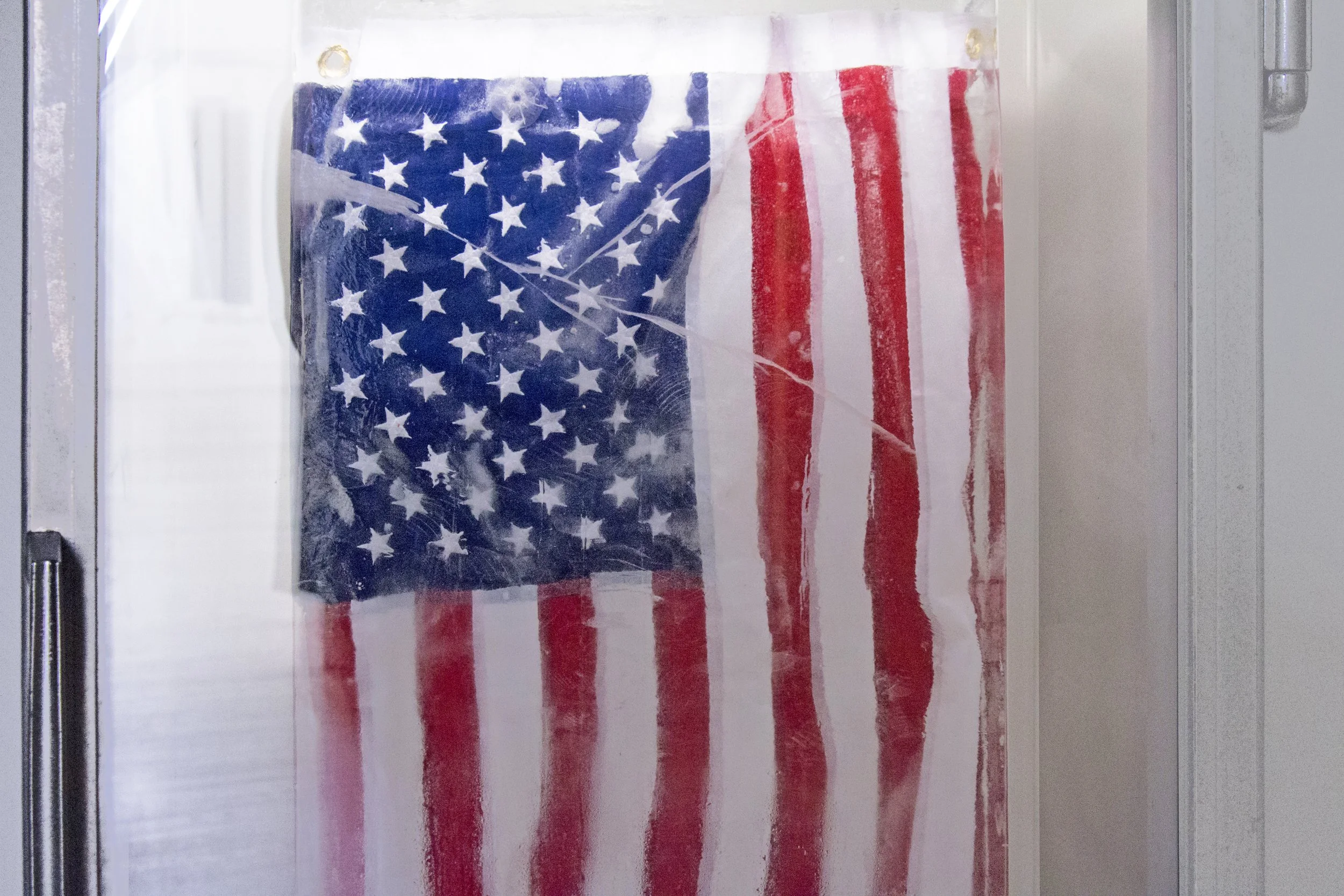
Kamari Carter, Frozen Flag, 2024. American flag, ice, commercial freezer. 77 x 36 x 30 inches/ 195.6 x 91.4 x 76.2 cm. Courtesy of the artist and Microscope Gallery, New York.
White Columns, founded in 1970 by artists including Jeffrey Lew and Gordon Matta-Clark, remains one of the most enduring and quietly radical institutions in New York. Emerging from the artist-run space at 112 Greene Street in SoHo, a site synonymous with experimentation, process-based work, and resistance to institutional rigidity, White Columns has sustained a lineage that privileges artistic risk over market certainty.
Matta-Clark’s presence within this origin story is particularly resonant. His practice, defined by cutting, splitting, and intervening directly into architectural structures, reimagined buildings not as fixed forms but as living systems open to disruption and reinterpretation. By exposing interiors and destabilizing facades, he revealed architecture as contingent and unfinished. White Columns inherits this ethos. Even its name suggests a skeletal framework, columns not as monuments, but as supports that hold space for something else to emerge. It is an architecture of possibility, a structure for knowledge, exchange, and becoming.
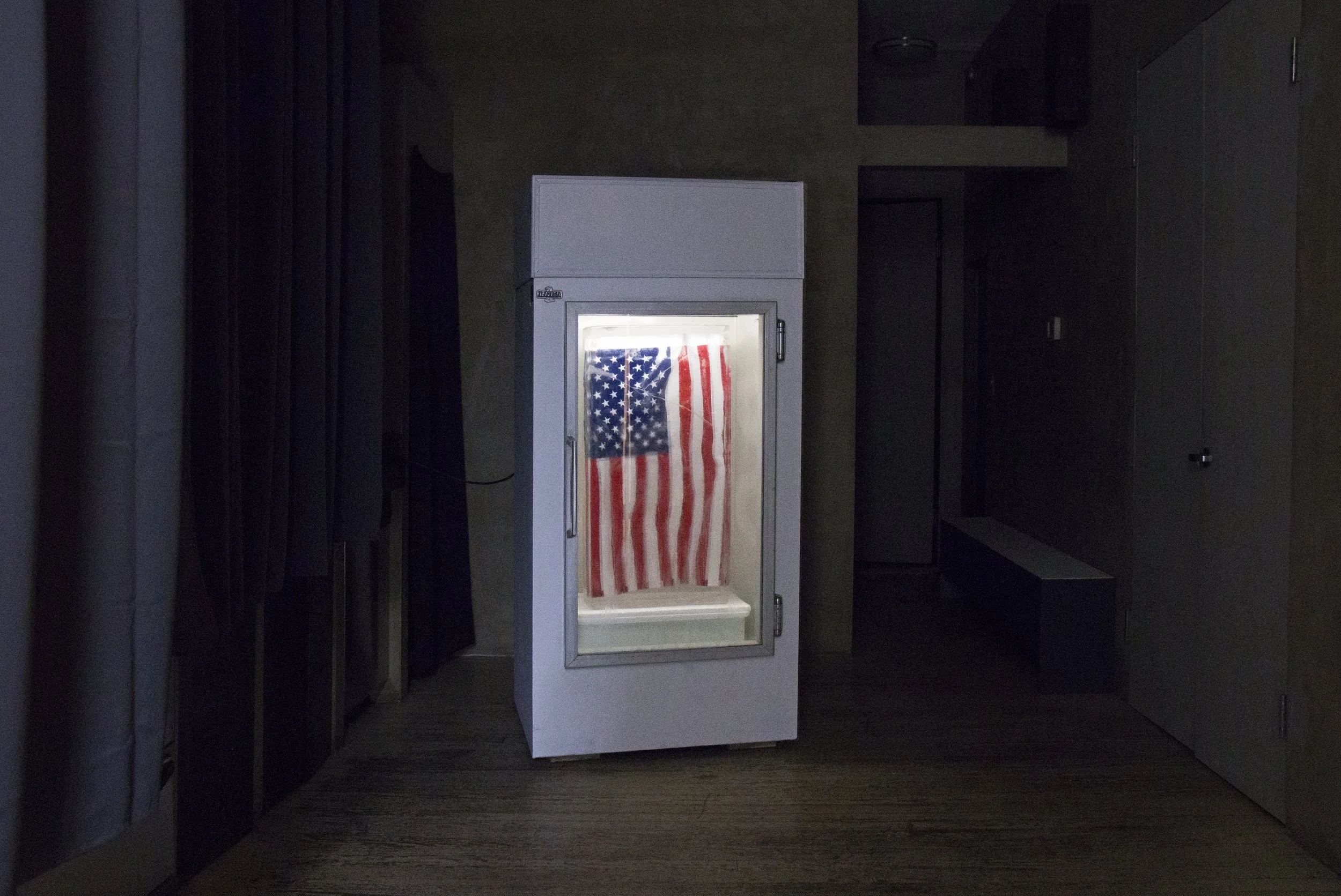
Kamari Carter, Frozen Flag, 2024. American flag, ice, commercial freezer. 77 x 36 x 30 inches/ 195.6 x 91.4 x 76.2 cm. Courtesy of the artist and Microscope Gallery, New York.
Now under the direction of Matthew Higgs, the institution continues to operate with rare clarity of purpose: supporting emerging artists, offering visibility through its registry and directory, and allowing work to exist before it is fully codified. I first met Higgs at a Madonna-hosted Yves Saint Laurent party during Art Basel Miami Beach in 2022. What stayed with me was not the spectacle, but his sincerity. He spoke with conviction about helping artists find footing in New York, about building platforms that allow practices to develop without premature pressure. That ethos is not abstract; it is structural.
New York’s cultural history has long depended on spaces like this, artist-led, provisional, and deeply responsive to their moment. Institutions such as The Art Students League of New York and the EFA Robert Blackburn Printmaking Workshop have provided generations of artists with access to tools, education, and community outside traditional academic or commercial frameworks. One might also consider Printed Matter, Inc. and Pioneer Works, which foreground experimentation, research, and cross-disciplinary exchange as central to artistic production. Spaces such as Amant and Performa extend this ecosystem through ambitious programming and event-based engagement, even as their structures remain more curated and episodic. Together, these institutions form a layered network—one that sustains artistic practice at its most vulnerable and most generative stages. White Columns stands as a rare continuity within that lineage: a place where discovery is not only preserved, but actively produced.
Within this context, I found myself particularly drawn to the work of Kamari Carter. His practice moves fluidly between performance, installation, and sound, operating less as a series of discrete works and more as an ongoing system of communication. There is a collaborative sensibility embedded in his approach, one that mirrors the logic of music, where exchange, improvisation, and responsiveness become foundational. His work listens as much as it speaks.
What is especially striking is the way objects in Carter’s installations begin to assume bodily presence. In works such as Event Horizon, microphones and megaphones cease to function as neutral instruments; they become surrogates for human figures, dispersed throughout space yet bound through systems of transmission. Each carries fragments of voice, authority, and vulnerability, transforming the gallery into a field of distributed embodiment.
Equally compelling is his engagement with time as material. In sculptural works in which the American flag is encased in ice, the object undergoes gradual dissolution. The work does not assert a fixed meaning; it evolves. As the ice melts, the piece shifts, destabilizes, and ultimately disappears, allowing meaning to accumulate through duration rather than declaration.
What becomes increasingly urgent is how such a work continues to evolve, whether its meaning is shaped by discourse, audience reception, or the pressure of public events that reframe its context. As ICE activity becomes increasingly visible, not as abstract policy, but as something witnessed, circulated, and felt in real time, the work takes on renewed charge. Carter’s gesture, freezing a national symbol only to let it dissolve, mirrors the instability of systems that claim permanence yet remain in constant negotiation.
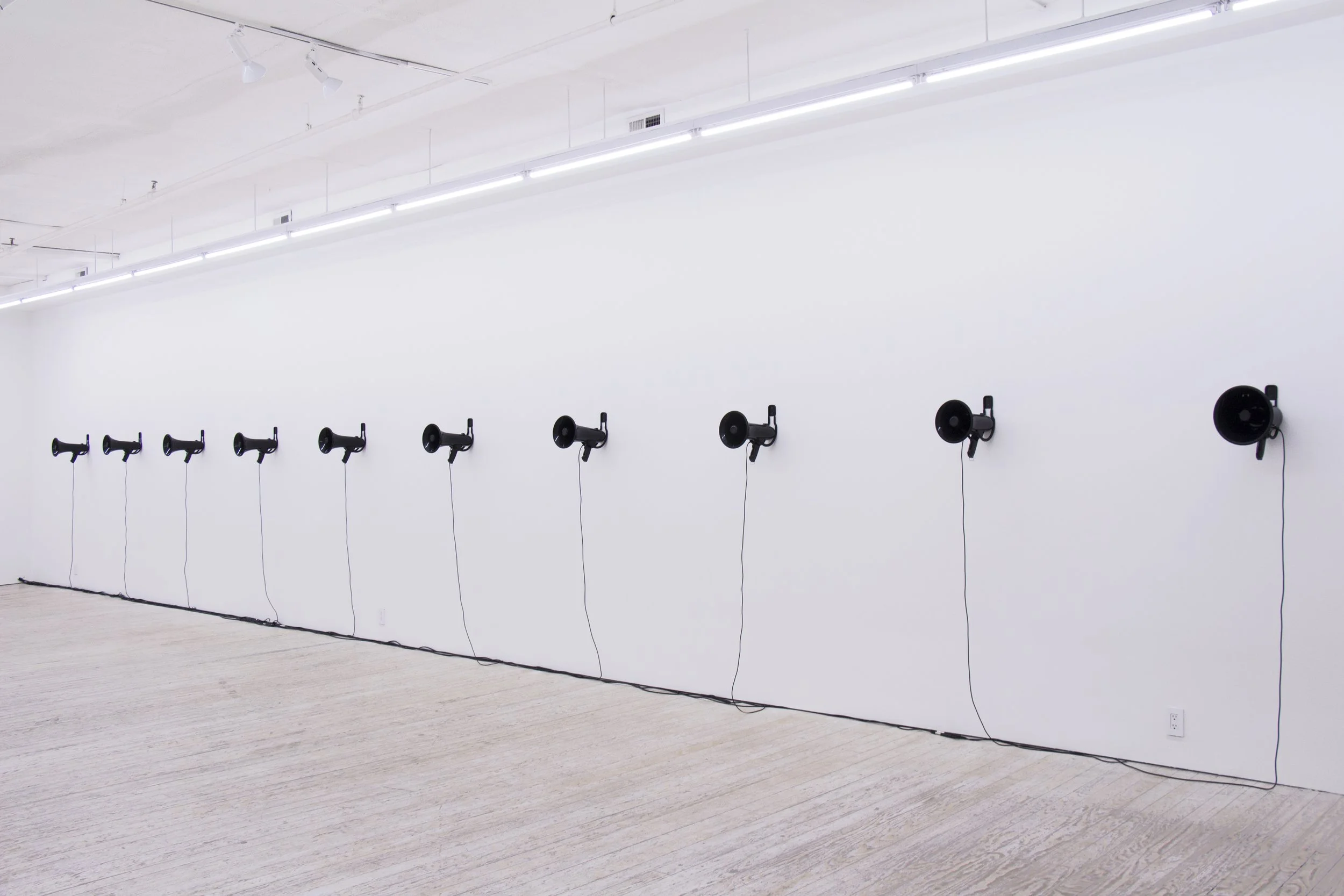
Kamari Carter. Event Horizon, 2023. 10 black megaphones, 10-channel live audio broadcast. Dimensions variable. Courtesy of the artist and Microscope Gallery, New York.
One might think here of Barbara Kruger’s Untitled (Questions) mural at MOCA in Los Angeles, which became an unintentional backdrop to protests against ICE raids. The work itself did not change, yet its meaning intensified through circumstance. Carter’s work operates within a similar temporal elasticity: it remains materially consistent, yet is continually reauthored by the world around it.
His practice enters into a broader historical dialogue. The reconfiguration of national symbols recalls Hank Willis Thomas, whose work interrogates the visual language of power and identity. The integration of material, sound, and social space finds resonance with Theaster Gates, particularly in the construction of environments that extend beyond the purely aesthetic. At the same time, Carter’s engagement with systems of information aligns with the legacy of Hans Haacke, whose work foregrounds the political and institutional frameworks that shape perception.
This evening at White Columns is presented in collaboration with Precog Magazine, a platform that has cultivated a space for interdisciplinary inquiry at the intersection of technology, cyberculture, and feminist thought. Precog distinguishes itself through its commitment to process and speculation, foregrounding emerging ideas rather than fixed conclusions, and fostering a network of practices that reflect the fluid, hybrid conditions of contemporary media.
Alongside Carter, the program includes performances by Emiri Fujimoto and Timothy Simonds, whose practices expand the evening’s exploration of sound and presence in distinct yet complementary ways. Fujimoto’s work operates at the threshold of perception, where fragility, silence, and duration recalibrate the act of listening itself. She creates sculptures and installations shaped by performative action and sensitivity to site. Her work lingers in transitional moments, in the quiet decisions that happen just before leaving, like choosing a souvenir at the exit. There is a sense of aftermath in her scenes. A celebratory cake sits untouched in an empty room while A.G. Cook’s Beautiful (2023 edit) loops in the background, its refrain stretching time into something suspended and repetitive. The space holds onto a feeling that is already slipping away, like a blush fading from the face. Simonds, by contrast, constructs dense sonic architectures, layering accumulation, rhythm, and tension into compositions that blur the boundaries between music, installation, and performance.
Together, these practices form a dynamic constellation, one in which sound is not simply heard, but inhabited. What emerges is not merely a program of performances, but a shared inquiry into how systems of communication are structured, how presence is registered, and how meaning unfolds in real time.
In this sense, the evening at White Columns reaffirms the enduring necessity of spaces that enable such encounters. It is within these frameworks—both literal and conceptual—that contemporary art continues to evolve.
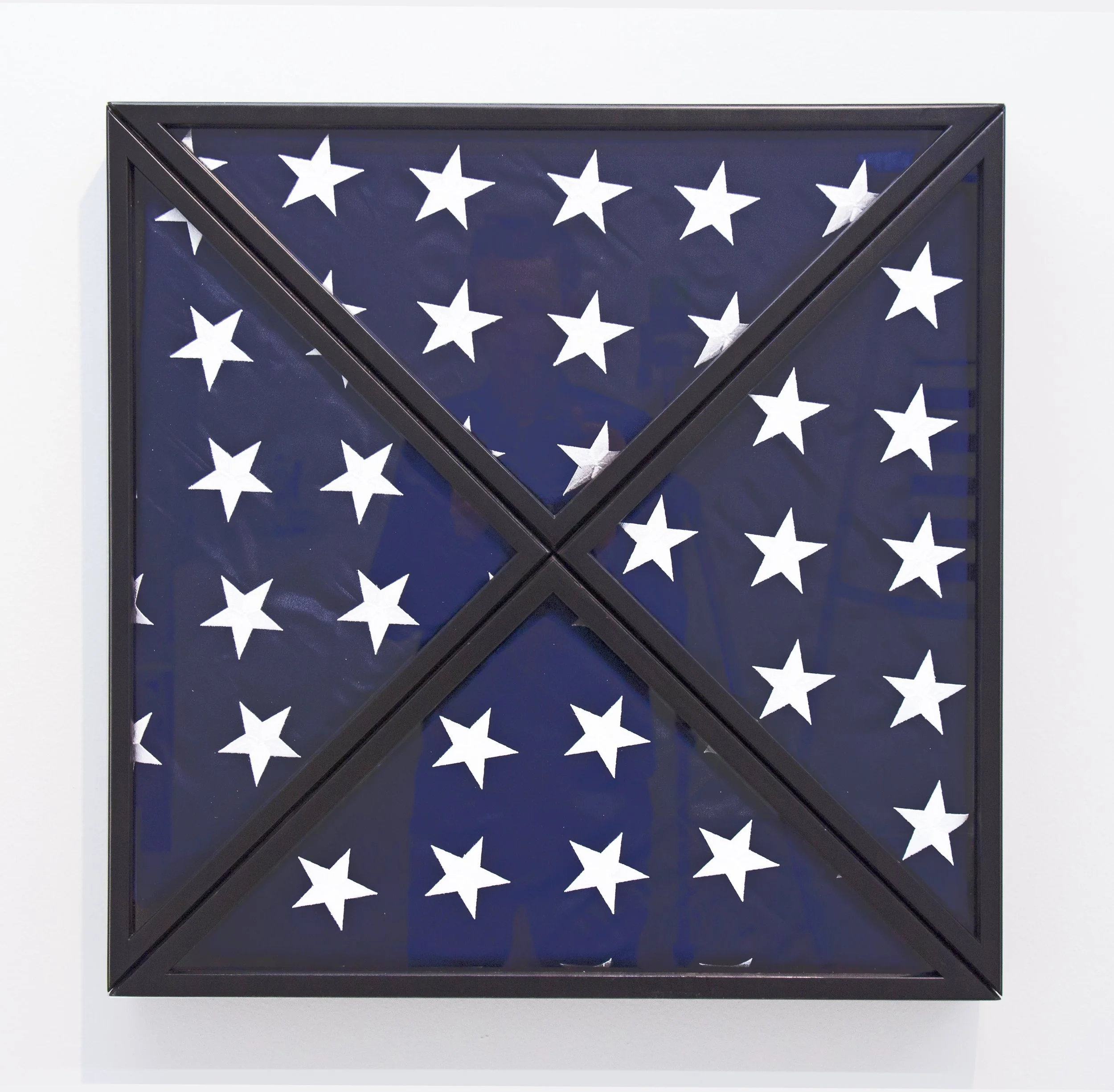
Kamari Carter, Twilight's Last Gleaming, 2024. Military-grade American flags, mahogany shadow boxes. 26 x 26 x 3 1/2 inches/ 66 x 66 x 8.9 cm. Courtesy of the artist and Microscope Gallery, New York.
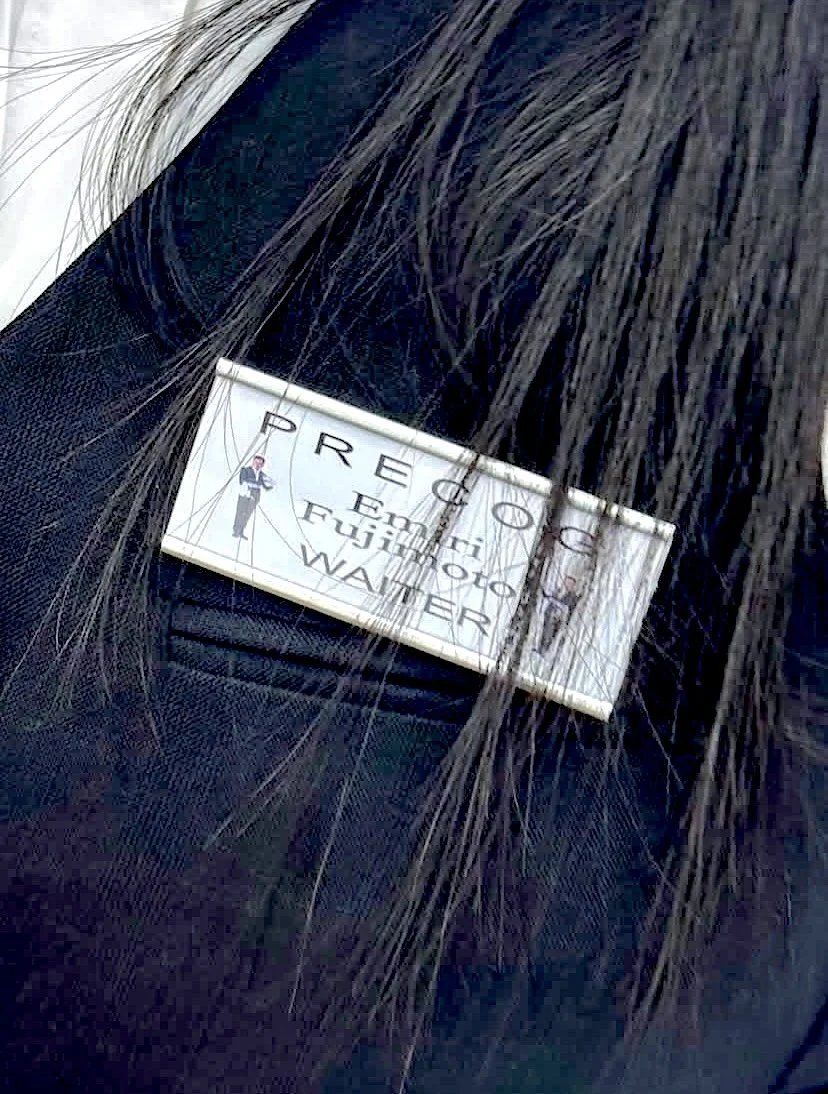
Emiri Fujimoto, PRECOG WAITER (detail), performance view, White Columns, New York, 2026. Courtesy of the artist.
Precog Magazine. Volume 9 Cover. Courtesy of White Columns, New York.
Interview
AMADOUR:
White Columns is presenting an evening of sound installation and performance in collaboration with Precog, an independent magazine that engages with science, technology, technoplastics, cyberculture, and feminism. You’re part of this program alongside artists Emiri Fujimoto and Timothy Simonds. I’d love to begin at the origin. How did your relationship with Precog begin, and how did this particular performance come into being?
KAMARI CARTER:
My relationship with Precog actually dates back to the early COVID period, those first months of 2020 into 2021, when everything felt uncertain but also strangely generative. Precog is committed to examining the intersections of science, technology, culture, and gender, with a focus on fostering critical dialogue around how these forces shape contemporary life. They were organizing these informal studio exchanges, open calls where artists could present their practices, discuss methodologies, and build community in a moment where physical proximity wasn’t possible. I joined one of those conversations and got to know the people behind the magazine. There was an immediate sense of alignment; they were interested in the work, and I was drawn to what they were building.
A few months later, they invited me to contribute to one of their issues. Being an independent publication, everything takes time, funding, production, and the assembly of materials, but we stayed in dialogue. That relationship just kept developing organically. So when they reached out more recently about this launch event at White Columns, it didn’t feel like a formal invitation as much as a continuation of an ongoing conversation. It was immediate, of course, I wanted to be part of it.
AMADOUR:
White Columns holds such a specific position in New York that it’s almost mythic in the way it supports artists at formative stages while still maintaining a certain rigor. What does that space represent to you personally?
KAMARI CARTER:
It feels like a necessary space. There are fewer and fewer institutions that genuinely hold space for experimentation without overdetermining outcomes. White Columns has managed to sustain that ethos for a long time, which is rare. It’s a place where emerging practices can coexist alongside more established ones without a hierarchy that feels oppressive.
There’s also something about its physicality; it’s close to major institutions like the Whitney, but it doesn’t feel consumed by that proximity. It has its own rhythm. It’s slightly removed and quieter, which allows for a different kind of engagement. I think spaces like that are essential, especially right now. They allow for risk, and risk is where a lot of meaningful work begins.
AMADOUR:
You’re presenting alongside other artists, but not necessarily collaborating in a direct sense. I’m curious about that dynamic. Have you been in dialogue with them, or is this more of a constellation of individual practices?
KAMARI CARTER:
It’s more of a constellation. Each of us is presenting something distinct, occupying different moments within the event. I’ve met Emory before through Precog, we’ve crossed paths at fairs and events, and they’re incredibly generous and thoughtful in their approach. Timmy, I haven’t met yet, so I’m actually looking forward to that moment of encounter. But I trust the curatorial instinct behind the selection. There’s a shared sensibility even if the works themselves are autonomous.
AMADOUR:
Your work often operates in sound as a kind of spatial and emotional architecture. For someone who won’t be physically present for this performance, how would you describe what you’re creating?
KAMARI CARTER:
I think of it as a kind of container for memory and breath. There’s a spaciousness to the sound, something that doesn’t overwhelm but instead allows for presence. I want the audience to be able to insert themselves into it without feeling overwhelmed.
There are synthesized elements, but also something deeply personal; I’m incorporating archival voicemails that move in and out of the composition. They function almost like anchors, or interruptions, depending on how you encounter them.
I don’t approach it with a fixed objective. It’s less about delivering a message and more about working through something in real time. The performance becomes a site of processing, and the audience is invited into it, not as passive listeners but as participants in its unfolding.
AMADOUR:
That idea of “working through” feels central to your practice more broadly. I was revisiting your installation Event Horizon at Microscope Gallery, which used megaphones positioned almost like bodies within space, each carrying a distinct voice. It felt both architectural and deeply human. Can you talk about how that work emerged?
KAMARI CARTER:
That piece was about giving voice to what is typically disembodied. The megaphones were broadcasting live police and EMS scanner audio from regions in the United States where there had been significant violence against African Americans. The data I used to locate those regions came from census information, though I’m always cautious about its limitations.
What was important was that the audio was live. I had no control over what was being said or when. The only parameter I could shape was volume. That lack of control was essential; it mirrored a kind of lived experience, a constant awareness of systems operating around you that you can’t fully access or intervene in.
By bringing those voices into the gallery, I wanted to collapse that distance. These conversations are always happening, but are typically hidden. What does it mean to make them audible? To make them present within a shared space?
AMADOUR:
There’s also a recurring engagement with national symbolism in your work—the frozen flag, Patriot Act, Red, White, and Blue. When I encountered the image of the flag encased in ice, it felt almost destabilizing in its simplicity. What draws you to that kind of symbolic intervention?
KAMARI CARTER:
The American flag is already a charged symbol. Placing it in ice is more of an interruption than an addition to that meaning.
This forces a different viewing: what does freezing something meant to move mean? What is it to hold it suspended, unable to perform its function?
And then there’s the temporal aspect, it melts. The work changes. So the question isn’t fixed either. It evolves. I’m interested in that instability, in the way meaning can shift depending on time, context, and perception.
Ultimately, I want the work to resist easy resolution. I want it to provoke a kind of sustained engagement—where the viewer has to sit with their own interpretations and assumptions.
AMADOUR:
It’s interesting because the work almost accrues meaning over time rather than asserting it immediately. That feels increasingly rare.
I also wanted to talk about Landline/Lifeline, your graduate thesis. The use of rotary phones, the fragmentation of narrative, it feels like you’re constructing a kind of sonic puzzle. How did that piece develop?
KAMARI CARTER:
It began with an interest in emergency systems, particularly 911. It’s something we all understand as necessary, but when you start looking into its history and how it functions, it becomes much more complex.
I wanted to explore complexity through sound. I split dispatcher and caller conversations across multiple phones: picking up a receiver lets you hear only one side. To piece together the full narrative, you had to move through the space and make connections.
The rotary phones were important; they’re tactile, physical. They carry a sense of history. They slow you down.
The stories themselves were intentionally contrasting: one deeply tragic, the other unexpectedly hopeful. That juxtaposition reflects the reality of those systems. Every call exists within a spectrum of urgency, emotion, and consequence.
AMADOUR:
Your practice moves fluidly between installation, sound, and image. When you approach two-dimensional work, does it feel like a departure or an extension?
KAMARI CARTER:
For me, two-dimensional work is an extension I’m learning to navigate. I don’t feel bound by its traditional lineage.
I’m working with screen printing and large inkjet prints. It’s different—more controlled, yet still open to experimentation.
I don’t want to limit myself to a single medium. Some of the artists I admire most move across forms as the work demands. That flexibility feels important.
AMADOUR:
Tell me about your sound design work—and also, what originally drew you to sound?
KAMARI CARTER:
Collaboration usually begins with someone bringing an idea, a direction, a framework, and I respond to that through experimentation. I draft, test textures, and refine with feedback. It’s iterative, and it’s very much about translation: how do you take someone else’s vision and give it a sonic language?
Much of that traces back to what I grew up with—watching Cartoon Network in the late ’90s and early 2000s: Dexter’sLaboratory, Ed, Edd n Eddy, The Powerpuff Girls. The creators of those shows were all connected through CalArts, even roommates at times, which I always loved as trivia. That shared creative environment shaped the era’s visual and sonic language.
Video games—Smash Bros., Zelda, Mario—depend on sound. Sound gives them dimension, emotion, and memory. That’s when I realized its power.
AMADOUR:
That connection to CalArts is wild; it really was its own kind of movement. And you’re originally from Los Angeles?
KAMARI CARTER:
Yeah, born and raised in Los Angeles. Cedars-Sinai, near Hollywood.
AMADOUR:
You’ve also had projects intersect with major institutions—MoMA and the Pérez Art Museum. What have those experiences been like for you?
KAMARI CARTER:
The MoMA project was a screening, and I worked on sound for Kambui Olujimi’s film Blood From Stone. It was a one-night event, but it was significant for me. I was still a graduate student at Columbia at the time, so stepping into that context felt surreal.
At the Pérez Art Museum, I was part of a moving-image program, Perpetual Motion, curated by Barbara London during Art Basel. That was a different energy, more expansive, more communal. Both experiences were important, but in very different ways. [ Perpetual Motion examined how rapid technological change shapes contemporary artistic practice across film, video, sound, and performance. In an era defined by constant media circulation and shortened attention spans, the moving image remains one of the most vital and ubiquitous art forms. Featuring ten works spanning two to eleven minutes, the exhibition brings together artists including Kamari Carter, Richard Garet, Bang Geul Han, Cornelia Parker, Wong Ping, Zina Saro-Wiwa, Aki Sasamoto, Joey Skaggs, Federico Solmi, and Claudix Vanesix. Each piece reflects the evolving landscape of media art, posing urgent questions about society, perception, and community.]
AMADOUR:
And outside of the work, what are the spaces that sustain you, in New York or Los Angeles?
KAMARI CARTER:
In New York, I have a serious sweet tooth. Grace Street in Koreatown, the churro waffle, is essential. Sam’s Fried Ice Cream in Chinatown is another favorite.
And then museums—the New Museum, MoMA, the Whitney, the Museum of the Moving Image. They’re all part of the rhythm of being here.
AMADOUR:
Who were the most formative figures in your education?
KAMARI CARTER:
At Columbia, Seth Cluett and Mia Masaoka were incredibly influential. They helped me articulate what I cared about, what I was willing to commit to as an artist.
AMADOUR:
And now you’re at Brown, working toward your doctorate. How has that shaped your practice?
KAMARI CARTER:
It’s been transformative, but also demanding. A doctorate requires endurance; it’s a long arc, but I’ve been lucky to have faculty who really support the work.
I’ll be defending my dissertation soon, so it’s a moment of transition. I’m grateful for the time there, but also ready for what comes next.
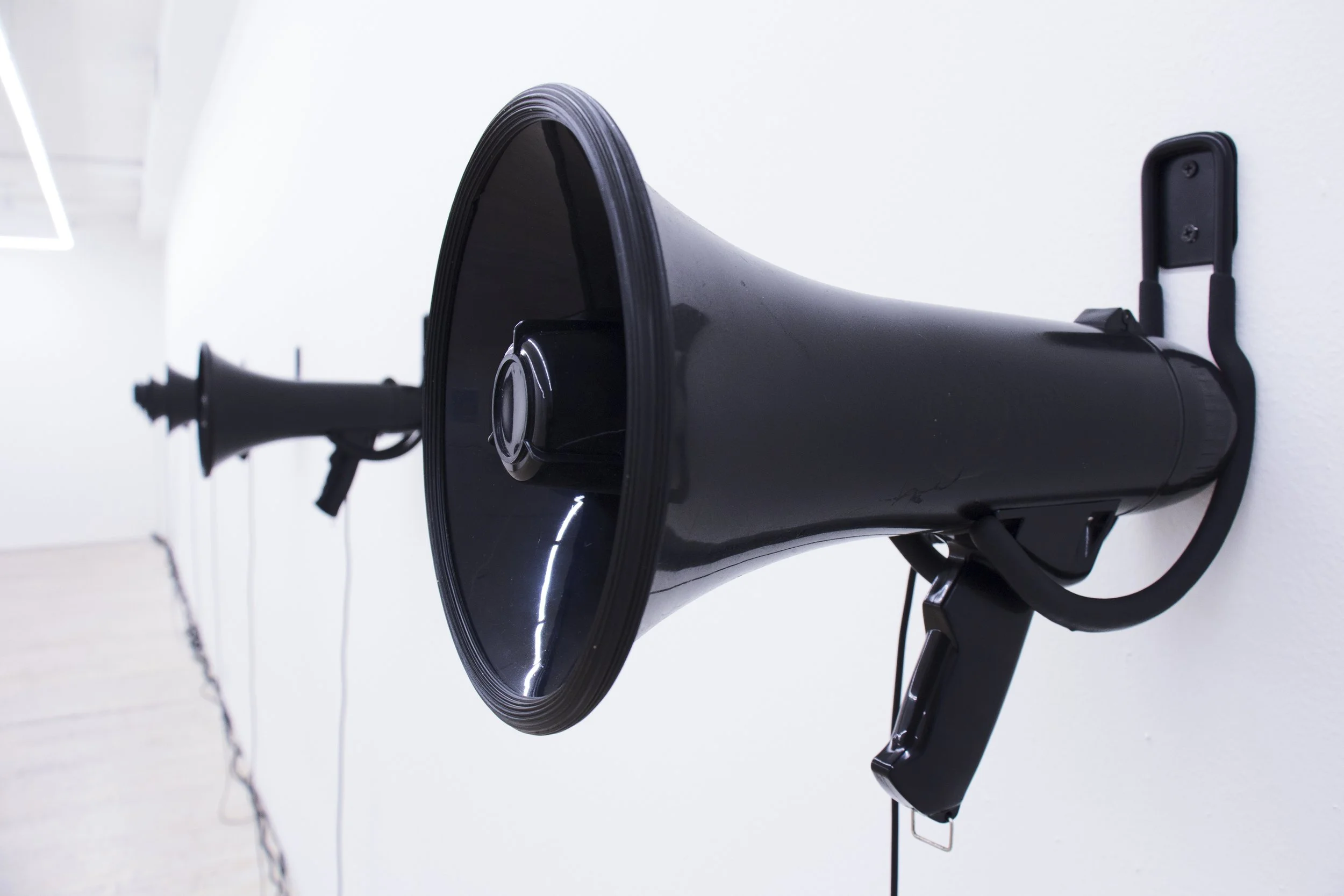
Kamari Carter. Event Horizon, 2023. 10 black megaphones, 10-channel live audio broadcast. Dimensions variable. Courtesy of the artist and Microscope Gallery, New York.