LUC TUYMANS INTERVIEW: ON ‘THE FRUIT BASKET’ AND THE IMAGE TODAY
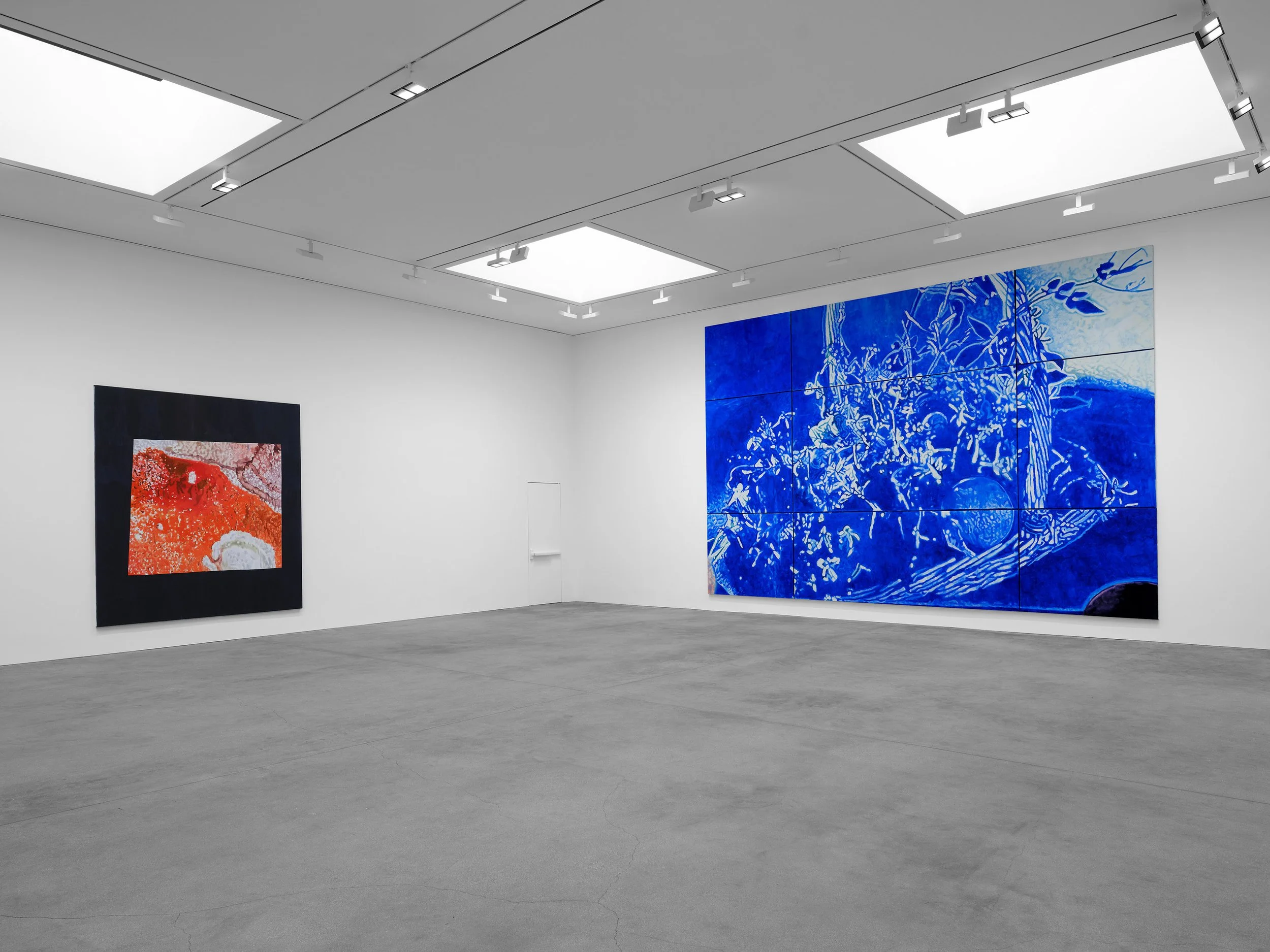
Installation view, Luc Tuymans: The Fruit Basket, David Zwirner, Los Angeles, February 24-April 4, 2026. Photo by Elon Schoenholz. Courtesy David Zwirner.
At David Zwirner, Luc Tuymans: The Fruit Basket marks Tuymans’s first solo exhibition in Los Angeles and brings together a new group of paintings shaped by what the gallery describes as a specifically American atmosphere of fracture. Anchored by the monumental nine-part painting The Fruit Basket (2025), the exhibition moves between mediated imagery, historical tension, and the eerie instability of contemporary life, with works that draw from sources as varied as illuminated manuscripts, documentary footage, and digitally captured images. The presentation first debuted in New York in November 2025 before traveling to Los Angeles in February 2026.
The art-historical stakes of scale in Tuymans’s work return almost involuntarily, even as Tuymans insists that scale is not inherently synonymous with grandeur or pictorial dominance. That distinction lingers, perhaps because it resists resolution. It may be part of why The Fruit Basket holds so insistently: it is enormous, yes, but its force does not quite declare itself through size. Instead, scale operates as a kind of quiet dissonance, less an assertion than a condition, where looking is prolonged, even strained, and the image never fully settles into authority. From here, the work seems to open onto a longer history, reaching back to Peter Paul Rubens and the Baroque ambitions that once defined Antwerp itself, where scale functioned as proclamation—devotional, theatrical, and inseparable from power.
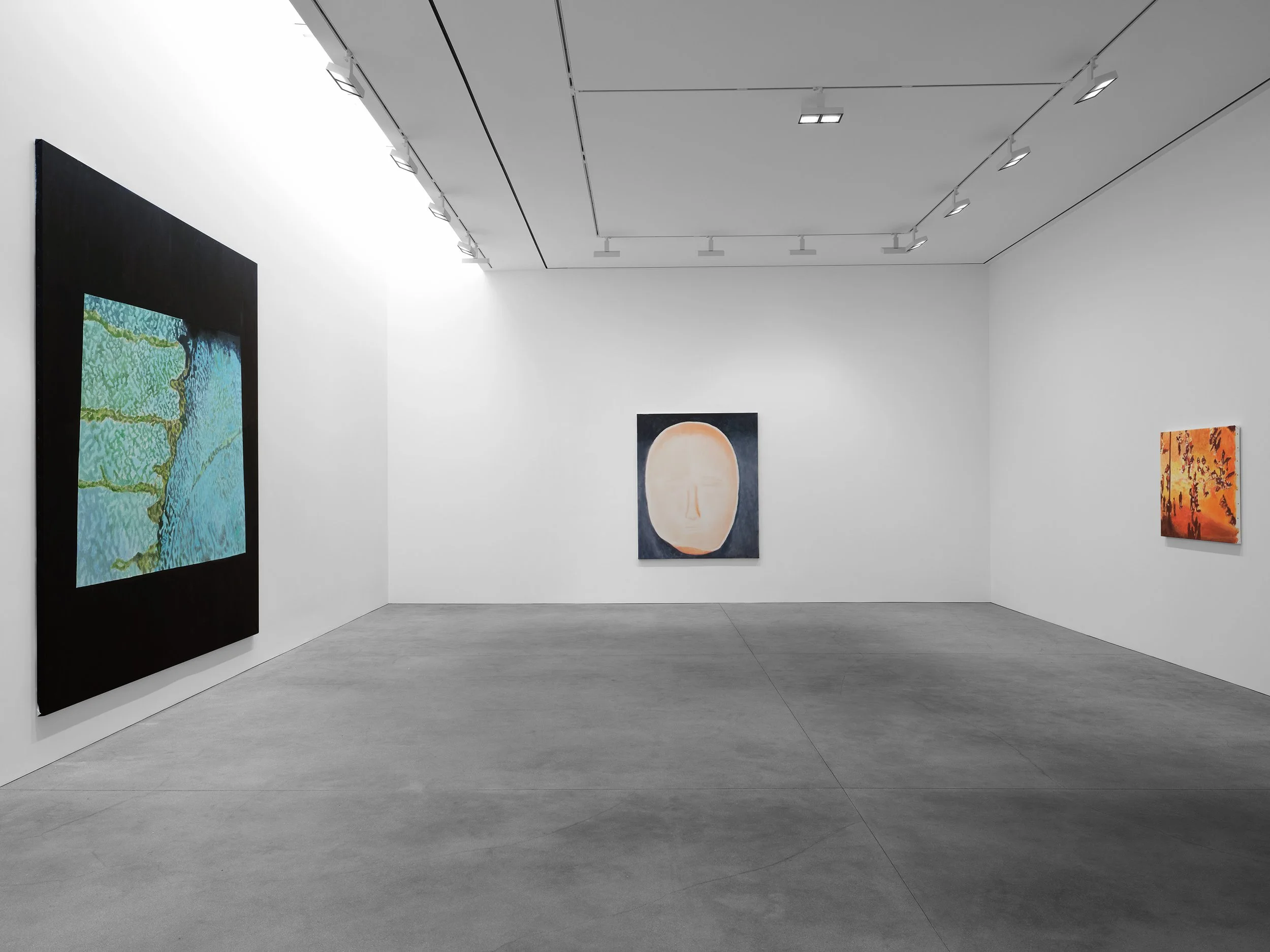
Installation view, Luc Tuymans: The Fruit Basket, David Zwirner, Los Angeles, February 24-April 4, 2026. Photo by Elon Schoenholz. Courtesy David Zwirner.
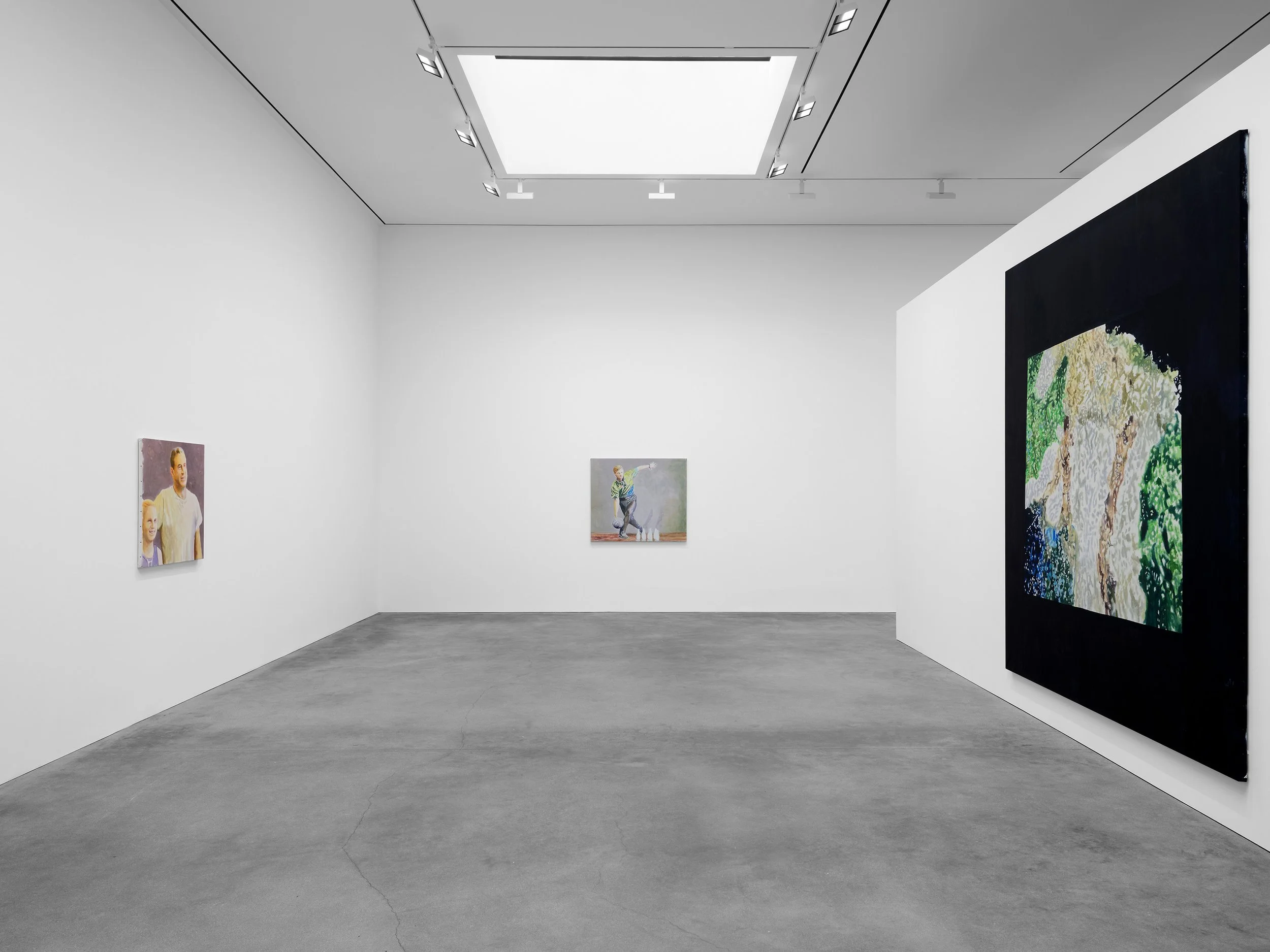
Installation view, Luc Tuymans: The Fruit Basket, David Zwirner, Los Angeles, February 24-April 4, 2026. Photo by Elon Schoenholz. Courtesy David Zwirner.
To understand how Tuymans positions himself within this lineage, it is useful to consider how scale operates across a range of contemporary and historical practices. That sense of scale, as expansion takes on a distinct inflection, is evident in David Hockney’s retrospective at Tate Britain in 2017, where works like A Bigger Grand Canyon (1998) made scale feel panoramic—expansive, almost euphoric, as though vision itself could be stretched outward and sustained across space. In that context, scale operates as extension, amplifying perception and producing a kind of visual openness. A further shift emerges in Venice in 2022, where Anselm Kiefer’s Questi scritti, quando verranno bruciati, daranno finalmente un po’ di luce was installed at the Palazzo Ducale(2022), in a charged dialogue with the grand historical theater of the Sala dello Scrutinio. There, scale appears inseparable from architecture, history, and spectacle—the work absorbing the weight of its setting, materializing time and memory with an almost mythic intensity. If Hockney extends vision outward and Kiefer binds scale to the gravity of history, then both clarify, by contrast, the singularity of Luc Tuymans’s approach. Antwerp, in turn, introduces another register, one defined by a longstanding permeability between disciplines. This is evident in “Margiela, The Hermès Years” at MoMu - Fashion Museum Antwerp (March 31–August 27, 2017), a retrospective of Martin Margiela’s collaboration with Hermès, where fashion, material, and conceptual thinking are woven into the very fabric of the city. This condition reaches back to Peter Paul Rubens, whose The Elevation of the Cross (1610–11), installed in the Cathedral of Our Lady in Antwerp, stages scale as both devotion and spectacle—an image inseparable from its architectural and civic context. From Rubens’s workshop to Margiela’s deconstruction, Antwerp sustains a persistent sensitivity to material, surface, and the staging of presence—where construction and erasure operate simultaneously. Within this continuum, Tuymans’s work becomes more complex: neither anchored in Baroque spectacle nor aligned with fashion’s calibrated display, but instead withholding, its scale registering less as visual command than as a kind of suspended cognition. His paintings do not expand outward or monumentalize history; they hold the image in a state of hesitation, where enlargement intensifies instability rather than resolving it.
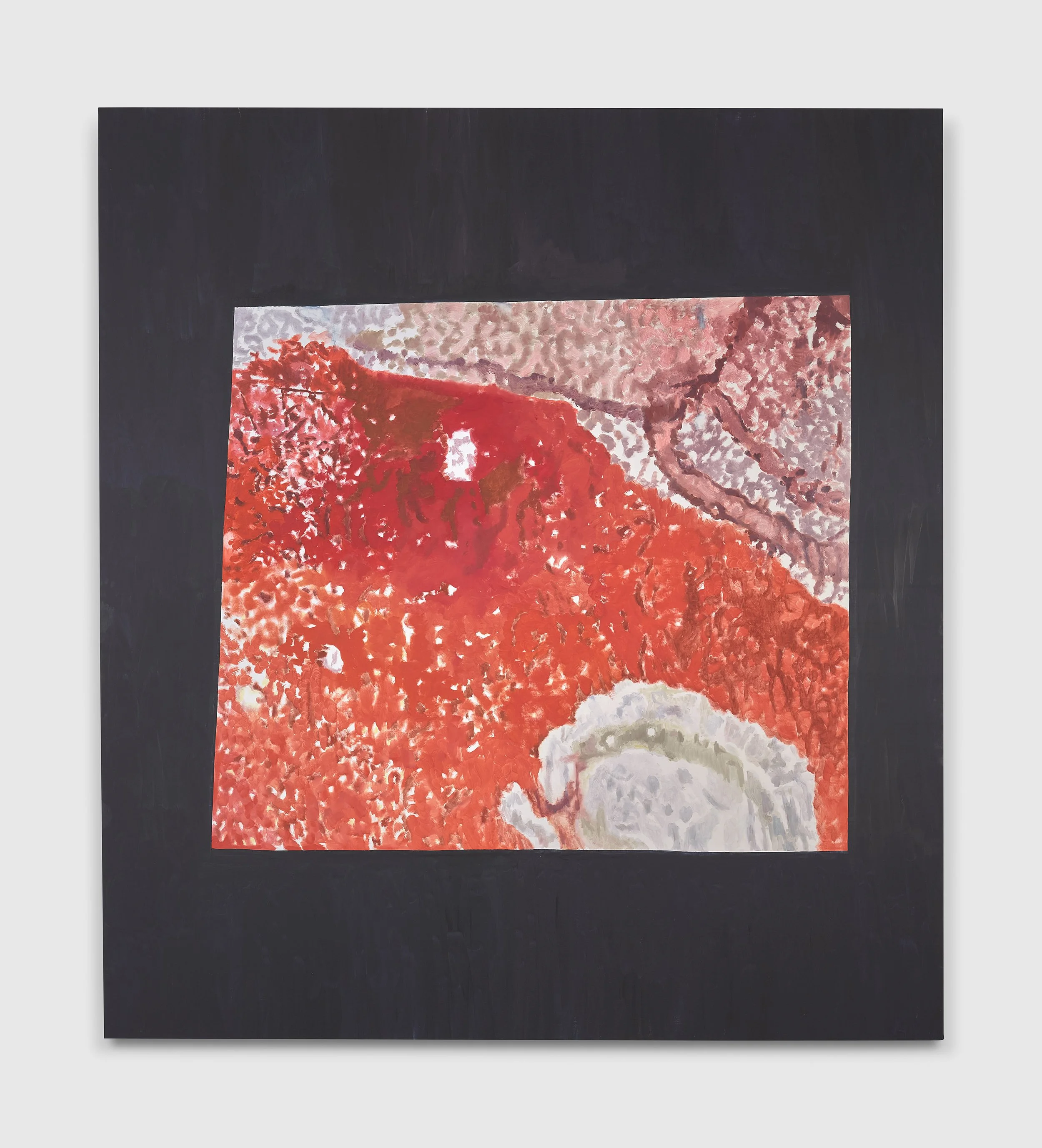
Luc Tuymans, Illumination II, 2025. © Luc Tuymans. All rights reserved. Courtesy Studio Luc Juymans, Antwerp, and David Zwirner.
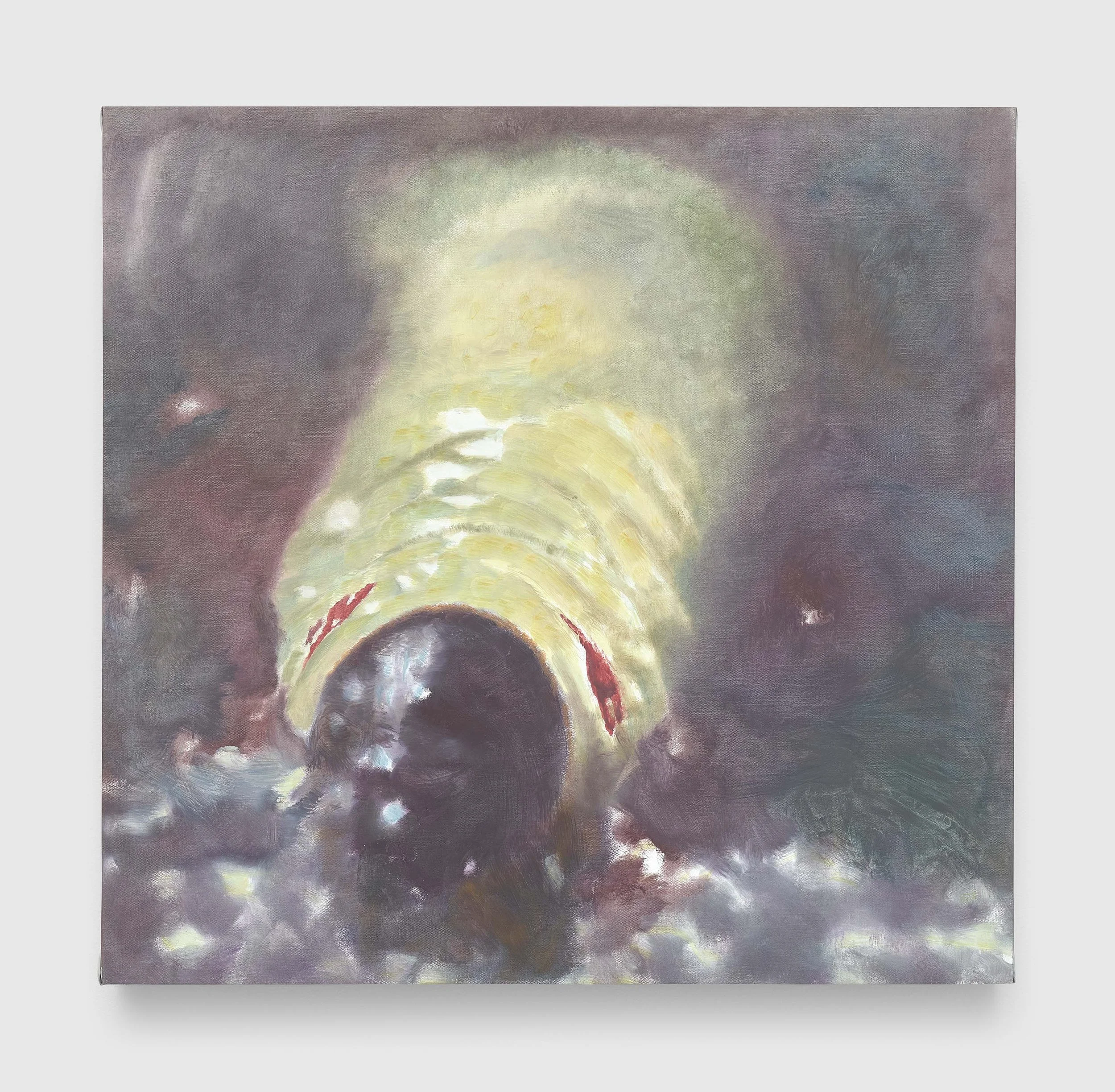
Luc Tuymans, The Maggot, 2025. © Luc Tuymans. All rights reserved. Courtesy Studio Luc Juxmans, Antwerp, and David Zwirner.
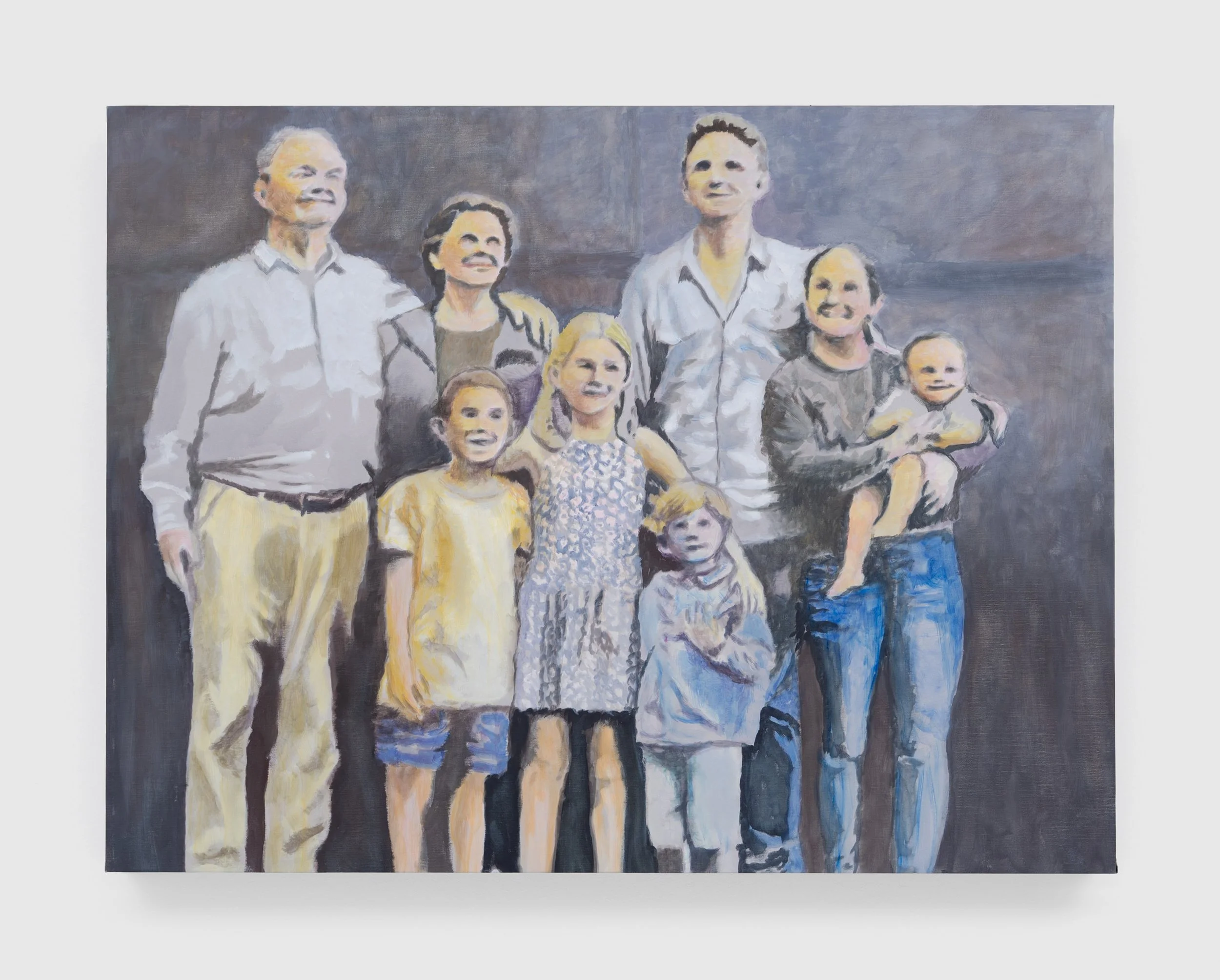
Luc Tuymans, The Family, 2025. © Luc Tuymans. All rights reserved. Courtesy Studio Luc Tuymans, Antwerp, and David Zwirner.
What begins to surface, then, is not only a question of scale, but of memory itself. The most banal of moments, a grocery run, a fruit basket on a table, the passing presence of someone unfamiliar on the street, becomes inseparable from lived experience, even as it resists narrative importance. These are contained moments, often perceived as incidental or without consequence in the longer arc of subjective life, yet they persist as the singular truth of human experience at its most finite. Tuymans does not elevate these fragments into spectacle; he holds them in suspension, as if in an attempt, ultimately unresolved, to register, or momentarily contain, what is already slipping beyond grasp.
From there, Los Angeles begins to feel essential. Luc Tuymans’s abstraction enters into a subtle dialogue with the history of painting, deeply legible in this city, where color, fragmentation, light, and atmosphere hover at the threshold of abstraction even as the image remains tethered to source material and figuration. That tension resonates in Los Angeles, a city shaped by luminosity, scale, optical pleasure, and spatial experimentation. One thinks, for instance, of Sam Francis’s Free Floating Clouds (1980), on view at The Huntington Library, Art Collections, and Botanical Gardens, a work whose scale, spanning roughly ten by twenty-one feet, commands the wall it inhabits, its dark blue splatters suspended against white in a loose, atmospheric grid. When I first saw it there years ago, the painting registered less as something to decode than as something to be experienced—expansive, immersive, and resistant to fixed meaning. And yet, within that openness, a quiet instability emerges. There is something in that measured unease that echoes Giorgio de Chirico: space as staging, as psychic structure, as something never neutral.
I first met Tuymans by chance just before his Los Angeles press preview, during Frieze Los Angeles week in 2026, at the home of Eugenio López Alonso, where a gathering was held in celebration of Paul McCarthy’s exhibition at The Journal Gallery. Alongside his wife, artist Carla Arocha of the duo Carla Arocha & Stéphane Schraenen, and his studio manager, artist Vanessa Van Obberghen, the evening carried an immediate sense of ease and familiarity. All of us were dressed in black, which lent the encounter an unexpected visual symmetry. When we met again at the press preview for The Fruit Basket, that sense of ease remained, but the conversation shifted—toward the evolution of his painting, the exhibitions that have shaped its trajectory, and, more personally, the fact that he and Arocha have been married for thirty years. That duration registers as more than anecdotal; it speaks to a steadiness, a discipline, and a sustained clarity that mirrors the long arc of Tuymans’s practice. What emerges, in both life and work, is a commitment to continuity without repetition, a way of moving forward while remaining rigorously attuned to what persists.
What makes The Fruit Basket so compelling in this context is that it enters that lineage surreptitiously. It arrives in a city associated with light and expansiveness, only to answer it with fracture, mediation, and compression. The result is an exhibition that feels not only art-historically alive, but specifically alive to Los Angeles. What follows is a conversation on Los Angeles, painting, architecture, migration, and the strange afterlives of images.
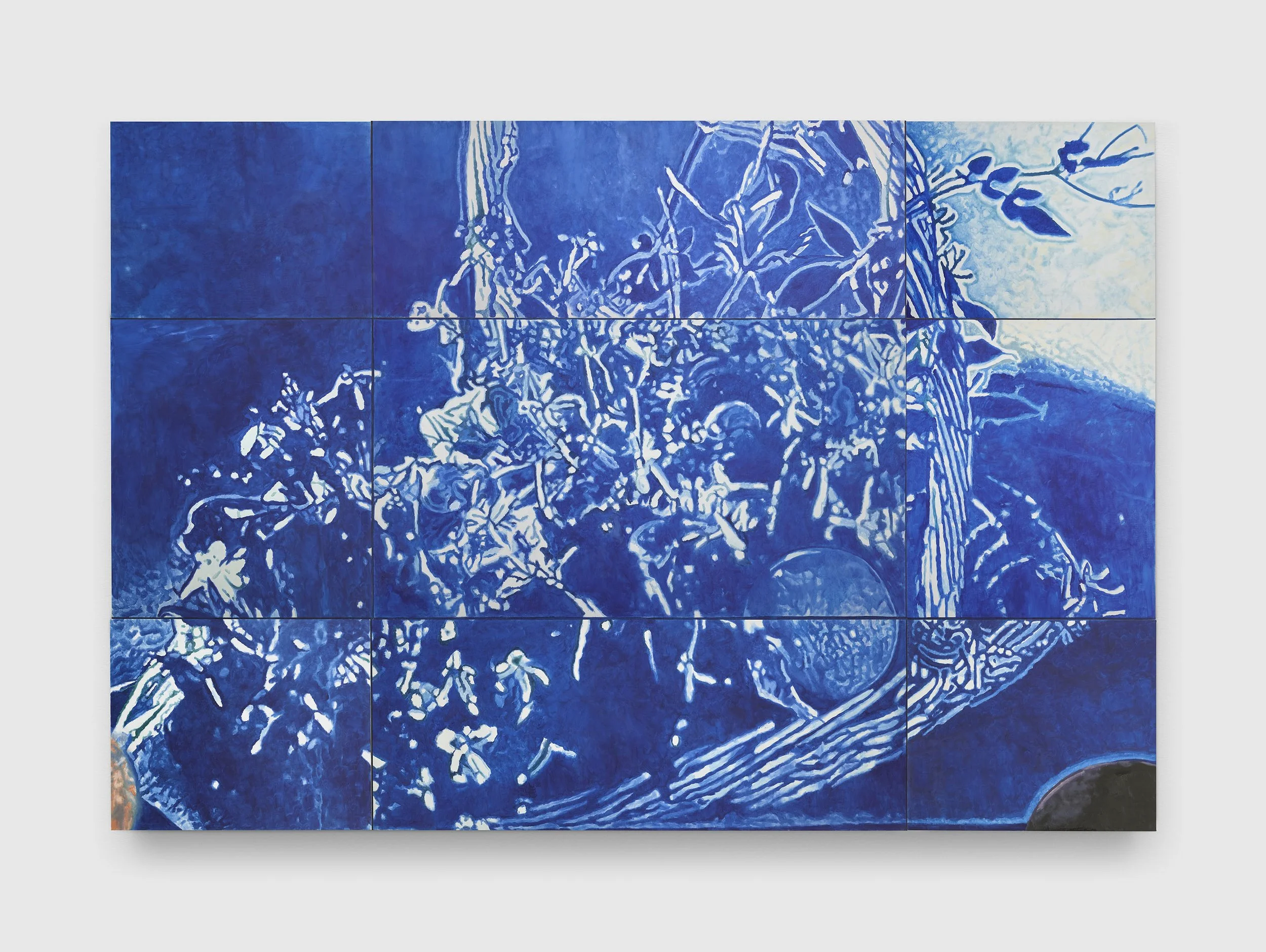
Luc Tuymans, The Fruit Basket, 2025. © Luc Tuymans. All rights reserved. Courtesy Studio Luc Tuymans, Antwerp, and David Zwirner.
Interview
AMADOUR: At David Zwirner, your first solo exhibition in Los Angeles, is anchored by the huge painting The Fruit Basket (2025), which measures over sixteen feet high and more than twenty-three feet wide. Drawn from your photograph of that fermented fruit basket and shaped by broader reflections on the United States, the work feels at once intimate and cinematic. I wanted to begin with Los Angeles itself: how do you see the city, and what has your relationship to it been over time?
LUC TUYMANS: As I said, it is, first of all, a horizontal city. It is a city that is stretched out, a completely different condition from New York, Chicago, or even San Francisco, which is more condensed. It takes a while to move through the city. You need a car, or somebody has to drive you. So in that sense, the experience of distance is different here. And then there's the fact that you probably have to know people to really get a feel for its atmosphere.
AMADOUR: When was your first time in Los Angeles? Were you here with anybody in particular?
LUC TUYMANS: The first time must have been around 1996. Carla and I came, and we stayed in Venice Beach, which was, of course, a very clichéd version of Los Angeles to begin with. We had friends here, and I also took an architecture tour, which was an eye-opener because it gave me a different perspective on how the city actually functions. That made it much more interesting to me.
AMADOUR: I wanted to ask you about your painting, The Fruit Basket (2025). It is such a massive scale, and I personally love large paintings. I remember that on the tour you were speaking about how you see it from afar. I wanted to hear your thoughts on monumentality.
LUC TUYMANS: A large painting does not necessarily mean that it is monumental. A small painting can be just as monumental as a large one. That is something people sometimes miss. In this particular case, though, the monumentality is deliberate because the actual object being represented is so small in comparison. It is not directly an American image, but it does have a kind of resonance with another still life I made that was more directly linked to something that happened in the United States, around 9/11, when Carla and I were here. I made a larger-than-life still life then, and this could be seen as a follow-up, though it is still quite different. It goes back to a project in Capri that never came to fruition, one related to Curzio Malaparte. While I was there, I saw a lecture by an American writer who had won the Malaparte Prize. In the room, there was a screen divided into nine parts, and on it was projected an image of a fruit basket in this heightened bluish tone. I photographed that image with my iPhone. [At Palazzo Grassi in Venice from March 24, 2019, to January 6, 2020, Luc Tuymans: La Pelle took Curzio Malaparte’s world as its point of departure, using Tuymans’s muted, desaturated paintings to explore the unstable boundary between historical violence and everyday banality. The exhibition returned to Malaparte’s controversial 1949 novel La Pelle and to Casa Malaparte in Capri, later immortalized in Jean-Luc Godard’s Le Mépris (1963), to examine how spaces can absorb political tension, memory, and psychic charge.] The next day, I saw the actual fruit basket, which was blackened, decayed, and completely fermented fruit dating back to Malaparte. It is this object that the winner ceremonially holds and then returns. That gave me the idea of mediated imagery—an image that deals, on the one hand, with decay and, on the other, with this kind of digital or interior light, which is also present throughout the rest of the exhibition. That was the conundrum I was trying to work through in the painting. Because the composition runs diagonally, it also reminded me of a vessel. Then I thought of Théodore Géricault’s The Raft of the Medusa (1818–1819) in the Louvre, one of my favorite paintings. It has that same diagonal thrust. And I had never fully realized how large it was, because so much of its force is concentrated in the center. That gave me the idea to make The Fruit Basket at a related scale.
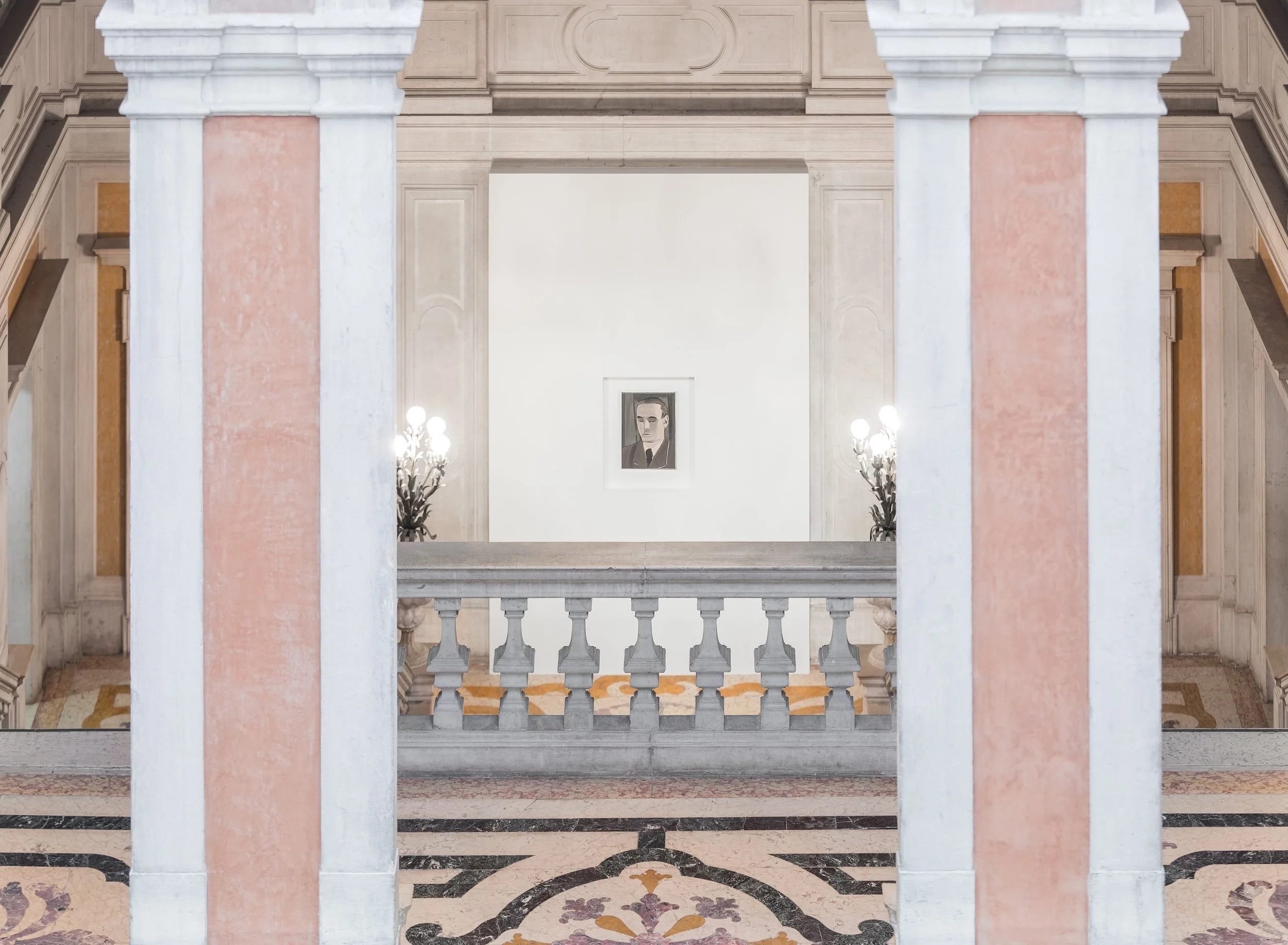
Luc Tuymans, Secrets, 1990, Private Collection, Courtesy Zeno X Gallery, Antwerp. Installation View at Palazzo Grassi, 2019 © Palazzo Grassi, Photography by Delfino Sisto Legnani e Marco Cappelletti.
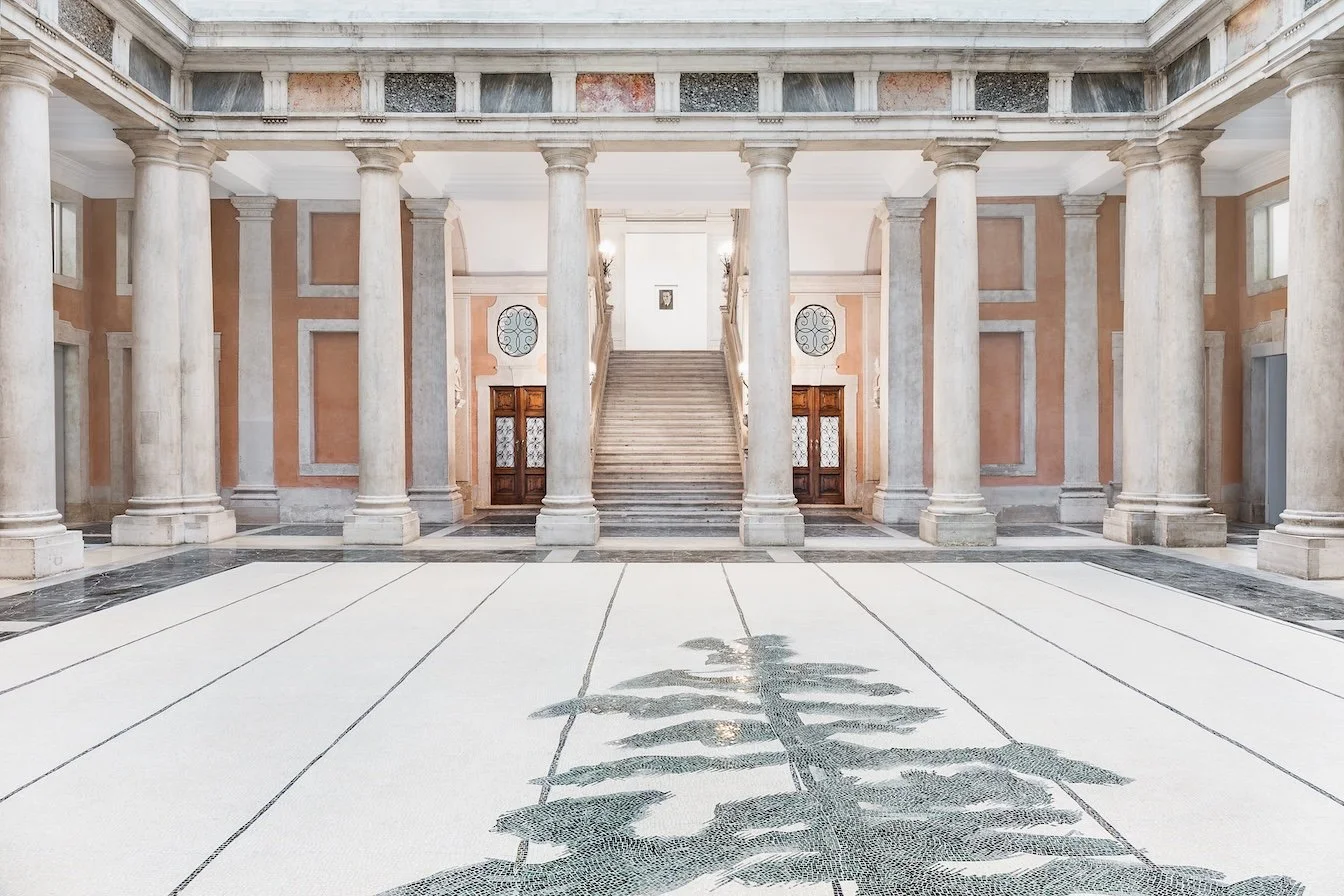
Luc Tuymans, Schwarzheide, 2019, Fantini Mosaici, Milano, Installation View at Palazzo Grassi, 2019 © Palazzo Grassi, Photography by Delfino Sisto Legnani e Marco Cappelletti.
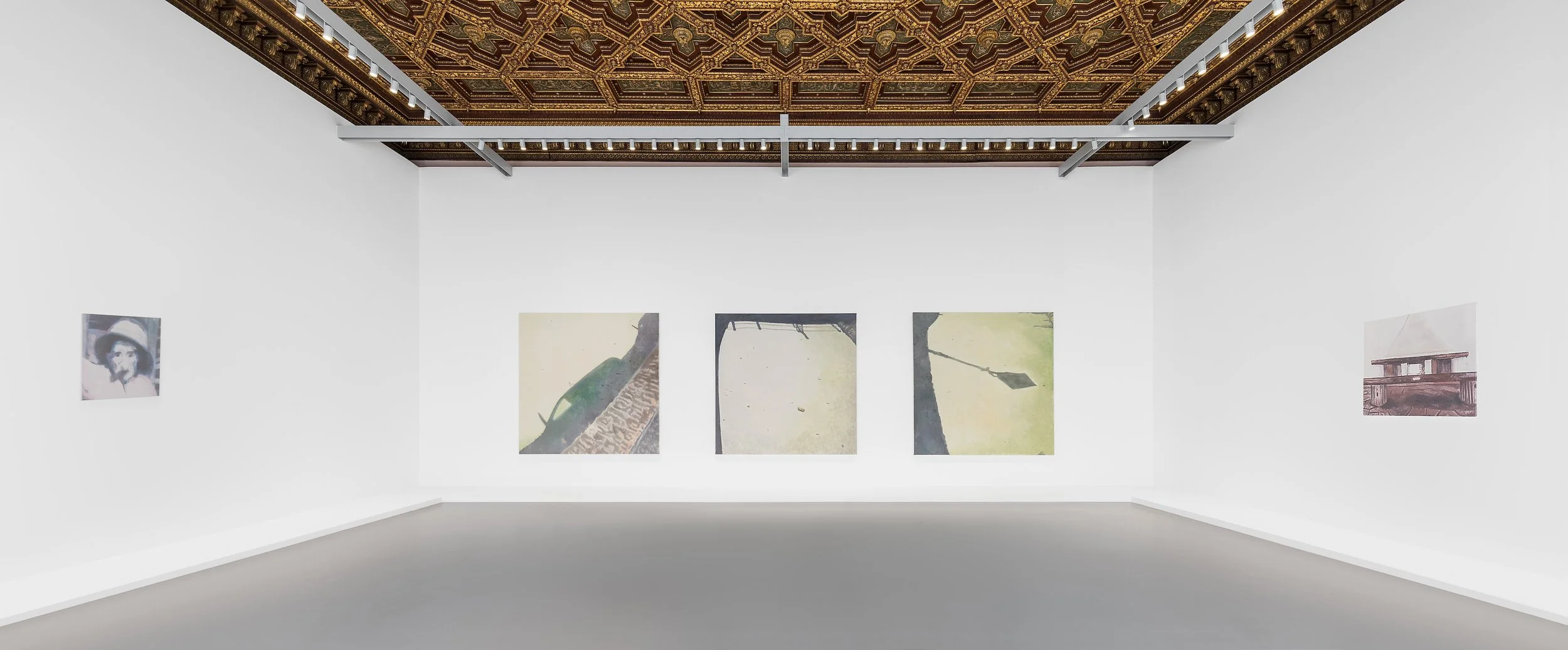
(From left to right) Luc Tuymans, Issei Sagawa, 2014, Tate, Murky Water, 2015, Collezione Prada, Milano, Le Mépris, 2015, Collection of Mimi Haas. Installation View at Palazzo Grassi, 2019 © Palazzo Grassi, Photography by Delfino Sisto Legnani e Marco Cappelletti.
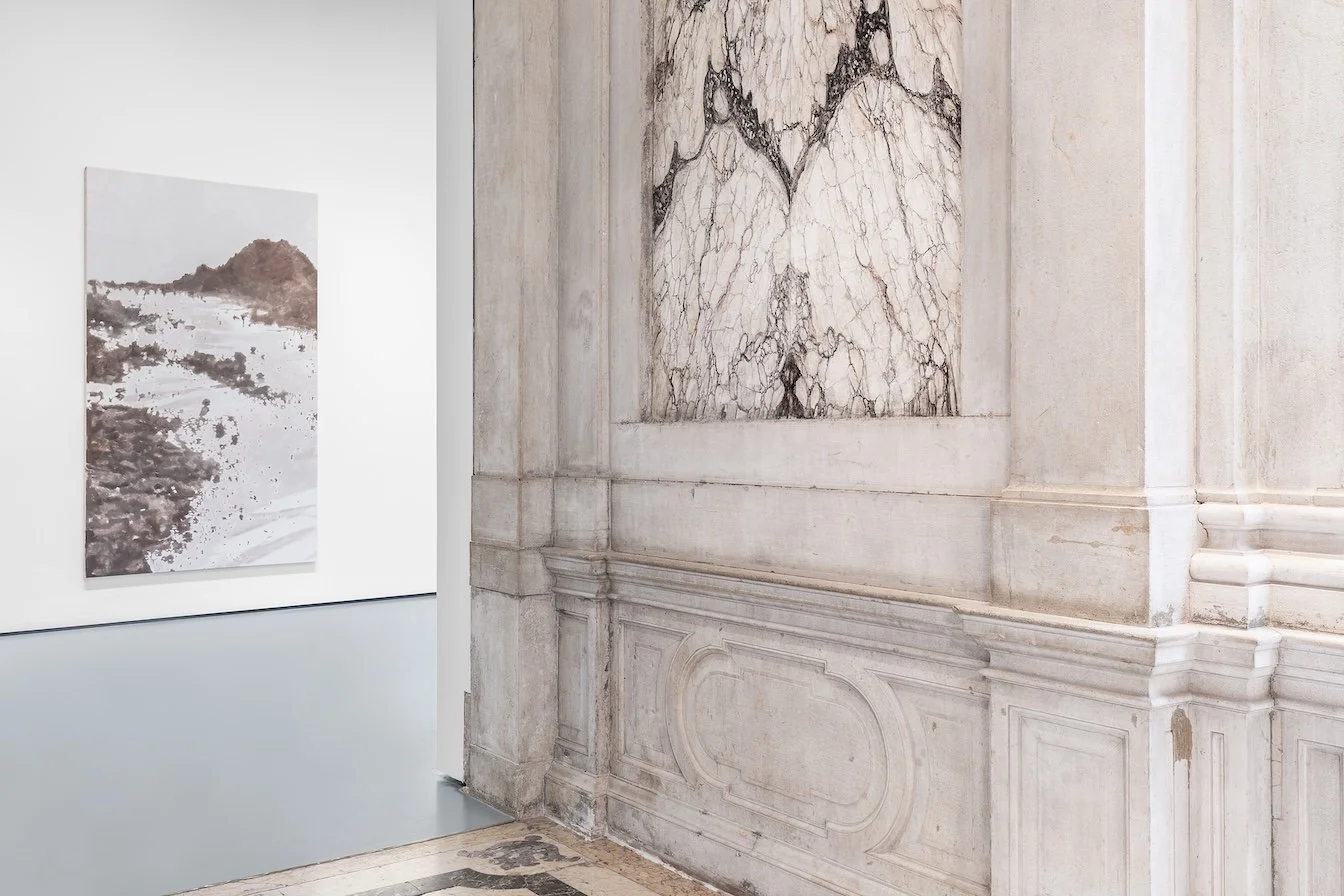
Luc Tuymans, Mountains, 2016, Pinault Collection. Installation View at Palazzo Grassi, 2019 © Palazzo Grassi, Photography by Delfino Sisto Legnani e Marco Cappelletti.
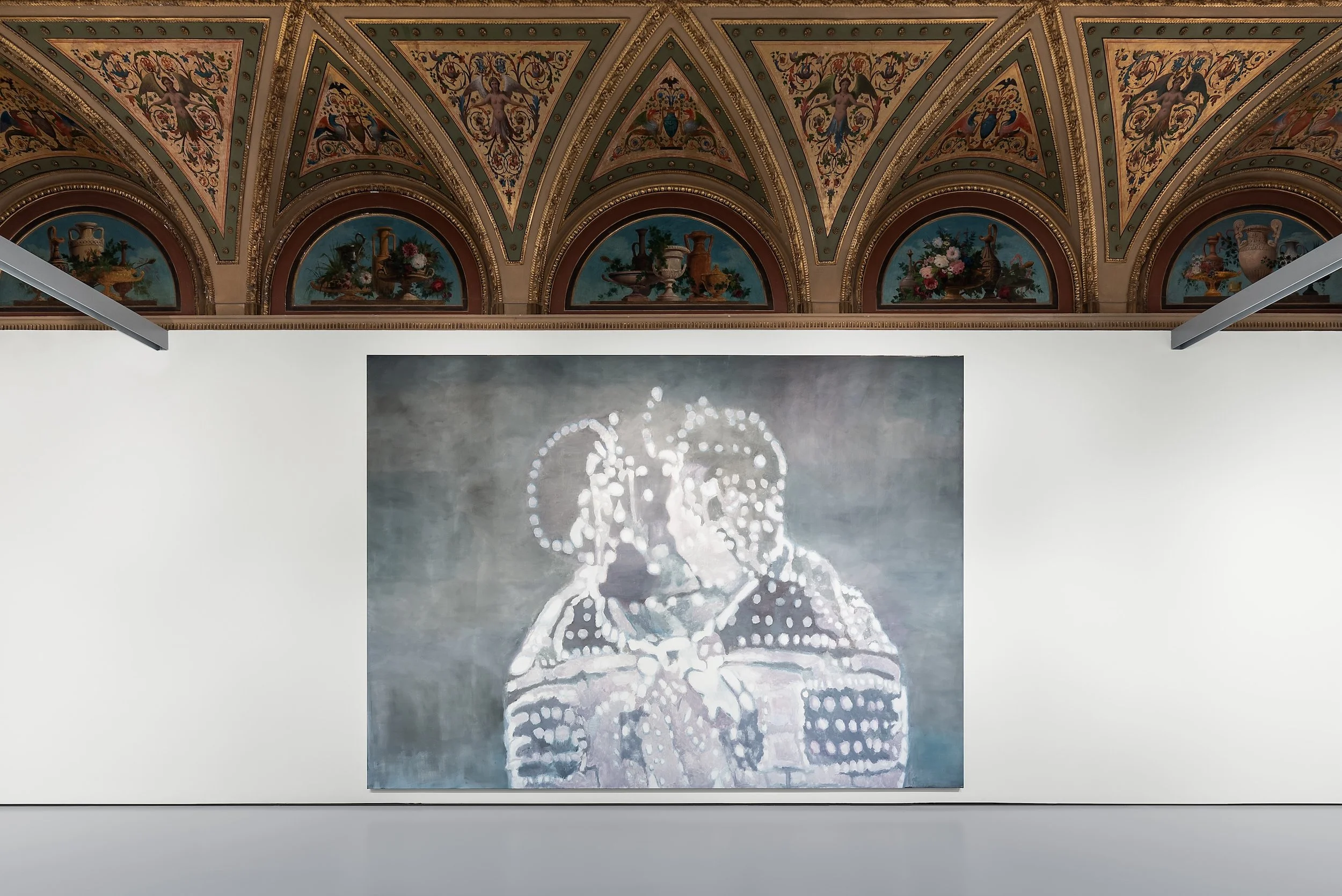
Luc Tuymans, Turtle, 2007, Private collection, Courtesy David Zwirner, New York/London. Installation View at Palazzo Grassi, 2019 © Palazzo Grassi, Photography by Delfino Sisto Legnani e Marco Cappelletti.
AMADOUR: I was looking through your earlier work and kept returning to Morning Sun (2003), which was included in your 2024 retrospective at the UCCA Center for Contemporary Art in Beijing. I was also thinking about your paintings related to China and, more broadly, about the idea of the foreign experience. It made me consider how architecture, perspective, and light operate in your work. What are you looking for when you travel that then enters the paintings?
LUC TUYMANS: Most of the things I encounter remain just that—encounters. But the specific image you referred to from China is from one of my visits to Shanghai. I was very impressed and also shocked by the speed at which everything modernized and by the sheer scale of the city. There was a particular view near the Bund, where you have these older buildings tied to the colonial past—the French quarter, the British presence—and then when you look from there toward the newer part of the city, the contrast is extraordinary. In one image, an iron ring was built into the bridge's structure, so the city appeared framed at the center, almost like a target. It also reminded me of René Magritte’s The False Mirror (1929), where the eye replaces the iris with clouds. So the image held both progress and nostalgia simultaneously. That interested me. What interests me about travel, generally, is that I try not to take too many images, because they distort memory. It can ruin the experience of travel and the remembrance of it. But every now and then, when I do make an image or choose one, it is because something very specific has occurred. It has to be particular. It has to be targeted.
AMADOUR: I wanted to ask about your Louvre project in the Valentin de Boulogne Rotunda, L’Orphelin (2024), too. Again, I see this attention to space and to how painting addresses architecture. I remember speaking with Vanessa as well about how the Los Angeles exhibition was thought in relation to other spaces. How do you access a space when you are building out a show? Are you photographing it? Working digitally? Working with models?
LUC TUYMANS: First of all, we always go and look at the space physically. That is crucial. You need to experience the space at its actual scale. You can see photographs, but that does not really work in the same way. Then we make documentation and take photographs, and after that we work from a floor plan. From there, we build the space in SketchUp and begin testing. In earlier days, I would make a maquette and work with photocopies or drawings, but now there are quicker and more precise tools. Still, the first condition is always the physical encounter with the space itself.
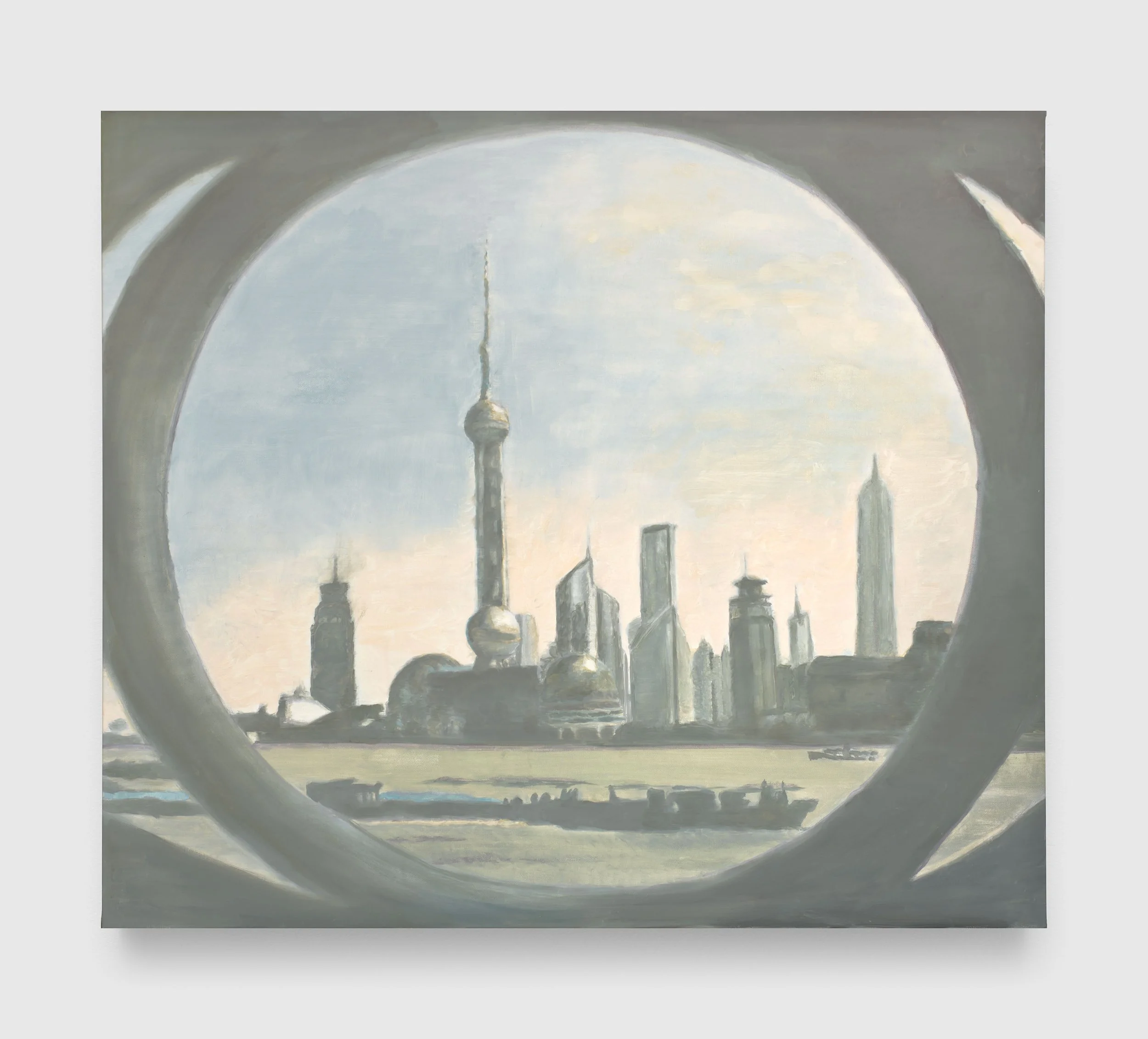
Luc Tuymans, Morning Sun, 2003. © Luc Tuymans. All rights reserved. Courtesy Studio Luc Tuymans, Antwerp, and David Zwirner.
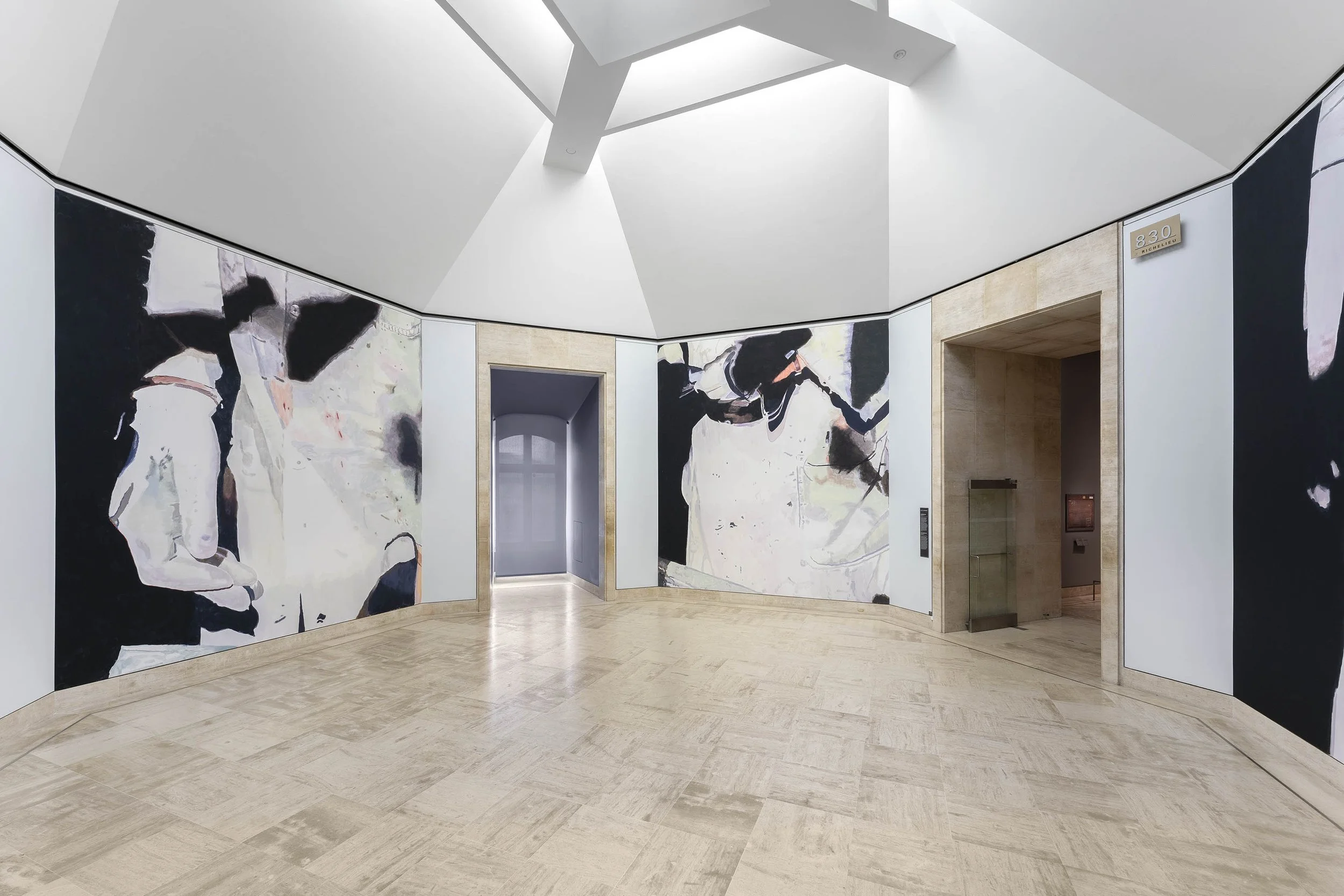
Installation view, Luc Tuymans: L'Orphelin, Louvre Museum, Paris, 2024. Photo by Nicolas Brasseur.
AMADOUR: Let’s return to the Los Angeles exhibition and the Illumination paintings—Illumination I (2024) and Illumination II, III, and IV (2025). I see a relationship to geometric abstraction there, and as someone who works in that language myself, I was very curious about them, especially the dark framing.
LUC TUYMANS: The Illumination paintings came from a documentary I saw about the restoration of fifteenth-century illuminated manuscripts. What interested me immediately was that all of this happened before printing became widespread. Printing changed everything. It was, in a sense, an industrial revolution in the dissemination of knowledge, and that intrigued me. I enlarged the imagery from the documentary even further, making it more indecipherable and mysterious, to the point where you are no longer sure what you are looking at. You begin to see the paint as material, but you also begin to sense the paper as material. That was very important to me. Then, when I photographed the screen on my iPhone, I got this dark border around the image. The border was never perfectly straight because of the angle from which I took the picture. That was the decisive trigger for the paintings. Those dark borders—it is not actual black, because I do not use black—made me think that the illuminations were illuminating themselves again through digital light, which had now become real light. And of course, there is another source as well: my long fascination with Mark Rothko. I have always loved the idea that Rothko made portals. There is one image of him that I always think about: Rothko late in life, in his studio, seated in a chair with a cigarette, looking at a painting leaning against the wall. What is remarkable about Rothko is that the paintings almost become environments. He wanted viewers to stand before them at a particular distance and to be engulfed by them, to enter them. That was another element that pushed me toward making these works. In fact, the Illumination paintings were the first works for the show. They set everything else in motion. Then The Fruit Basket became something else, and from there the exhibition grew organically, layer by layer.
AMADOUR: You live and work in Antwerp, which is obviously a place with a tremendous historical density. What does daily life there look like for you, and how does it inform the work?
LUC TUYMANS: I do not paint every day. There are many other things to do in life. Usually, I get up, do the groceries, and do normal things. But what is important is that I do not like going somewhere else, hiring a studio, and trying to paint there. I can make drawings elsewhere, yes, but to really paint, I prefer to do it in the place where I am from—in the homestead, in a sense. That also has to do with light. The light in Antwerp is entirely different from the light in Los Angeles. If I were to paint in LA, the shadows would be different. Here, we are used to a light that is often gray but highly luminous. It adds a different kind of subtlety to what one sees and how one perceives the visual. Tonal analogy becomes more important than harsh color. Even with these newer paintings, which are perhaps more chromatic than some earlier works, there is still that cooler underpinning. The red painting, for example, still carries a sense of coolness. But in the work derived from a photograph taken in the American Southwest near the Mexican border, you can see the heat. You can feel the temperature shift. You can see it in the changing shadows. That has an immediate impact on the work. When I had that exhibition in the United States organized by Helen Molesworth and Madeleine Grynsztejn [Tuymans’s first U.S. retrospective, Luc Tuymans, jointly organized by SFMOMA and the Wexner Center for the Arts, brought together approximately eighty paintings from 1978 onward and traveled from 2009 to 2011, surveying his career while emphasizing how his work is shaped by Northern European painting traditions as well as photography, television, and cinema] —which then traveled and was later shown in Brussels at the Palais des Beaux-Arts—the overhead lighting there allowed the paintings to be seen in the kind of light they were painted in. That was quite surprising for some people. It made visible how they had actually been made. That was important.
AMADOUR: Going back to The Fruit Basket and to The Raft of the Medusa, I also wanted to ask about your relation to artists more broadly. Whom are you looking at, or not looking at? And I’m asking this too in relation to Antwerp, because one feels that history there very strongly.
LUC TUYMANS: There are many artists I look at, including younger artists you may not know, people I am in conversation with. These conversations are not only about painting, but about many things. If I were to go back to the old masters, I would probably choose Jan van Eyck over Leonardo da Vinci because I think Van Eyck is more unforgiving. The Van Eyck brothers did not invent oil painting, but they brought it to such a level of refinement that it could create extraordinary depth and precision and be handled in new ways. Then, of course, the medium falls into Leonardo's hands, and from there another trajectory begins. So in that sense, yes, my lineage begins in that region. But the list could be long. I already mentioned Rothko. I could also say Piet Mondrian, Kazimir Malevich, or Ad Reinhardt's black paintings. The range is very broad. What matters to me is that the artists I admire positioned themselves within the medium with real relevance. They made the medium matter. That is very important in painting, because it can also become irrelevant when there is too much of it or when it loses precision. For me, it is always about how a painting is made, how effective it is, and probably also an element of minimalism. I am not interested in paint as theatrical excess, or in huge chunks of material. That does not appeal to me. I like something that is extremely direct, but also extremely precise. Timing and precision are essential.
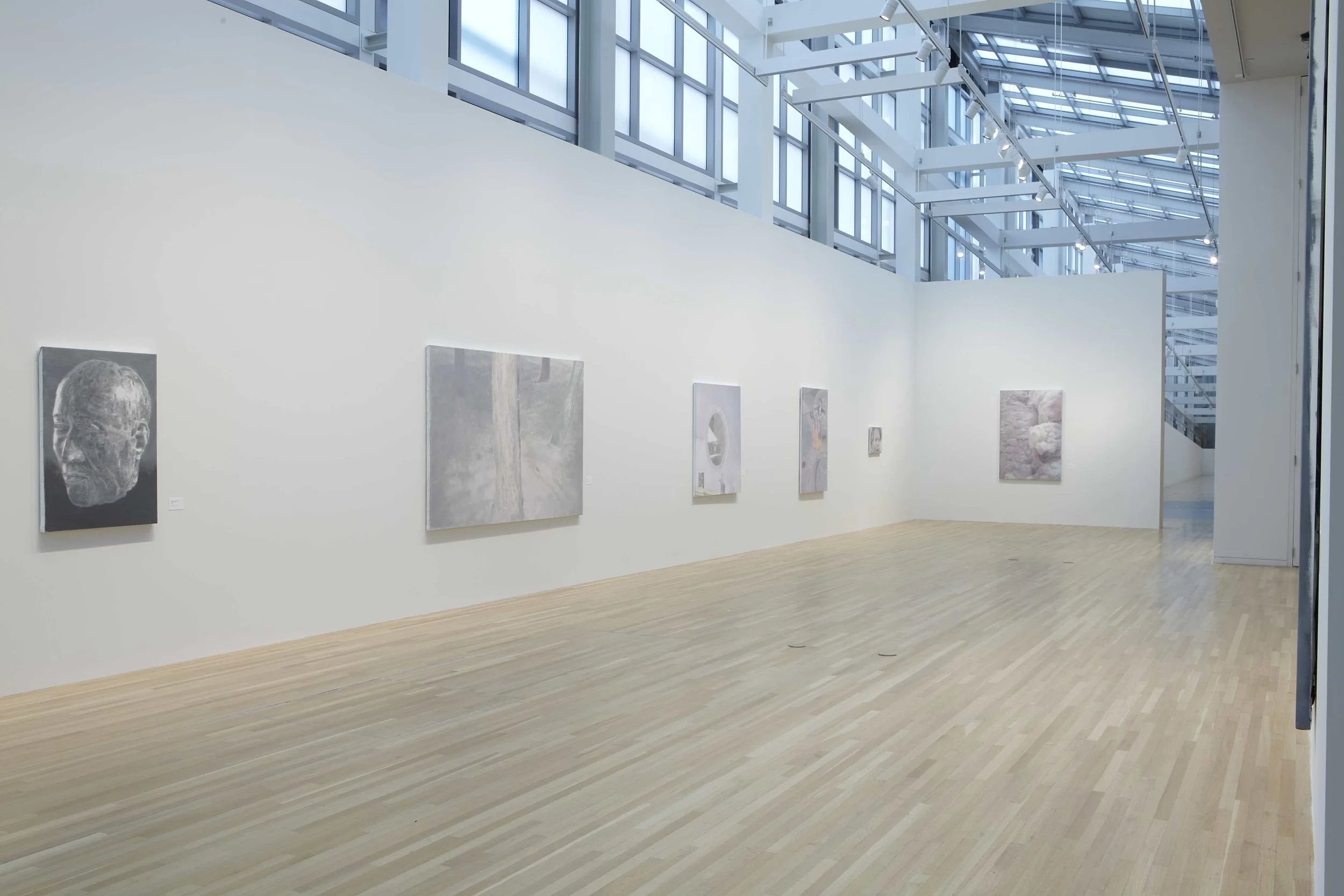
Installation view, Luc Tuymans, Wexner Center for the Arts, Columbus, United States, 2009-2010. Photo by Cory Piehowicz. Courtesy Wexner Center for the Arts, The Ohio State University
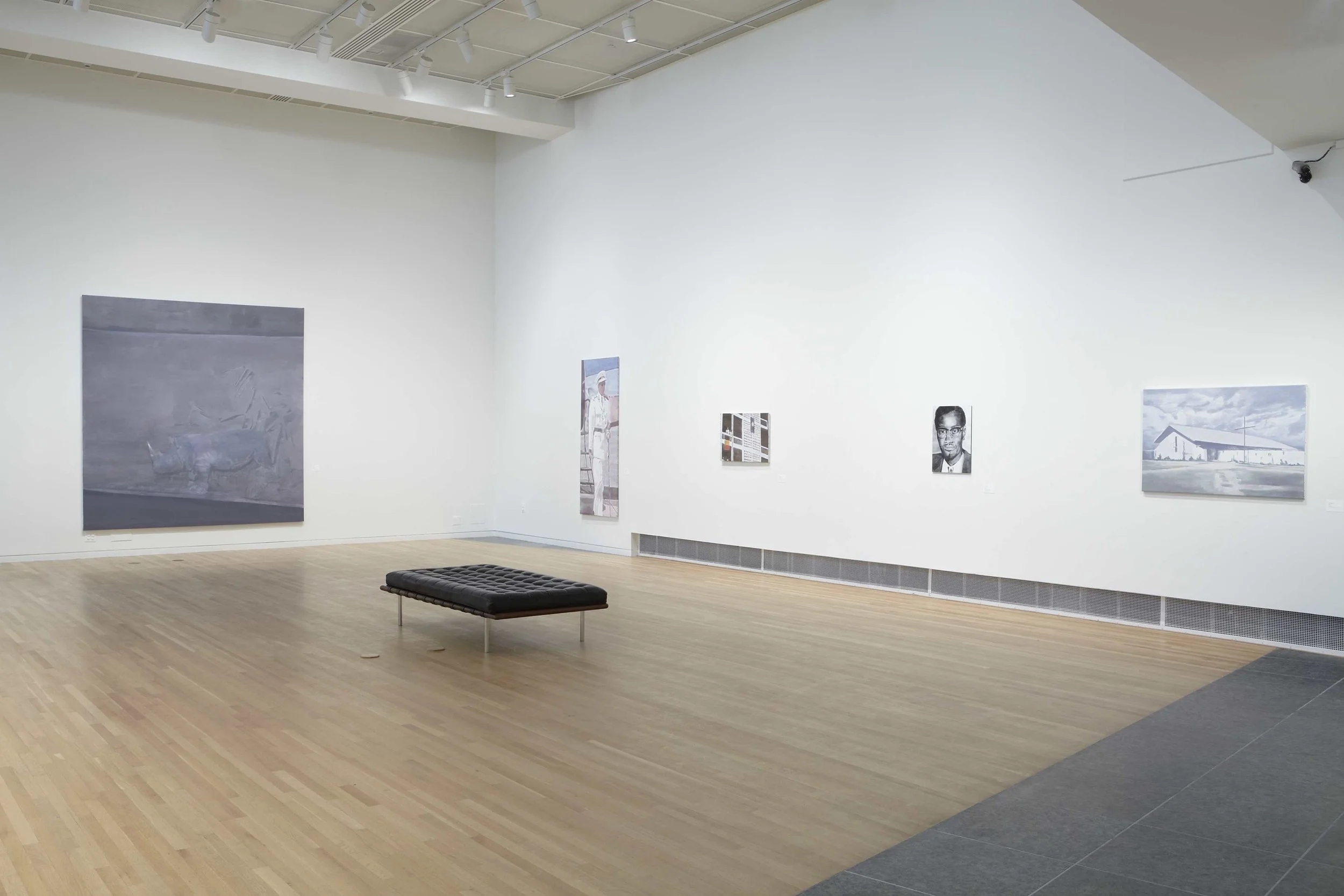
Installation view, Luc Tuymans, Wexner Center for the Arts, Columbus, United States, 2009-2010. Photo by Cory Piehowicz. Courtesy Wexner Center for the Arts, The Ohio State University
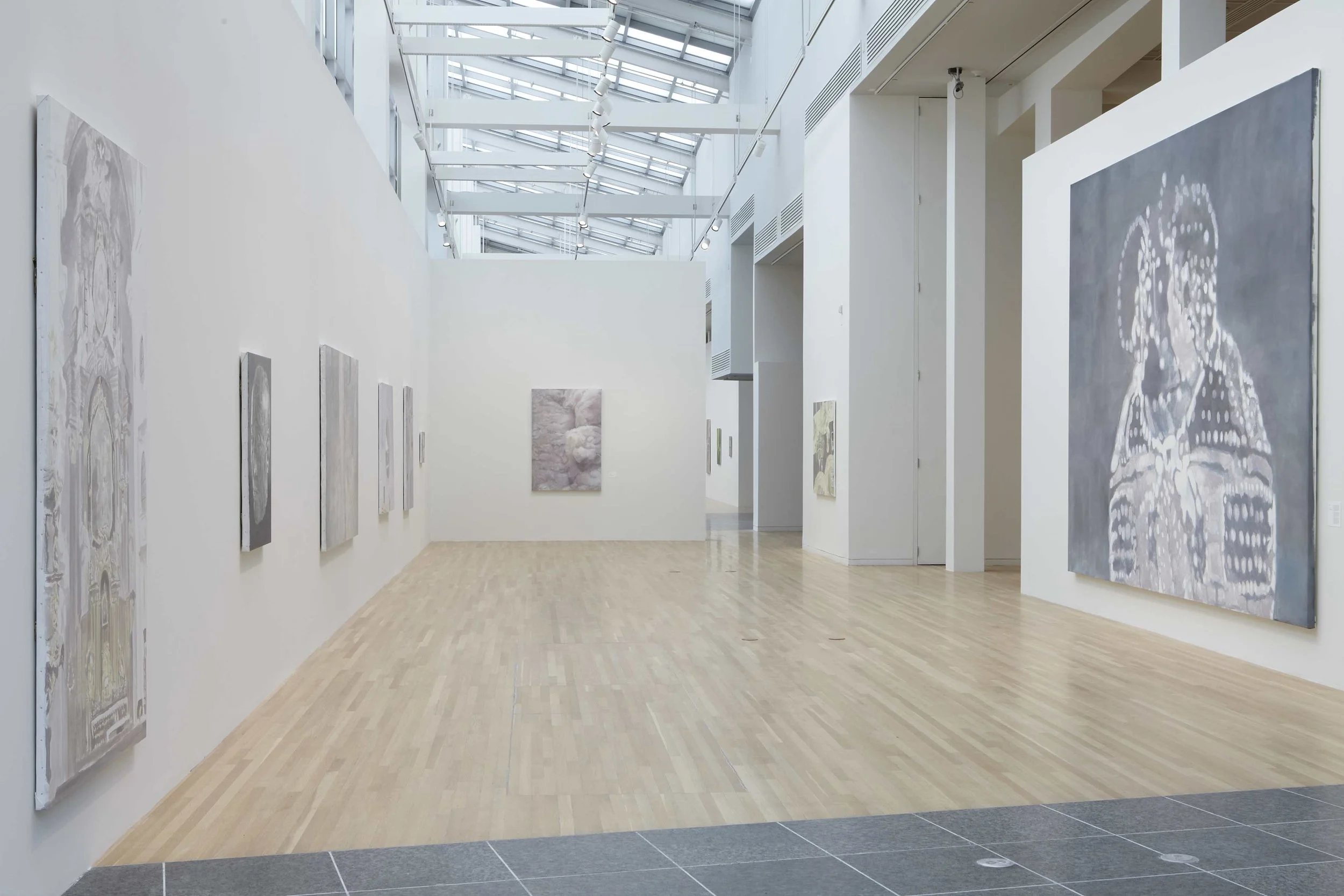
Installation view, Luc Tuymans, Wexner Center for the Arts, Columbus, United States, 2009-2010. Photo by Cory Piehowicz. Courtesy Wexner Center for the Arts, The Ohio State University
AMADOUR: Are there any Los Angeles painters or artists you are in conversation with right now?
LUC TUYMANS: Not really painters in Los Angeles. I met Ed Ruscha once, a long time ago, but only briefly. I know Paul McCarthy, although he is not a painter, even if some of the work is painterly. But no, I would not say I am in active dialogue with Los Angeles painters specifically.
AMADOUR: I also wanted to ask about Carla. What is the relationship between your practices? Do they inform one another? Are you constantly looking at each other’s work?
LUC TUYMANS: Yes, definitely. If Carla makes something and wants me to see it, I go and look at it. If I make a painting, I always ask for her opinion, and I take it seriously because she has a very sharp and critical eye. I think the same is true in reverse. So yes, it is a real collaboration in that sense, or maybe better to say a real negotiation of ideas. If I think I have a very good idea, Carla can destroy it in thirty seconds. That is useful. It is important to have that sort of board to play against, somebody with whom you can really test ideas. We are both critics of one another’s work.
AMADOUR: How do you think about critique more generally? Do you see it as necessary?
LUC TUYMANS: Critique is important as long as it is constructive. That is the condition. When I was teaching, the first thing I would say in a student’s studio was that whatever I was about to say was subjective. If the student had a better point and could convince me, that was perfectly fine. This is not a science. Critique is often about lost possibilities. It is about pointing out other routes that could be taken, or other possibilities that may already exist within the work but have not yet been seen. That is its value. Otherwise, one can lose a lot of time by becoming fixed on a single direction that may not be the right one. Sometimes, a very small remark can be transformative. It can make you realize something you had overlooked. Those are the moments when critique matters most.
AMADOUR: I also read that you studied art history. Was there a particular area that interested you, or why did you choose it?
LUC TUYMANS: To be honest, I had been thrown out of every academy, and this was something I could do as a working student. I only had to attend two days a month, and most of it was self-study. It was also a way to prove to my parents that I could earn a diploma. At the same time, I had mixed feelings about it, because the art history program itself was not especially compelling. At the Free University in Brussels, it seemed to stop around James Ensor. It did not feel very alive to me. But I finished it, and in the end, I wrote a thesis comparing art history and anthropology, because I felt art history was not really a science, whereas anthropology was far more factual. That comparison interested me.
AMADOUR: I wanted to go back to Migrants (2025), too. In the United States, we are in a very intense moment politically around migration. I was wondering how you see the migrant situation in Europe in relation to what is happening here, and how that enters your work.
LUC TUYMANS: The image in Migrants (2025) is, in a sense, the only fully real image in the exhibition. The fruit basket exists, yes; the aluminum tube exists; the American figures are based on 3D-printed figurines, so they are not exactly real; they are already one step removed. But Migrants comes from actual footage, from something happening in the world, and in that sense it captures a very specific moment in time. Migration is, of course, one of the major global issues of the present, especially given the geopolitical instability we are living through. What interests me is the misunderstanding around it—the failure to think seriously about how different populations can be integrated, and how a rational coexistence could be built, which would in fact be culturally enriching rather than threatening. Migration, in a way, is normal. Mixture is normal. It enriches a culture. Without that, culture becomes impoverished. A lot of MAGA people look at Europe as if we are losing civilization or are about to be overrun. It is an insane and antiquated idea, but also a dangerous one. And it is unintelligent, because it closes a society off from an enormous amount of culture, information, and possibilities. We live in a global world; it's important not to ignore that. Of course, Europe has its own fanaticisms too. There are nationalisms everywhere, even in the city I live in. But I have always opposed nationalism of that sort because I think it is deeply dangerous. Carla and I both belong to a generation that believed in pluralism. What we are seeing now is a profound distortion and polarization of society for malevolent ends. Of course, migration has to be managed. It has to be thought through. There are points of saturation, certainly; one can think of Turkey or of Poland in relation to the war in Ukraine. But that is entirely different from allowing right-wing demagogues to weaponize the issue in order to intensify division. That is not a solution.
AMADOUR: As a final question, what films have you seen recently that have stayed with you?
LUC TUYMANS: To come back to Hollywood, one of the latest films I saw was One Battle After Another (2025) by Paul Thomas Anderson, which I liked very much. I like many of his films—Magnolia (1999), for example, and There Will Be Blood(2007)—and this one interested me because it felt a little Quentin Tarantino-like on the surface, but had more substance in another way. It gathered a great deal of what feels specific to the present moment and arranged it with a sardonic sense of humor. I also saw Americana (2025), and Bugonia (2025), which again felt tied to the contemporary climate of conspiracy thinking and the insanity that grows out of it, the way it can tip into delirium. Those are probably the three most recent films I have seen.
AMADOUR: Thank you so much, Luc. I hope to see you soon in Antwerp, or perhaps somewhere else in the world.
LUC TUYMANS: Me too. Take care.
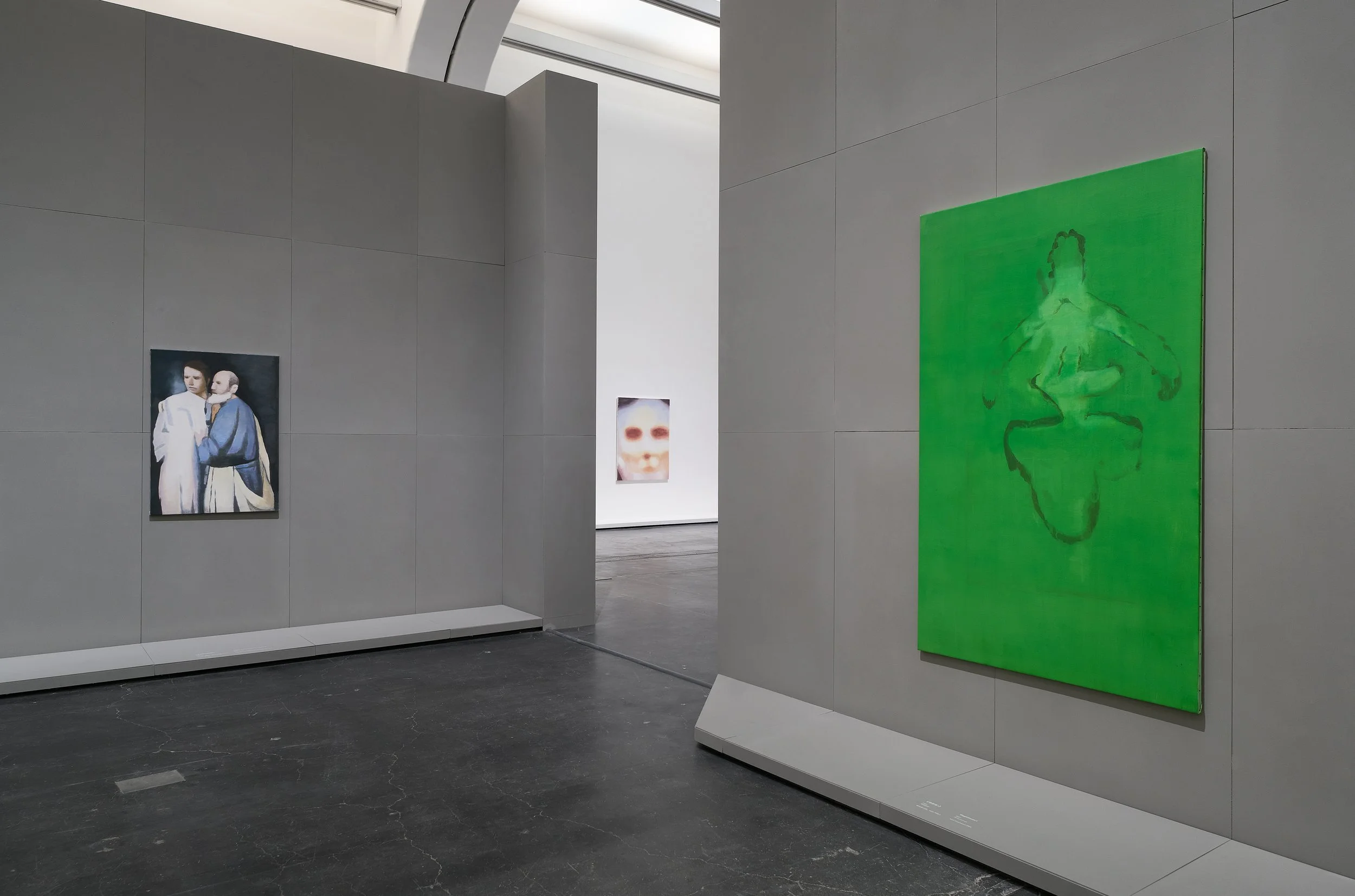
“吕克•图伊曼斯:过去”展览现场图,UCCA尤伦斯当代艺术中心,2024。图片由UCCA尤伦斯当代艺术中心提供,摄影:孙诗。Installation view of "Luc Tuymans: The Past," UCCA Center for Contemporary Art, 2024. Photograph by Sun Shi, courtesy UCCA Center for Contemporary Art.
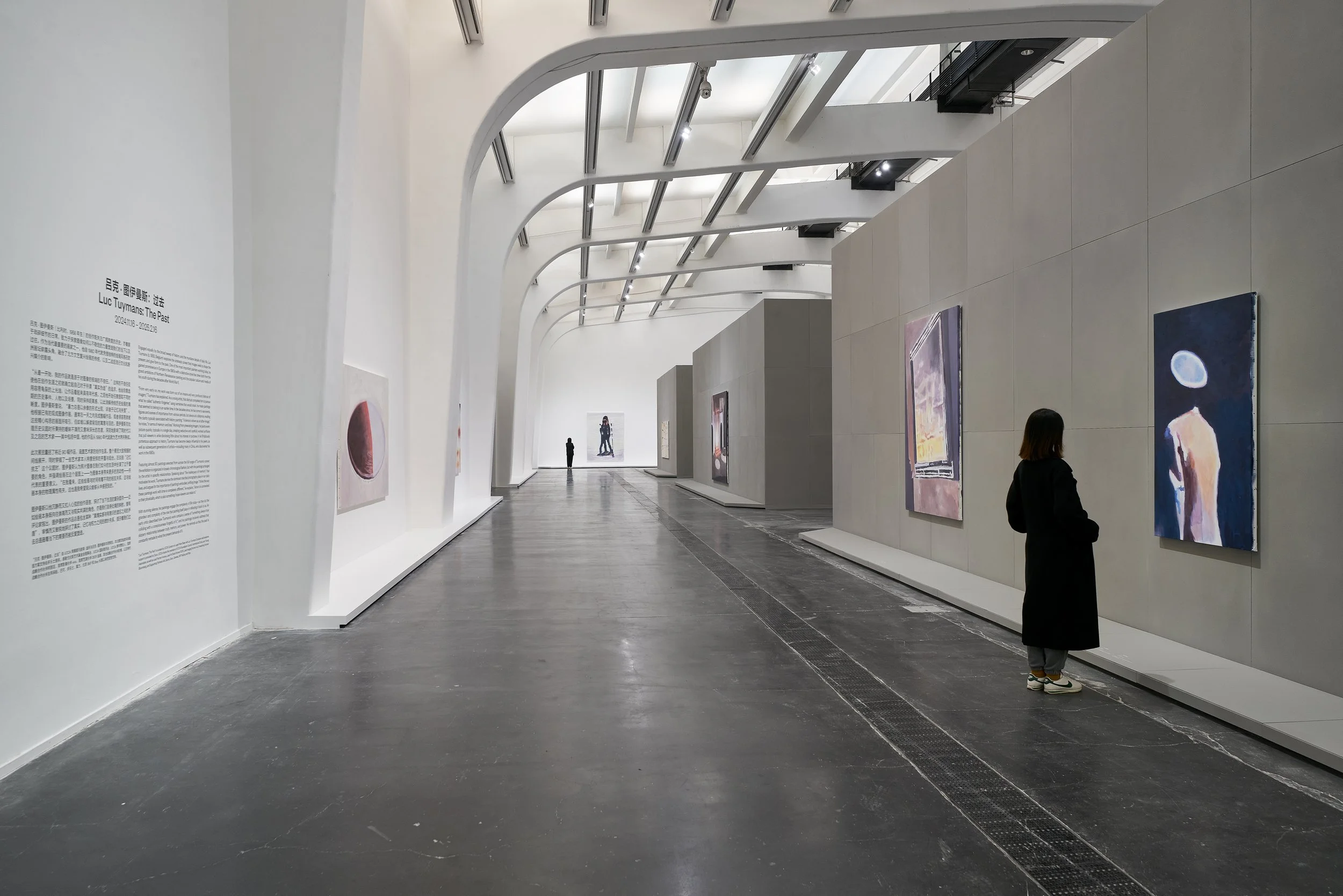
“吕克•图伊曼斯:过去”展览现场图,UCCA尤伦斯当代艺术中心,2024。图片由UCCA尤伦斯当代艺术中心提供,摄影:孙诗。Installation view of "Luc Tuymans: The Past," UCCA Center for Contemporary Art, 2024. Photograph by Sun Shi, courtesy UCCA Center for Contemporary Art.
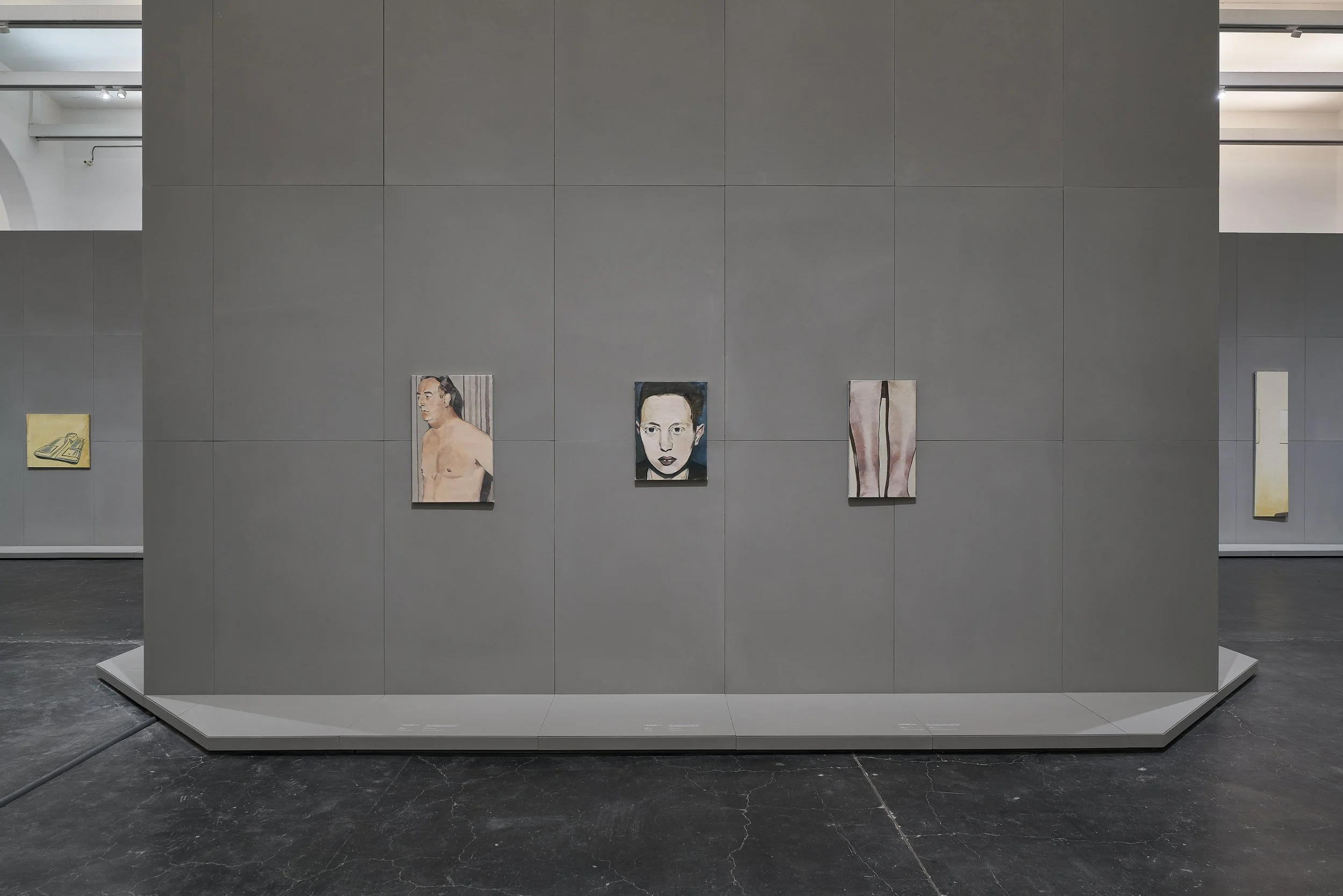
“吕克•图伊曼斯:过去”展览现场图,UCCA尤伦斯当代艺术中心,2024。图片由UCCA尤伦斯当代艺术中心提供,摄影:孙诗。Installation view of "Luc Tuymans: The Past," UCCA Center for Contemporary Art, 2024. Photograph by Sun Shi, courtesy UCCA Center for Contemporary Art.
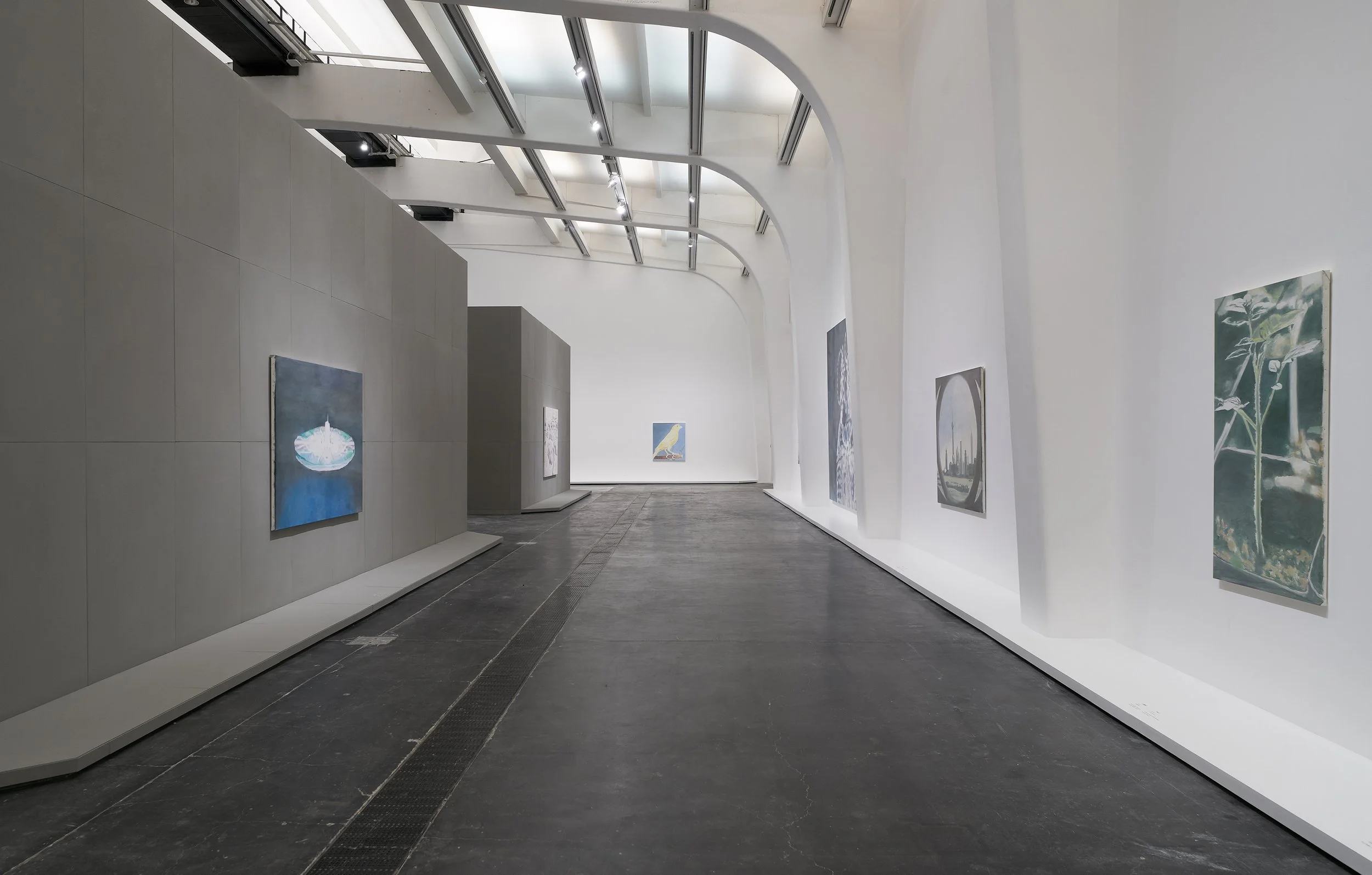
“吕克•图伊曼斯:过去”展览现场图,UCCA尤伦斯当代艺术中心,2024。图片由UCCA尤伦斯当代艺术中心提供,摄影:孙诗。Installation view of "Luc Tuymans: The Past," UCCA Center for Contemporary Art, 2024. Photograph by Sun Shi, courtesy UCCA Center for Contemporary Art.
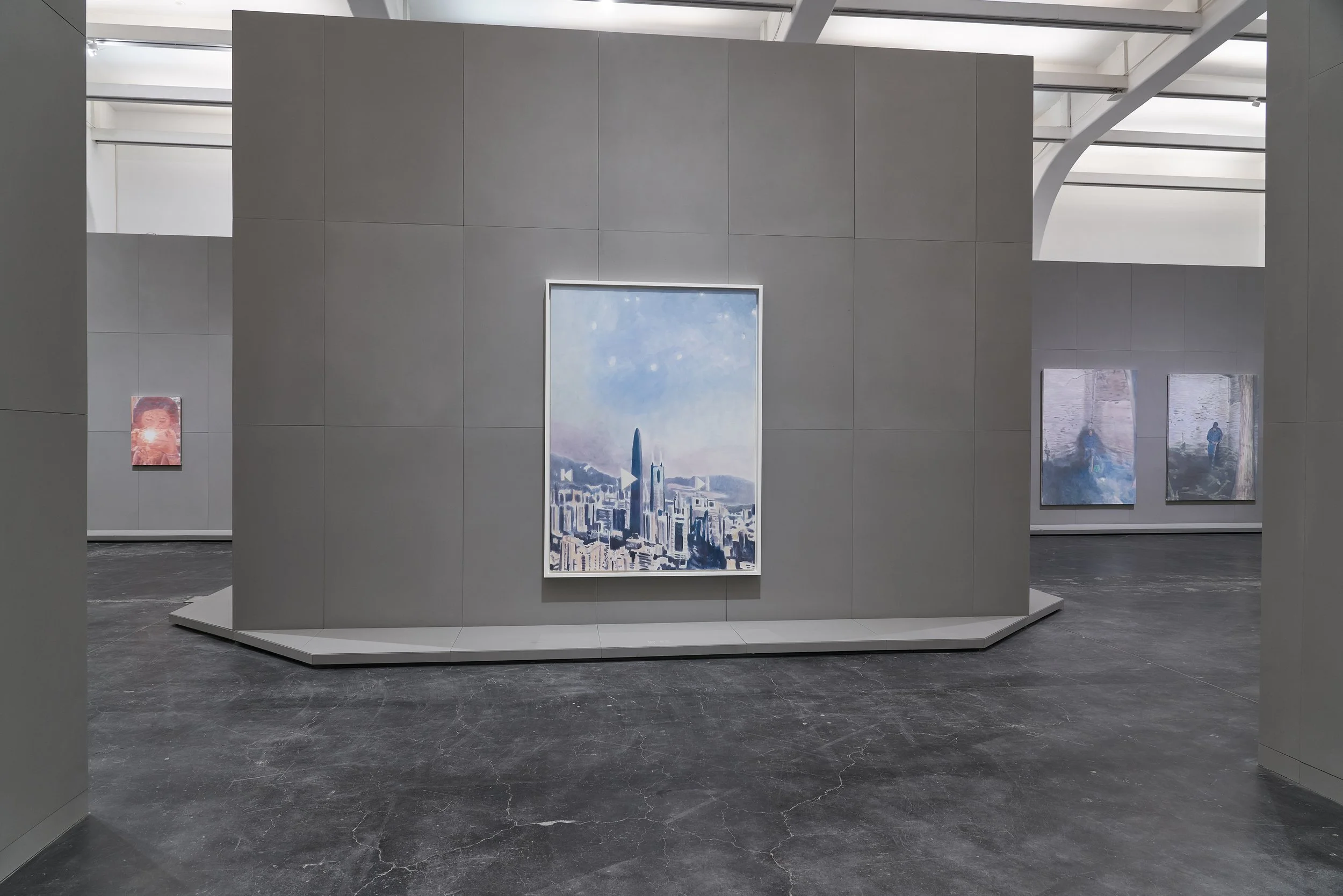
“吕克•图伊曼斯:过去”展览现场图,UCCA尤伦斯当代艺术中心,2024。图片由UCCA尤伦斯当代艺术中心提供,摄影:孙诗。Installation view of "Luc Tuymans: The Past," UCCA Center for Contemporary Art, 2024. Photograph by Sun Shi, courtesy UCCA Center for Contemporary Art.