ONE PLUS ONE EQUALS THREE: AN INTERVIEW WITH CARLA AROCHA AND STÉPHANE SCHRAENEN ON SPACE, PROCESS, AND COLLABORATION
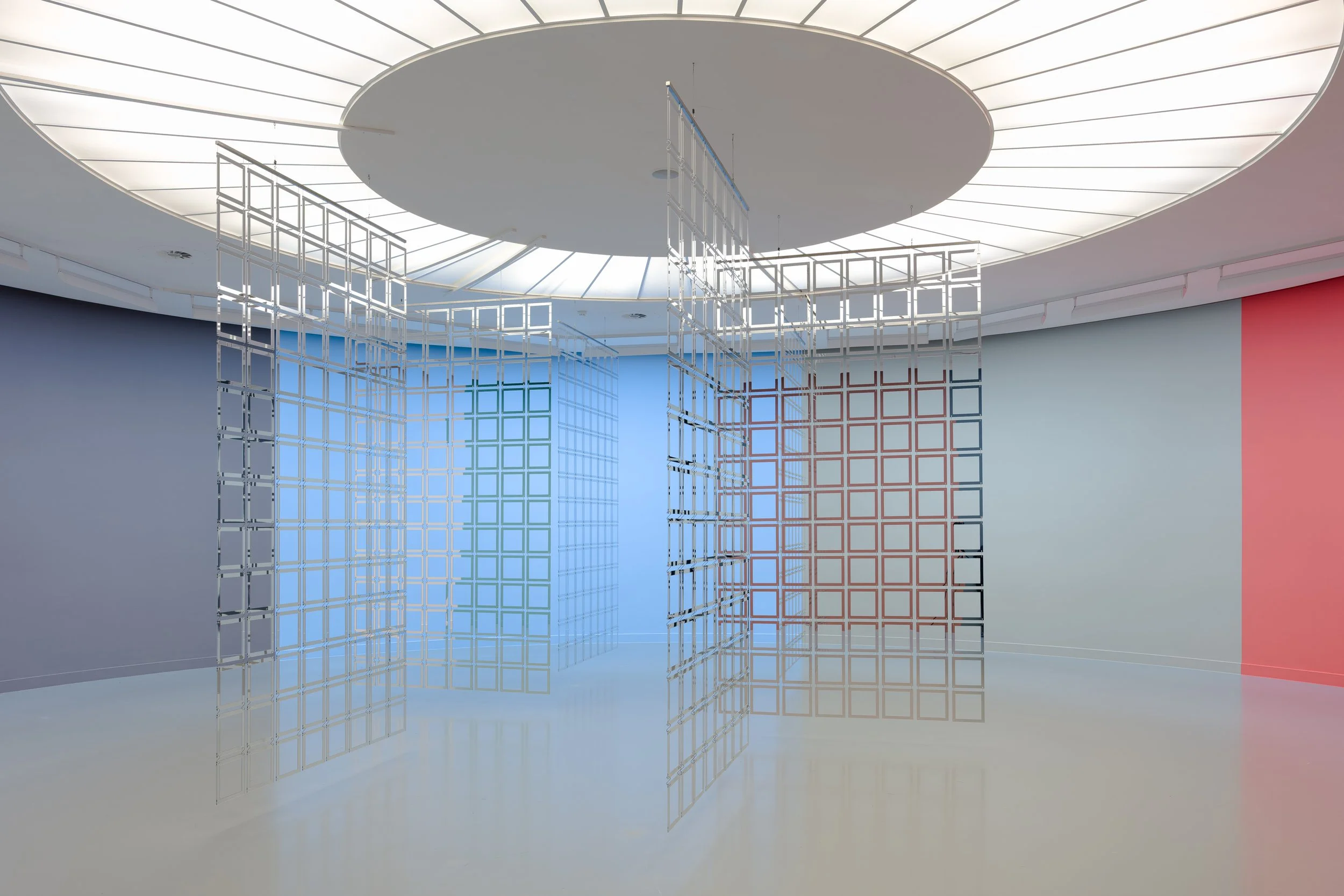
Arocha-Schraenen, Landscape (Antwerp), 2026. Mirrored plexiglass, stainless steel, and latex paint on wall. Overall dimensions variable. 6 panels; each approx. 382 x 200 cm. 20 Years and More: Works from the Collection, M HKA, January 24–May 24, 2026. Courtesy of the artists. Photo: Pieter Huybrechts.
Over the past two decades, artist duo Carla Arocha and Stéphane Schraenen have built a collaborative practice centered on shape, space, perception, and the ways people move through and experience environments. Working across installation, sculpture, and exhibition making, the pair create works that often transform familiar spaces into something unexpected, encouraging viewers to slow down and look again. In the lineage of artist partnerships such as Christo and Jeanne-Claude, Elmgreen & Dragset, Gilbert & George, amongst others, long-term artistic collaborations remain surprisingly rare; sustaining one requires not only a shared vision but an openness to difference and the willingness to continually grow together.
What I found especially compelling about Arocha and Schraenen is the way their practice emerges from the meeting of distinct cultural trajectories: Arocha, informed by experiences between Chicago and Venezuela and by broader histories across Latin America, and Schraenen, shaped by Belgium’s traditions of art, design, and exhibition culture. Rather than blending those perspectives into a single voice, their work allows both to remain present, creating something that feels simultaneously unified and multiple, singular yet plural.
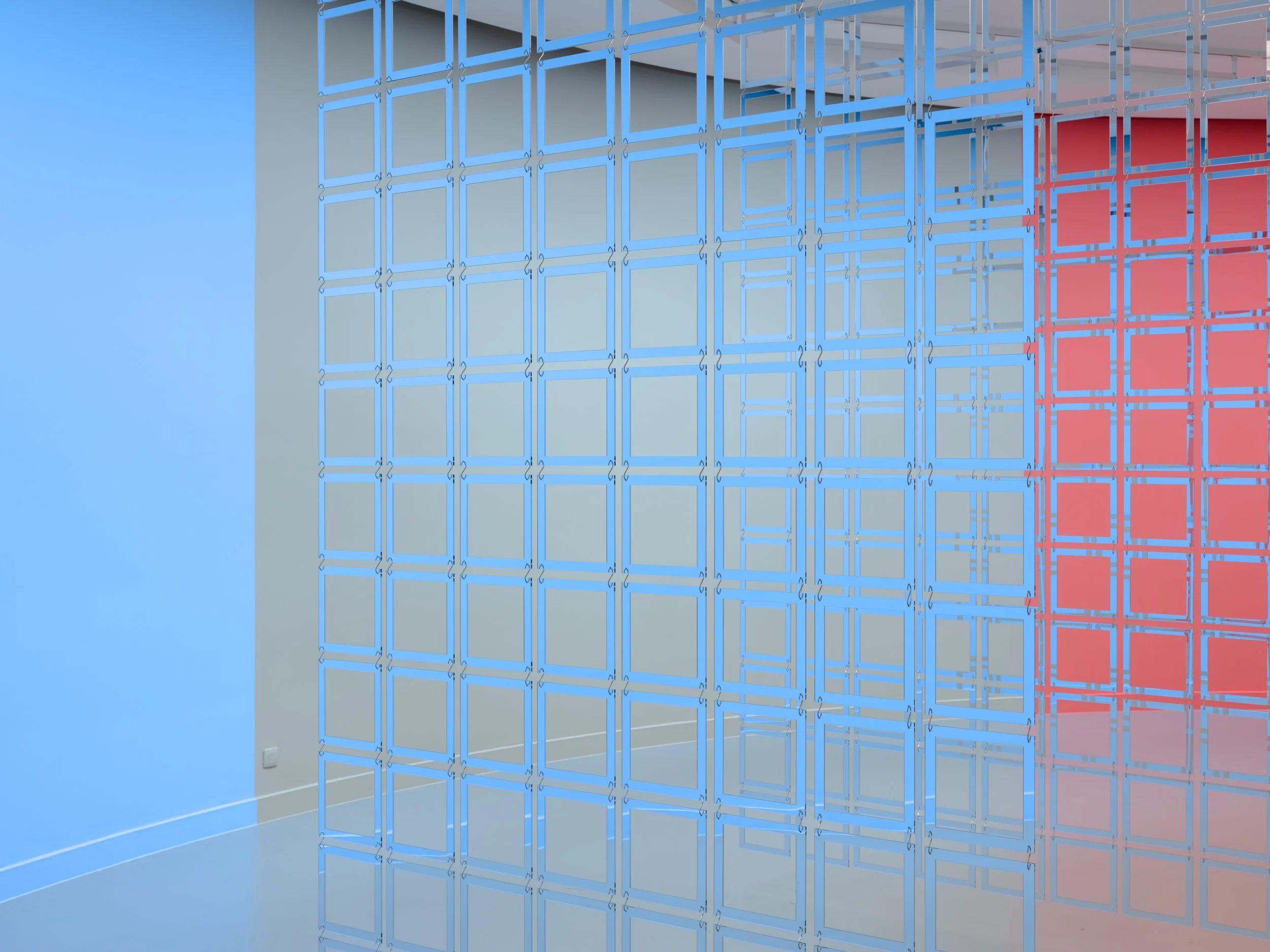
Arocha-Schraenen, Landscape (Antwerp), 2026. Mirrored plexiglass, stainless steel, and latex paint on wall. Overall dimensions variable. 6 panels; each approx. 382 x 200 cm. 20 Years and More: Works from the Collection, M HKA, January 24–May 24, 2026. Courtesy of the artists. Photo: Pieter Huybrechts.
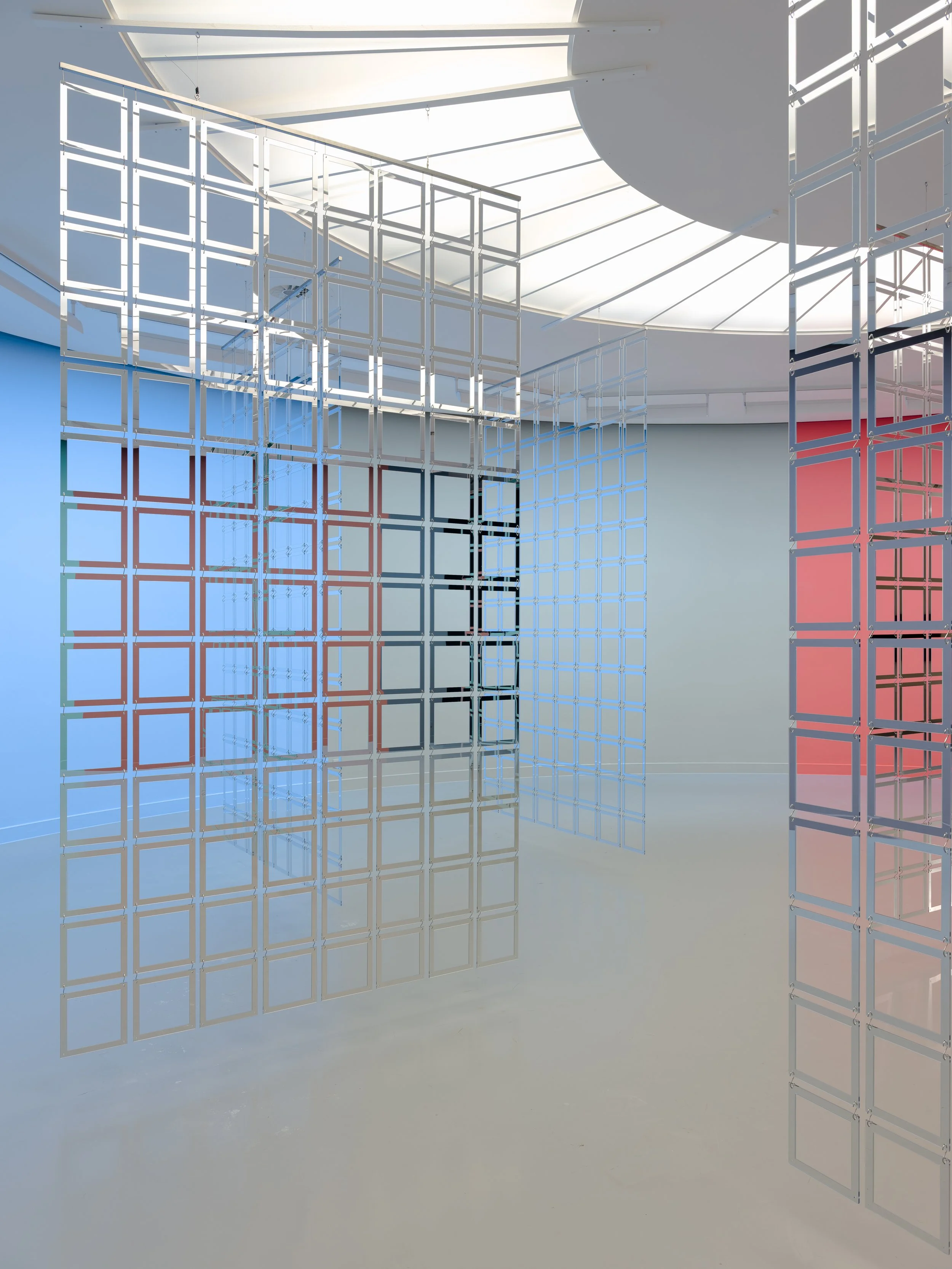
Arocha-Schraenen, Landscape (Antwerp), 2026. Mirrored plexiglass, stainless steel, and latex paint on wall. Overall dimensions variable. 6 panels; each approx. 382 x 200 cm. 20 Years and More: Works from the Collection, M HKA, January 24–May 24, 2026. Courtesy of the artists. Photo: Pieter Huybrechts.
Earlier this year, M HKA in Antwerp [Museum of Contemporary Art Antwerp (Dutch: Museum van Hedendaagse Kunst Antwerpen)] presented 20 Years and More: Works from the Collection, a survey reflecting on two decades of Arocha and Schraenen’s collaborative practice and its place within the museum’s collection. Running in parallel was the publication of Carla Arocha and Stéphane Schraenen: Monograph as Project, a remarkable 664-page volume authored and edited by Barbara Vanderlinden and designed by Irma Boom. More than a traditional monograph, the publication traces both artists’ individual trajectories and their shared practice through more than 700 images and 66 case studies, proposing collaboration itself as methodology and authorship: a collective inquiry. The artists often describe this relationship through a simple equation: one plus one equals three.
In contemporary art, conversations often begin long before the interview itself. I first met Carla Arocha in February 2026, during Frieze Los Angeles at a gathering hosted by collector Eugenio López Alonso at his home in Trousdale Estates. It was one of those evenings where worlds unexpectedly overlap. Moving through the crowd, I noticed three figures clothed entirely in black: something between the oeuvre of Yohji Yamamoto, Rick Owens, and Maison Margiela. I was also wearing black, as is my daily uniform, and there was an immediate sense of familiarity, as if meeting artistic relatives you had somehow not yet encountered. Naturally, I introduced myself. Present were Arocha, her husband, artist Luc Tuymans, and artist and studio manager Vanessa Van Obberghen.
We initially spoke in English before Arocha and I naturally shifted into Spanish, finding common ground in our shared South American roots. Arocha was born and raised in Caracas; my mother’s family is from Bogotá, Colombia, and there is this indescribable regional connection that makes one feel rooted in a shared history. Somewhere between conversations about migration, artistic life, and abstraction, we discovered another shared language: a fascination with geometry, form, and the ways visual language can carry memory, movement, and emotion across place. Arocha is brilliant, and I enjoyed hearing about her adventures in Chicago, where she and Tuymans first met in 1995, when Tuymans was preparing an exhibition for the Renaissance Society, and fell in love. She also shared insights into life in Antwerp and possesses an openness to learning and an endless zest for exploration. That first conversation would become the beginning of several encounters across Los Angeles that week, and, eventually, this interview.

Stéphane Schraenen, What I Don't See at Night (Sleeping Room), 1999 (executed 2024). Acrylic paint and ultra-pigmented acrylic paint on canvas. 164 x 272 cm. 20 Years and More: Works from the Collection, M HKA, January 24–May 24, 2026. Courtesy of the artists. Photo: Pieter Huybrechts.
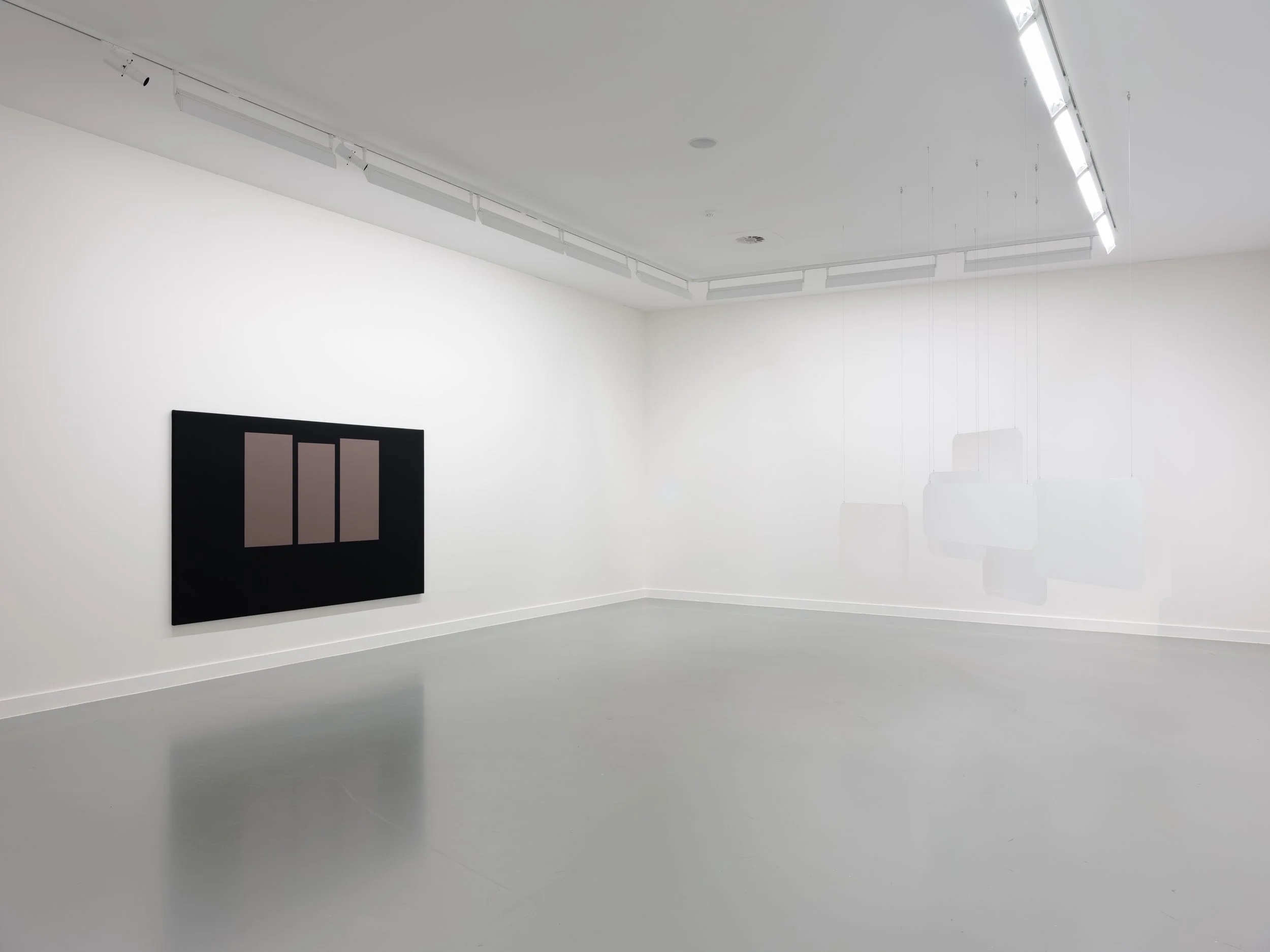
Carla Arocha & Stéphane Schraenen, installation view, 20 Years and More: Works from the Collection, M HKA, January 24–May 24, 2026. Courtesy of the artists. Photo: Pieter Huybrechts.
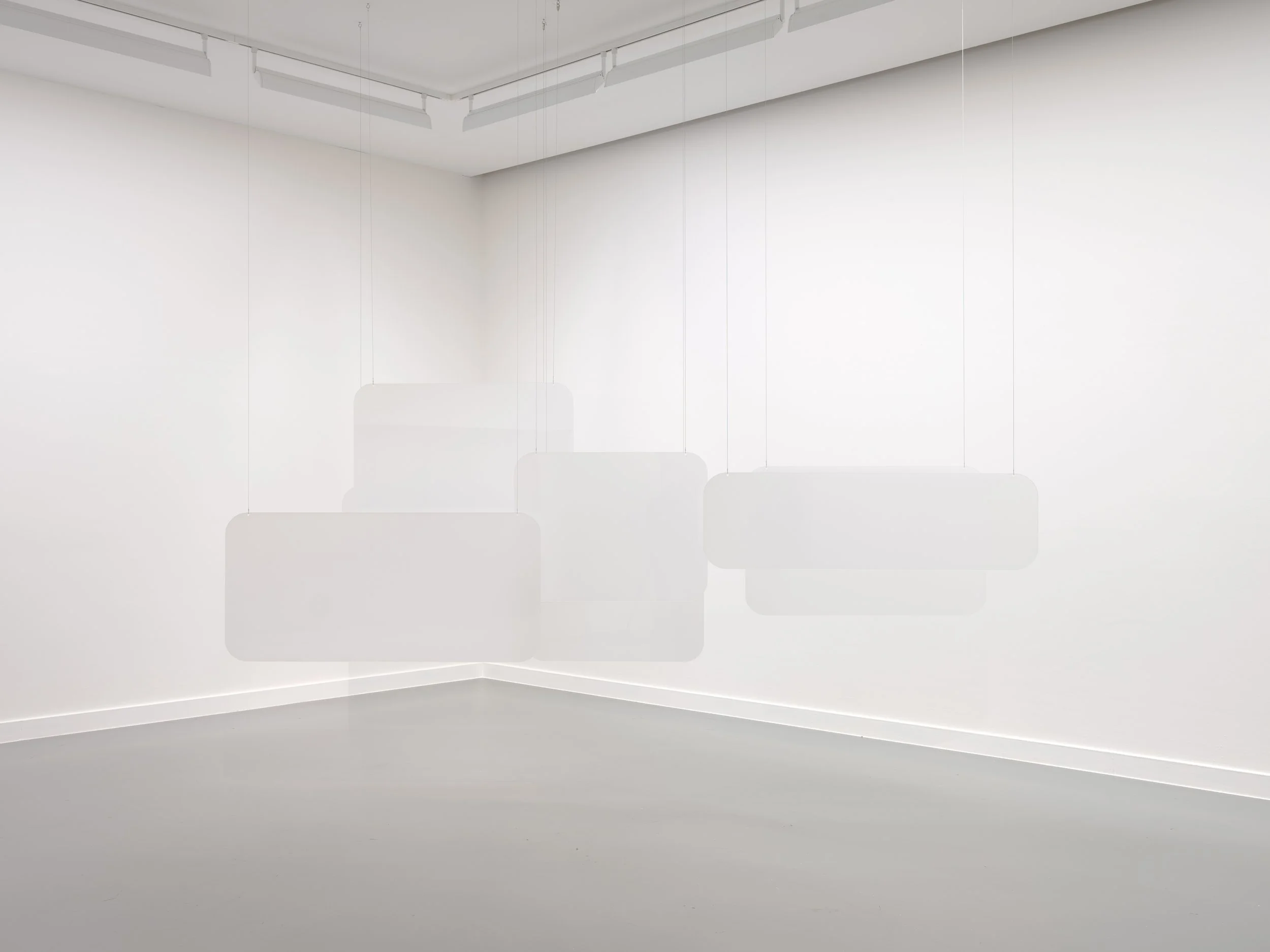
Carla Arocha, Screen, 2005. Translucent plexiglass and stainless steel. 7 panels, various sizes; overall dimensions variable. 20 Years and More: Works from the Collection, M HKA, January 24–May 24, 2026. Courtesy of the artists. Photo: Pieter Huybrechts.
While I met Arocha in person, my introduction to Schraenen happened differently: through email, reading, and research. We have yet to meet beyond FaceTime, but I have found myself drawn to his trajectory within Belgium’s artistic ecosystem and the broader cultural environment that shaped him. Born and raised in Antwerp, Schraenen emerged from a world that moves fluidly between design, publishing, and conceptual art, an interdisciplinary sensibility that continues to shape his approach today. Growing up in proximity to experimental publishing through his father, publisher and archivist Guy Schraenen, co-founder of the Archive for Small Press & Communication (ASPC) and co-founder of Galerie Kontakt with Anne Marsily, offers one point of entry into understanding that environment, though what interested me most was not soley his biography but the way these influences appear in the work itself: an attention to structure, systems, language, and the choreography of how images and ideas move across space.
What struck me most about 20 Years and More: Works from the Collection at M HKA was not only the scale of the works but their capacity to reorganize the experience of inhabiting space. Throughout the exhibition, Arocha and Schraenen’s works rarely function as static objects; rather, they activate the surrounding architecture itself. Walls appear unstable, reflections proliferate, surfaces become performative, and the viewer is drawn into the work rather than remaining an external observer. In this way, collaboration feels less like a merging of identities and more like a shared method for transforming perception.
The effect feels immersive but also strangely familiar: the sensation of arriving somewhere for the first time and slowly orienting oneself through observation. Like driving into a new city and watching its skyline emerge before noticing the smaller details that begin to attach themselves to memory. I think of seeing Chicago for the first time, or passing through Sacramento on my way to the Bay Area from Reno, and experiencing that moment when buildings, light, and movement suddenly become legible as place. Arocha and Schraenen’s work produces something similar: an awareness that perception is relational and that space only becomes meaningful through movement, attention, and lived experience.
Among the earliest works on view, Arocha’s Screen (2004) is a mobile comprising six cloud-like suspended panels of Perspex (a transparent acrylic material made of polymethyl methacrylate). Rather than simply splicing the space, the work floats and softens it, allowing bodies, shadows, and movement to become part of its composition. Looking at the installation documentation, I found myself thinking of the suspended weightlessness of artist Gego’s Reticulárea (1969), first presented at the Museo de Bellas Artes in Caracas. Both artists transform atmosphere into material; however, while Gego dissolves line into an expansive network of wires that resembles a spider’s web, Arocha maintains restraint, employing transparency and nonspace as active compositional devices, as if looking up at the sky and clouds appearing static for a brief moment before they drift and dissolve.
Following this, Schraenen’s Sleeping Room (1999–2024), from his ongoing What I Don’t See at Night painting series, introduces another register entirely. These nocturnal abstractions emerge through positive and negative space, reflection, and fragments of urban experience. The work became legible to me through the lens of the artist Barnett Newman. Like Newman’s color fields and vertical “zip” paintings, and particularly his Zim Zum I (1969), a weathered steel sculpture at the San Francisco Museum of Modern Art, Schraenen compresses emotion into spatial intervals rather than narrative imagery, creating something psychological rather than descriptive. These forms begin to behave almost like figures, or passages cut into the wall, doors that are never opened but seem to lead somewhere beyond the visible surface. What emerges is a subtle understanding of light and form: their apparent simplicity reveals itself as something far more exacting. The quadrangle, here, becomes less a neutral geometry than a structure through which perception, atmosphere, and feeling are quietly organized.

Carla Arocha & Stéphane Schraenen, installation view, 20 Years and More: Works from the Collection, M HKA, January 24–May 24, 2026. Courtesy of the artists. Photo: Pieter Huybrechts.
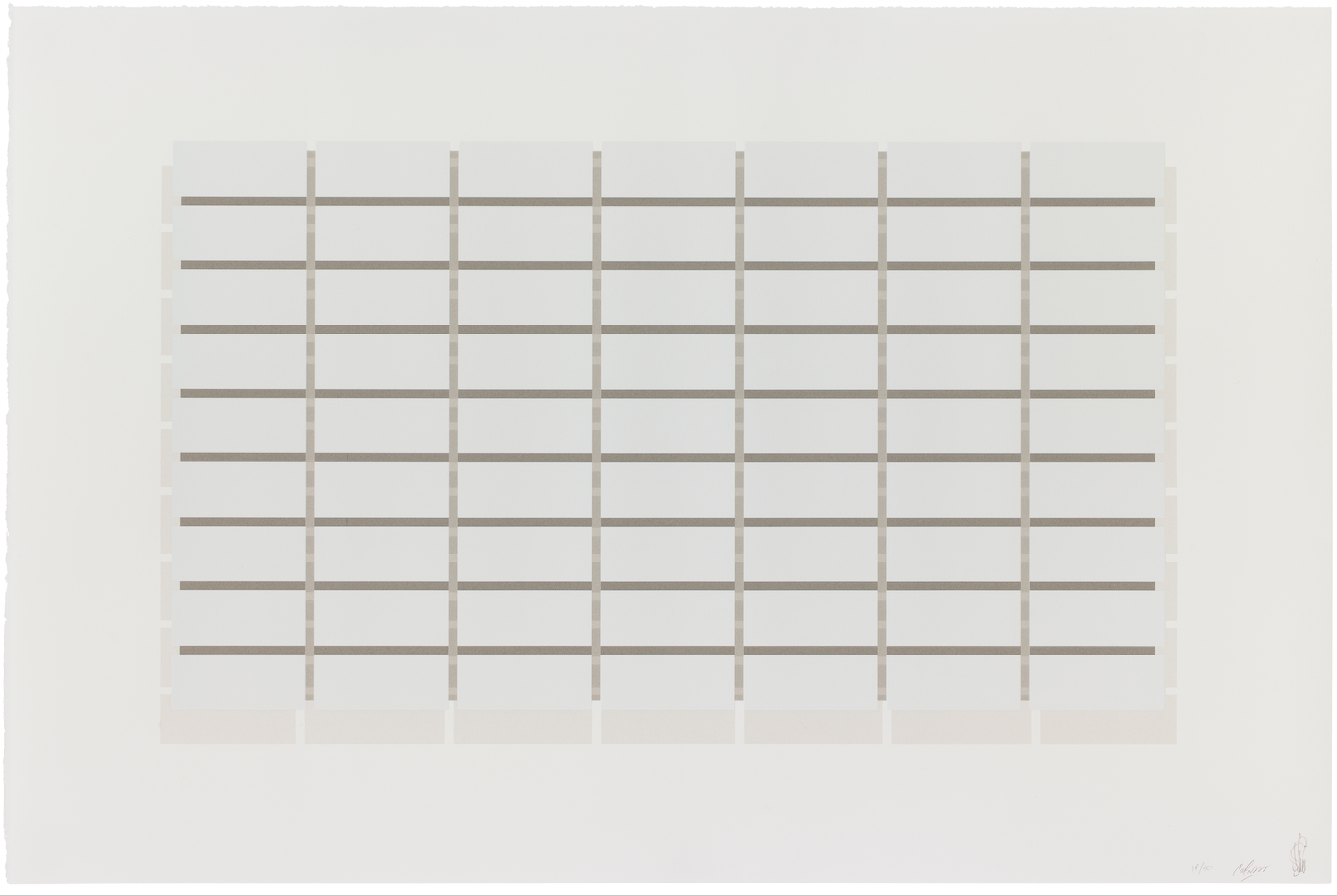
Carla Arocha & Stéphane Schraenen, Persiana, 2014. Silkscreen in 5 colors on Velin BFK Rives 300 g. Silkscreen 54.5 x 92 cm; sheet 80 x 120.5 cm. Edition of 30 plus 5 AP. 20 Years and More: Works from the Collection, M HKA, January 24–May 24, 2026. Courtesy of the artists. Photo: Pieter Huybrechts.
Their collaborative work, Persiana (2014), remains one of my favorite moments in the exhibition. Referencing blinds positioned before a window, the work proposes vision itself as unstable: are we observing, or are we being observed? This prompted me to think of Ana Mercedes Hoyos’ Ventana series, where windows become structures for memory, domesticity, and absence. Hoyos’ works also echo the What I Don't See at Night series, in which subtle optical gradations of color and linework transform seemingly minimal compositions into spatial investigations of perception, systems, and the ways in which form can operate as structural interference. Yet where Hoyos produces a trompe l’oeil effect through paint, Arocha and Schraenen arrive at something different, interpreting the portal as a silk-screened mirror: an object that does not reproduce reality so much as mediate our access to it. We never truly see ourselves directly; we come to understand ourselves through reflection, and here that reflection is muted, opaque, partially withheld. I also found myself tracing connections to Sandra Gamarra’s Piece of Gallery IV (2013), in which institutional space folds back upon itself and display becomes newly visible. What produces space? What logic allows us to define a perimeter? How does an urban space, a national border, or even a room become legible? Persiana hovers in that uncertainty: is it closed or open? Though fundamentally flat and two-dimensional, the work seems to resist remaining an image. Instead, it presses toward objecthood, almost demanding sculptural inquiry. Its surface behaves less as representation than as an event of perception.
The exhibition culminates with Landscape (Antwerp) (2026), a new installation created and donated to the museum, occupying M HKA’s circular gallery. Rather than depicting landscape directly, Arocha and Schraenen extract chromatic information from the city and translate it into monumental, gridded, semi-transparent planes of color alongside reflective architectural elements; elsewhere in the series, pixels operate as a methodology for selecting and organizing color. Looking through documentation of the work, I found myself moving between multiple art histories at once: the chromatic agility of Carlos Cruz-Diez’s Labyrinthe de Transchromie A (1965–2017) and the percussive repetition of Ellsworth Kelly’s Sculpture for a Large Wall (1956–1957), where landscape emerges through reduction rather than representation. What distinguishes Arocha and Schraenen, however, is that their works never fully resolve into an image; they remain contingent on shifting viewpoints and embodied movement. The scale at which they work demands inhabitation. Viewers must adjust their pace, orientation, and relationship to one another in order to encounter the piece fully. As someone who has visited Antwerp, I found myself thinking about the city’s strange relationship to time: how old it feels and yet how insistently it continues to produce newness, from the vertical presence of the MAS Museum to the theatrical grandeur of Antwerpen-Centraal station. What I find compelling about this ongoing series is its elasticity. Though rooted in place, these works could emerge from almost any city in the world. Their language remains surprisingly universal: color, shape, reflection, movement. Beauty is a difficult word because it can feel imprecise, but here it seems appropriate. The work feels less like an endpoint than the culmination of a practice that continues to expand while remaining open to the possibility of becoming something else.
While taking in the expansiveness of Arocha and Schraenen’s career, I found myself taking a walk around Reno, Nevada, my hometown, imagining which colors they might choose here. My attention returned to a very specific yet strangely anonymous high-rise in the downtown core: a reflective office tower formerly known as the Porsche Building. In the 1980s, before Reno’s contemporary identity as a center of logistics and technology, the site housed Porsche’s North American headquarters, which the company later relocated to Atlanta, where its later headquarters appears almost like an architectural descendant of Reno’s. Today, unless one knows that history, the structure reads differently: another mirrored office tower absorbed into the city’s changing skyline. I found myself imagining the building translated through Arocha and Schraenen’s methodology, pixelated into chromatic fragments and reorganized as an atmosphere rather than an image. In doing so, I kept returning to how much of our lives are spent inhabiting architecture and continually negotiating our bodies in relation to it.
What interested me was not nostalgia so much as the instability of designation itself. When does a headquarters become a nickname? When does a function become an image? Through Arocha and Schraenen’s work, the building became newly legible: less as architecture than as a surface of accumulated reflections, historical residue, and shifting use. Their extraction of chromatic information from urban environments began to feel less like formal abstraction and more like a form of urban archaeology.
At the time of this conversation, Arocha and Schraenen continue to expand their dialogue across a number of exhibitions, including Spinning Rumours Ópalo, a solo exhibition by Carla Arocha and Stéphane Schraenen that explores perception, instability, and the construction of meaning through the shifting optical and cultural associations of the opal at Galeria Fermay in Palma de Mallorca, Spain, and upcoming presentations in Antwerp, Brussels, Paris, Munich, and Chicago. Yet what interested me most was not chronology but process: how two artists sustain individuality while constructing a shared language; how abstraction becomes spatial, social, and lived; and how collaboration can generate something neither artist could produce alone. What remained with me was not a single image but a way of looking. Throughout their practice, perception appears less as something fixed than something continuously negotiated between surface and body, object and architecture, self and other. Their work suggests that space is never neutral; it is produced through movement, memory, and encounter.
For this conversation, I spoke with Carla Arocha and Stéphane Schraenen about space, process, fashion, memory, and what happens when one plus one becomes three.
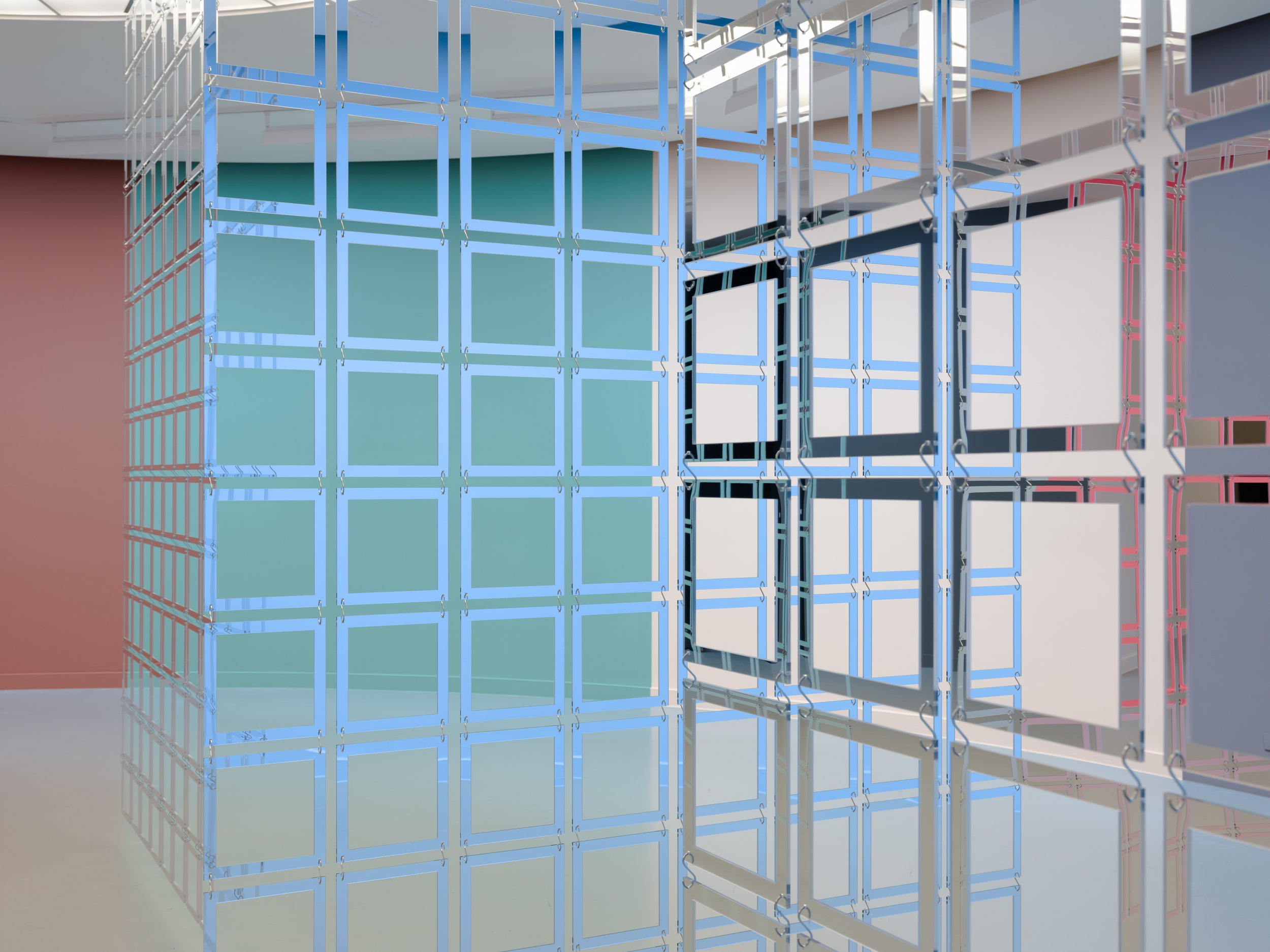
Arocha-Schraenen, Landscape (Antwerp), 2026. Mirrored plexiglass, stainless steel, and latex paint on wall. Overall dimensions variable. 6 panels; each approx. 382 x 200 cm. 20 Years and More: Works from the Collection, M HKA, January 24–May 24, 2026. Courtesy of the artists. Photo: Pieter Huybrechts.
INTERVIEW:
AMADOUR:
Where do I find you today?
CARLA AROCHA & STÉPHANE SCHRAENEN:
We are speaking from within the installation of an exhibition opening next Friday at ING’s headquarters in Brussels [Completed in 1965 and designed by Gordon Bunshaft of Skidmore, Owings & Merrill, the ING Marnix Building in Brussels is widely recognized as a modernist masterpiece and a significant example of postwar corporate architecture.]. The environment is dynamic, with people preparing the space, announcements in the background, and that distinctive atmosphere where an exhibition remains in process before it becomes public. Beginning our conversation here feels particularly appropriate.
AMADOUR:
I wanted to start with your recent publication, Monograph as Project. I love it. What struck me immediately is that it doesn’t feel like a conventional retrospective monograph; it feels total, almost all-encompassing. I was especially curious about your collaboration with Irma Boom. How was it like to collaborate with Boom on the book?
CARLA AROCHA:
Working with Irma was an extraordinary experience. From our first meeting, there was an immediate sense of familiarity. I was immediately struck by how attuned she was to our work, not only in terms of form but also in understanding our conceptual approach. As collaborators, we function as two individuals creating a unified practice, and she grasped this dynamic instinctively. This is central to the idea that one plus one equals three: two authors generate a third, emergent presence. The book’s design reflects this synthesis, appearing both inevitable and, in many ways, perfect.
STÉPHANE SCHRAENEN:
Before approaching her, we looked at many designers and many books. What drew us to Irma was her remarkable ability to make complexity appear simple without flattening it. We kept returning to projects she had done, books that dealt with layered systems, overlapping narratives, structures that could easily become overwhelming. That mattered to us because our work already contains multiple trajectories. There’s the question of collaboration itself: two people remaining distinct while producing one body of work. There are conceptual, formal, and historical lines. Irma seemed uniquely capable of addressing that complexity while making it feel seamless.
CARLA AROCHA:
Her books always feel completely attuned to their content. That was important to us. They never impose a style over the work.
STÉPHANE SCHRAENEN:
Exactly. If you look across her books, none of them resemble each other superficially. And yet after seeing enough of them, you immediately recognize an Irma Boom book. Most designers become identifiable through the repetition of style. With Irma, identity comes from something else—her ability to disappear into the logic of the material and allow the content to determine the form.
AMADOUR:
I love that. I'm curious, between the two of you, how many languages do you speak?
CARLA AROCHA:
Two.
STÉPHANE SCHRAENEN:
Three fluently. Two more that I understand and can speak a little.
So… six or seven between us.
AMADOUR:
I think one reason I’ve always loved geometric abstraction is that it feels like a universal language. Shapes move across cultures in ways language sometimes can’t. When you first began working together, what actually brought you together? Was it visual language? Conversation? Shared references? How did those things become one practice?
CARLA AROCHA:
All of it. There was visual language, of course, but there was also film, music, fashion, and ways of living. Those things matter more than people sometimes admit. And beyond formal language, there was always the concept. Because we use a formal vocabulary, yes, but form is never there for its own sake. There’s always something underneath holding it together. The concepts are really what sustain the structure. Very early on, it became obvious to both of us that whatever this was, it belonged to the future.
STÉPHANE SCHRAENEN:
And when you mention geometric abstraction being universal, I often think: if you can’t say it with a circle, a square, and a triangle, then why start drawing a tree? A tree is recognizable. But abstraction allows another kind of recognition. Of course, symbols and colors shift across cultures. Meaning changes. But there’s still something fundamentally open and shared inside those forms.
AMADOUR:
I wanted to ask both of you about this language you’ve built over time through architecture, perception, and ways of moving through space. I’m curious where that instinct originally came from. Was there a beginning point? Were you always looking at buildings, paying attention to infrastructure, interested in technological systems? Or was there some moment where everything suddenly aligned and became the trajectory that your work has followed since?
CARLA AROCHA:
As I get older, I feel less and less attached to the idea of a single decisive moment. I think everybody is born with some kind of intuition and, whether consciously or unconsciously, that intuition guides you throughout life. Of course, intuition alone is not enough. You have to feed it. You cannot simply continue forever believing instinct will carry everything; you have to look, study, experience things, become curious, and build a relationship with the world around you. But I do think that language develops gradually. It matures. It finds itself over time. Looking back now, I don’t think there was an “aha” moment where suddenly everything appeared. It feels much more like a continuous unfolding, where certain interests become clearer and certain ways of seeing become more articulate. The language starts to reveal itself to you little by little, until you eventually realize that what you thought was a direction was actually something that had always been there.
STÉPHANE SCHRAENEN:
Architecture is one of the things that surrounds us most intimately. Maybe even more than art and, in our case, sometimes more than nature, simply because we are city people. We are city dwellers. That relationship to constructed space becomes inseparable from how we think. One thing that also feels important here is the moving image. Because for me, walking through a city is already cinematic. You are constantly editing. It’s one long traveling shot. You look upward, then downward. You pass through a doorway; a car cuts across your vision; reflections interrupt one another; windows reveal fragments of interior life. There is a constant sequencing of experience. And when you enter a gallery or museum, that doesn’t disappear. You’re still moving through a constructed environment. That’s why I don’t think about artworks as isolated objects. The space around them matters almost as much as the works themselves. The distances between pieces, the pathways, the pauses, the moments of compression and release—they all become part of the work because the viewer is not static. The viewer is roaming. So when we make exhibitions, we cannot abstract ourselves from the space we are addressing.

Former Banque Lambert headquarters, Brussels. Functionalist architecture by Gordon Bunshaft, 1956–1960. Public Domain.

Carla Arocha & Stéphane Schraenen, Untitled (Chair Type I), 2024. Stainless steel, 49.5 × 88 × 49.5 cm. Segue, The Marnix Gallery, June 12–October 30, 2026. Courtesy of the artists. Photo: Hugard & Vanoverschelde.

Carla Arocha & Stéphane Schraenen, Window Set (1), 2022. Mirror and aluminum, 3 panels, various sizes; overall approximately 190 × 150 × 25 cm; Window Set (2), 2022. Mirror and aluminum, 5 panels, various sizes; overall approximately 200 × 340 × 25 cm; Window Set (3), 2022. Mirror and aluminum, 2 panels, various sizes; overall approximately 150 × 145 × 25 cm. Segue, The Marnix Gallery, June 12–October 30, 2026. Courtesy of the artists. Photo: Hugard & Vanoverschelde.
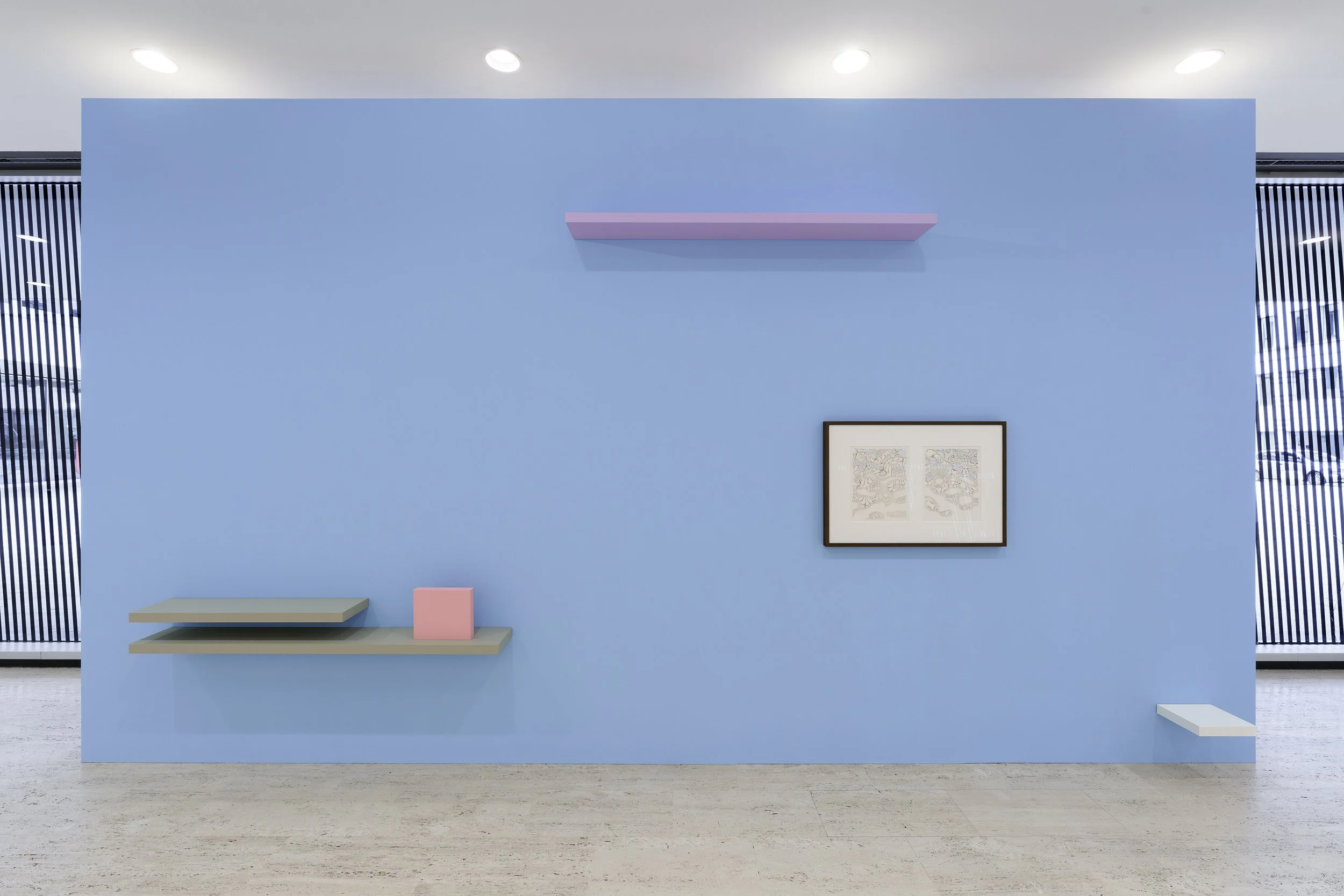
Carla Arocha & Stéphane Schraenen, Marnix (img_21–img_45), 2026. Colored pencil on paper, each 39 × 30 cm. Segue, The Marnix Gallery, June 12–October 30, 2026. Courtesy of the artists. Photo: Hugard & Vanoverschelde.

Carla Arocha & Stéphane Schraenen, Floop, 2022. Nitrile rubber, diameter 80 cm. Edition of 9 + 2 artist's proofs (#2/9). Segue, The Marnix Gallery, June 12–October 30, 2026. Courtesy of the artists. Photo: Hugard & Vanoverschelde.
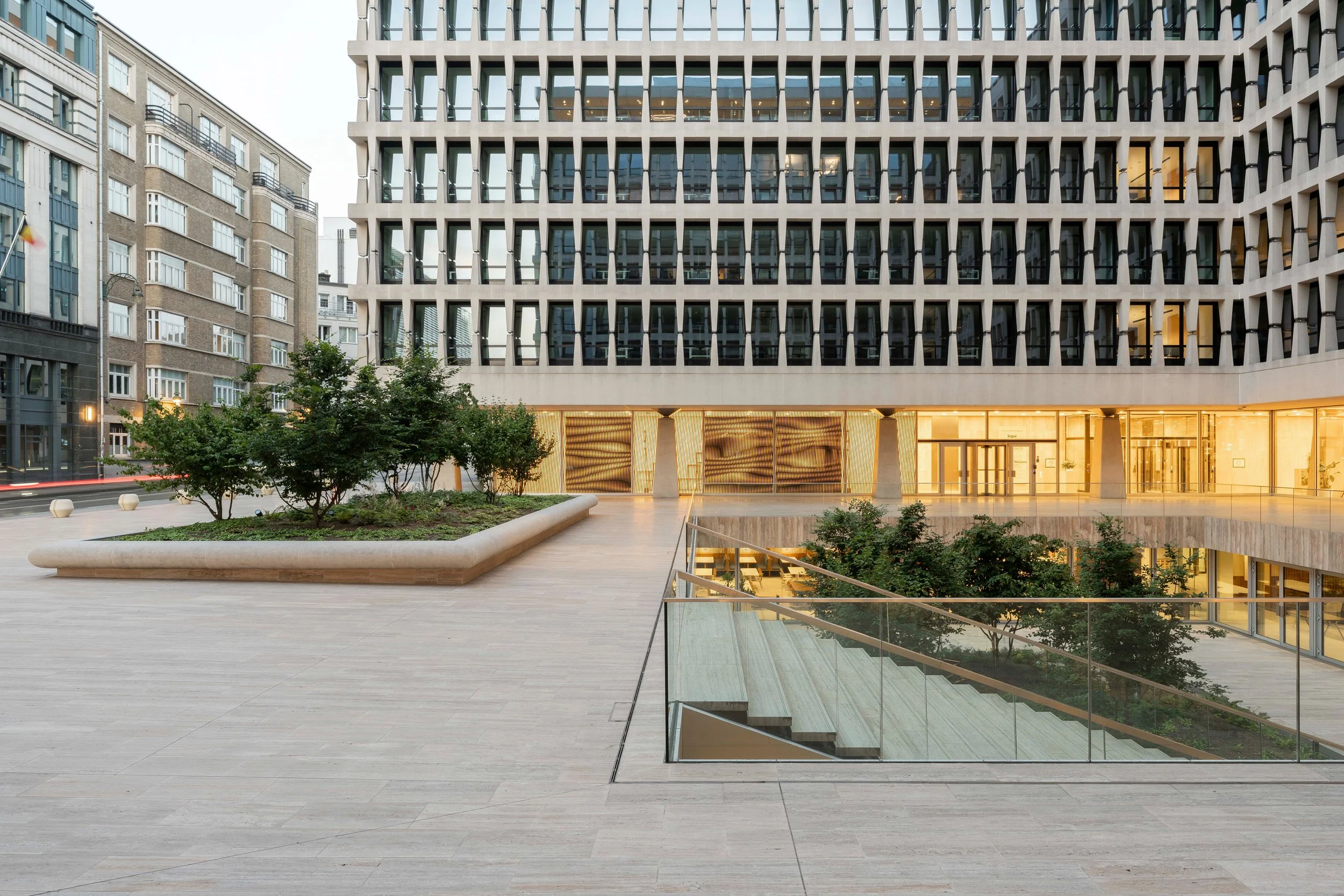
Exterior shot, Segue, The Marnix Gallery, June 12–October 30, 2026. Courtesy of the artists. Photo: Hugard & Vanoverschelde.

Carla Arocha & Stéphane Schraenen, Untitled (Chair Type I), 2024. Stainless steel, 49.5 × 88 × 49.5 cm. Segue, The Marnix Gallery, June 12–October 30, 2026. Courtesy of the artists. Photo: Hugard & Vanoverschelde.
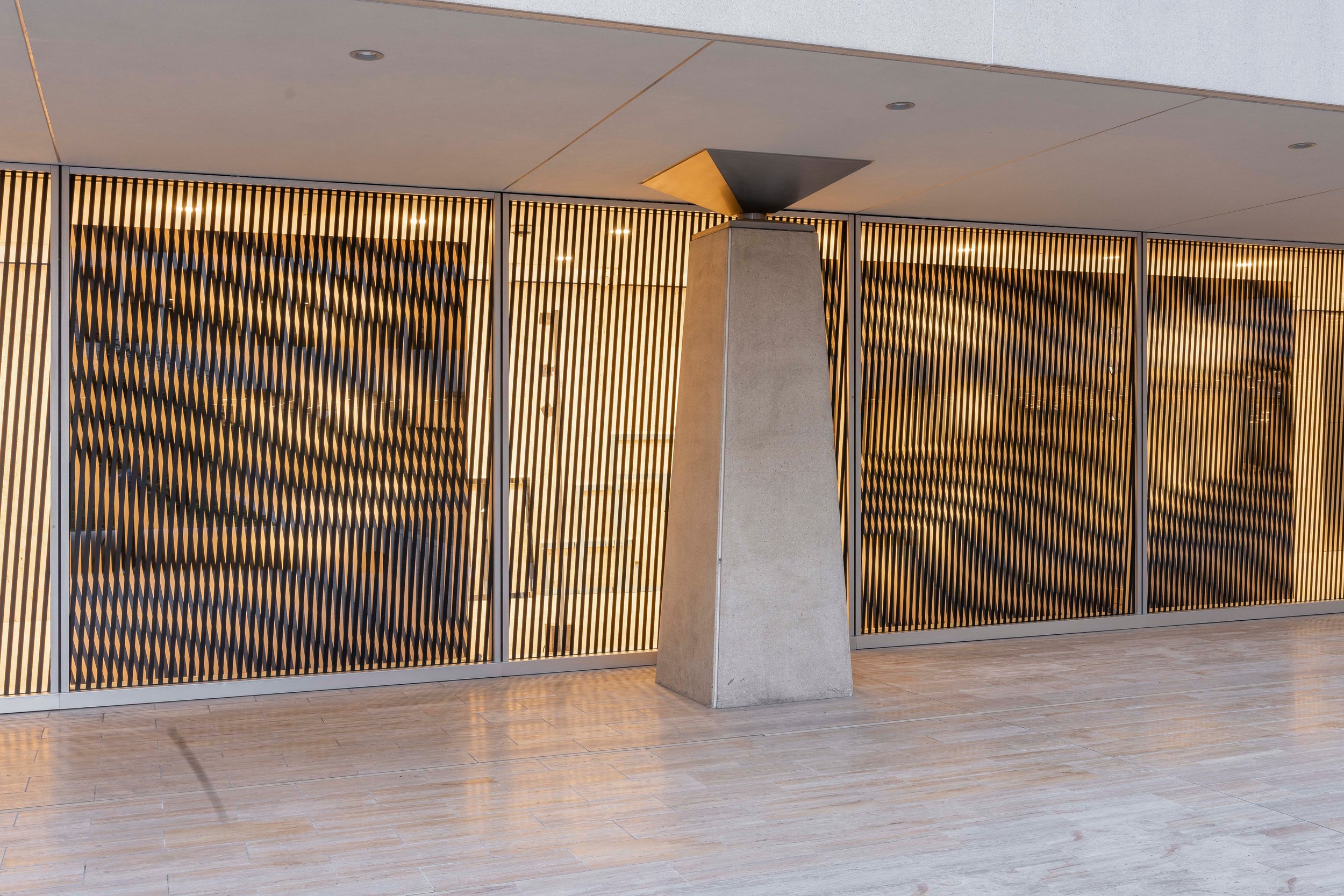
Carla Arocha & Stéphane Schraenen, Segue, 2026. Self-adhesive vinyl cutout on windows and walls. Window approximately 380 × 1950 cm; two walls, 370 × 327 × 40 cm and 370 × 654 × 40 cm. Segue, The Marnix Gallery, June 12–October 30, 2026. Courtesy of the artists. Photo: Hugard & Vanoverschelde.
CARLA AROCHA:
Your attention already says something about you before you even realize it. For example, there are things that I simply wouldn’t notice. I probably wouldn’t become fascinated by an ashtray or some incidental object sitting in a room. But windows—I love windows. They drive me crazy. I always notice them. You begin to ask yourself why certain things keep drawing your attention, while others fade into the background. Then slowly you realize those attractions are telling you something. Cities become like layered cakes, histories built on top of histories. Coming from Venezuela, that relationship feels very natural to me because I grew up in a profoundly modernist environment. Caracas erased so much of what came before it. Colonial and pre-colonial identities, entire histories, were overwritten by modernization. So for me, this environment of layers and construction became my natural habitat. Then later, Chicago entered that equation too. But I think what remains constant is becoming interested in how places accumulate meaning.
STÉPHANE SCHRAENEN:
When we install exhibitions, there is something we always do. We walk all the way back to the entrance, then turn around and look. That first image matters enormously to us because it becomes the master shot. It’s the first experience a viewer will have before interpretation begins, before movement starts, before meaning accumulates. Everything else can adapt later, but that initial encounter establishes the emotional and conceptual condition for everything that follows. There is a kind of directness in that first moment that cannot really be replaced once it has happened.
CARLA AROCHA:
And sometimes that first view also helps you understand your own work. You suddenly realize what you’ve actually made. You see relationships that weren’t entirely visible while producing the work itself, and the installation becomes another stage of understanding.
STÉPHANE SCHRAENEN:
Ultimately, it becomes a question of language. What connects us is that we’ve developed a shared toolbox, almost a grammar. You build a sentence, then a paragraph, then a chapter, then a book. Exhibitions function in very much the same way. There’s a vocabulary, a structure, a way of constructing meaning through sequence and relationships. After enough years working together, you begin to know where punctuation belongs. You know where a period should go, where a question mark should remain open, and where emphasis should appear. Some exhibitions become almost essayistic in that sense. They operate through accumulation and structure rather than through singular statements.
CARLA AROCHA:
It’s difficult to explain because, after a certain point, it doesn’t feel like methodology. It doesn’t feeling like a strategy or a process and instead becomes something much closer to life itself. It becomes a way of moving through the world.
STÉPHANE SCHRAENEN:
And that also shapes how we work. We rarely sit in the studio producing isolated objects and then later assembling them into an exhibition. Usually, the process begins the other way around. An opportunity appears, a space appears, a context presents itself, and from there we begin thinking. The exhibition becomes a kind of thinking machine, a structure that generates relationships between works rather than simply containing them. Individual pieces may eventually leave and exist independently, but in the beginning, they belong to a larger system, a larger surrounding. That’s why we keep returning to this idea that one plus one equals three, that the whole becomes larger than the sum of its parts.
AMADOUR:
I also wanted to talk about your exhibition, 20 Years and More at M HKA, and, of course, return to Landscape Antwerp (2026), because when I think about your collaborative practice, that work is one of the first images that comes to mind. Going further back, though, one piece that personally struck me was Persiana (2014) [persiana translates to “blinds” or “window blinds” in Spanish], especially for its architectural qualities, its lines, and the way it made me think about broader histories of geometric abstraction across Europe, South America, North America, and beyond. I’d love to hear more about what this exhibition meant to both of you and whether either of these works feels especially resonant to elaborate on.
STÉPHANE SCHRAENEN:
Well, the funny thing is that we can actually see Persiana behind you right now. That’s the image. That’s the silkscreen we made based on that work. Which somehow feels appropriate because one of the things that interests us about the piece is precisely that uncertainty; it’s never entirely clear whether you are inside or outside.
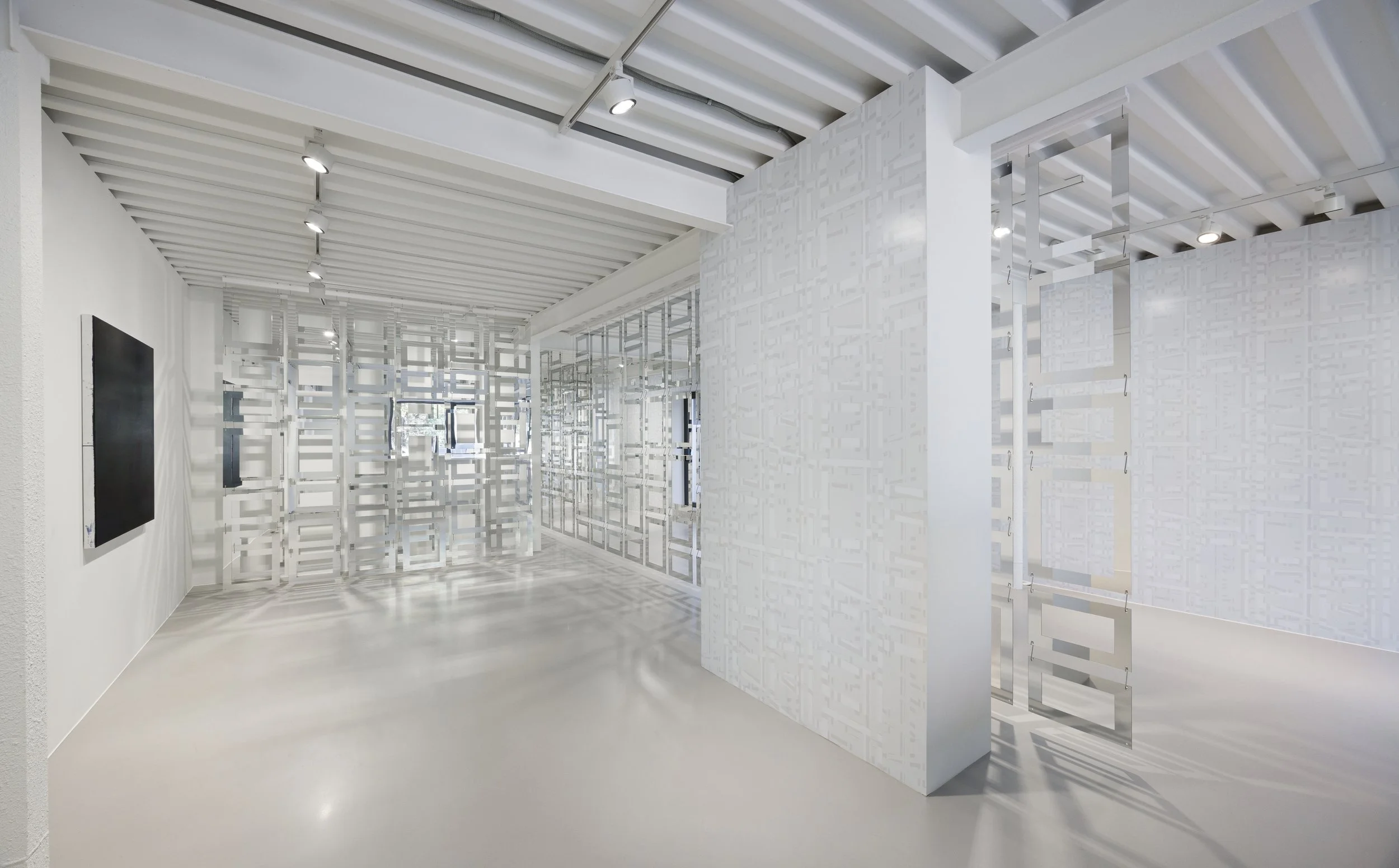
Carla Arocha & Stéphane Schraenen, Target, 2012. Acrylic on canvas, 120 × 120 cm (47 1/4 × 47 1/4 in); Shadows Know, 2025. Wallpaper, dimensions variable; Wasp Nest, 2024. Two-way mirrored Plexiglas and stainless steel, overall dimensions variable. Shadows Know, Jason Haam New Gallery, November 15, 2025–January 31, 2026. Courtesy of the artists. Photo: Jason Haam.

Carla Arocha & Stéphane Schraenen, Wasp Nest, 2024. Two-way mirrored Plexiglas and stainless steel, overall dimensions variable. Shadows Know, Jason Haam New Gallery, November 15, 2025–January 31, 2026. Courtesy of the artists. Photo: Jason Haam.

Carla Arocha & Stéphane Schraenen, Wasp Nest, 2024. Two-way mirrored Plexiglas and stainless steel, overall dimensions variable. Shadows Know, Jason Haam New Gallery, November 15, 2025–January 31, 2026. Courtesy of the artists. Photo: Jason Haam.
AMADOUR:
That’s amazing. I’m actually at my stepfather’s office in Reno right now.
CARLA AROCHA:
But I think that uncertainty is exactly the point. There’s always a speculative aspect in the work. You wonder what’s happening, but there is never a final solution, and there is never a complete answer waiting for you. Ideally, the work is completed by the viewer. With windows, especially, there is always something speculative because a window is both access and separation. A persiana creates a strange condition in which you are visually invited into a space while simultaneously being held outside it. You can see through the window or you cannot. You can imagine what exists beyond it or remain uncertain. And the same thing happens in reverse because someone could also be looking outward from the other side. That creates a space that is inherently speculative because wherever you stand, you never entirely know what is happening elsewhere. For me, abstraction works in a similar way. Abstract language doesn’t resolve questions. It presents something and leaves you with it. You have to enter into it somehow. And personally, abstraction is simply what I love looking at most. If I had to choose across the entire spectrum available to us, I would choose abstraction. I choose hard edge. To me, that language is extremely attractive. It’s incredibly sexy.
STÉPHANE SCHRAENEN:
But at the same time, it’s also representational, even if not directly. Often, the titles become a clue. They provide an opening into understanding how representational the abstraction might actually be. That happens with the landscape pieces as well. In Landscape Antwerp, unlike Persiana, the work isn’t operating like a window but more like an urban view. For both Landscape Antwerp and Landscape Guadalajara (2015), we began with something very ordinary: a stock image. In the case of Antwerp, we used an aerial image of the city and extracted eight color pixels from it. Those colors became the surrounding fields around the work. Then we introduced mirrored structures into that environment—architectural and urban elements positioned within the larger field. The result is that the image begins to break apart and reconstruct itself. The city becomes repixelated. It gets scrambled and rebuilt into something almost pointillistic, almost pixelistic. The landscape is still present, but it becomes impossible to fully recover.
CARLA AROCHA:
And that’s important because it becomes another abstraction, but one that never stays fixed. As you move through the work, the image keeps changing. It becomes cinematic. It never actually gives you a landscape. But the landscape still emerges because the moment you read the word "landscape," your mind begins to construct one. No two people see exactly the same work. Depending on where someone stands, how tall they are, what colors dominate their field of vision, they might suddenly experience more brick and feel a stronger sense of the city, or more green and begin reading the landscape as park space, or more sky and feel themselves pulled upward. So the work becomes an editing machine. It continuously edits this idea of Antwerp.
STÉPHANE SCHRAENEN:
There was another layer to that work as well because the museum itself was in a moment of political uncertainty. There were discussions about restructuring it, transforming it, and even questions about whether it should continue in its current form. So we decided to donate the piece and deliberately call it Landscape Antwerp. We wanted to anchor it. Not simply make a generic landscape, but make something materially tied to that place. The colors came from Antwerp. The title came from Antwerp. The work became attached to that institution. That idea of anchoring appears often in our practice. Sometimes works include coordinates or references to the places where they were first shown. Many of our works don’t really have traditional titles, but rather subtitles that function almost like GPS markers. They allow works to carry memory with them.
CARLA AROCHA:
Because memory matters. And in this case, it was also a statement. There were conversations about moving the museum collection elsewhere and disconnecting it from their institutional histories, and we said no. This piece stays. I don’t believe the museum disappears—I think institutions transform—but this work belongs there. It isn’t permanently installed, but it belongs to that place. That mattered to us.
AMADOUR:
I love that. I’ve been to Antwerp once or twice, but on one visit, I really took my time there. What stayed with me wasn’t even one specific artwork but the city itself—the colors, the atmosphere, the history. And what I remember most vividly was arriving through the train station because it feels so dramatic that immediately you understand you’ve entered a place with a very particular sense of itself. And then you walk out of the station, and suddenly the city opens. The plaza blends this monumental historical atmosphere with modern architecture, yet it still retains a richness and soul that feel very particular to Antwerp. I think I see that in your work too. I also wanted to ask more about Chicago because when I think about your structures, I think about those bold forms rising upward and these moments of negative space. And I became curious about the process as well. Once the conceptual thinking exists, how does the work actually begin? Are you sketching on paper? Drawing digitally? How does an exhibition move from an idea into visual form?
CARLA AROCHA:
First comes struggle. But really, the beginning is always conceptual. The first question is never what something should look like. The first question is always what the exhibition is actually about and what we are trying to pursue through it. There is a conceptual phase in which everything remains unresolved, and we begin testing possibilities and directions before anything becomes material. That stage takes time because we need to understand the internal logic before we begin giving it form.
STÉPHANE SCHRAENEN:
Then gradually the practical side begins to appear because of the way we produce work. Technical drawings become necessary quite early. Plexiglass has to be laser cut. Steel has to be welded and fabricated. Different elements often move through different workshops and production processes. Even though the finished works may appear continuous, they are usually built in modular systems that can expand horizontally or vertically depending on the site. So the process moves through several stages. We draw. We sketch shapes. We print photographs of the exhibition space and work directly onto those images. Eventually, those ideas move into SketchUp because we want to understand how something behaves in architecture before it exists physically. It isn’t really about technology for its own sake—it’s about scale, proportion, movement, and understanding how a gesture changes once it occupies space.
CARLA AROCHA:
But I also think your question about Chicago is really a question about travel. We’ve traveled together a great deal, and I think places eventually enter the work whether you consciously intend them to or not. What you see changes what you make. It happens through osmosis. Sometimes I imagine that if I had spent my entire life in one neighborhood and never left, maybe the work would look completely different. Maybe the visual language would have stayed smaller or more enclosed. But once you begin traveling and paying attention to architecture, especially, you realize how deeply environments shape perception. Chicago architecture is extraordinary. Caracas also had remarkable buildings. Those experiences remain with you.
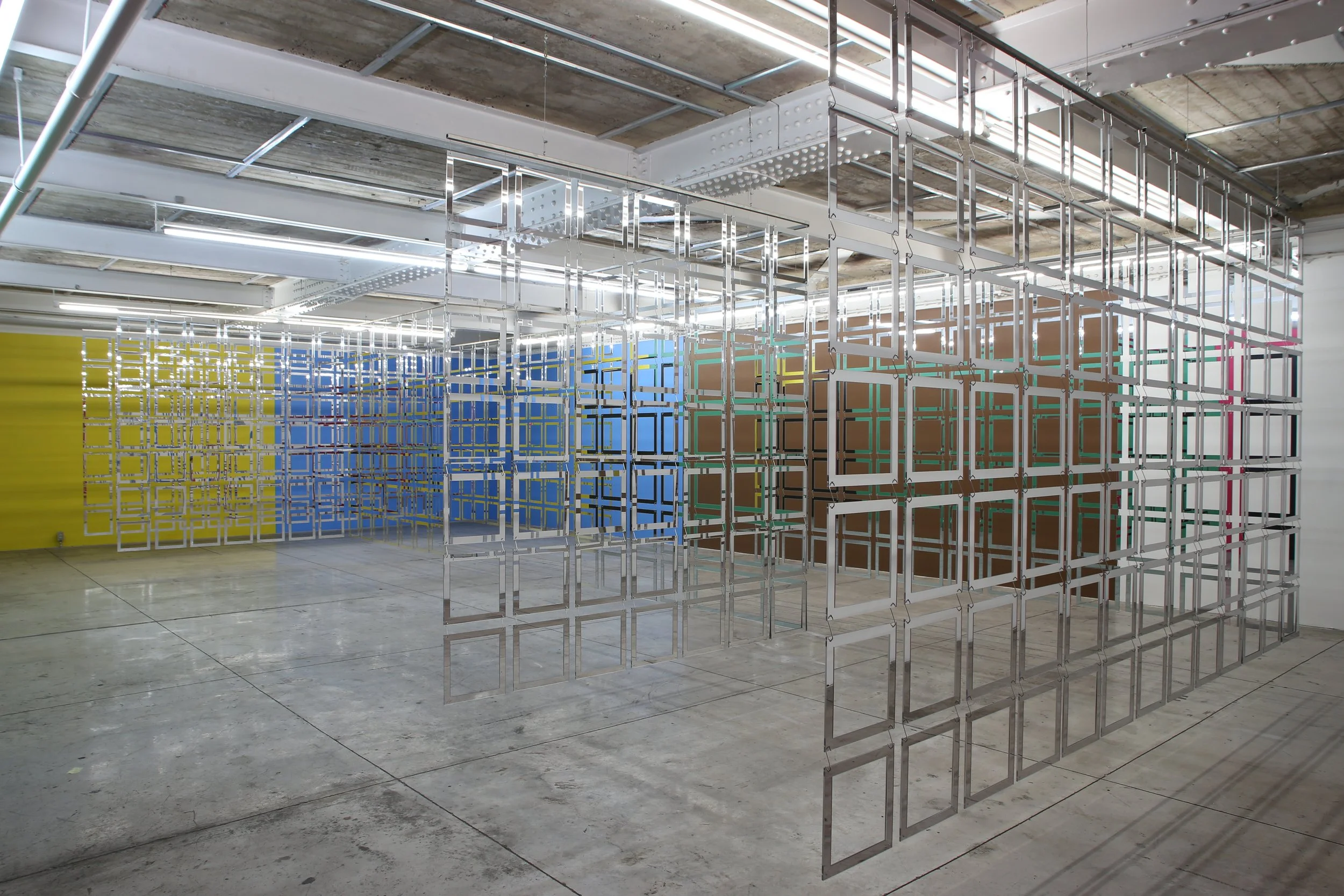
Carla Arocha & Stéphane Schraenen, Landscape (Mexico), 2015. Mirrored Plexiglas, S-hooks, and acrylic paint, twelve panels, overall 300 × 1500 × 920 cm. Landscape, Sala Juárez – Laboratorio de Artes Variedades, Guadalajara, 2015. Private collection, Guadalajara. Photo: Ricardo Guzmán.
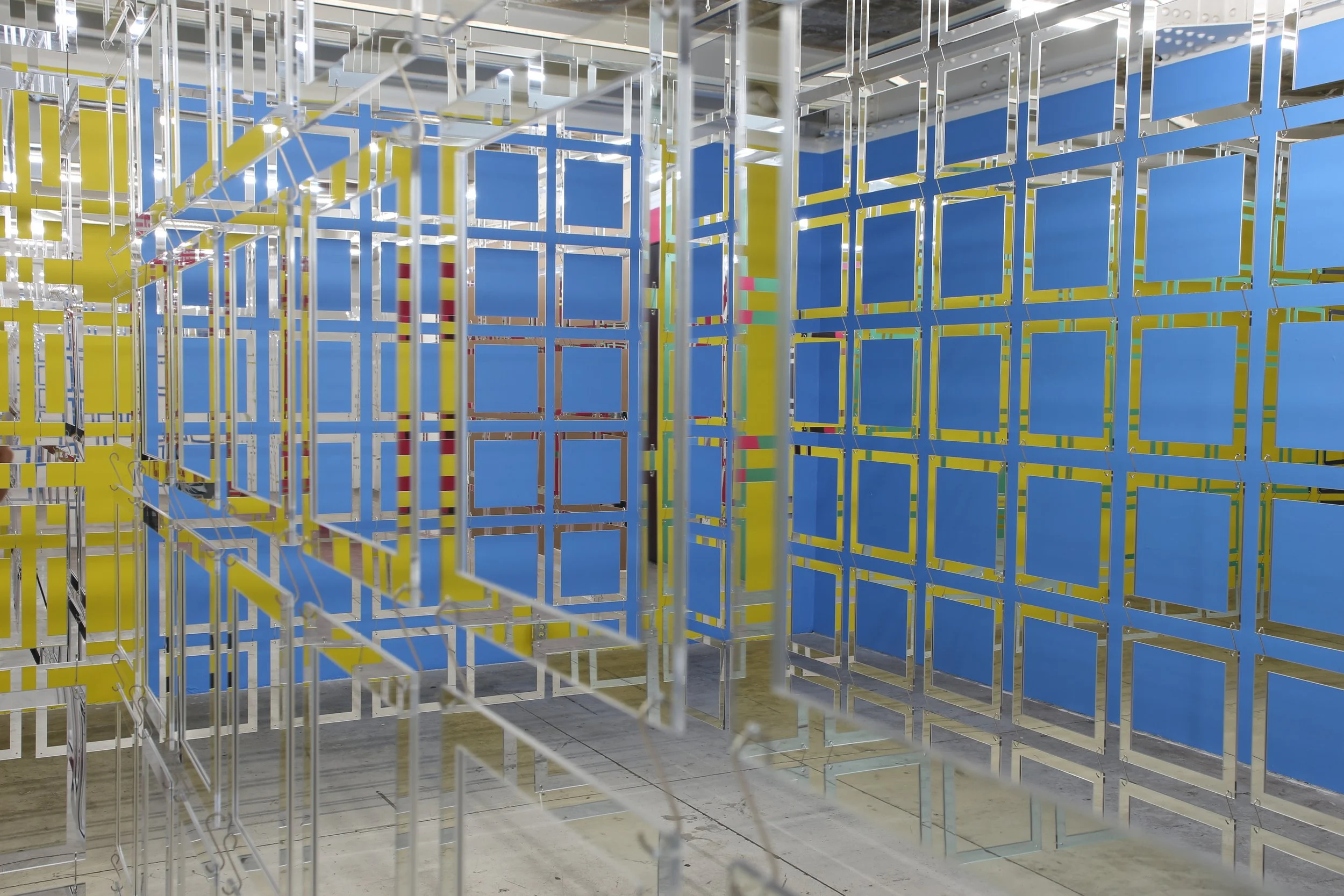
Carla Arocha & Stéphane Schraenen, Landscape (Mexico), 2015. Mirrored Plexiglas, S-hooks, and acrylic paint, twelve panels, overall 300 × 1500 × 920 cm. Landscape, Sala Juárez – Laboratorio de Artes Variedades, Guadalajara, 2015. Private collection, Guadalajara. Photo: Ricardo Guzmán.
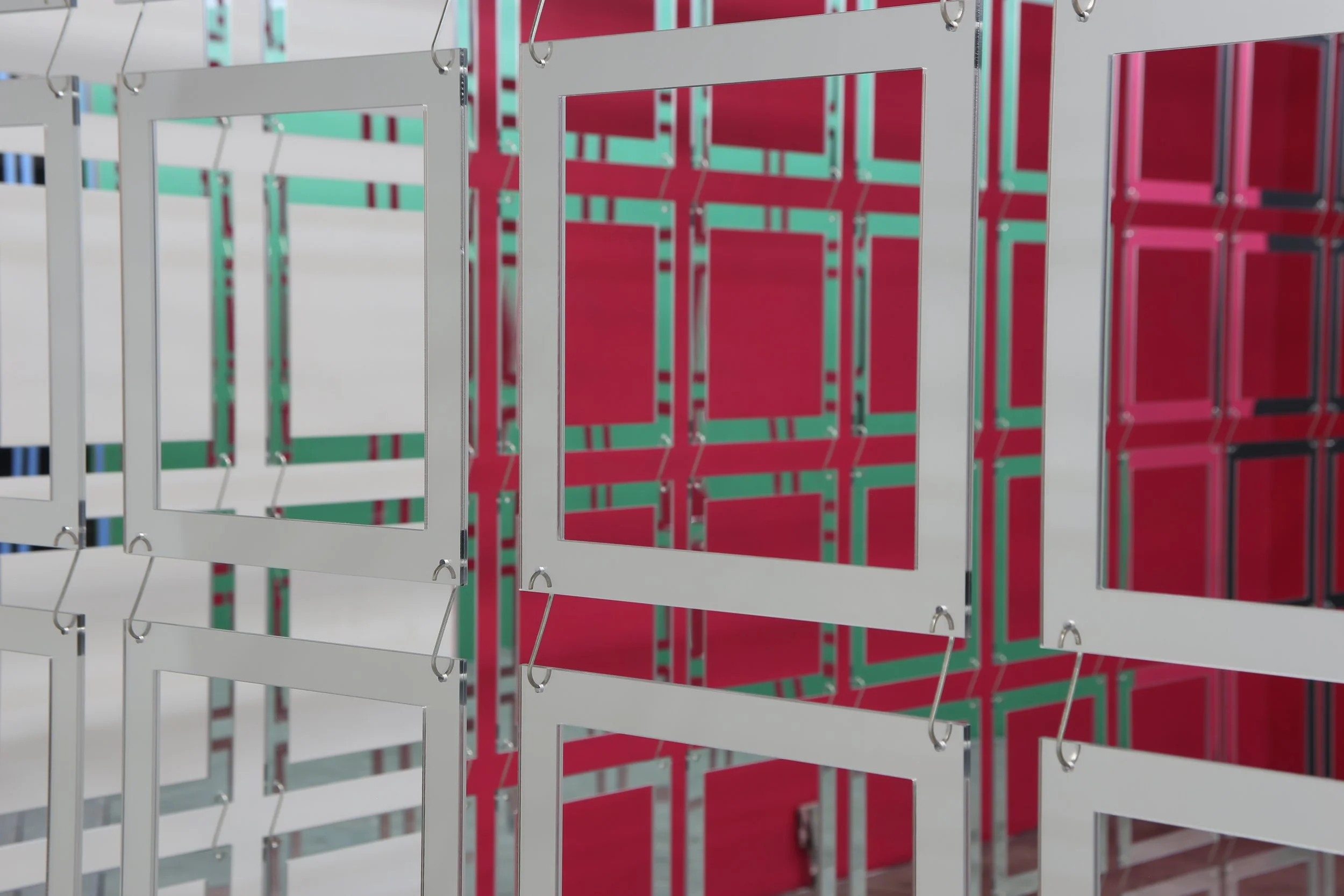
Carla Arocha & Stéphane Schraenen, Landscape (Mexico), 2015. Mirrored Plexiglas, S-hooks, and acrylic paint, twelve panels, overall 300 × 1500 × 920 cm. Landscape, Sala Juárez – Laboratorio de Artes Variedades, Guadalajara, 2015. Private collection, Guadalajara. Photo: Ricardo Guzmán.
AMADOUR:
Which buildings specifically?
CARLA AROCHA:
In Caracas, there was a building called Previsora, which belonged to an insurance company and was built in the 1970s [located in Caracas’s Plaza Venezuela district, completed in 1973 and best known for its distinctive pyramidal silhouette and illuminated clock, serving as the headquarters of Seguros La Previsora]. I remember being a child, seeing it appear, and thinking it was remarkable. Then there was another building we called the Black Cube [Centro Banaven is one of Caracas’s most iconic modernist landmarks, distinguished by its reflective façade, stepped geometric form, and the integration of artist Jesus Rafael Soto’s Volumen Virtual Suspendido(Suspended Virtual Volume) (1979), within its central atrium]. It was entirely black glass, perfectly cubic, and inside it was a shopping mall. What fascinated me was the disconnect between exterior and interior. From the outside, it looked monumental, futuristic, almost impossible. Inside, it was completely ordinary. There was no relationship between what the building promised and what the experience actually was.
You never had the sensation, from being inside, of understanding what the outside looked like. That difference between appearance and experience stayed with me, and I think those kinds of perceptions remain somewhere in the work.
AMADOUR:
How about for you, Stéphane? You’re moving through so many different places and contexts all the time. Looking at your exhibitions now, they’re crossing Antwerp, Brussels, Paris, Munich, Chicago, and beyond. I’m curious how you think about audiences across those different geographies because earlier you mentioned walking into a space and thinking about that first image—that master shot. How do you think about reception? How does context shape the work once it leaves you?
STÉPHANE SCHRAENEN:
I think for me it has less to do with geography itself and more to do with people. Without sounding overly grand, I think the same work can manifest in completely different ways depending on where and when it appears. A piece shown in Antwerp might be read entirely differently if it appeared in Caracas ten years ago, or in Munich today, or in Chicago tomorrow. Social conditions change, economic realities shift, and political circumstances reshape perception. The work itself may remain structurally the same and maintain its autonomy, but the reading changes because the questions people bring to it change. What interests me is not telling people what to think or positioning the work as moral instruction. We’re not interested in pointing fingers or creating a correct interpretation. What interests me more is creating situations where people begin to question their own assumptions, their own habits of looking, and their own set of beliefs. It was seeing someone look differently at the corners of the room afterward. For me, the moment the work changes how someone perceives the world around them—even slightly—it has already succeeded.
CARLA AROCHA:
And honestly, I don’t think there’s anything pompous about that. I actually think it’s a very humble position because it rests on the belief that people are fundamentally the same. We’re human, and that’s the beginning. It doesn’t matter what part of the world someone comes from, what language they speak, or what context they arrive from. I have a great deal of trust in people. I would never begin from a position of underestimating an audience or assuming that one group needs something fundamentally different than another. That also doesn’t mean overestimating people; it simply means trusting that everyone will receive something. Maybe not the same thing and maybe not everything, but something. For me, the responsibility is simply to make the work and offer it. Whatever happens afterward belongs partly to the person encountering it. Because of that, I would never approach one population differently from another or make work differently depending on where it is shown. The work exists, people meet it, and then something happens in that encounter.
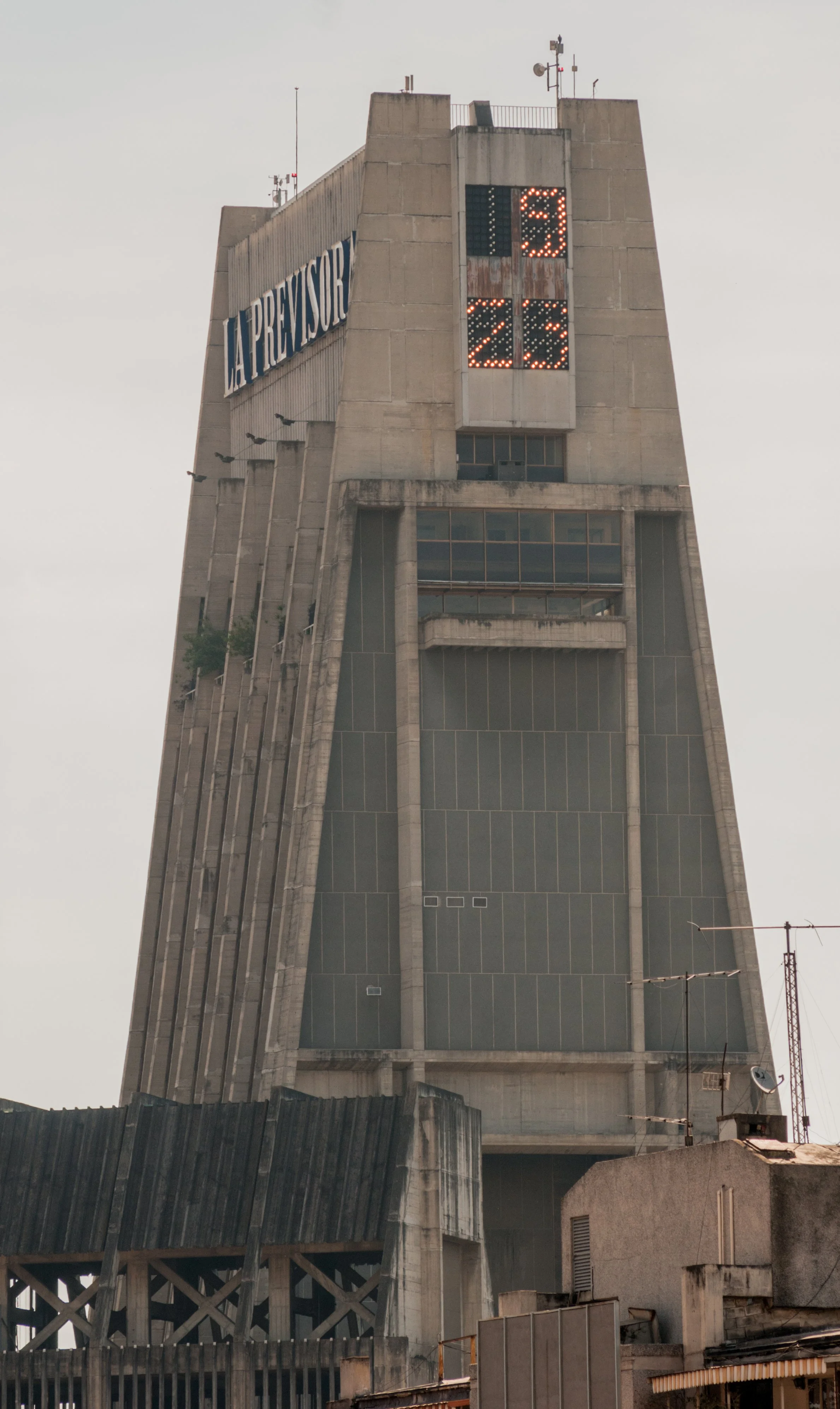
Torre La Previsora (now Torre Seguros Mercantil), Caracas, Venezuela, completed 1973. Photograph by Wilfredor. Public Domain.
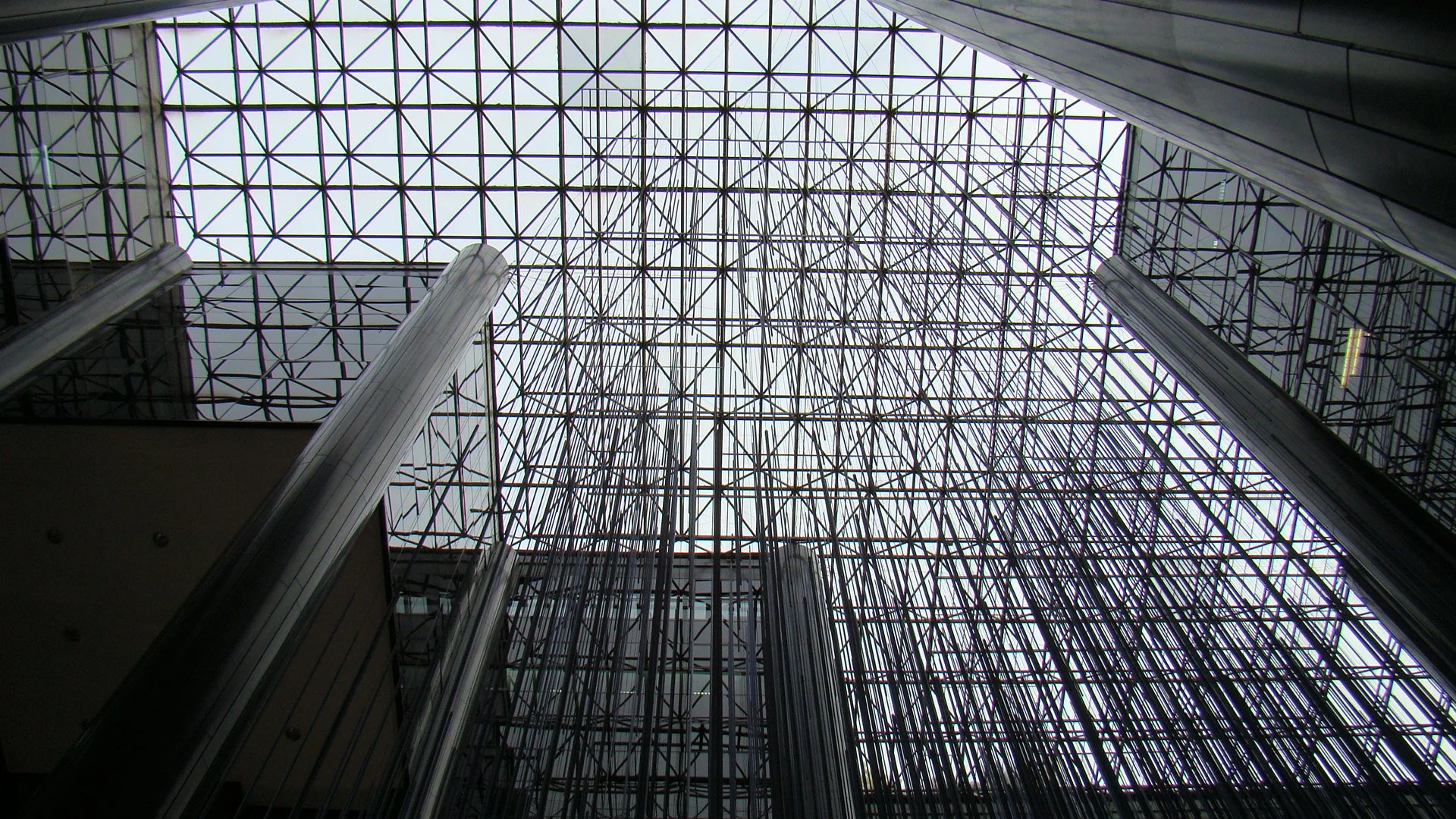
Cinestismo (interior view), internal courtyard of Cubo Negro, Caracas, Venezuela. Photograph by Samuelistok. CC BY-SA 3.0. Public Domain.
AMADOUR:
And then moving to Spinning Rumours Ópalo, I kept thinking about the title itself because it suggests circulation, transformation, instability, movement, and the ways ideas shift as they pass through people and places.
CARLA AROCHA:
For me, it was exciting since we were showing works we had never shown before, and uncertain at the same time, as it always is the case when showing something new. The exhibition left us very happy and looking forward to the future ones.
AMADOUR:
Going back to what we were discussing earlier around institutions and the museum, I became curious about your everyday relationship to Antwerp itself. Walking through the city now, what feels most changed? What has surprised you this year?
CARLA AROCHA:
I think the most shocking thing has been the situation with the M HKA. It became political very suddenly, and it felt like something exploded overnight. Around last October, it arrived almost like an atomic bomb. [In late 2025, the Flemish government proposed stripping Antwerp’s M HKA (Museum of Contemporary Art Antwerp) of its national museum status, canceling plans for a new €130 million building, and relocating its 8,000-work collection to S.M.A.K. in Ghent as part of broader structural reforms introduced by Culture Minister Caroline Gennez. The decision sparked immediate backlash from artists, museum professionals, and advocacy groups, who condemned the move as institutional dismantling; protests included a 24-hour occupation of the museum, while legal reviews challenged the proposal’s legitimacy. Following sustained local and international pressure, the government ultimately reversed course, allowing M HKA to retain its status as a collecting and heritage institution and announcing a new framework, “M HKA 2.0,” intended to strengthen collaboration across the Flemish museum landscape.]
STÉPHANE SCHRAENEN:
The strange thing is that until very recently, the expectation had been completely different. There were plans to break ground on a new building, and then suddenly everything changed. Suddenly, there was no new building. Then there was a discussion of no museum. Then discussions about losing museum status and moving collections elsewhere. For us, for Luc [Tuymans], for many people around us, it became something very significant because we’re talking about the first museum of contemporary art in Belgium. Something that felt rooted suddenly felt uprooted.
CARLA AROCHA:
That has probably been the most dramatic change I’ve felt in Antwerp recently. But there are also these daily changes that somehow feel connected to the same atmosphere.
STÉPHANE SCHRAENEN:
On a very everyday level, the city constantly feels under construction. Roads are opened and closed endlessly. Every few days, something changes. Streets disappear and reappear. You never know whether a major road will suddenly become inaccessible again tomorrow. Of course, we’re joking a little when we talk about concrete politics, corruption, and all of that, but there is also a real feeling underneath it that decisions happen elsewhere and then suddenly appear in daily life. And for us, it feels connected to the same uncertainty surrounding the museum. Funding appears, disappears, shifts direction, priorities change, plans are announced and withdrawn. It becomes this continuous negotiation between different political interests.
CARLA AROCHA:
We don’t know all the details, and we’re not pretending to. But emotionally, it feels ugly, and maybe that’s the difficult part. Change itself isn’t the problem. Things should change. Cities change, institutions change, people change—that part feels normal and even necessary. But there’s a difference between transformation and destruction. Transformation can create something new. Destruction feels different. I think that’s why people reacted emotionally to it. It isn’t really about resisting change; it’s about feeling that something meaningful could disappear before understanding what comes next.
AMADOUR:
Yeah. It almost feels like a civic trauma.
CARLA AROCHA:
Yes, that feels close to what it is. Not because everything should remain the same forever, but because places carry memory and people build relationships with institutions over time. When those relationships suddenly become unstable, something larger than architecture is affected. At that point, the call timed out, and we started quickly figuring out how to continue the conversation, exchanging links, introducing ourselves to people entering the room, and promising to pick everything back up a few minutes later.
STÉPHANE SCHRAENEN:
Mirrors are often a kind of lure for us. They become a way to extend a hook and draw people toward the work. Of course, we’re also aware that not everyone is necessarily attracted to a mirror, but there’s something almost automatic that happens when people encounter one. You assume you’re going to receive yourself back. You expect recognition. But often that isn’t what happens. Instead of seeing yourself returned intact, you encounter yourself fragmented, dismembered, broken into sections. That very straightforward narcissistic expectation becomes interrupted or deflated. For some people, it can even feel unsettling to see themselves visually cut apart rather than coherently reflected back. That movement between attraction and rejection interests us. At the same time, mirrors never only reflect the viewer. They reflect the space as well. You begin seeing architecture differently through fragmentation. One example where this becomes especially visible is the large circular work “Mechelen Marauder" at the KMSKA (Royal Museum of Fine Arts in Antwerp). It stretches through the space and reflects the surrounding world, but the reflection itself becomes fractured. Everything around you remains present, and in some strange way, the work feels completely integrated into the architecture as though it had always belonged there, yet simultaneously, the image is broken apart. So what appears is almost a kaleidoscope, a fragmentation not only of the reflected world but of the space itself.
CARLA AROCHA:
And sometimes that fragmentation creates the opposite effect. It can unify. The piece at the twelfth edition of KMSKA worked like that for us because while everything was visually fragmenting, it was also becoming connected through reflection. Placement changes everything. When these fragmented mirror works enter a white cube, the experience can become surprisingly intense because suddenly you encounter yourself in pieces. Seeing your own body broken into different reflections can feel unfamiliar and disorienting. But after that first moment, something shifts. People stop looking only at themselves and become more aware of their surroundings. They begin to notice what the reflections are doing to the architecture, how they interact with neighboring works, and whether those works are ours or someone else’s in a group exhibition. All of those relationships become entangled. What’s also fascinating is watching people activate the work together. Their reflections overlap with those of people moving behind the work, and suddenly the boundaries between self and other begin to dissolve. You see your image merge with someone else’s movement, and there’s this brief instability where identities seem to overlap. Psychologically, I think that reflects something very ordinary. Most people are already doing more than one thing at once. We’re constantly divided between places, roles, thoughts, and attention. So maybe people recognize something familiar in that fragmentation. Some viewers seem genuinely surprised to see themselves mixed with others, because it creates a strange sensation of disembodiment and relation at the same time.
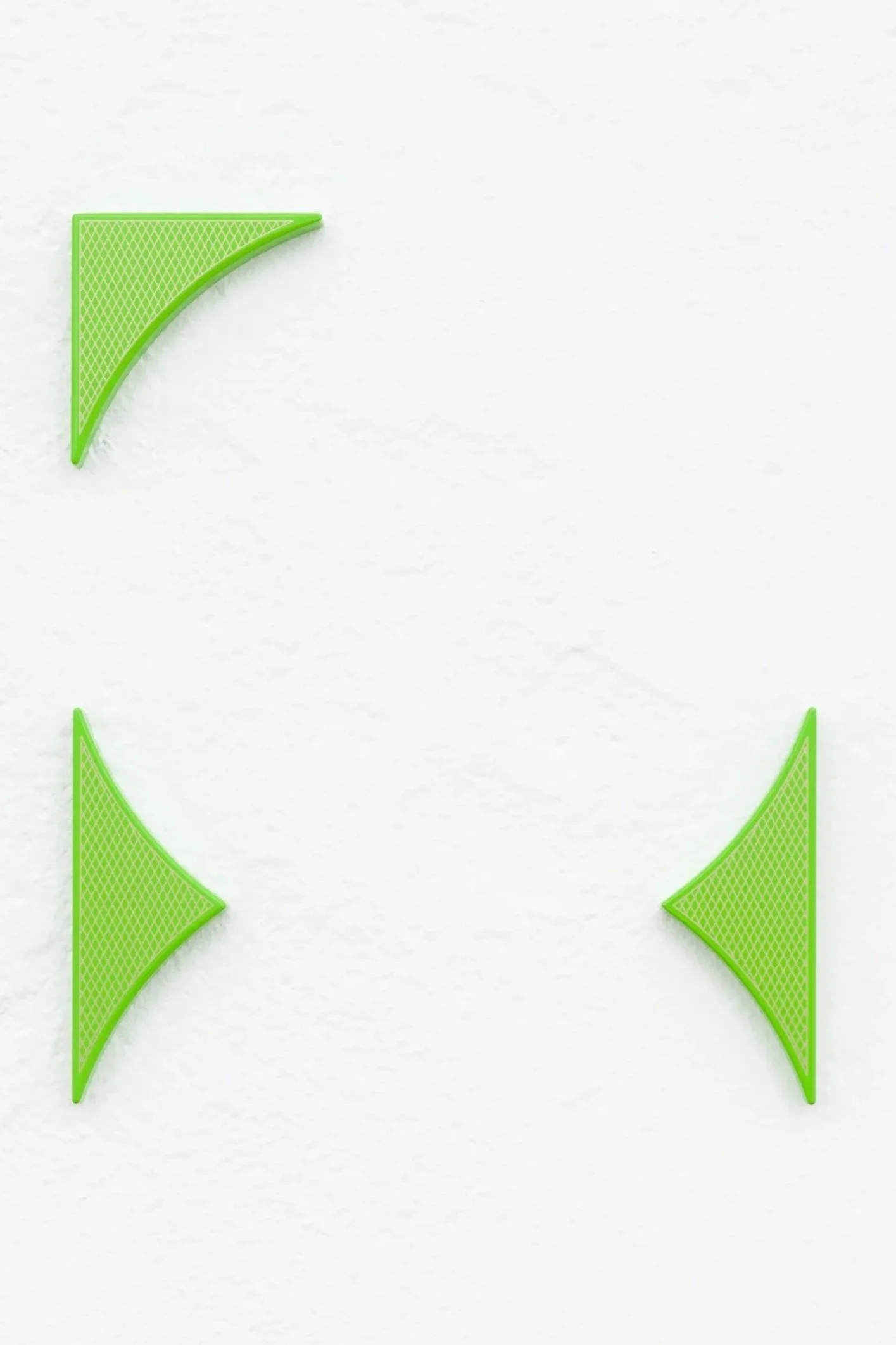
Carla Arocha & Stéphane Schraenen, Framed (Lime Green), 2011. Silkscreen on enameled Plexiglas, 15 works, each 29.5 × 24.5 × 1 cm. Edition of 15 unique works. Courtesy of the artists. Photo: Pieter Huybrechts.
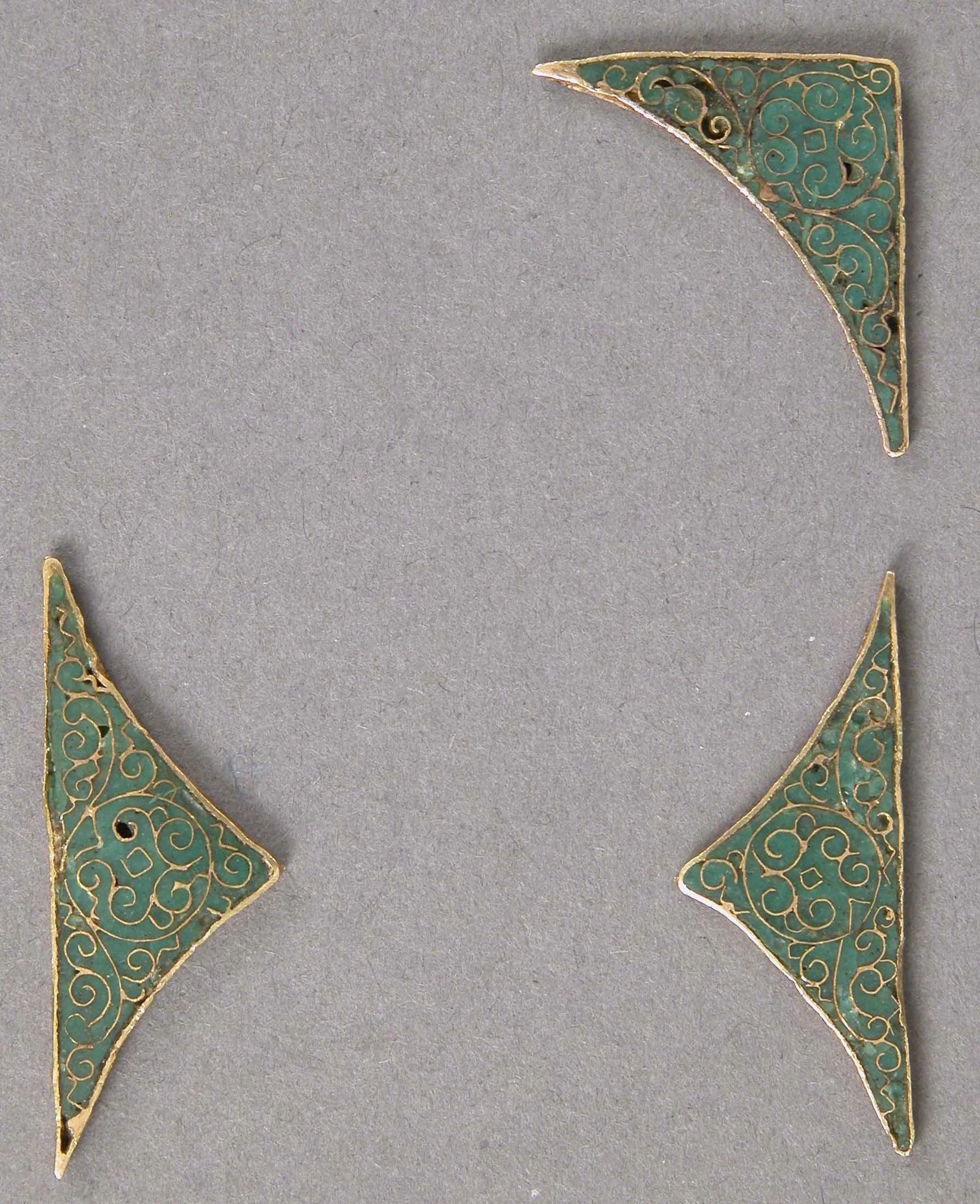
Element of an Icon Frame, Byzantine, 11th century (cloisonné enamel [metal compartments filled with colored enamel], gold, copper). Collection of The Metropolitan Museum of Art. Public Domain.
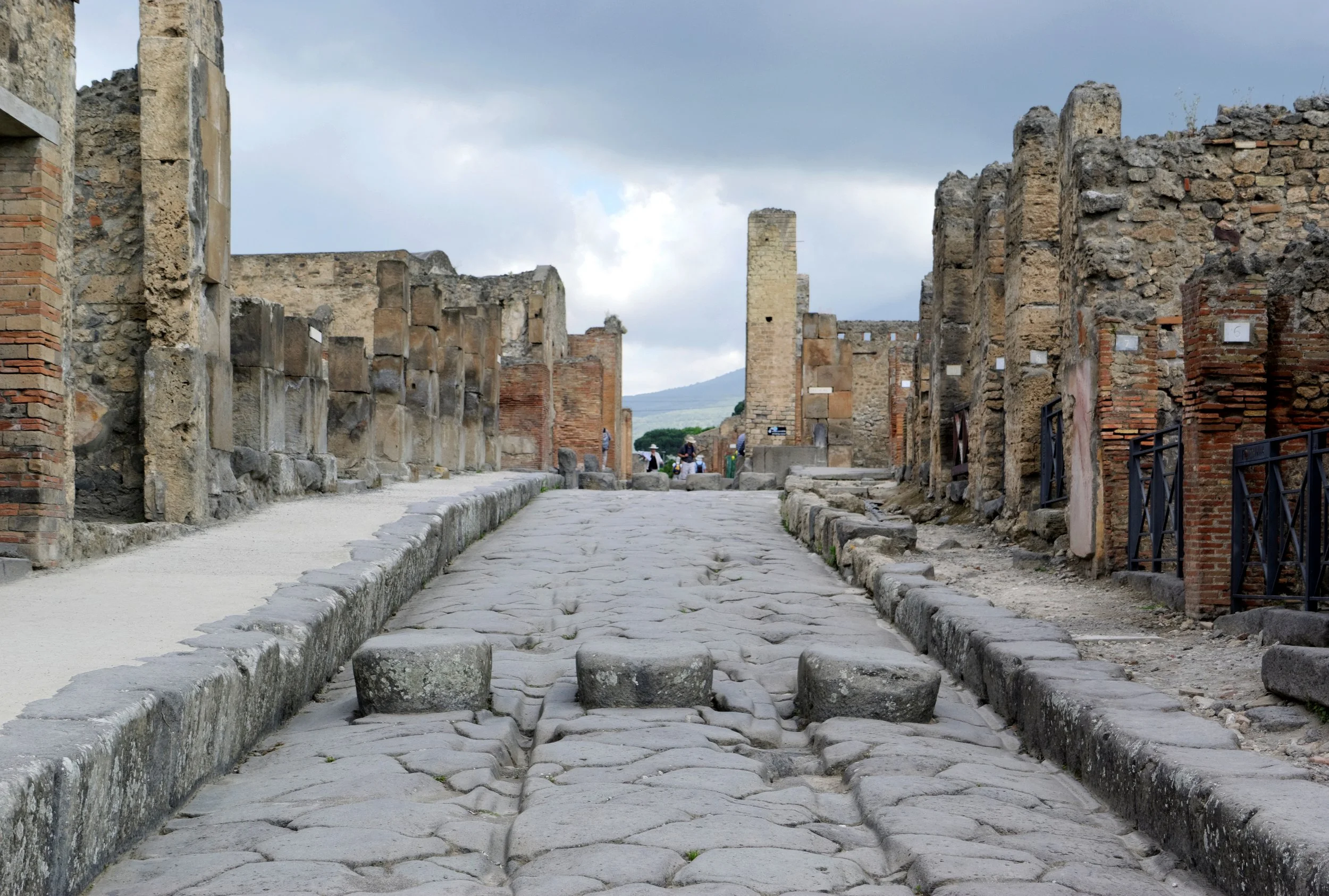
Pedestrian crossing, Via Stabiana, Pompeii. Photograph by Berthold Werner, 2013. Public Domain.
AMADOUR:
I think what you’re describing makes me think about Framed (Lime Green) (2010)as well, because the piece creates a similar sensation for me. I think of the three structural elements, and one feels absent, not actually missing, because the work is complete, but arranged in a way that makes you want to finish it. As the viewer, you start mentally inserting something. You begin completing the image. You almost want to add another line because the existing structure feels so resolved that your instinct becomes participation.
STÉPHANE SCHRAENEN:
Exactly. And maybe that’s the point. Because if the image were completely finished, then your attention would simply move toward filling the frame. But in those works, the frame itself becomes the piece. What interested us in that work is that the frame becomes the image. In a way, it operates almost like a Byzantine icon frame, because the piece itself becomes a site of projection [dating to the 11th century and now in the collection of The Metropolitan Museum of Art in Gallery 300, the Byzantine frame is made from cloisonné enamel, gold, and copper and reflects the highly refined decorative traditions of medieval Byzantine devotional objects. It was a gift from J. Pierpont Morgan in 1917.] You begin filling it with your own icons, your own references, your own expectations. There’s a kind of threefold movement happening because there is something missing, but the missing element is not actually absent. We never intended to put it there.
CARLA AROCHA:
What’s interesting is that this idea came from a very specific encounter. I remember seeing the original object years ago at the Metropolitan Museum and being completely affected by it. The first time we visited together, I wanted to show Stéphane this tiny thing hanging there because somehow it had stayed with me in such an outsized way. It was physically very small but conceptually enormous. Later, as we started talking about creating the edition, we almost simultaneously arrived at the same reference and thought: What about that piece?
STÉPHANE SCHRAENEN:
The work Framed comes from a Byzantine icon frame that remained incomplete. What fascinated us wasn’t the image but the structure around the image. It remained unresolved and, as a result, stayed active. What happens more broadly in our work is not necessarily elevating things but redirecting attention toward what is usually overlooked. Negative space interests us. Mundane things interest us. The frame becomes the artwork. Corners become central. Things that normally exist in the background suddenly occupy center stage. That’s also happening in the window works we’re showing here in Brussels, and they appear toward the back of the book in the Floop exhibition [series of minimalist canvases that explores perception through the use of Colorshi$ (dichroic) paint, causing color and light to continuously transform according to the viewer’s position and movement. and a circular sculptural edition.] They’re based on photographs of windows taken at construction sites. But instead of inserting glass, we made the frames themselves out of mirror. Suddenly, the reflective surface no longer belongs to the window but to the surrounding structure. That displacement changes everything. Instead of looking through the window, you begin looking at the condition of looking itself. In that sense, it almost turns the concept of the window inside out. The window is no longer functioning as an opening but as an object leaning against a wall. You can’t really see through it anymore. You only see what is already there. And yet the frame creates another kind of speculation, because reality now appears through reflection rather than transparency. It also inevitably enters into dialogue with art history and with painting because of that long tradition of understanding painting as a window onto the world. By translating that idea into installation and removing the image itself, the work becomes one more step removed from representation and one more step closer to perception.
AMADOUR:
That’s fascinating because when I first encountered that piece, my references were completely different. I immediately thought about artists working through grids and structures. I thought about Agnes Martin. I thought about Channa Horwitz. I thought about Sol LeWitt. Even in works like Sleeping Room (2023), I found myself thinking a little about Barnett Newman and this idea of division or splitting. What I love now, hearing the Byzantine reference, is that it opens another layer entirely. Because even though I think people could project a very contemporary reading onto your work, there’s also something ancient in it. I went to Istanbul for the first time in December, specifically to see Hagia Sophia and take in Byzantine architecture, and what struck me was realizing how contemporary geometry can feel while simultaneously carrying these exceptionally old histories. So it made me curious whether those deeper historical fascinations existed early for both of you. As children, what civilizations drew you? What worlds stayed with you? Because I feel like those early attractions end up laying the foundations in the back of your mind for how you eventually see things.
STÉPHANE SCHRAENEN:
I loved going to Pompeii when I was a kid. One of the things that fascinated me most in Pompeii as a child wasn’t necessarily the grand architecture but something much smaller and stranger. I became obsessed with the street crossings. The roads were deeply worn, and they must have been full of mud, sewage, and the everyday life of the city. Then there were these raised stone blocks that allowed people to cross. In a way, they looked almost like zebra crossings [these 2,000-year-old stones represent the functional blueprint for modern-day zebra crossings, safely segregating pedestrian traffic from cart traffic]. I remember thinking they felt particularly modern. That idea stayed with me—the realization that systems of movement and circulation are ancient, and that people have always been trying to organize space, bodies, and experience.
CARLA AROCHA:
As a child, I didn’t travel very much physically, but I traveled a lot through books. One thing that stayed with me very strongly was the Amazonian decoration and visual language, because so much of it was abstract yet still connected to the world. I remember looking at those images and asking myself questions like, "How is this a leaf? How is this a tree? How is this a snake?” That fascinated me. The idea that something could become a pattern and still remain connected to reality felt mysterious. Patterns themselves became something I was always drawn toward, but not because of perfection. I was always looking for where the pattern broke, where something shifted slightly, where the imperfection appeared. I think that attention never really disappeared.

Carla Arocha & Stéphane Schraenen, Ópalo, 2026, Transparent plexiglass, acrylic paint, and stainless steel, 8 panels,
400 x 97 cm. Spinning Rumours, Ópalo, Galería Fermay, March 21–May 22, 2026. Photo: Grimalt de Blanch.

Carla Arocha & Stéphane Schraenen, Spinning Rumours, Ópalo, Galería Fermay, March 21–May 22, 2026. Photo: Grimalt de Blanch.
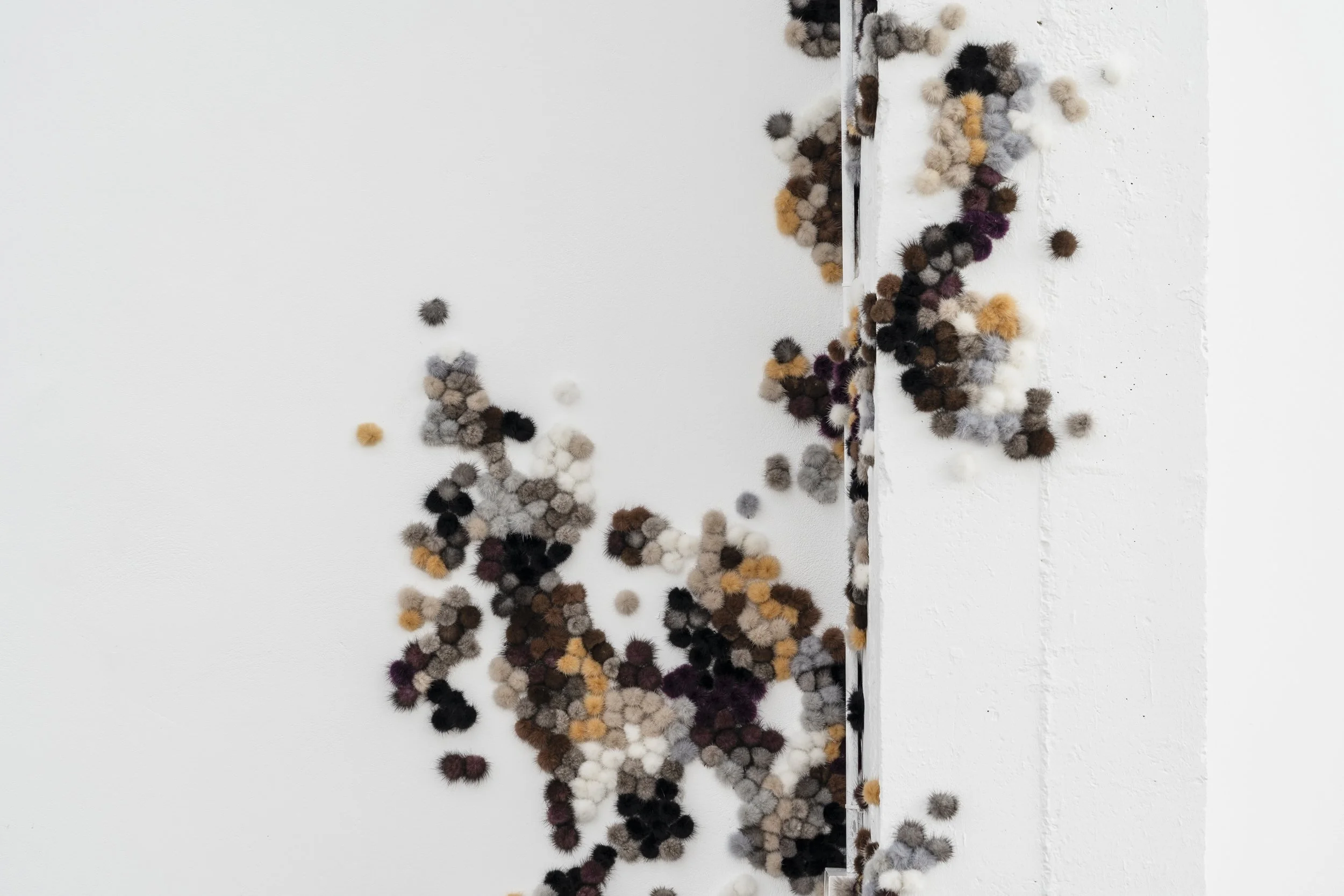
Carla Arocha & Stéphane Schraenen, Ghost-Fuzz, 2026, Fur on wall Multiple elements, diameter 3 cm; overall dimensions variable. Spinning Rumours, Ópalo, Galería Fermay, March 21–May 22, 2026. Photo: Grimalt de Blanch.
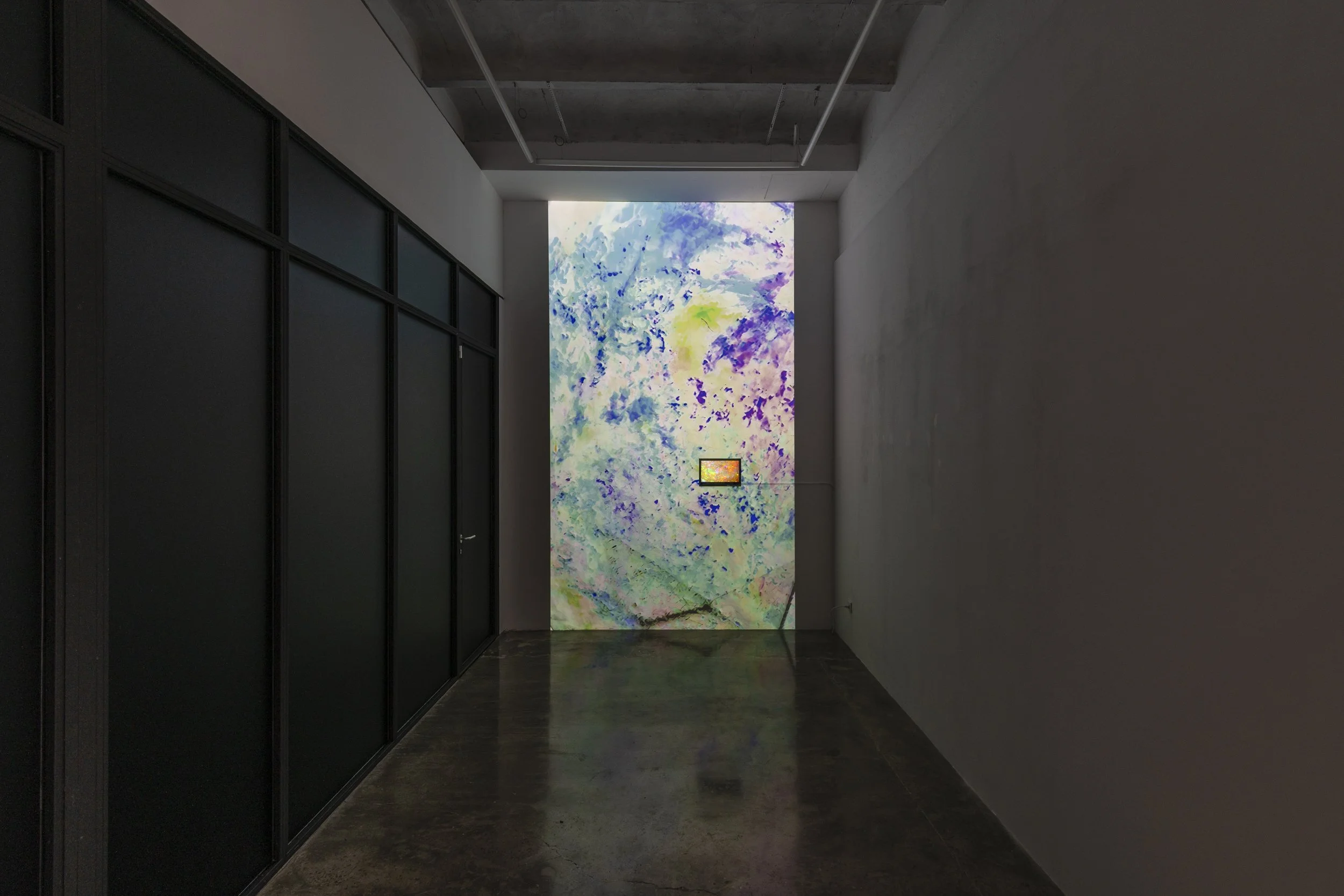
Carla Arocha & Stéphane Schraenen, Lumen Internum, 2026, 2 channel video, Duration 30’ 44”, 16:9, 1080p, Edition of 3 + 2 AP. Spinning Rumours, Ópalo, Galería Fermay, March 21–May 22, 2026. Photo: Grimalt de Blanch.

Carla Arocha & Stéphane Schraenen, Lumen Internum, 2026, 2 channel video, Duration 30’ 44”, 16:9, 1080p, Edition of 3 + 2 AP. Spinning Rumours, Ópalo, Galería Fermay, March 21–May 22, 2026. Photo: Grimalt de Blanch.

Carla Arocha & Stéphane Schraenen, SiO2·nH2O I-IX, 2026, Watercolor on paper, 23 x 31 cm, framed 39 x 47 cm. Spinning Rumours, Ópalo, Galería Fermay, March 21–May 22, 2026. Photo: Grimalt de Blanch.
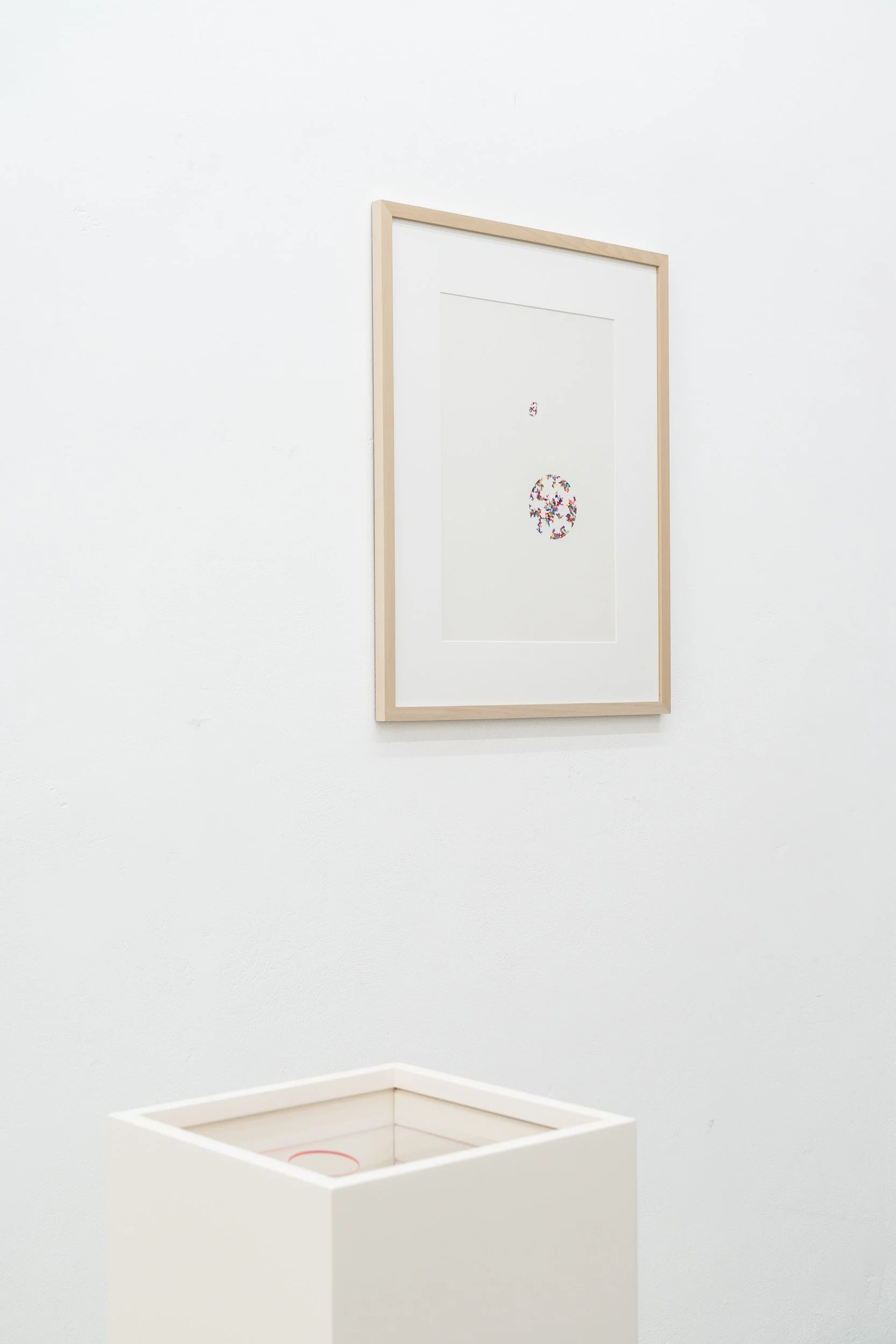
Carla Arocha & Stéphane Schraenen, Opal I, 2017, Ink on embossed paper, 51 x 36 cm, frame 73 x 58 cm; Ópalo Box, 2026, Transparent plexiglass, acrylic paint, glass, mirror, and enameled MDF 90 x 31.5 x 31.5 cm. Spinning Rumours, Ópalo, Galería Fermay, March 21–May 22, 2026. Photo: Grimalt de Blanch.

Carla Arocha & Stéphane Schraenen, Ópalo Box, 2026, Transparent plexiglass, acrylic paint, glass, mirror, and enameled MDF 90 x 31.5 x 31.5 cm. Spinning Rumours, Ópalo, Galería Fermay, March 21–May 22, 2026. Photo: Grimalt de Blanch.
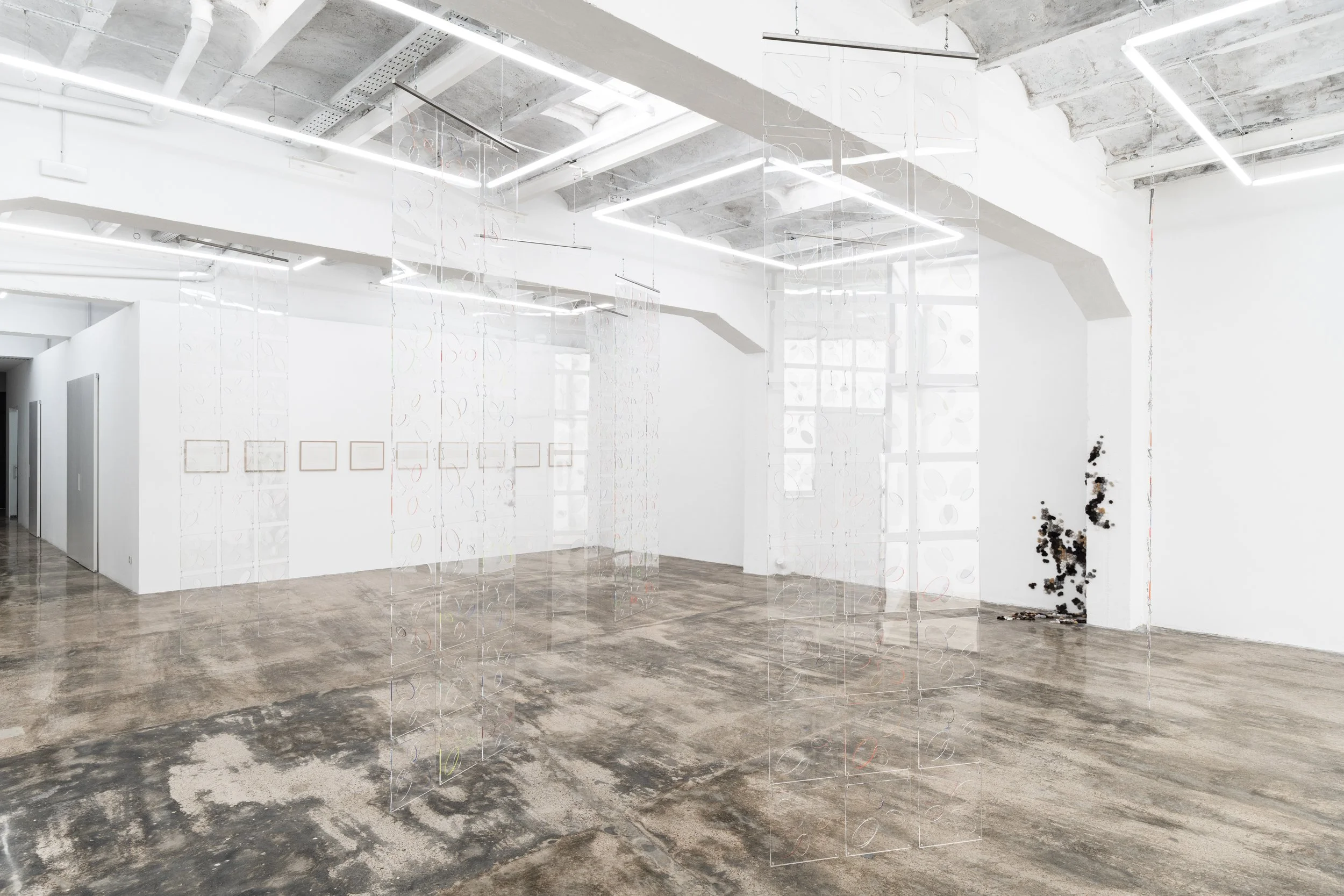
Carla Arocha & Stéphane Schraenen, Spinning Rumours, Ópalo, Galería Fermay, March 21–May 22, 2026. Photo: Grimalt de Blanch.
AMADOUR:
That’s amazing because you can actually trace that line directly into the work now. You can see those interests reflected in the exhibitions and in what you’re placing in museums today. I also wanted to ask on a personal note—how was Japan?
CARLA AROCHA:
Japan was intense. It began optimistically and quickly became quite busy. As Luc’s exhibition approached, everything accelerated, [held at the Richter Raum in Karuizawa, Japan, Condensation is a solo exhibition featuring six new, muted oil paintings by Luc Tuymans that engage in a direct artistic dialogue with a permanent installation of works by Gerhard Richter] and once you arrive and the work starts, there really isn’t a moment to breathe. I barely had time to see exhibitions. At one point, I passed your gallery [Kotaro Nukaga represents Amadour in Japan] and saw it was closed, but through the window I could see these beautiful glass works [by artist Yohei Chimura] and thought, "Ah, I wish I had time to make it there properly.” But we never managed to because everything conflicted and Tokyo isn’t exactly a small city. Toward the end of the trip, unexpected concerns also made the visit stressful and disrupted its rhythm. Still, I love Japan. It’s just that the end of the trip was difficult.
AMADOUR:
Hopping between time zones constantly, I understand. And how was the Venice Biennale?
STÉPHANE SCHRAENEN:
Venice was wonderful. We had a lot of fun and, like always, you see so many things that some disappear immediately, and others remain. There’s always an overwhelming amount of work and then a few moments that suddenly become unforgettable.
CARLA AROCHA:
If I had to choose one thing, it would probably be the last paintings of the late George Baselitz [Eroi d’Oro (Heroes of Gold)], a series presented at Fondazione Giorgio Cini on San Giorgio Maggiore during the 61st Venice Biennale. Opening just days after the artist’s death in 2026, the exhibition has been understood as a final gesture within Baselitz’s six-decade career.] The portraits of his wife, the self-portraits, especially the gold self-portraits—they were unbelievable.
STÉPHANE SCHRAENEN:
They were completely moving. Those works created that rare feeling where your body responds before your thoughts do. You stand in front of them, and something physical happens first. Your hair stands up, and you almost feel like crying. That Baselitz exhibition was exceptionally strong. Honestly, I had never considered myself a particularly devoted Baselitz viewer. Of course, I understood his importance and, over time, had learned to appreciate his work more deeply, but I had never had that immediate emotional reaction before. This exhibition changed that. What struck me was the contradiction inside the work. These were enormous paintings—four-meter-high gold paintings shown in sequence—and yet they felt intimate. They felt humble. They felt almost small emotionally despite their scale. There was something in the calligraphic quality of the lines and in those upside-down portraits of his wife and himself that completely transformed the experience of monumentality. They never felt grand in the theatrical sense. They felt direct. They felt vulnerable. That tension stayed with me.
CARLA AROCHA:
They were genuinely moving. Part of what made the experience stronger was that they weren’t caught inside the main intensity of the Biennale flow. There was this feeling of unexpectedly finding yourself almost alone with them. That changes everything. The Biennale itself was mixed, as it always is. You see a tremendous amount of work, and inevitably, some of it disappears immediately, while other things remain with you. I remember the Peru Pavilion being beautiful [for the 61st Venice Biennale, Peru presents Indigenous Shipibo-Konibo artist Sara Flores with her solo exhibition Sara Flores: From Other Worlds, curated by Issela Ccoyllo and Matteo Norzi and presented in the Arsenale. The project explores ancestral knowledge, Indigenous futures, and the visual language of kené through a new body of immersive works.]
I also remember the Luxembourg Pavilion staying with me, though parts of it became almost too excessive for me [the Luxembourg Pavilion at the 61st Venice Biennale presents artist Aline Bouvy’s immersive installation La Merde, commissioned by Kultur | lx and curated by Stilbé Schroeder, combining film, sound, and a mirrored architectural structure to explore shame, bodily regulation, and the social construction of norms.]
CARLA AROCHA:
But I actually thought the film La Merde was very good [displayed on the other side of the structure, the film functions as a cinematic essay exploring social abjection, femininity, bodily control, and the societal constructs of cleanliness]. It was excessive and uncomfortable in ways that felt intentional. It seemed to speak not only about the world but also about spectacle itself, about art audiences, performance, embarrassment, humor, and the strange rituals around looking. Part of what made it work was that audiences became implicated in the experience. While people watched, they themselves became visible. You could see viewers becoming uncomfortable, then laughing at themselves for becoming uncomfortable. That circularity felt very relevant. It was confrontational but not empty. Sometimes discomfort was exactly the point.
STÉPHANE SCHRAENEN:
And I think work should sometimes be allowed to become uncomfortable. Even when something isn’t completely for me, I appreciate when artists commit fully to an idea. But one exhibition that really stayed with me was the exhibition Nancy Spector curated bringing together Richard Prince and Arthur Jafa [Helter Skelter: Arthur Jafa and Richard Prince is a major exhibition at Fondazione Prada’s Ca’ Corner della Regina running alongside the 61st Venice Biennale, bringing the two artists into their first direct dialogue through more than 50 works across photography, film, painting, and sculpture to examine image appropriation, American mythmaking, and the fractures embedded within contemporary visual culture. The exhibition’s title draws layered references to the 1968 Beatles song, Charles Manson’s later appropriation of the phrase as an apocalyptic racial fantasy, and Helter Skelter: L.A. Art in the 1990s (MOCA, 1992), a landmark exhibition later criticized for its exclusion of Black artists. Although the exhibition’s literary program included a somewhat more diverse group of Los Angeles–based writers, among them poet and author Michelle T. Clinton, the near-total absence of Black artists in the exhibition itself remained one of its most enduring criticisms.] That felt exceptional. If someone has the chance to spend time with that exhibition, they should. What I thought was especially successful was that, unlike many large international exhibitions that become more about display than dialogue, this exhibition actually created relationships between works. There was tension. There were questions. The works transformed one another. They created conversations rather than coexistence.
CARLA AROCHA:
That was maybe what I missed elsewhere. Too often exhibitions become accumulations. This one created meaning through relation. And somehow it made complete sense, even though nobody had really thought to place those two artists together before. Apparently, years earlier, Nancy Spector had visited Arthur Jafa’s studio, and he kept returning to Richard Prince in conversation; eventually, that connection became an exhibition. Once you see the work together, it feels obvious. The conversation in the catalogue is excellent too. You feel that the exchange is continuing there.
AMADOUR:
I love that. And maybe as a final question, because this is now twenty years of work and such an enormous body of production, what strikes me is that I never really feel like I’m seeing the same thing twice. Every time I return to your work, there seems to be another layer, another relationship, another way of entering it. So I wanted to ask what you imagine for the next twenty years. And maybe also how you think about forecasting at all. When you began, did you imagine arriving here? Did it feel linear? Did it feel surprising? What did the future look like then, and what does it look like now?
STÉPHANE SCHRAENEN:
I think one of the reasons I eventually knew I wanted to do this—and do it together—was that I wanted to make things I had not yet seen. That feeling has stayed with me.
CARLA AROCHA:
So when I think about the next twenty years, I don’t really think in terms of milestones or predictions. I think more about remaining surprised. I hope we continue making things that surprise us. I hope we continue finding situations where we don’t immediately know the answer and where we resist repeating ourselves. I think repetition is dangerous because once you begin making things simply because they worked before, something disappears. What still excites me is encountering something unexpected. Although in twenty years I’ll be eighty-something, so that’s also part of the equation.
STÉPHANE SCHRAENEN:
Well, now you’ve committed yourself.
CARLA AROCHA:
Exactly. So maybe the next phase is just longer nails.
STÉPHANE SCHRAENEN:
But seriously, I don’t think either of us has ever approached work with a forecasting mindset. We’ve mostly kept moving forward and responding to what comes in. Different spaces appear, different cities appear, different invitations appear, and those contexts continue feeding us. That’s what keeps things alive. I don’t really imagine some grand master plan. I think the work continues because curiosity continues.
CARLA AROCHA:
And I think there’s also responsibility in that. You have to continue giving. The world feels increasingly strange sometimes, and because of that, I think it becomes more important—not less important—to continue contributing whatever you can. Not necessarily making more or becoming bigger, but continuing to offer something, remaining curious, and continuing to make. That’s probably how I imagine the future.
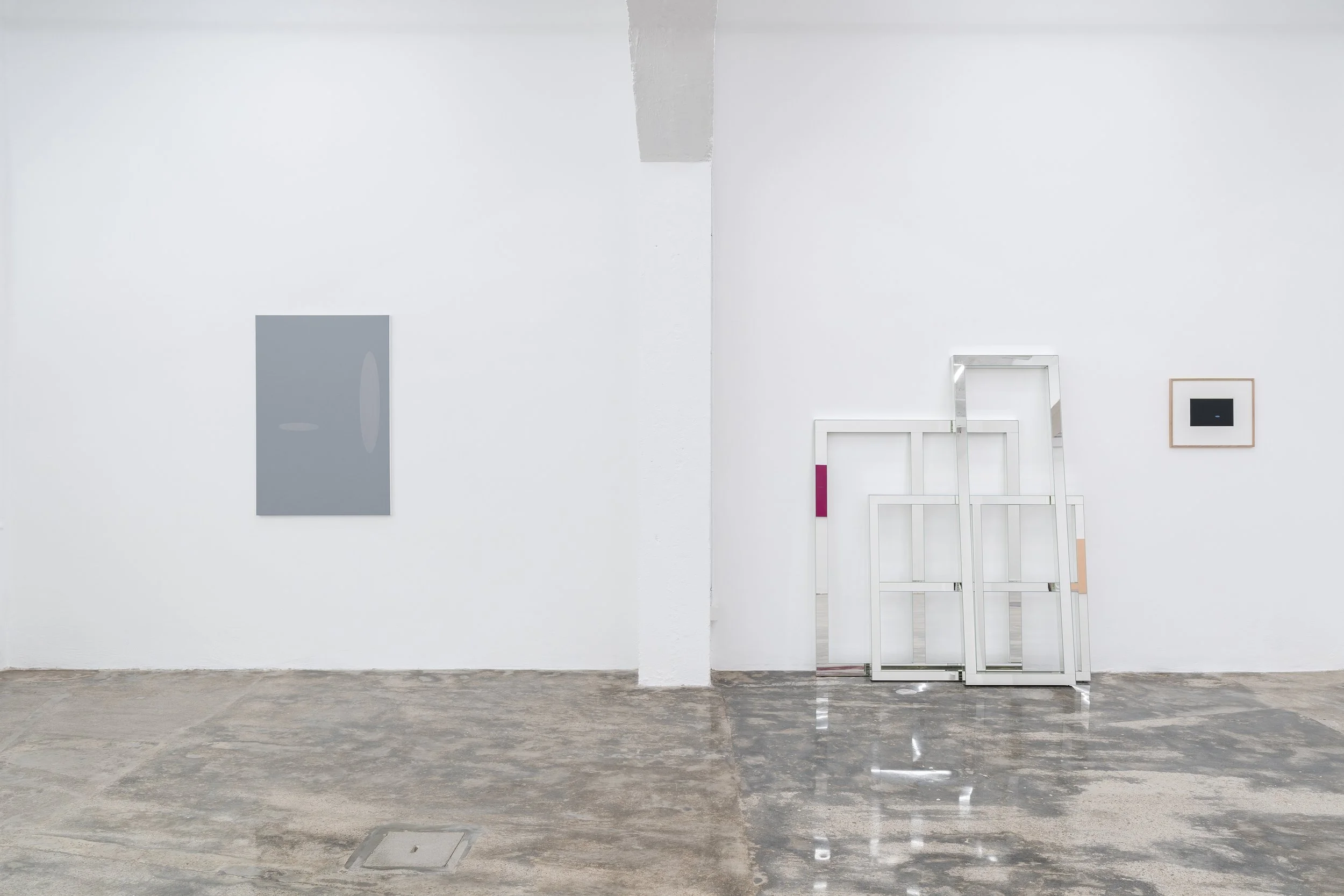
Carla Arocha & Stéphane Schraenen, FLOOP, Galería Fermay, September 17–November 5, 2022. Photo: Grimalt de Blanch.
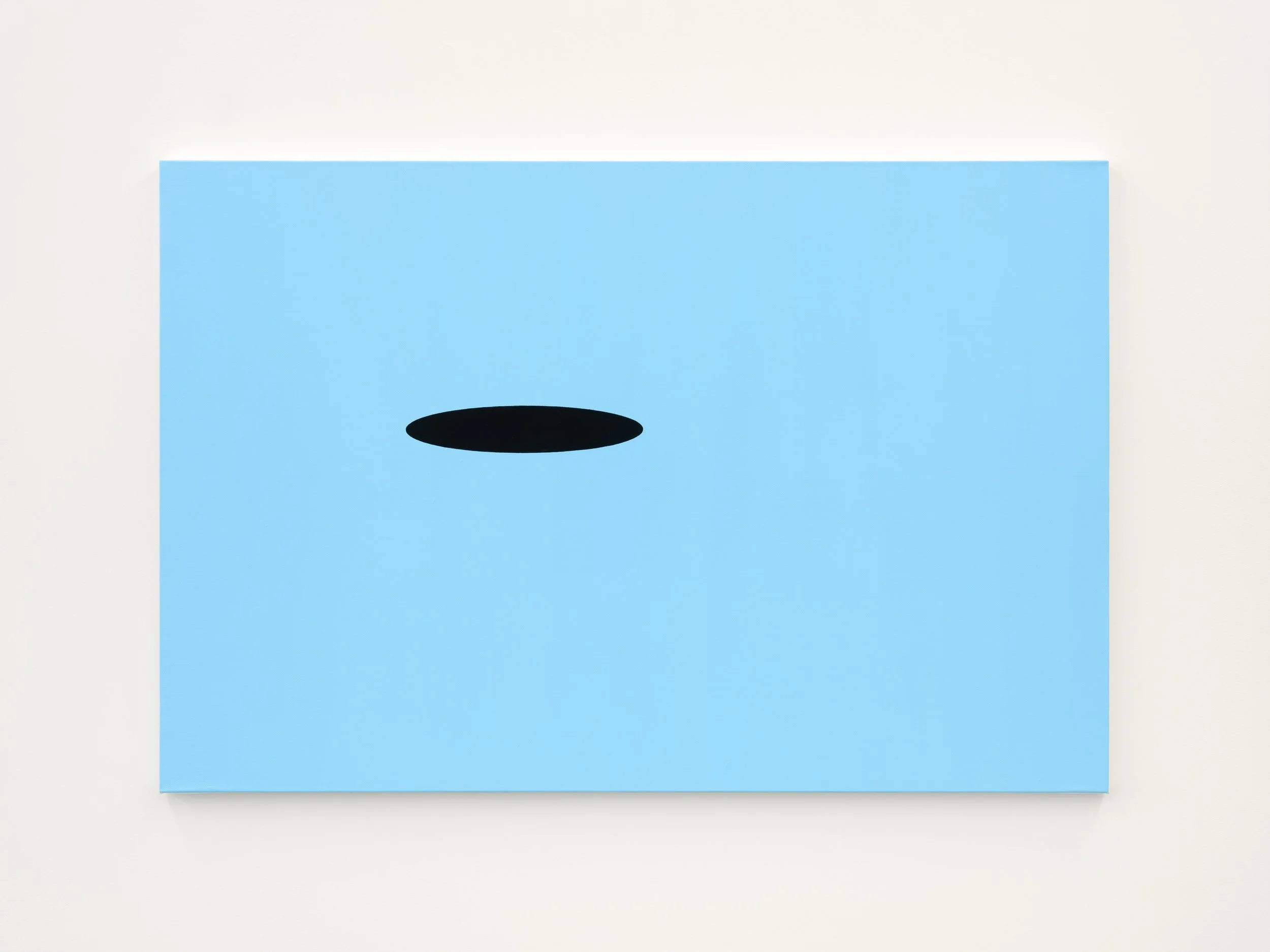
Carla Arocha & Stéphane Schraenen, Floop 9, 2022. Ultra-pigmented acrylic paint and acrylic paint on canvas, 80 × 120 cm. FLOOP, Galería Fermay, September 17–November 5, 2022. Photo: Grimalt de Blanch.
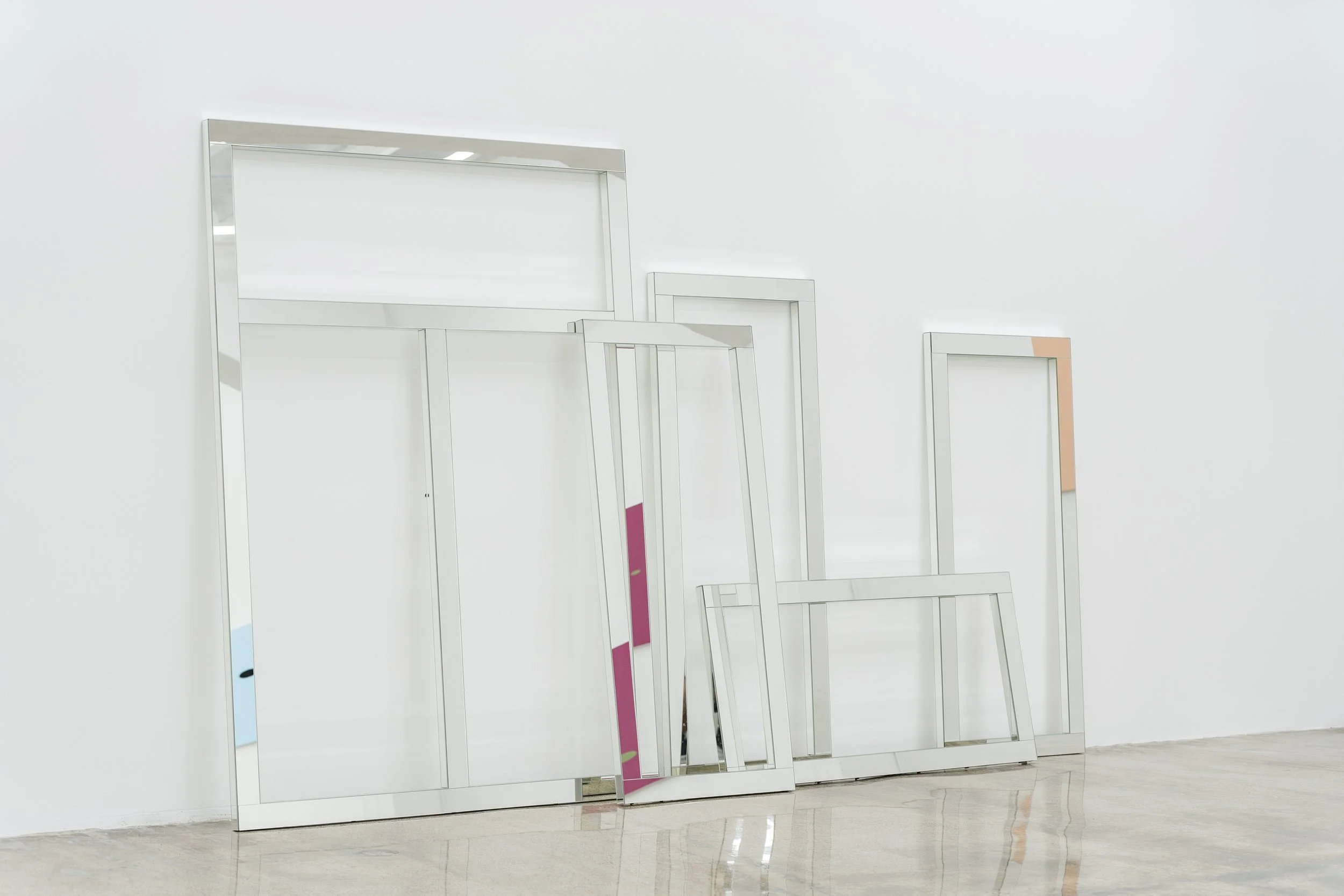
Carla Arocha & Stéphane Schraenen, Window Set (2), 2022. Mirror and aluminum, 5 panels, various sizes; overall approximately 200 × 340 × 25 cm. FLOOP, Galería Fermay, September 17–November 5, 2022. Courtesy of the artists. Photo: Grimalt de Blanch.
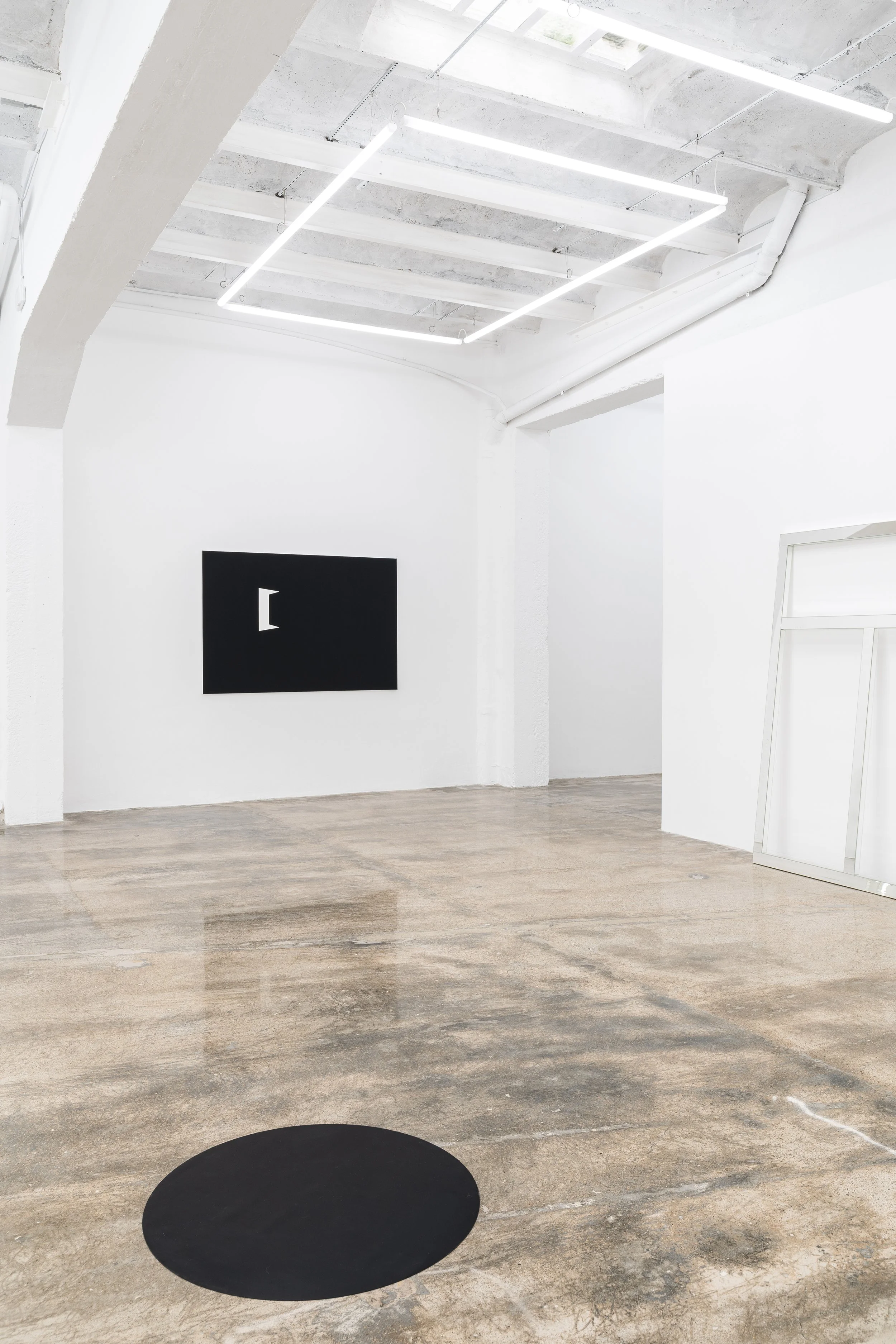
Carla Arocha & Stéphane Schraenen, Large Door, 2022. Ultra-pigmented acrylic paint on canvas, 120 × 180 cm; Floop, 2022. Nitrile rubber, diameter 80 cm. Edition of 9 + 2 artist's proofs (#2/9). FLOOP, Galería Fermay, September 17–November 5, 2022. Courtesy of the artists. Photo: Grimalt de Blanch.
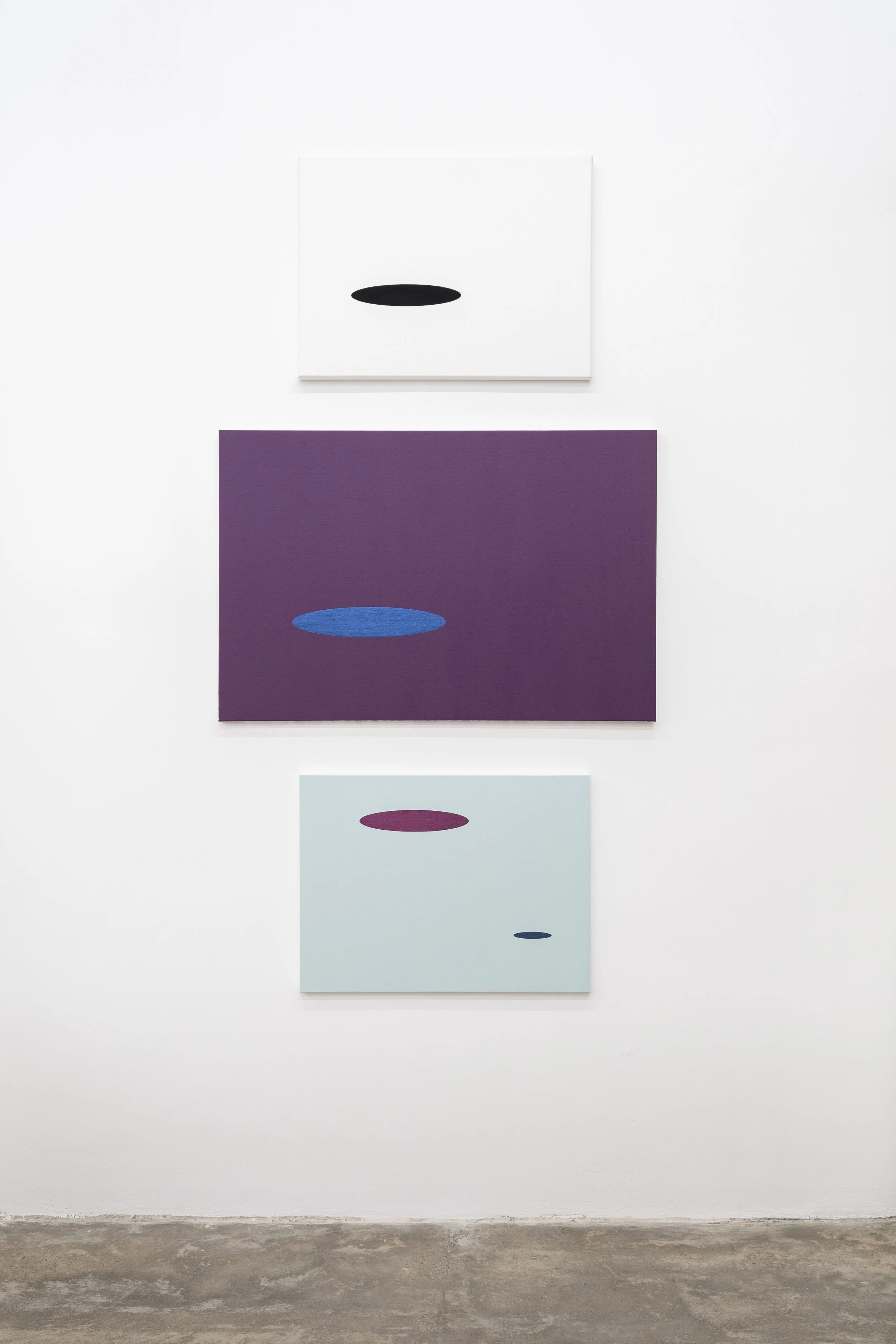
Carla Arocha & Stéphane Schraenen, Floop 3, 2022. Color-shift acrylic paint and acrylic paint on canvas, 80 × 120 cm; Floop 5, 2022. Ultra-pigmented acrylic paint and acrylic paint on canvas, 60 × 80 cm. FLOOP, Galería Fermay, September 17–November 5, 2022. Courtesy of the artists. Photo: Grimalt de Blanch.
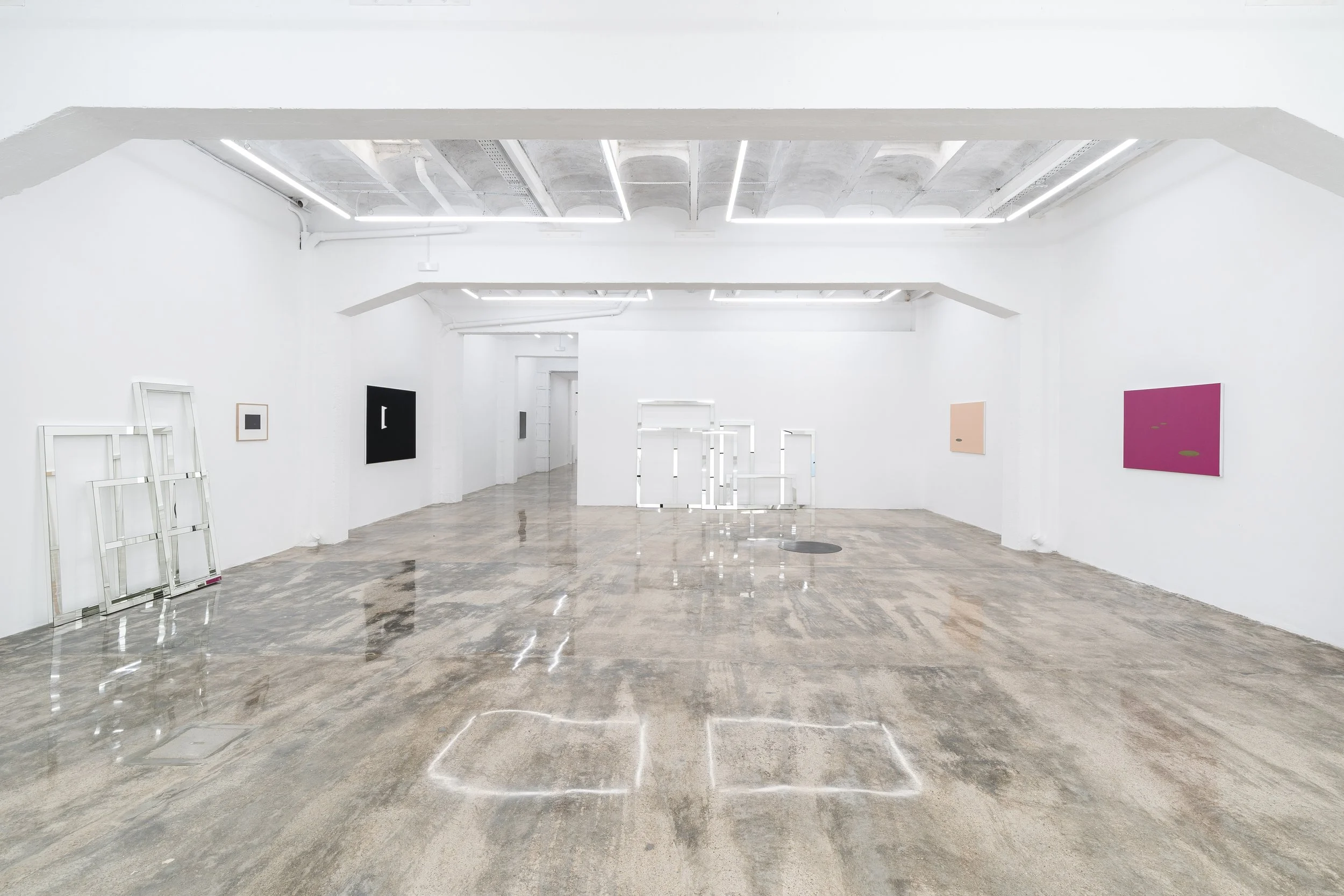
Carla Arocha & Stéphane Schraenen, FLOOP, Galería Fermay, September 17–November 5, 2022. Photo: Grimalt de Blanch.