IN THE WAKE OF NAIROBI AND VENICE: ADRIAN ELISHEVA PARR ZARETSKY ON WATER, WOMEN'S LABOR, AND LIU SHIMING'S LEGACY
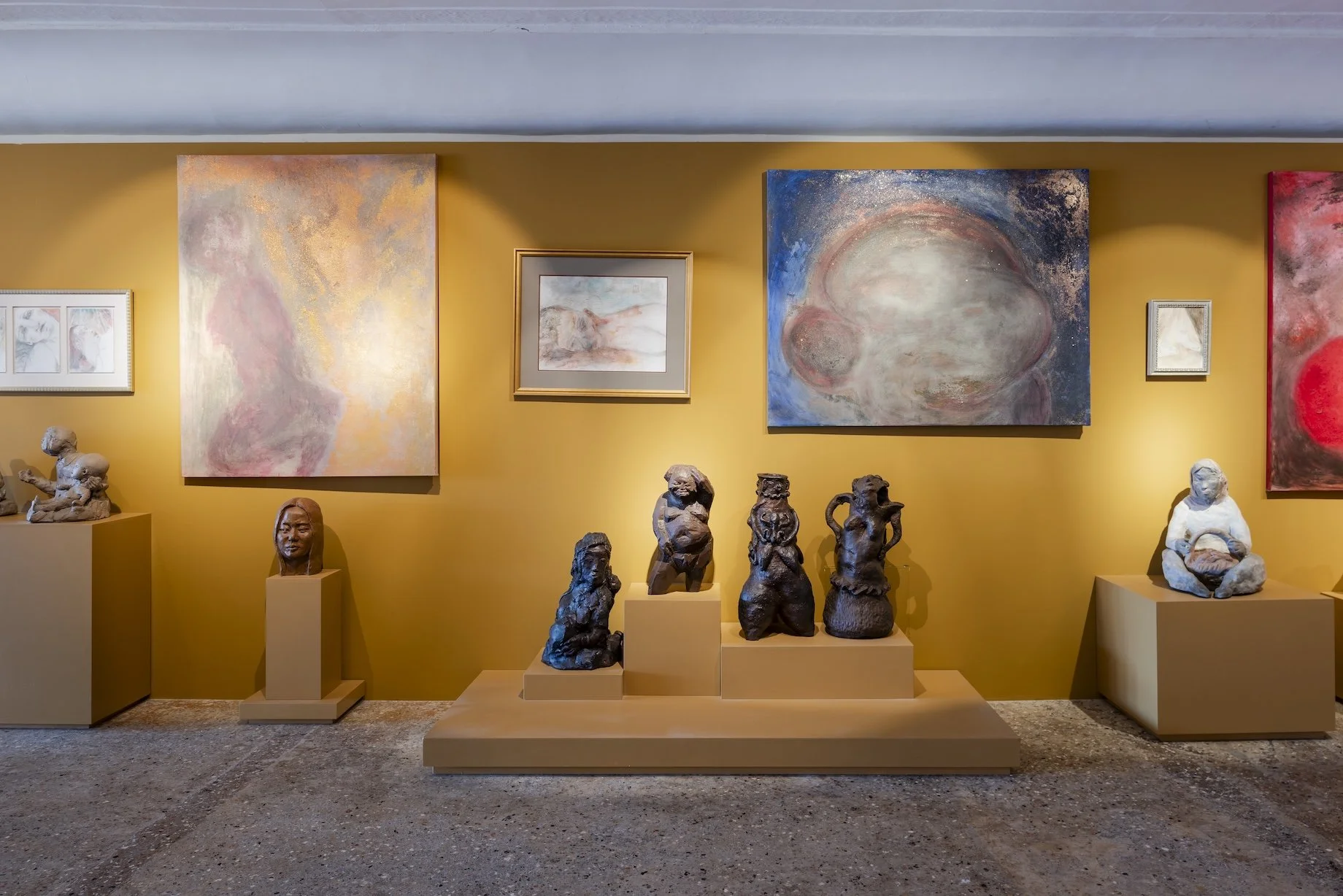
Intimate Unthinkables, 2026, Works by Liu Shiming: Baby with a Big Head, 2005 (cast 2025), bronze, 16 7/8 × 19 1/2 × 20 in.; Bust of a Woman, 1984 (cast 2025), bronze, 13 3/8 × 7 7/8 × 8 3/4 in.; Red Sister-in-Law, 1993 (cast 2025), bronze, 23 5/8 × 15 3/8 × 13 7/8 in.; Old Lady Touching Her Head, 2000–2010 (cast 2025), bronze, 23 5/8 × 11 3/8 × 8 3/4 in.; Human Shaped Jar, 1998 (cast 2025), bronze, 29 1/2 × 14 3/4 × 12 3/4 in.; Human Shaped Jar, 2002 (cast 2025), bronze, 29 1/2 × 14 3/4 × 12 3/4 in.; Woman Vendor, 1991 (cast 2025), bronze, 22 1/2 × 16 7/8 × 23 1/8 in. Courtesy of the European Cultural Center.
Currently on view in Venice, Italy, Intimate Unthinkables (2026) brings Adrian Elisheva Parr Zaretsky's work into conversation with the legacy of Chinese sculptor Liu Shiming. Parr Zaretsky, a UNESCO Chair in Water and Human Settlements and Dean of the College of Design at the University of Oregon, has built a career across art, sustainability, and social practice. Raised in Sydney and educated between Australia and Europe, her intellectual and creative life has taken her through Vienna, Melbourne, Florence, Nairobi, Beijing, and communities across the United States. Parr Zaretsky is, in the truest sense, a globetrotter. Yet her internationalism is not the polished cosmopolitanism of an artist simply moving from one cultural capital to another. Her work is built through sustained encounters with people, landscapes, and systems of knowledge, shaped by years of considering water access, climate change, and the ways design and policy enter everyday life.
Intimate Unthinkables, 2026. Exhibition view. Courtesy of the Liu Shiming Art Foundation and the European Cultural Center.
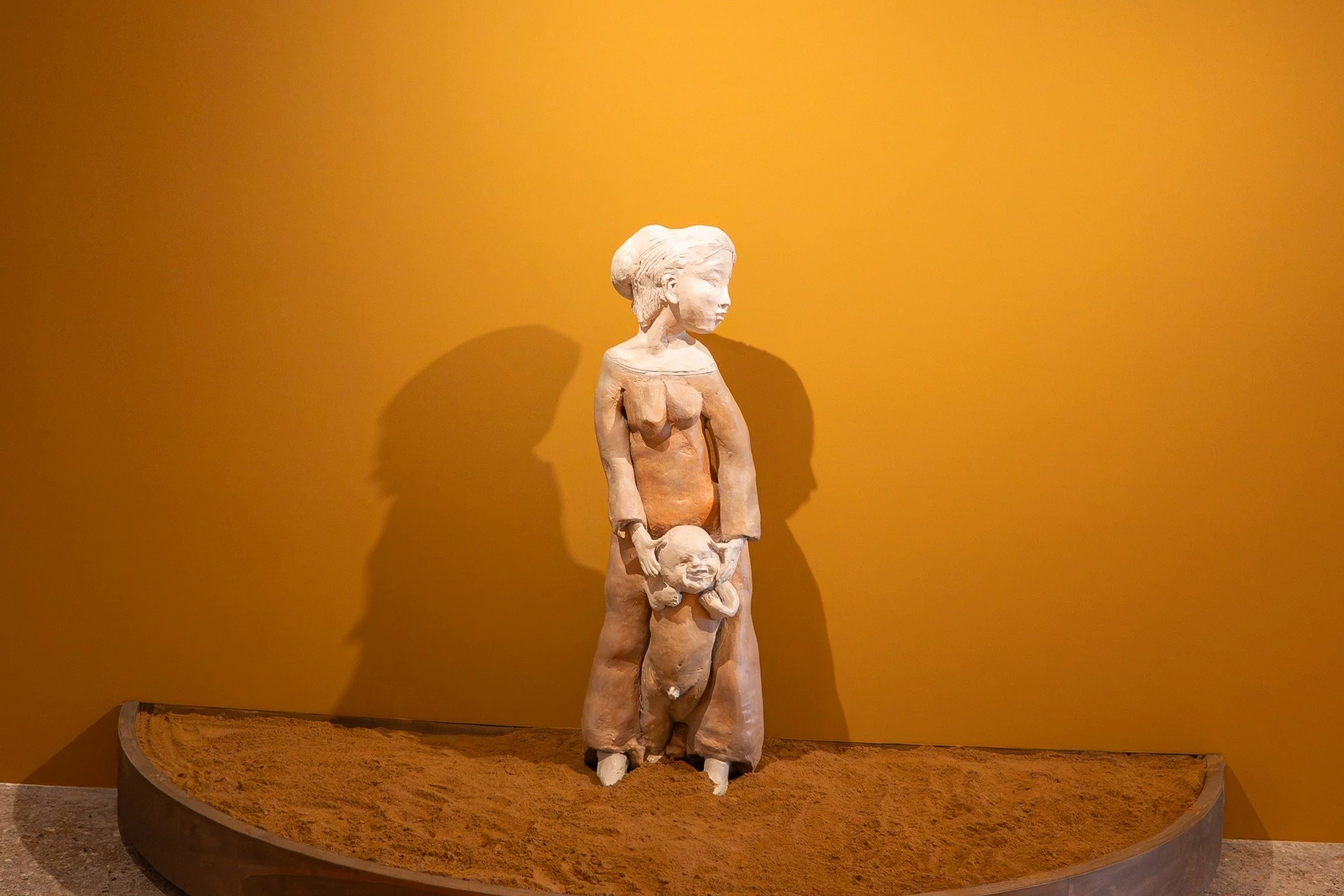
Liu Shiming, Mother Returns, 1993 (cast 2025), Bronze, 48 x 15 ¾ x 12 ½ in. Courtesy of the Liu Shiming Foundation.
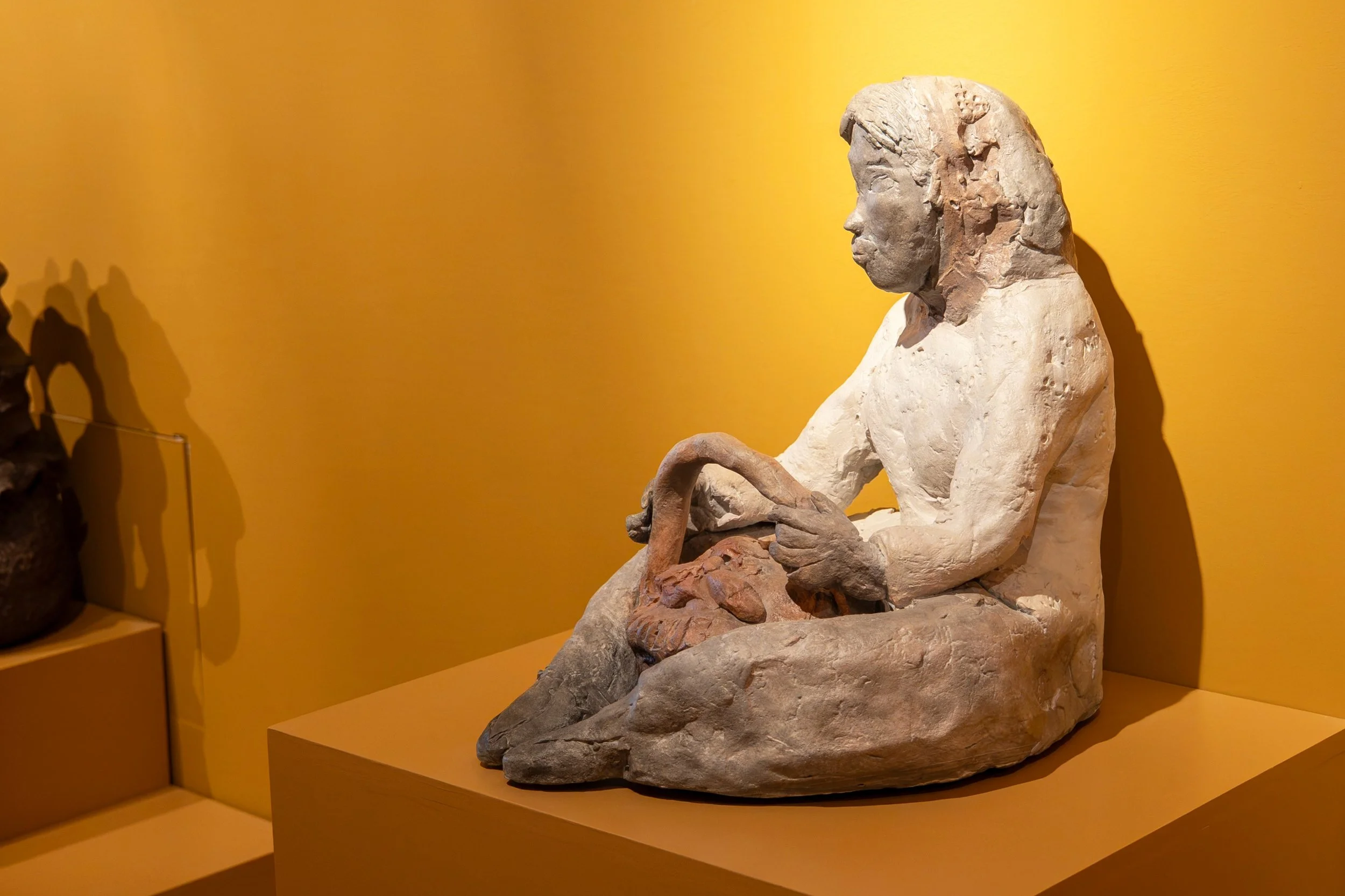
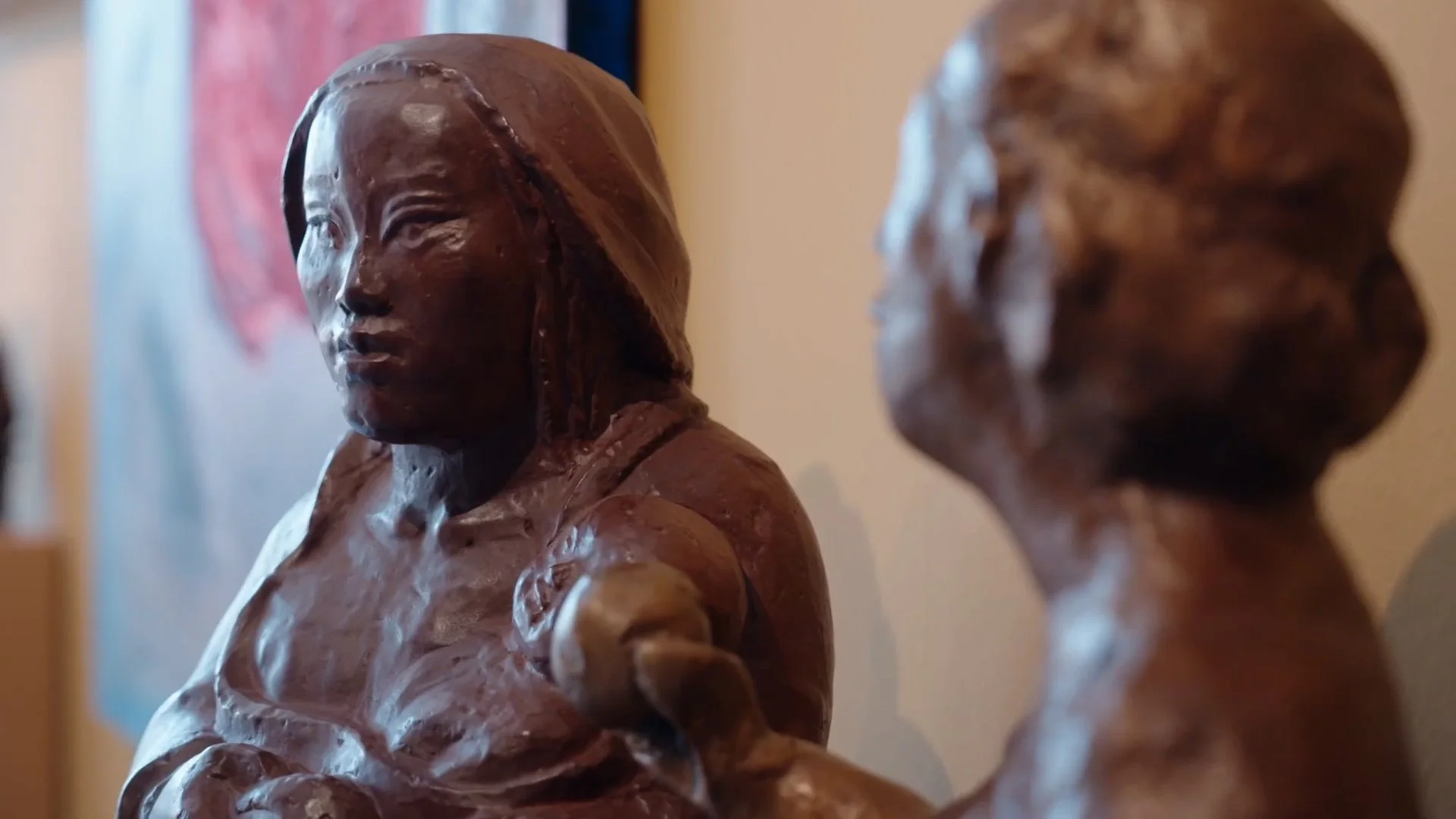
Liu Shiming, Woman Vendor, 1991 (cast 2025), Bronze, 22 ½ x 16 7/8 x 23 1/8 in. Courtesy of the Liu Shiming Foundation.
It is fitting, then, that Parr Zaretsky's artistic practice is rooted in a form of social engagement that is as concerned with listening as it is with making. Her documentaries The Intimate Realities of Water (2016) and Thirsty & Drowning in America (2018) are particularly significant because they resist the documentary impulse to speak on behalf of their subjects. While working with women in the informal settlements of Kibera and Dagoretti in Nairobi, Kenya, Parr Zaretsky became increasingly uncomfortable with the institutional mechanisms of conventional research: standardized questions, translators, data collection, and consent forms presented to women who, in some cases, could not read or write their own names. She stopped the research and asked the women themselves how they wanted to be represented. The answer was disarmingly simple. Parr Zaretsky would bring a camera, without a large film crew, and the women would lead her through their communities, determining where to go and what stories to tell.
This distinction is central to understanding Parr Zaretsky's work. Her films do not merely document communities; they attempt to preserve the perspective from which those communities understand themselves. Before The Intimate Realities of Water entered the international film circuit, she returned the film to the women who had made it possible, screening it in their own community. They arrived with children, friends, and neighbors and watched themselves on screen. The sequence is significant because Parr Zaretsky's methodology reverses a familiar extractive model of documentary production. The image is not first delivered to the institution, festival, or international audience. It is returned to its subjects.
This ethics of encounter extends into Intimate Unthinkables (2026), Parr Zaretsky's two-person exhibition with Chinese sculptor Liu Shiming at Palazzo Mora in Venice. She first encountered Liu's work at the Liu Shiming Foundation in New York and later traveled to Beijing, where she studied an archive of more than four hundred sculptures. Rather than attempting to summarize Liu's enormous body of work, she established a specific curatorial parameter: women's experiences. She was drawn to sculptures of washing, feeding children, and caring for families, as well as works that retained the physical evidence of Liu's hands pressing into clay he often gathered from the rural regions in which he worked.
Parr Zaretsky has consequently built an exhibition in which two cultural and historical positions are not collapsed into one another but allowed to resonate. Motherhood, women's labor, care, and the largely unmonumentalized work of daily survival become connective tissue between the two practices. In this regard, I think of Simone Leigh, particularly Brick House (2019), the monumental fusion of a Black woman's body with architectural forms associated with Africa and the African diaspora. Leigh's sculpture centers a Black female subject while simultaneously transforming her body into architecture: a figure that occupies, supports, and claims space. Parr Zaretsky and Liu work at a different scale and from different cultural histories, yet Intimate Unthinkables shares Leigh's insistence that women's lives and intellectual labor are not peripheral subjects. They are structures around which worlds are built.
Liu's sculptures, meanwhile, seem to suspend relationships in time. A mother feeds a child; two figures lean toward one another; bodies remain joined through modest gestures of care. There is something ancient in them and something unmistakably modern. Their rough surfaces and compressed forms resist the polished authority of the classical monument, yet the figures possess the temporal ambiguity of objects excavated from another civilization. I am reminded of Simone Fattal's sculptures and, specifically, the way her work entered the Louvre's Department of Near Eastern Antiquities in Les Voix des antiquités orientales (2024). Fattal placed contemporary forms into conversation with ancient, often fragmented objects, approaching the museum's sculptures as works whose voices had become silent across time. Liu's figures generate a related instability. They seem capable of belonging to an archaeological past and the immediate present at once. The ordinary relationship becomes an artifact, frozen before it can disappear.
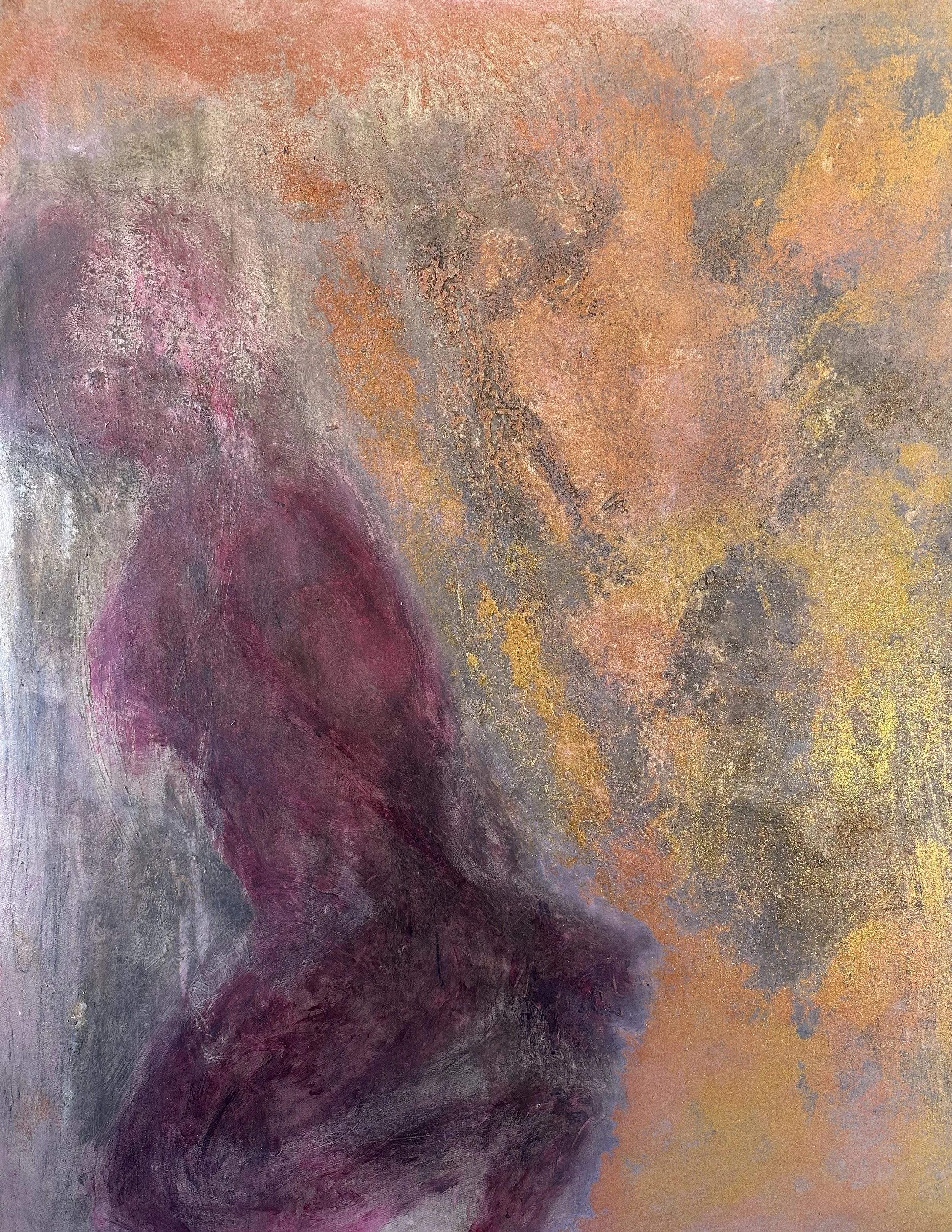
Adrian Elisheva Parr Zaretsky, BDE #9, 2024, oil and ash on canvas, 48 × 60 in. Courtesy of the artist.
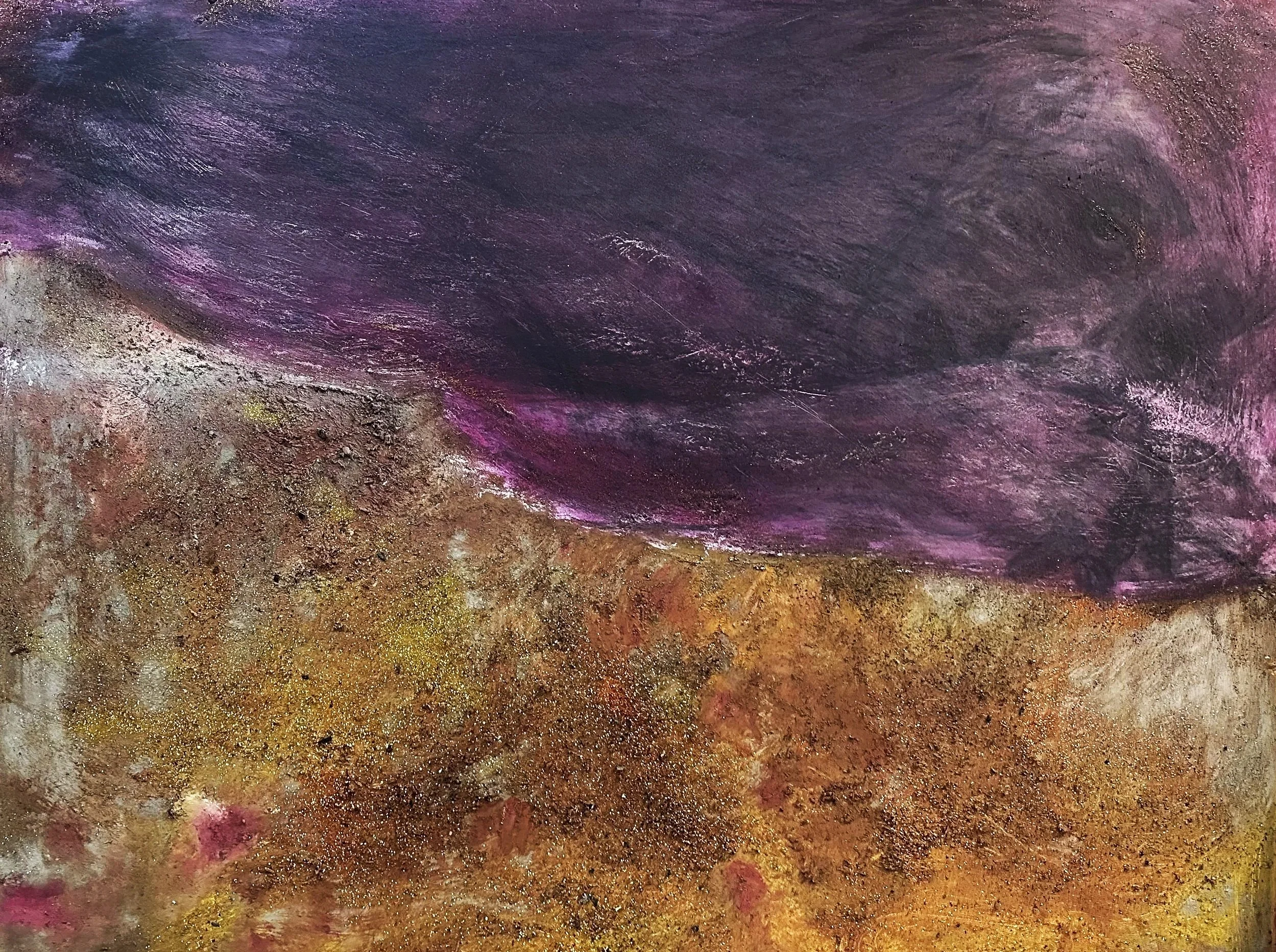
Adrian Elisheva Parr Zaretsky, BDE #2, 2024, oil and ash on canvas, 48 × 60 in. Courtesy of the artist.
Parr Zaretsky enters a much broader and increasingly urgent lineage of artists for whom earth is not simply depicted but physically enters the work. I think of South African artist Dineo Seshee Bopape, whose installations employ soil, clay, ash, and plants as repositories of memory, geography, and ancestral knowledge; Nigerian-Belgian artist Otobong Nkanga, whose Taste of a Stone (2010) and broader practice examine the unstable relationships between bodies, landscapes, extraction, and material circulation; and Taiwanese artist Su Yu-Xin, who grinds stones, shells, minerals, and earth into her own pigments, treating color itself as a record of geology, migration, and extraction. Her practice belongs to this expanded ecological field, but her materials carry a distinctly personal tension. Ash is both the remnant of a former structure and evidence of the increasingly violent wildfires of the American West. Soil contains dormant possibilities for future life. Glitter interrupts these materials with associations of celebration, femininity, fashion, and queer and trans communities.
Parr Zaretsky's use of ash also makes it difficult for me not to think about fire in the American West. I think of the Palisades Fire in Los Angeles and the Camp Fire that devastated Paradise, California, and of the increasingly urgent question of how we might better care for forests before catastrophe arrives. I learned more about Indigenous approaches to this question through Fire Kinship: Southern California Native Ecology and Art (2025) at the Fowler Museum at UCLA, an exhibition centering Tongva, Cahuilla, Luiseño, and Kumeyaay knowledge and presenting fire not simply as a destructive force, but as a generative part of ecological stewardship. Living between California and Nevada, these questions rarely remain theoretical for long. As I write this from Reno, smoke from the Elephant Fire burning near Loyalton has drifted into Northern Nevada. The air smells faintly of smoke, and the haze has altered the sky.
This morning, I hiked through Galena Forest Regional Park along the Mt. Rose Corridor of the Sierra Nevada with my cousin. Inside the forest, the Jeffrey, Washoe, and ponderosa pines seemed almost to hold the smoke between them. I do not know if they were absorbing it, but I found myself thinking about how a forest takes care of itself, how many generations of trees can inhabit the same landscape, and how human ideas of care do not always align with the needs of the living things we claim to love. Along the trail, I noticed initials carved into the bark of several trunks and branches: lovers marking their presence, insisting that a relationship be made permanent. Curious, I later searched to see whether this causes harm and learned that cutting through bark creates a wound, potentially disrupting the tissues that transport water and nutrients through the tree. The discovery brought me back to Liu Shiming's figures. His sculptures preserve the tenderness of bodies in relation, the quiet gestures through which people make love visible. Yet the initials at Galena Creek suggested another possibility: love, in its desire to leave a mark, can also become the wound through which it is written.
What emerges is an art practice built through contact: between the artist and a tree, between watercolor and gravity, between a camera and the person who chooses where it should look, and, in Venice, between Parr Zaretsky and an artist born decades earlier on the other side of the world. Intimate Unthinkables does not argue that she and Liu are alike. Its achievement is more subtle. The exhibition proposes that cultural difference does not preclude resonance and that, across histories, certain gestures remain legible: a hand pressing into clay, a woman caring for a child, a body carrying water, an artist attempting to understand another person's life without claiming ownership over it.
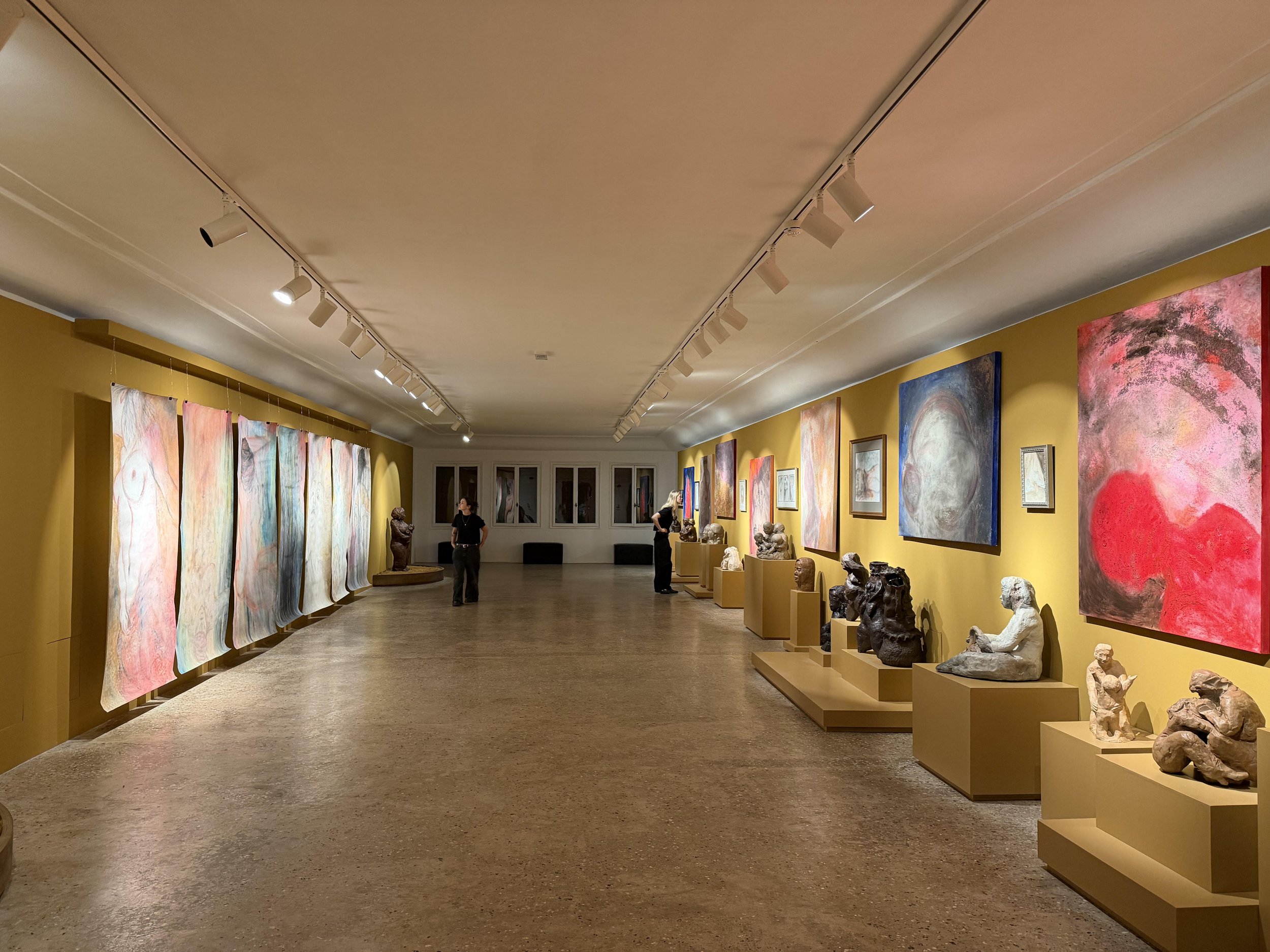
Intimate Unthinkables, 2026. Exhibition view. Courtesy of the artist.
INTERVIEW:
AMADOUR:
Your work is currently on view in Intimate Unthinkables at the European Cultural Center in Venice, Italy, and I'm excited to see it when I visit the Biennale in September. You're exhibiting alongside Chinese sculptor Liu Shiming, whose work and legacy have had a profound influence on modern Chinese art. To begin, where do I find you today?
ADRIAN ELISHEVA PARR ZARETSKY:
I'm currently in Eugene, Oregon.
AMADOUR:
Not too far from me then; we're both on the West Coast. I’m in Incline Village, Nevada, on the shore of Lake Tahoe. One of the biggest questions I had was how this pairing with Liu Shiming came about, because at first glance your practices seem quite distinct. How did that connection happen?
ADRIAN ELISHEVA PARR ZARETSKY:
I first encountered Liu Shiming's work several years ago while visiting the Liu Shiming Foundation in New York. I had gone there originally because the foundation had generously funded scholarships for our art and art history students at the University of Oregon, and I wanted to thank them personally. During that visit, I discovered their gallery and saw Liu Shiming's sculptures for the first time. As I spent time with the work, I began imagining what it might look like to enter into a dialogue with it.
AMADOUR:
That’s fascinating as a pair, and I can see how you both place emphasis on the human figure.
ADRIAN ELISHEVA PARR ZARETSKY:
Exactly. My practice has always involved conversation, whether with communities or with other artists. Much of my UNESCO work is collaborative, and I also noticed that the foundation had previously placed Liu Shiming's sculptures in conversation with contemporary artists such as Hank Willis Thomas. That inspired me to think about what kind of dialogue my work could have with the estate. Although we're separated by geography, generation, and historical context, I believe both of our practices are concerned with human vulnerability and resilience. That became the foundation for this installation.
AMADOUR:
That's fascinating. So this really began almost by chance during that visit?
ADRIAN ELISHEVA PARR ZARETSKY:
Yes. The scholarship funding brought me there, and discovering the gallery happened almost incidentally. It was only after spending time with Liu Shiming's work that I began imagining this conversation between our practices.
AMADOUR:
Your work incorporates oil, watercolor, pencil, pastel, and I was especially curious about the use of soil. It seems to bring the work back into direct conversation with the earth. How did you begin working with those materials?
ADRIAN ELISHEVA PARR ZARETSKY:
The canvases are built from oil paint mixed with soil, forest debris, ash, and glitter. Sometimes I literally drag the canvases through the forest or across the earth. With the paper works, I'll rub them against trees so they collect resin. That resin creates resistance when I begin drawing because I'm suddenly negotiating with another material that has entered the work on its own terms. Ultimately, I'm interested in the porous boundary between human and nonhuman worlds. The process itself becomes a way of thinking through vulnerability and attachment. Ash, for example, represents the remains of something that once had a fixed form. It's the residue left behind after transformation. Living here in Oregon, that's impossible to separate from the increasing wildfires across the American West. When I first arrived five years ago, the region had just experienced devastating fires.
AMADOUR:
The fires have truly been increasing across the West.
ADRIAN ELISHEVA PARR ZARETSKY:
At the same time, ash also points toward another kind of transformation. It becomes material evidence of ecological change. Soil is equally alive. It isn't simply inert matter; it contains countless possibilities for future life that haven't yet emerged. I love that layer of meaning embedded within the material itself. When all of these materials are combined with oil paint, they create thick, heavily textured surfaces. Then glitter enters the composition as something completely different. Without reducing it to stereotypes, glitter carries associations with celebration, fashion, femininity, and queer and trans communities. It introduces joy into the work, creating a conversation between ecological reality, celebration, and the slower, contemplative nature of oil painting, which requires patience as each layer dries. With watercolor, I often dilute it heavily, so I lose complete control. The paint begins acting according to its own logic. It develops its own agency, and that loss of control deeply interests me. Questions of agency and ethics are central not only to my artistic practice but also to my broader work in cultural production.
AMADOUR:
Interestingly enough, I recently discovered the work of Japanese artist Yukinori Yanagi, whose installations use living ant colonies moving through plexiglass networks that trace national flags. I've been thinking about his work recently because it raises questions about how we use living systems within art and what ethical responsibilities accompany those decisions. Listening to you speak about forests also makes me think about environmental stewardship. Who decides how a forest should exist? Should it be left untouched? Should it be actively managed? Historically, many forests experienced natural cycles of fire, but today those questions have become much more complicated. How do you think about contemporary forest management?
ADRIAN ELISHEVA PARR ZARETSKY:
That's a particularly interesting question here in Oregon because many of my colleagues at the University of Oregon research sustainable forest management. Coming originally from Australia, I've also learned a great deal from Indigenous knowledge about how forests have traditionally been managed. One important example is controlled burning. Carefully managed burns remove the thin layers of scrub and young vegetation that become highly flammable. That practice has long been part of Indigenous approaches to caring for forests. Because of that history, I don't think leaving forests entirely untouched is necessarily the most natural approach. Historically, many ecosystems evolved alongside regular cycles of burning. Without that process, forests accumulate enormous amounts of combustible material, making fires dramatically more destructive. At the same time, we can't ignore the reality that climate change has fundamentally altered these conditions. Hotter temperatures and prolonged drought have made contemporary fires far more extreme than those of the past. Addressing these challenges requires multiple forms of knowledge. We need to learn from Indigenous elders whose expertise has been developed over thousands of years, while also embracing new technologies—sensor systems, monitoring tools, and other scientific approaches—that help us better understand what's happening within forests. One of the challenges with today's fires is that they can continue burning underground long after the visible flames disappear. Those hidden fires can later reignite elsewhere; we're facing extraordinarily complex environmental problems, and solving them will require genuinely interdisciplinary thinking. No single discipline has all the answers.
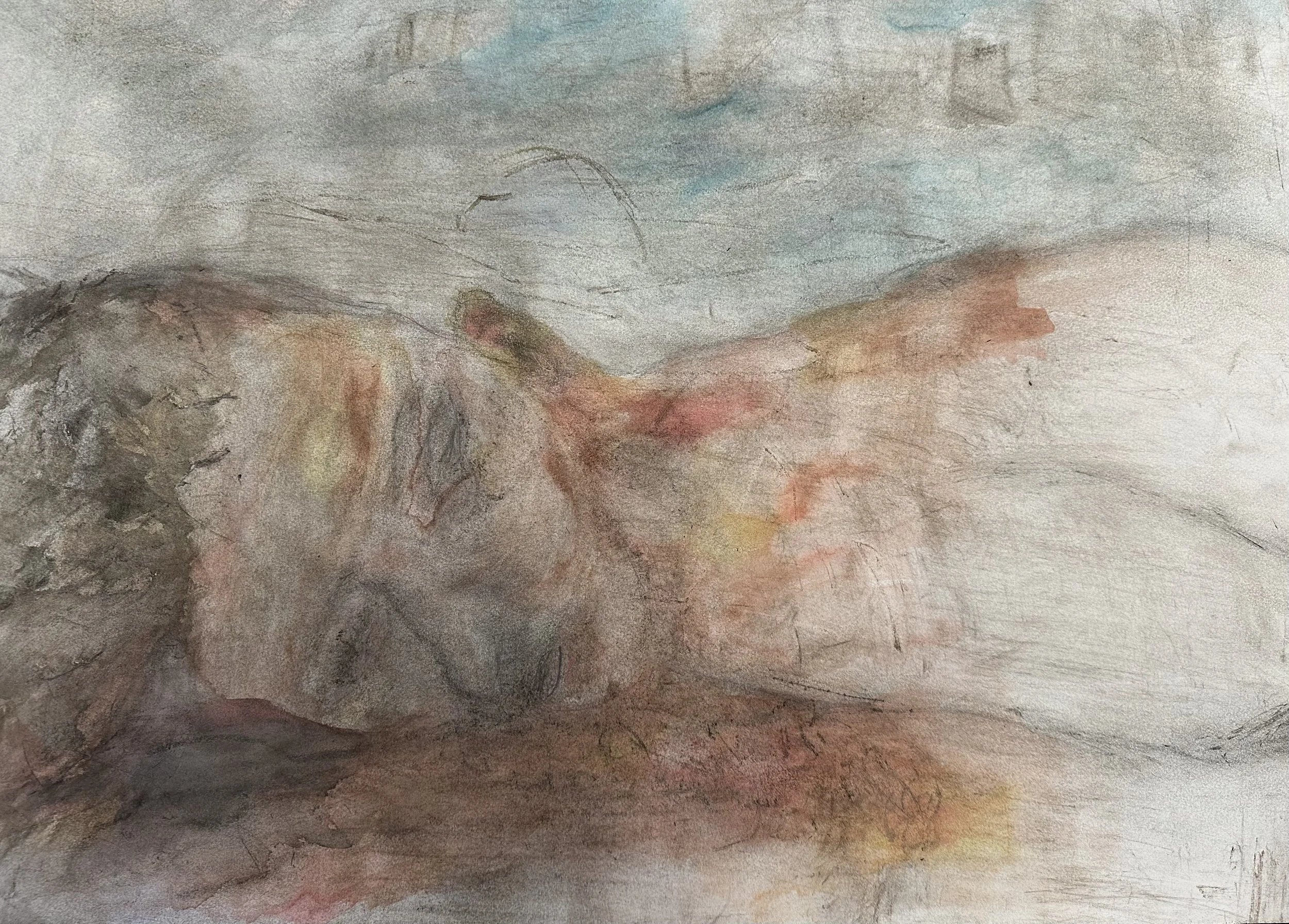
Adrian Elisheva Parr Zaretsky, No Name #2, 18” x 24”, watercolor, pencil, pastel, and soil on paper. Courtesy of the artist.
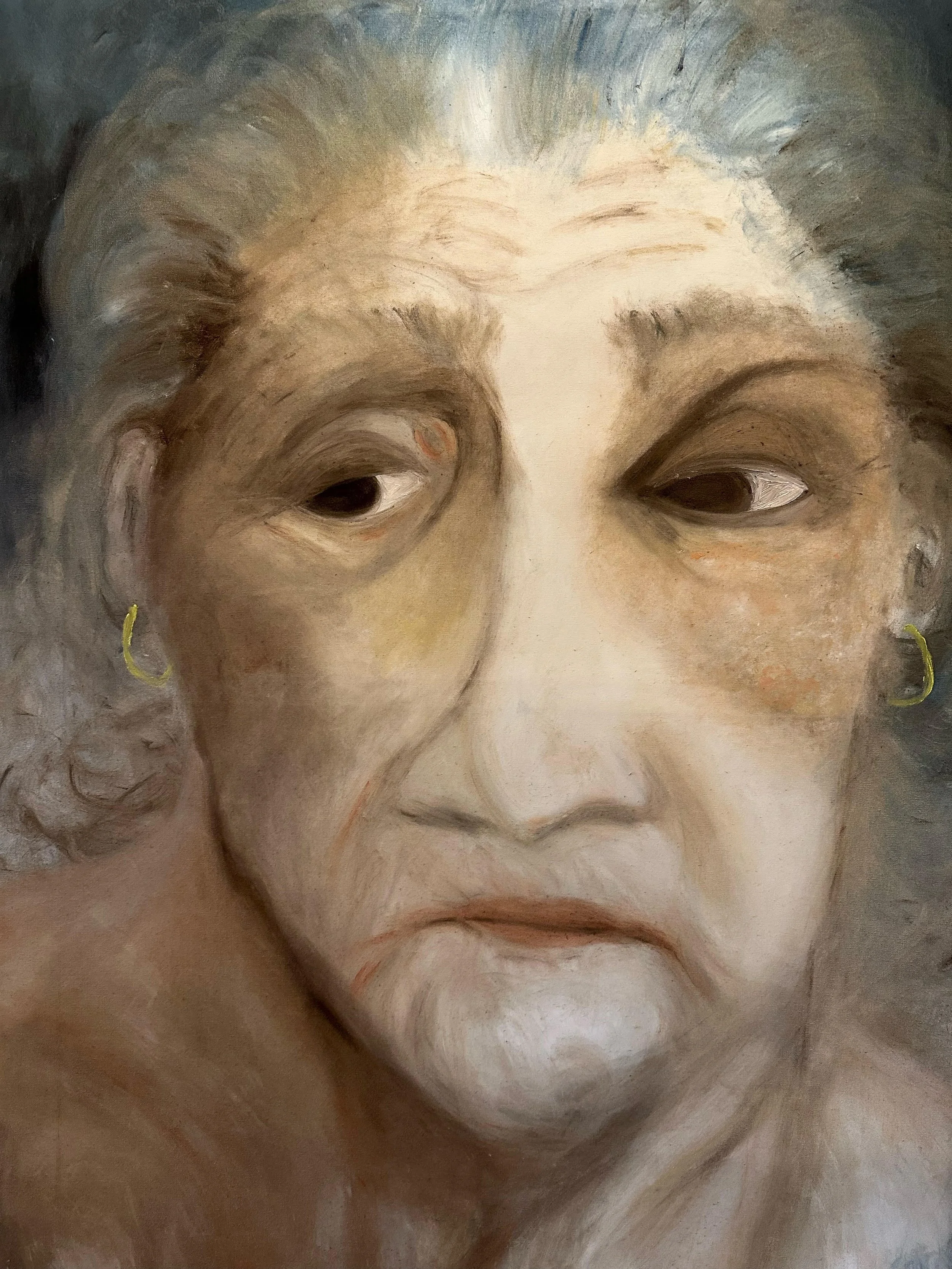
Adrian Elisheva Parr Zaretsky, Batsheva, 2023, from the Stop Right There series, oil on canvas, 48 × 60 in. Exhibited at the European Cultural Center, 2023. Courtesy of the artist.
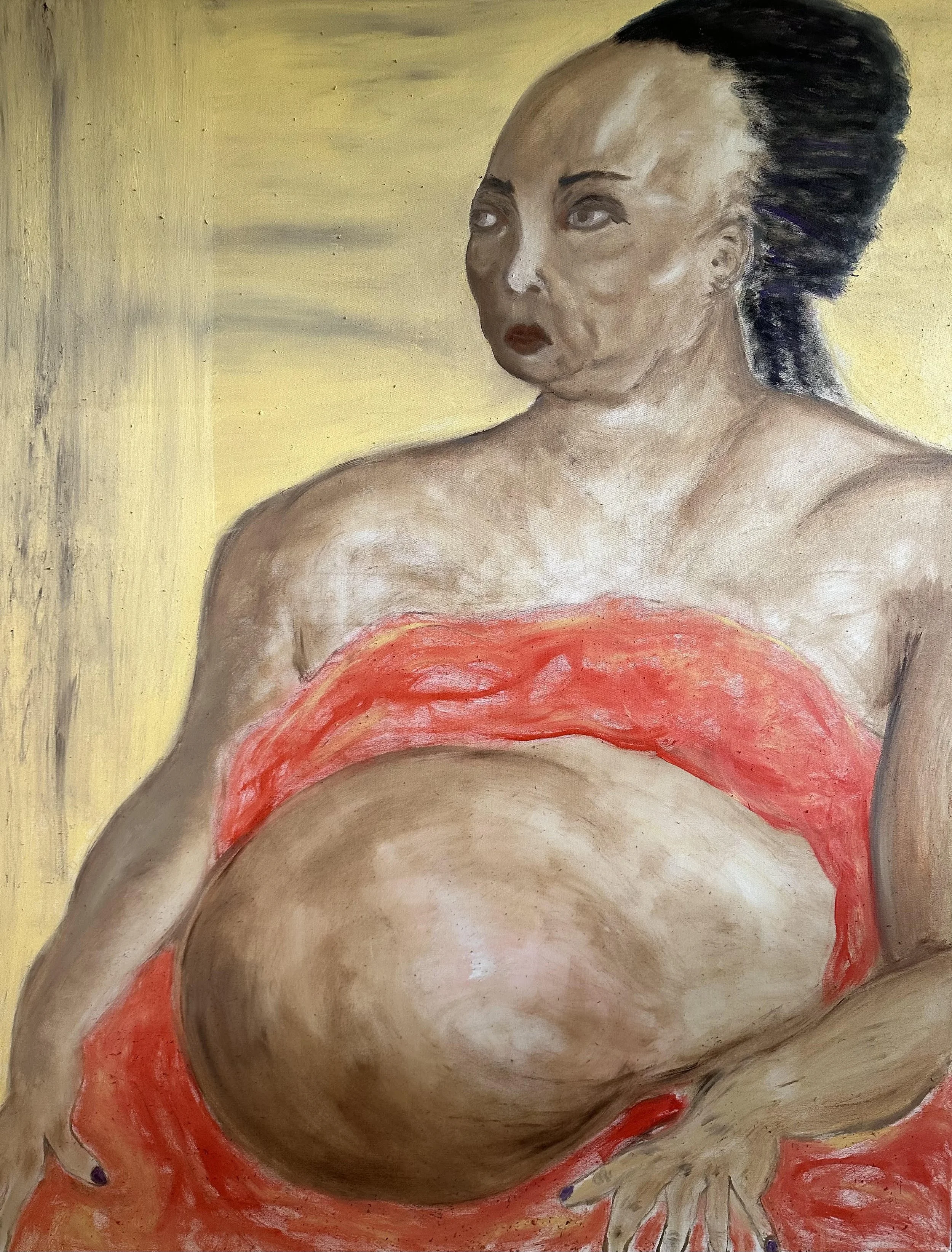
Adrian Elisheva Parr Zaretsky, Afraimah, 2023, from the Stop Right There series, oil on canvas, 48 × 60 in. Exhibited at the European Cultural Center, 2023. Courtesy of the artist.
AMADOUR:
I find that fascinating, especially your point about Indigenous knowledge systems. Speaking of Australia, where are you originally from?
ADRIAN ELISHEVA PARR ZARETSKY:
I grew up in Sydney before spending part of my education in Vienna. I later completed my PhD at Monash University in Melbourne and also spent time in Florence at Harvard's Center for Renaissance Studies, Villa I Tatti, studying their collections. So while Sydney is home, my education has taken me to quite a few places.
AMADOUR:
I love that. I actually traveled through Australia a couple of years ago. I made it to Uluru and Kata Tjuta, drove across the Outback from Adelaide through Coober Pedy to the Northern Territory, and had the opportunity to spend time learning about Aboriginal communities. That experience really changed how I thought about land management and Indigenous knowledge. When you mention controlled burning, are you primarily referring to the Australian bush, or does that extend into other ecosystems as well?
ADRIAN ELISHEVA PARR ZARETSKY:
Primarily the Australian bush, because those landscapes have evolved alongside regular fire cycles. The important distinction is that these are controlled burns. The goal isn't to destroy the forest but to remove the dry undergrowth before it accumulates into dangerous fuel. From what I understand, the heat from the fire also creates a protective charred layer around eucalyptus trees. The bark becomes charred, but the tree's interior remains alive, and that process can help protect the trees against future fires. It's an extraordinary practice that Indigenous Australians developed over thousands of years before European colonization. Fortunately, as Australia has continued its work on Aboriginal reconciliation, there has been a growing willingness to listen to Indigenous elders and to recognize that their knowledge offers invaluable guidance in confronting today's environmental challenges.
AMADOUR:
Returning to your exhibition in Venice, your painting No Name Number Two is presented alongside Liu Shiming's sculpture In Love. How did you decide which works would be placed in dialogue? Was that a curatorial collaboration, or did it emerge from your own research?
ADRIAN ELISHEVA PARR ZARETSKY:
It really emerged through research. I traveled to Beijing, where Liu Shiming's archive is housed, and spent several days studying more than four hundred sculptures. I knew from the beginning that I needed parameters, or the project would have been overwhelming, so I decided to focus specifically on women's experiences, which became the guiding framework for selecting works. From there, I was especially drawn to sculptures depicting ordinary moments in women's lives—washing, caring for children, feeding families, those kinds of everyday experiences. I was also interested in works where you could still feel Liu Shiming's physical interaction with the clay: sculptures that preserved the traces of his hands rather than appearing overly polished. Although some of the busts reveal his interest in French Realism, many of the sculptures retain an incredible immediacy. You can sense both the artist's body and the material itself interacting. I also found it fascinating that Liu Shiming frequently used clay he collected himself from the rural places in China where he was working. That relationship between local material and artistic practice deeply resonated with my own work.
AMADOUR:
I love that approach to field research: traveling directly to the archive and immersing yourself in the material before making any decisions. Liu Shiming was relatively new to me as well, and what strikes me is how an artist can become canonical within one cultural context while remaining largely unknown in another. The exhibition creates a dialogue between distinct art-historical contexts, bringing those histories together in Venice before an international audience. That also connects to another part of your practice that I wanted to ask about: your documentaries The Intimate Realities of Water and Thirsty and Drowning in America. Water seems to be becoming another central material in your work, politically and socially. I'm curious how those projects developed.
ADRIAN ELISHEVA PARR ZARETSKY:
Those documentary projects are closely connected to my work as a UNESCO Chair, where I focus on the social, ethical, and cultural dimensions of sustainability. Much of that work centers on water rights and the impacts of climate change, particularly rising sea levels. While my UNESCO work often operates through research, education, and policy, my artistic practice explores many of the same questions through different means. The two approaches constantly inform one another. Interestingly, the documentaries themselves began almost by accident. I had spent four years working in and out of informal settlements in Nairobi, primarily with women, trying to better understand issues surrounding water and sanitation. The original research wasn't about filmmaking at all. It was about understanding why newly constructed water and sanitation facilities—technically excellent engineering solutions—weren't being widely used by women. I became interested in what culturally appropriate engineering and design might look like. Rather than assuming the infrastructure simply needed to exist, I wanted to understand how these facilities could be designed so women actually felt comfortable using them: safety was a major concern. The architecture itself often felt intimidating. Many of the structures were built as purely utilitarian concrete buildings, without regard for local cultural preferences, everyday patterns of use, or even the emotional experience of entering those spaces. I spent a great deal of time speaking with women in the community about how those facilities could be redesigned to feel safer and more welcoming through materials, colors, and forms that more closely resonated with their lived experience.
AMADOUR:
A mentor of mine, Toni Harsh, recently said to me, “Educate a woman, you educate a family.” I think about how that idea also applies to infrastructure. When infrastructure is designed around women's safety, needs, and well-being, the benefits can extend throughout entire families and communities.
ADRIAN ELISHEVA PARR ZARETSKY:
Yes, and as that research progressed, UNESCO understandably asked me to formally document the work. That meant going through the university's ethics review process, working with translators, preparing standardized interview questions, collecting data, and asking participants to sign consent forms. When I returned to the communities with those requirements, something immediately felt wrong. By that point, I had already built genuine relationships with many of these women. Suddenly introducing translators, questionnaires, and official paperwork created distance between us. I realized that the research methodology itself reflected a deeply colonial way of producing knowledge. Many of the women were illiterate and couldn't actually read the consent forms they were being asked to sign; some couldn't even write their own names. I found myself asking what meaningful consent could possibly look like under those circumstances.
AMADOUR:
That's so true. Sometimes the methodology itself can create distance from the very people you're trying to understand. Treating others with closeness and empathy can fundamentally change how knowledge is gathered.
ADRIAN ELISHEVA PARR ZARETSKY:
And so I stopped the research. Instead, I gathered the women together in community centers in Kibera and Dagoretti and simply asked them how they wanted their stories to be told. Rather than imposing a method, I wanted them to shape the process themselves. Together we decided that I would bring only a camera—not an entire film crew—and that they would guide both me and the camera through their communities. They would decide what stories were important, where we would go, and what they wanted to share. That decision became the foundation for The Intimate Realities of Water. It was my first documentary. Before submitting it to film festivals or screening it internationally, I took it back to the communities where it had been made. We organized a public screening at the community center, and it was one of the most moving experiences I've ever had. The women dressed beautifully for the occasion, bringing their children, friends, and neighbors together. There was this mixture of excitement and shyness as they watched themselves and one another appear on screen.
AMADOUR:
What I admire most is the way you make people feel seen. When I think about the women you worked with in Nairobi, the lack of resources they're navigating can be almost unimaginable from the perspective of much of Europe or the United States. Many of us take basic infrastructure for granted. At the same time, we live in a culture where we're constantly documenting ourselves through phones and social media. We see ourselves reflected everywhere. To imagine a community gathering together, dressing up, and watching themselves on film, perhaps for the first time, is incredibly moving. I don't think many people in the twenty-first century realize there are still communities without consistent access to the internet, electricity, or many of the technologies we assume are universal.
ADRIAN ELISHEVA PARR ZARETSKY:
Absolutely. During my time there, I wasn't simply conducting research. I was spending entire days in the settlements helping with daily life—washing clothes by hand, collecting water, cooking meals, caring for children. There was also a great deal of humor because I was obviously much less skilled than they were at many of those everyday tasks. We laughed constantly while working together, and those moments of shared laughter found their way into the film. Afterward, the documentary was screened through UNESCO during a COP conference [COP (Conference of the Parties) is a global meeting where leaders from countries all over the world gather to negotiate, update, and enforce international agreements], where it became part of broader conversations about water, sustainability, and community-led research. It then entered the international film festival circuit, where, somewhat unexpectedly, it received several awards. One of the things I found fascinating while working in Kenya—and also in Tanzania—was the ingenuity people demonstrated with very limited resources. You might find a tiny solar panel sitting on top of a small hut in what appeared to be the middle of nowhere. Someone would turn that into a small business where people from surrounding villages could come and charge their phones. Those phones weren't necessarily being used for social media. Often they were essential for banking and everyday economic activity because mobile banking had become such an important part of daily life. People were constantly finding creative ways to make systems work despite very limited infrastructure. It was an extraordinary experience.
AMADOUR:
And I don't mean to generalize anyone's experience. Of course, people in Kenya use social media and digital technologies, just as access to the internet and electricity remains unequal even within the United States. Those disparities continue to shape people's lives in profound ways.
ADRIAN ELISHEVA PARR ZARETSKY:
Building those relationships required years. What you've just pointed out is actually one of the central lessons I learned—not only while working with Indigenous communities in the United States but also in the informal settlements in Kenya. These are not homogeneous populations. That became one of my major arguments to the United Nations. When we categorize people simply as "slum populations" or "informal settlement communities," we flatten enormous social complexity into a single label. The category itself produces stereotypes and prevents us from understanding how these communities actually function internally. Without recognizing that complexity, it's very difficult for international policy to address the problems it hopes to solve. One of the most surprising discoveries from my research was the existence of clear social hierarchies within Nairobi's informal settlements. Families whose grandparents had lived there for generations possessed greater social, economic, political, and cultural capital than newer arrivals. They often occupied areas that were less vulnerable to flooding and other environmental hazards. When the Millennium Development Goals [the United Nations' eight global development targets for 2000 to 2015, focused on poverty, health, education, and inequality] introduced new infrastructure, water pumps, sanitation facilities, and electricity, it unquestionably improved many aspects of daily life.
AMADOUR:
It's a remarkable piece of history. The Millennium Development Goals essentially transformed global development from a broad aspiration into a unified, data-driven framework for measuring improvements in human life.
ADRIAN ELISHEVA PARR ZARETSKY:
But because policymakers treated the settlements as homogeneous communities, they overlooked how those improvements would interact with existing social inequalities. Many long-term residents actually owned the shacks they lived in, along with several neighboring structures, which they rented to newly arrived families. When electricity reached those homes, landlords could advertise that the property now had access to electricity. But it was often the tenant, not the landlord, who had to pay to connect the electricity. Many couldn't afford to use it even after paying for the installation. At the same time, rent increased because the property now offered improved infrastructure. The same thing happened with water. Homes near newly installed water pumps became more desirable, driving rents upward. Families who could no longer afford those higher rents were pushed farther from the city center, where they established entirely new informal settlements. Ironically, development projects intended to reduce inequality sometimes contributed to the creation of new forms of displacement. Those families also lost proximity to employment. Many residents worked as cleaners, gardeners, childcare providers, or domestic workers for wealthier households in Nairobi. Once they were forced farther outside the city, those jobs became much more difficult to reach. So they experienced multiple layers of disadvantage simultaneously. That was one of the major findings my research tried to bring into conversations surrounding the Millennium Development Goals. The statistics showed that more people had gained access to water and electricity. At the same time, however, informal settlements continued to expand. My work suggested that rising rents and internal displacement were part of the explanation.
AMADOUR:
You can hear how profoundly that experience affected you. How did those lessons carry into your second documentary, Thirsty and Drowning in America?
ADRIAN ELISHEVA PARR ZARETSKY:
The response from UNESCO was equally important. They saw the project as an alternative model for approaching sensitive cross-cultural issues—one that emphasized collaboration rather than extraction. That experience eventually led to my second documentary, Thirsty and Drowning in America, which focused on water justice in three Native American communities across the United States. It took several years to complete, largely because I wanted to build genuine relationships with the communities involved. Before I could begin filming, I first needed the approval of tribal elders in each community, and that process understandably required time. The documentary follows three Indigenous communities confronting very different manifestations of the same environmental crisis. In Louisiana, I worked with the Isle de Jean Charles Biloxi-Chitimacha-Choctaw Tribe, whose homeland is steadily disappearing beneath rising seas and increasingly severe hurricanes. From there I traveled north to Shishmaref, Alaska, where I worked with the community's Indigenous woman mayor. Entire sections of the island were literally being claimed by the ocean. Homes were disappearing as coastlines eroded, and climate change was no longer an abstract future problem; it had become an everyday reality. She shared stories that have stayed with me ever since. One involved her uncle, who had gone seal hunting in the traditional way, traveling across sea ice with his dog sled. While he was out hunting, the ice suddenly fractured beneath him. He drifted into the Chukchi Sea, surviving for weeks by sucking moisture from the ice until he eventually floated close enough to shore to swim through freezing water back to land. Even then, he couldn't simply walk inside. His family had to warm his body gradually over the course of nearly a week because bringing him indoors too quickly could have sent his body into shock. He survived. Many others did not. Those were stories almost entirely absent from mainstream media, despite revealing how profoundly climate change was already transforming Indigenous lives.
AMADOUR:
These stories remain largely absent from mainstream media, which is precisely why they feel so essential. Thinking about the Native American communities you worked with, what strikes me is how distinct each one is. Indigenous communities are so often discussed collectively, yet every nation has its own history, culture, and environmental realities. Bringing those stories together must have taken an enormous amount of time.
ADRIAN ELISHEVA PARR ZARETSKY:
Yes, exactly that! The third community I worked with was at Standing Rock during the Dakota Access Pipeline protests. I spent time with LaDonna Brave Bull Allard and other community members discussing their concerns about the pipeline and its potential impact on their water supply. Their fears centered not simply on environmental damage but on protecting water as a sacred resource fundamental to their people's survival. Like The Intimate Realities of Water, the documentary was first shared with UNESCO before entering the international film festival circuit, where it also received several awards. For me, however, these documentaries are never separate from my artistic practice. My work as a UNESCO Chair asks how we might create more sustainable and just futures through research, education, and policy. My artwork asks many of those same questions through painting, installation, and visual language. The Venice exhibition, for example, explores care, intimacy, imagination, and cross-cultural dialogue as essential resources for navigating ecological and social uncertainty. Ultimately, sustainability isn't simply a technical problem to solve. It's also a profoundly cultural and human question. Art allows us to imagine new ways of living together.
AMADOUR:
That's impressive. These are exactly the kinds of stories that need to be told because they reveal forms of inequality that don't necessarily appear in statistics alone. What you're doing feels almost like fact-checking institutions, not in an adversarial sense, but by showing where lived experience complicates official narratives. Organizations like UNESCO do extraordinary work, but they also need people willing to continually reassess whether their approaches are producing the intended outcomes. As someone serving as a UNESCO Chair, I think that's exactly the perspective I'd want to hear.
ADRIAN ELISHEVA PARR ZARETSKY:
Thank you, I think it ultimately comes down to nuance. And I really appreciated something you said a moment ago, that without understanding, there can never be dignity. Those two ideas belong together. Without genuinely understanding people's lives, it's impossible to treat them with the dignity they deserve.