AMADOUR’S ‘NEVADA PROSCENIUM’ AT TRUCKEE MEADOWS COMMUNITY COLLEGE, RENO, NEVADA: AN EXHIBITION ESSAY
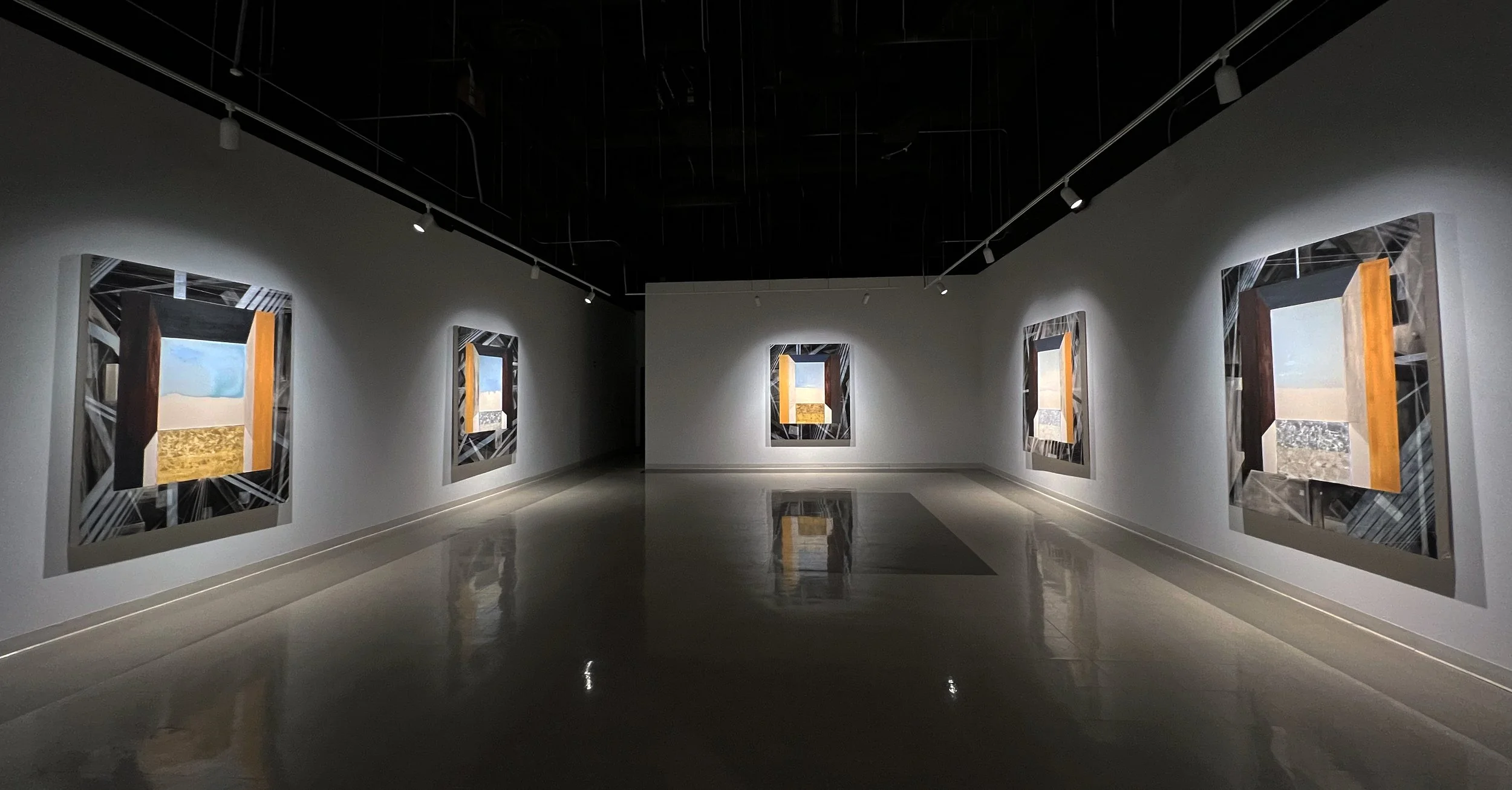
Amadour: Nevada Proscenium at Truckee Meadows Community College, Reno, Nevada. Courtesy of the artist.
Written on the occasion of Amadour: Nevada Proscenium, presented at Truckee Meadows Community College Main Gallery, Reno, Nevada (May 18–June 18, 2026).
Amadour: Nevada Proscenium at Truckee Meadows Community College (TMCC) is a solo exhibition and ongoing painting series that positions Nevada as an active stage: structured through geometric abstraction and shaped by the continuous construction of visibility, labor, and value within its landscape. Rejecting the myth of Nevada as a blank frontier, the work asserts that the land is ancient, ecologically complex, and defined by layered histories. Here, Nevada is not a passive backdrop but a central subject in which American identity and presence are negotiated and made visible.
At its core, Nevada Proscenium argues that systems of extraction shape not only landscapes but visibility itself, determining whose labor, histories, and futures are permitted to appear. Abstraction intervenes where representation might seduce. By refusing pictorial resolution, geometry holds violence in view without rendering it consumable.
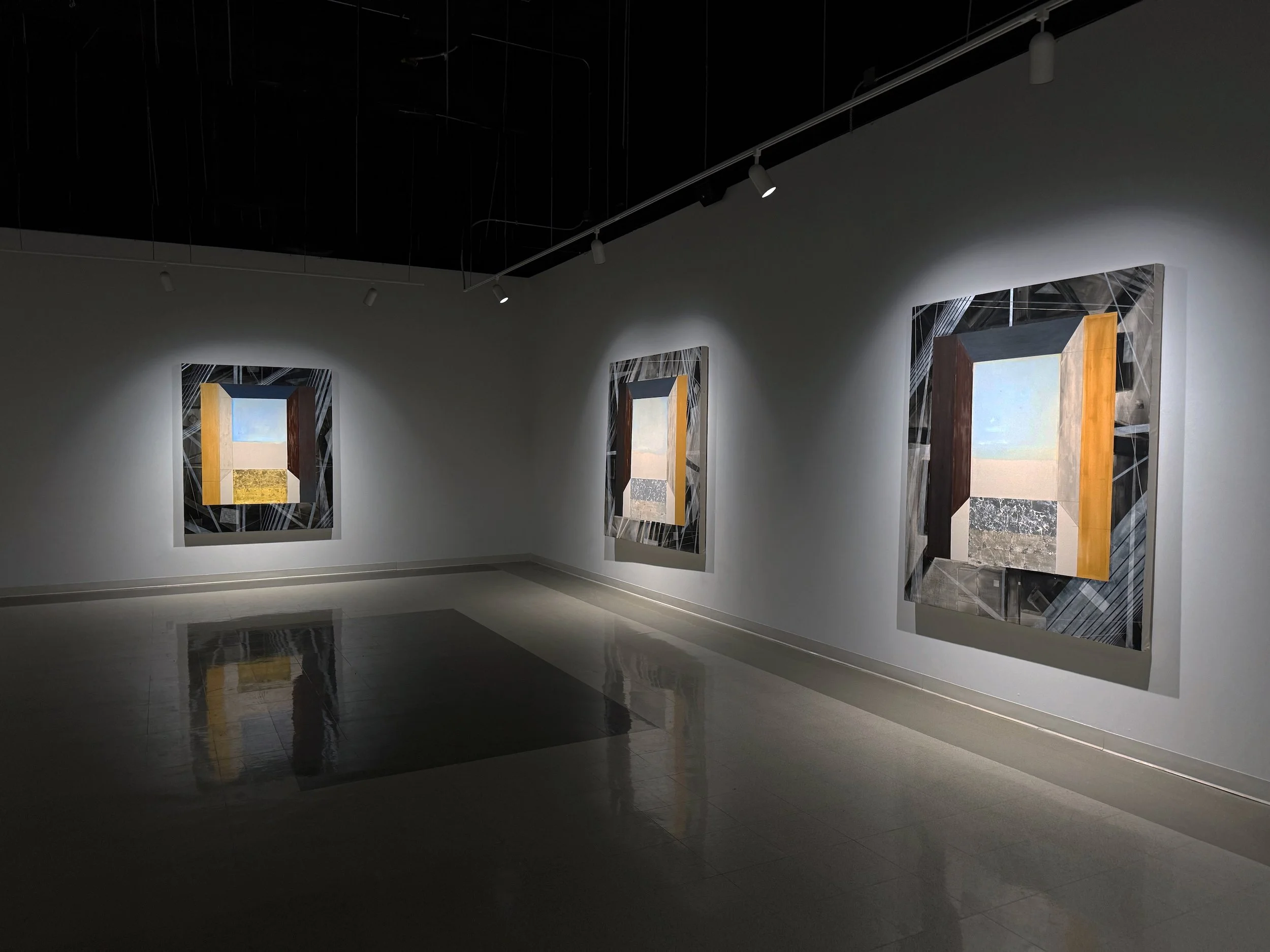
Amadour: Nevada Proscenium at Truckee Meadows Community College, Reno, Nevada. Courtesy of the artist.
The exhibition’s site at TMCC in Reno is deeply personal. Community colleges in Nevada have long served as vital access points for first-generation and Latinx students. As a former high school dropout who earned a GED at TMCC, returning to this institution marks a full-circle moment: my first solo institutional exhibition and my first exhibition in Nevada. The location echoes the project’s central concerns of visibility, return, and the construction of opportunity.
Nevada has been among the fastest-growing states for Latinx communities in recent decades, yet this demographic reality is often underrepresented within dominant historical narratives. Frontier mythology continues to overshadow the communities that have sustained the state’s industries, schools, and labor systems. This series centers Latinx experience not to exclude other histories but to address a persistent absence within how Nevada has been represented. Latinx presence has shaped the state from extractive economies to contemporary civic life long before it was formally acknowledged.
Mining is central to this inquiry. Nevada’s identity has long been tied to extraction, reducing land to resource and progress to spectacle while obscuring the labor that made such development possible. The work reflects on workers whose contributions remain largely unrecorded, including labor histories connected to the Mexican Mine in Virginia City and the broader workforce that sustained the Comstock Lode. Their absence from official histories becomes a structural absence within the paintings themselves.
Long before statehood, Nevada existed as Indigenous land stewarded by nations including the Washoe (Wašiw), Northern Paiute (Numu), Western Shoshone (Newe), and Southern Paiute (Nuwuvi), whose environmental knowledge shaped this region across millennia. Following colonization and periods of Mexican and American territorial control, extraction transformed the landscape at extraordinary speed. The Comstock era depended on systems of labor and movement that reached across borders and communities.
This history extends beyond the mine itself. The square-set timbering system developed in Virginia City in 1860 transformed underground extraction through modular wooden frameworks that allowed mining at unprecedented depths. These systems consumed immense quantities of timber harvested from the Sierra Nevada and Lake Tahoe basin, contributing to the large-scale destruction of old-growth forests.
Laborers including Latinx, Asian, Indigenous, Irish, Chinese, and immigrant communities participated in the construction, transport, and maintenance of these systems. Yet public memory has often privileged narratives of expansion while minimizing many workers whose labor materially sustained Nevada’s rise. The wealth generated through extraction helped connect Nevada to broader systems of finance, infrastructure, and political power during the nineteenth century. These transformations extended far beyond Virginia City and shaped Reno, San Francisco, and the development of the American West.
As a first-generation Colombian and Mexican American, these histories are lived, not abstract. The rectangle operates both as formal structure and cultural metaphor, suggesting containment, passage, surveillance, and architecture. The horizon meets the viewer at eye level, positioning the body within the work rather than outside it. The rectangle also references mine architecture itself: the modular logic that translated earth into a grid designed for stabilization and extraction.
This geometric logic reshaped not only underground space but social space as well.
The mine, the school, and the museum become parallel architectures through which value is assigned.
As an artist working in Nevada, I find it essential to consider how institutional systems continue to structure visibility in the present.
Nevada’s educational landscape remains marked by uneven access, particularly in Title I schools where large percentages of students qualify for free or reduced lunch. Access to visual art, music, and physical education remains inconsistent across communities, leaving many students with limited opportunities to encounter cultural production as part of everyday life.
For me, arts education cannot be separated from questions of land, labor, and historical memory. The same structures that determine which histories are preserved often shape who receives access to imagination in the present. This exhibition therefore extends beyond historical recovery and asks what futures become possible when cultural participation is understood as essential rather than supplemental.
The project is inseparable from the ecology of the Great Basin. For thousands of years, Indigenous peoples stewarded this region through sustained environmental knowledge. Unlike most landscapes in North America, the Great Basin does not drain into the ocean. Water remains inland, ending in salt flats and terminal lakes where it evaporates. This closed system produces accumulation rather than release: minerals, residues, and histories remain embedded in place.
As a result, damage in the Great Basin is slow to disappear. What is taken quickly may take centuries to recover, if at all. The land is not empty but saturated with memory, labor, and consequence. Nevada Proscenium situates abstraction within this environment, where what is unseen continues to shape what remains.
The work is informed by artists who use structure as a method of perception. Geometry becomes both architecture and sanctuary. Colombian painter Ana Mercedes Hoyos’s Ventana series (1970s–1980s) treats the window as a site where interior life, light, and cultural memory intersect. Southern California painter Helen Lundeberg (1908–1999) constructed landscapes from imagination and projection rather than travel, creating spaces defined by distance and interiority. Agnes Martin (1912–2004) proposed abstraction as a site of contemplation and emotional orientation rather than pure formalism through restrained fields and subtle spatial relationships.
Together, these approaches model different ways of constructing place through perception, memory, and distance that underlie my own relationship to Nevada. The project also engages the modular logics of Sol LeWitt (1928–2007) and Channa Horwitz (1932–2013) through seriality, repetition, and the visualization of time through strict formal constraints. Geometry in Nevada Proscenium is therefore not treated as neutrality but as a method for understanding how landscapes, institutions, and histories become structured and experienced.
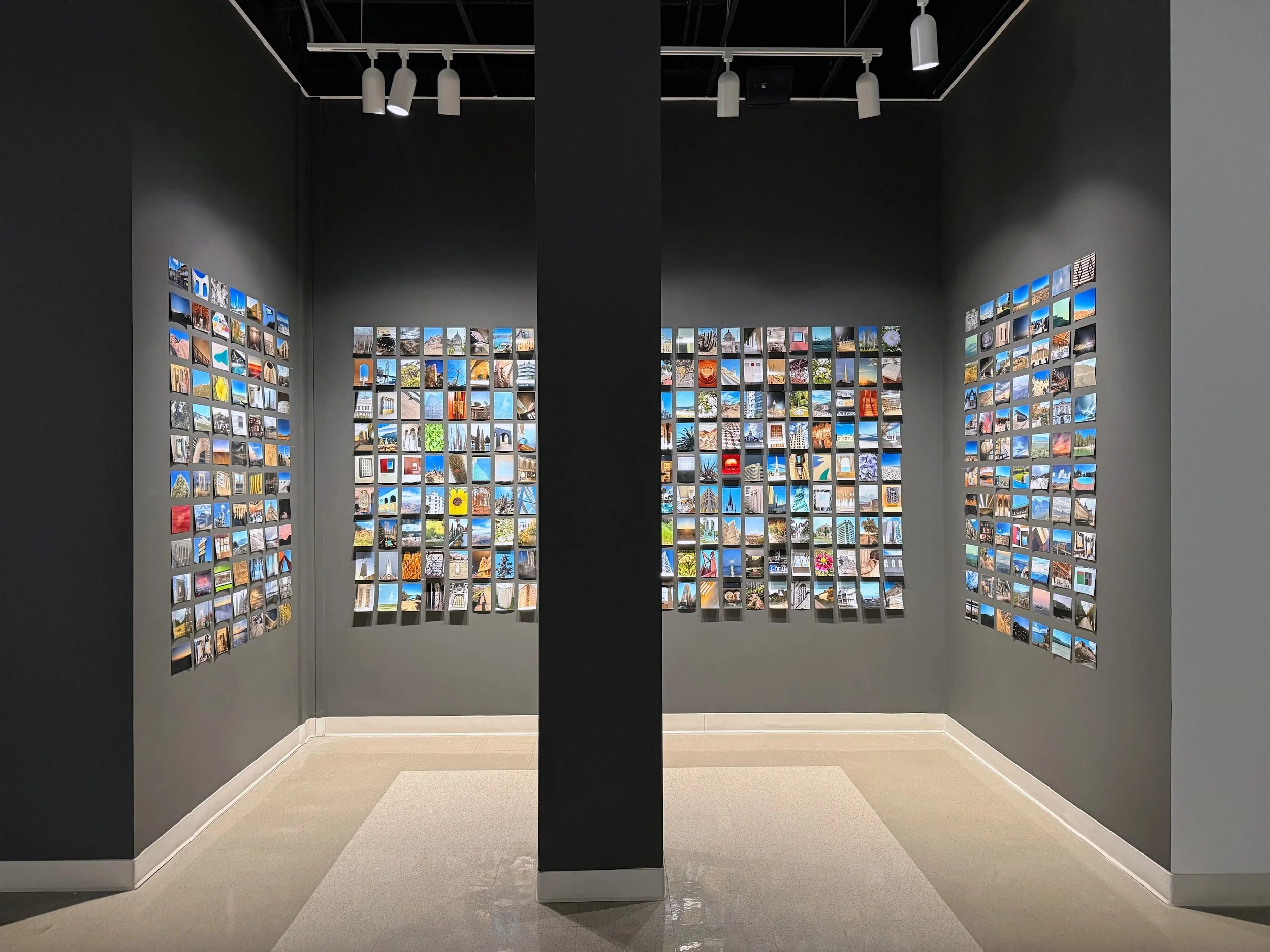
Installed alongside the paintings, the Nevada Proscenium Cartographic Archive (2026) functions as a parallel work and an entry point into abstraction. Composed of hundreds of photographs collected across my travels, the archive documents architecture, infrastructure, landscapes, mines, interiors, cemeteries, coastlines, and moments of spatial encounter that informed the exhibition’s visual language. Presented as a grid, the archive proposes mapping not as orientation alone but as a record of perception.
The archive draws in part from my engagement with Nancy Holt’s Western Graveyards (1968–1969), which I previously examined through an essay for the Holt/Smithson Foundation, and from the documentary and performative methodologies of Sophie Calle (1953–). Rather than illustrating the paintings, these images operate as traces and coordinates that reveal how observation becomes abstraction.
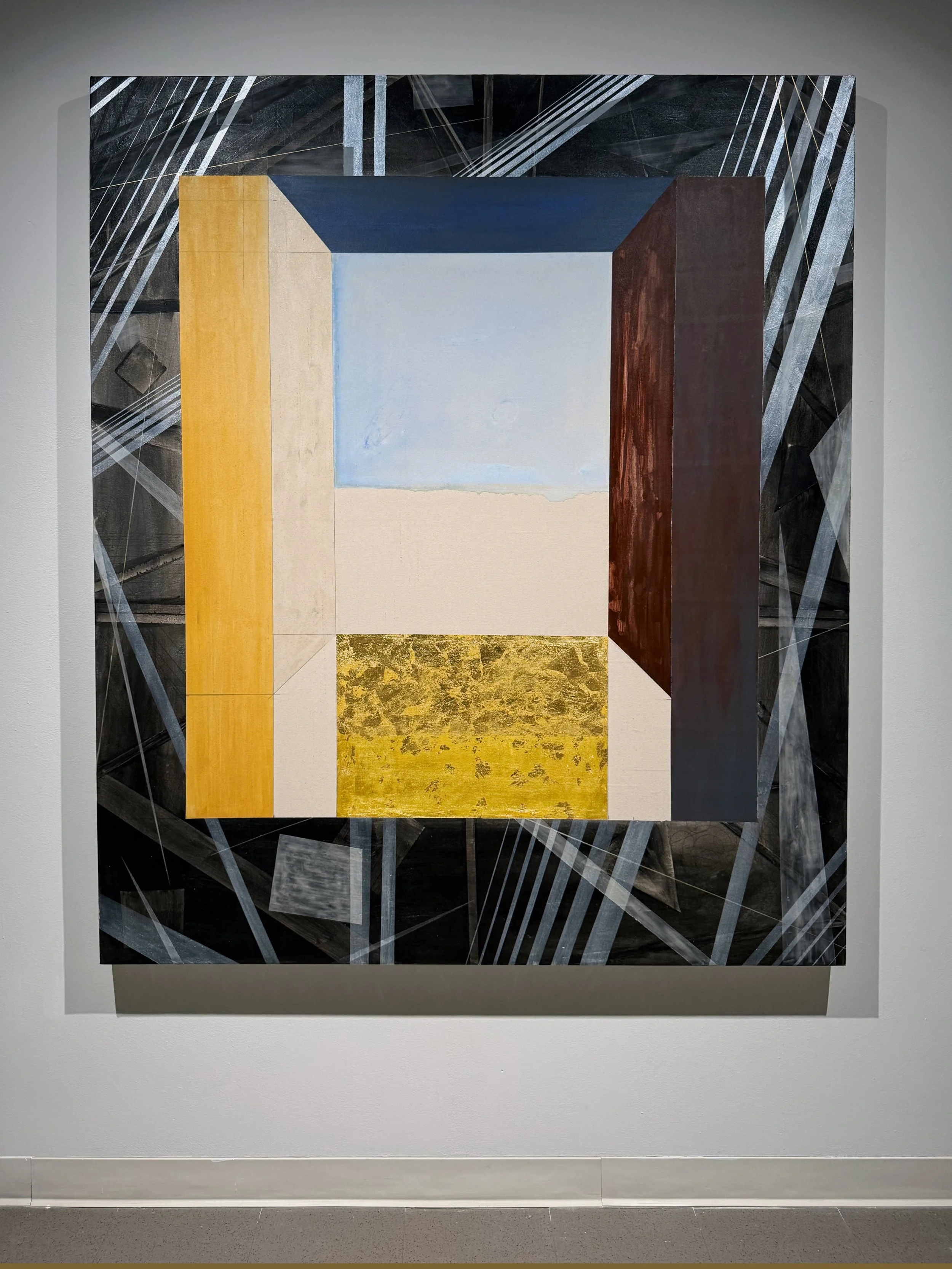
Amadour: Nevada Proscenium at Truckee Meadows Community College, Reno, Nevada. Courtesy of the artist.
If the archive documents where the body has traveled, the paintings propose what remains after experience has been compressed into structure. The archive therefore acts as a visual threshold. It offers viewers an entrance into the geometric paintings while preserving abstraction’s openness and allowing meaning to emerge through association rather than explanation.
My relationship with Nevada has been shaped by rupture as much as attachment. Bullying as a teenager produced estrangement from the place I grew up. In the early 2000s, when Mexican identity was frequently ridiculed in popular culture, I struggled with shame and dislocation. Loving Nevada, my family, and myself has been a gradual and deliberate process shaped by distance and return. This exhibition emerges from that process of return.
The paintings are composed of silver leaf, graphite, and acrylic on canvas. Silver leaf replaces gold and is intentionally allowed to oxidize, introducing exposure, instability, and time into the surface. As it shifts toward warmer tones, it echoes gold, reflecting Nevada’s ongoing cycles of valuation and extraction. While historically associated with silver mining, the state is now home to one of the largest concentrations of gold production in the United States. The material transformation mirrors shifting narratives of value that continue to define the region.
The bone-colored palette recalls the desert paintings of Georgia O’Keeffe (1887–1986) while questioning her singular position within representations of the American West. Here, bone is not romantic residue but restraint: land reduced by exposure, extraction, and evaporation.
Open space recurs throughout the work as a site of reflection: an aperture through which meaning emerges from the viewer’s position. It registers fragility and fragmentation while also holding the possibility of freedom, an open horizon, an expansive sky, and the capacity to inhabit one’s truth.
In this tension, Nevada Proscenium understands freedom as an American condition earned through presence, self-determination, and the insistence of being seen.
Nevada Proscenium is not conceived as a closed project but as an ongoing body of work. Alongside the California Incline series, I intend to continue developing these paintings across my lifetime with a sustained commitment to place, structure, and return. In this sense, I think of the long arc of serial practice found in Richard Diebenkorn’s Ocean Park series (1967–1988), not as formal imitation but as a model of dedication to a location as a site of continual rediscovery.
This exhibition is my first love letter to Nevada: my home state, the landscapes that formed me, and the communities that rarely see themselves reflected in large scale within contemporary painting. If this project asks viewers to see themselves inside abstraction, it also asks whether painting can act as a space of recognition.
Rather than concluding here, Nevada Proscenium opens toward the next body of work to come: The Mapes Suite, a continuation of these questions through architecture, memory, performance, and Nevada’s evolving cultural landscape. I would like to extend my thanks to Kyle Karrasch, TMCC Galleries Curator, for believing in me, and also to TMCC as an institution for being a well of knowledge and a gift to the community.
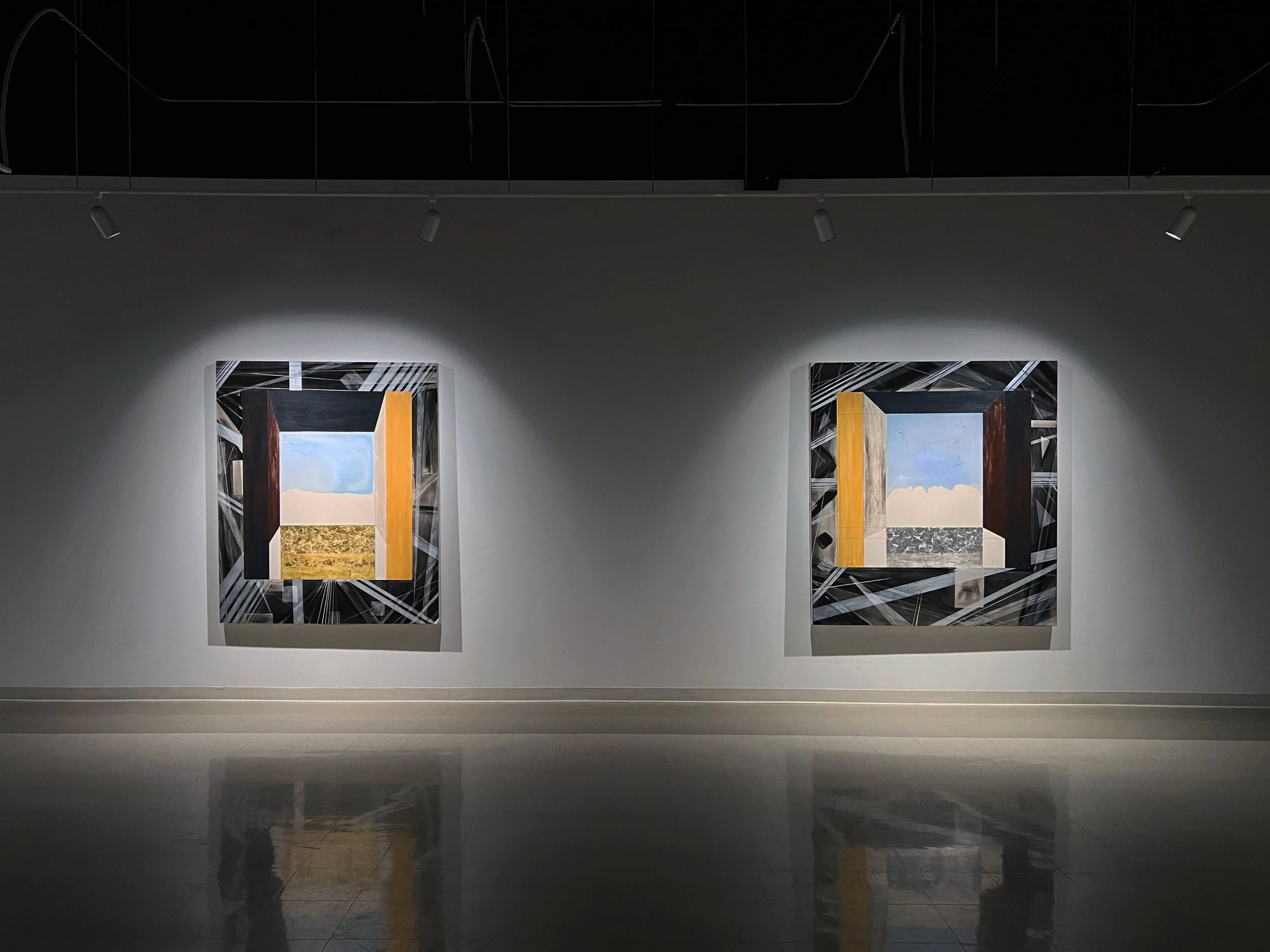
Amadour: Nevada Proscenium at Truckee Meadows Community College, Reno, Nevada. Courtesy of the artist.
Amadour: Nevada Proscenium at Truckee Meadows Community College, Reno, Nevada. Courtesy of the artist.