CLAUDE MONET AND VENICE: AN ESSAY ON THE VENETIAN PAINTINGS AS A PRELUDE TO THE LATE WATER LILIES

Claude Monet, "The Church of San Giorgio Maggiore, Venice, 1908. Oil on canvas, 26 1/8 x 36 7/8 in. (66.36 x 93.66 cm). Indianapolis Museum of Art at Newfields, The Lockton Collection, 70.76.
The recently concluded exhibition Monet and Venice at the de Young Museum in San Francisco offered a rare opportunity to encounter Claude Monet's Venetian paintings as they were intended to be seen: not as isolated masterpieces, but as a sustained meditation on light, atmosphere, and the passage of time. Installed together, the exhibition revealed the remarkable dialogue between paintings that are so often dispersed among museums and private collections around the world. Seen in sequence, these works invite a reconsideration of Venice not simply as one of Monet's final destinations, but as a pivotal chapter in the evolution of his late career and the renewed artistic confidence that would culminate in the Water Lilies (c. 1897–1926).
When Claude Monet arrived in Venice in the autumn of 1908, he encountered a city that had captivated painters, writers, pilgrims, and travelers for centuries, a place whose beauty had become inseparable from the history of Western art itself. Encouraged by his second wife, Alice Hoschedé Monet (1844–1911), the couple stayed first at the Palazzo Barbaro as guests of the American collector Mary Hunter (1855–1940) before moving to the Grand Hotel Britannia, today the St. Regis Venice, overlooking the Grand Canal.
From Canaletto and Francesco Guardi to J. M. W. Turner, Venice had long served as one of Europe's great laboratories of light, where architecture seems to rise from water and atmosphere continually reshapes the city's fragile appearance. Yet Monet did not come to Venice simply to paint its celebrated monuments. Throughout his Venetian series (1908–1912), he returned repeatedly to the same churches, canals, and palaces, not in search of the perfect view, but to observe, half-revealing, how the city transformed from one hour to the next. In Venice, architecture became a constant while light became the variable. The city offered Monet a place where reflection dissolved form, where water and sky exchanged identities, and where perception itself became the true subject of painting, and the potency of appearing as novelty. Arriving at a moment of profound artistic uncertainty, the Venetian paintings would ultimately mark one of the most consequential episodes of renewal in Monet's late career, laying the foundation for his return to the Water Lilies with renewed confidence.
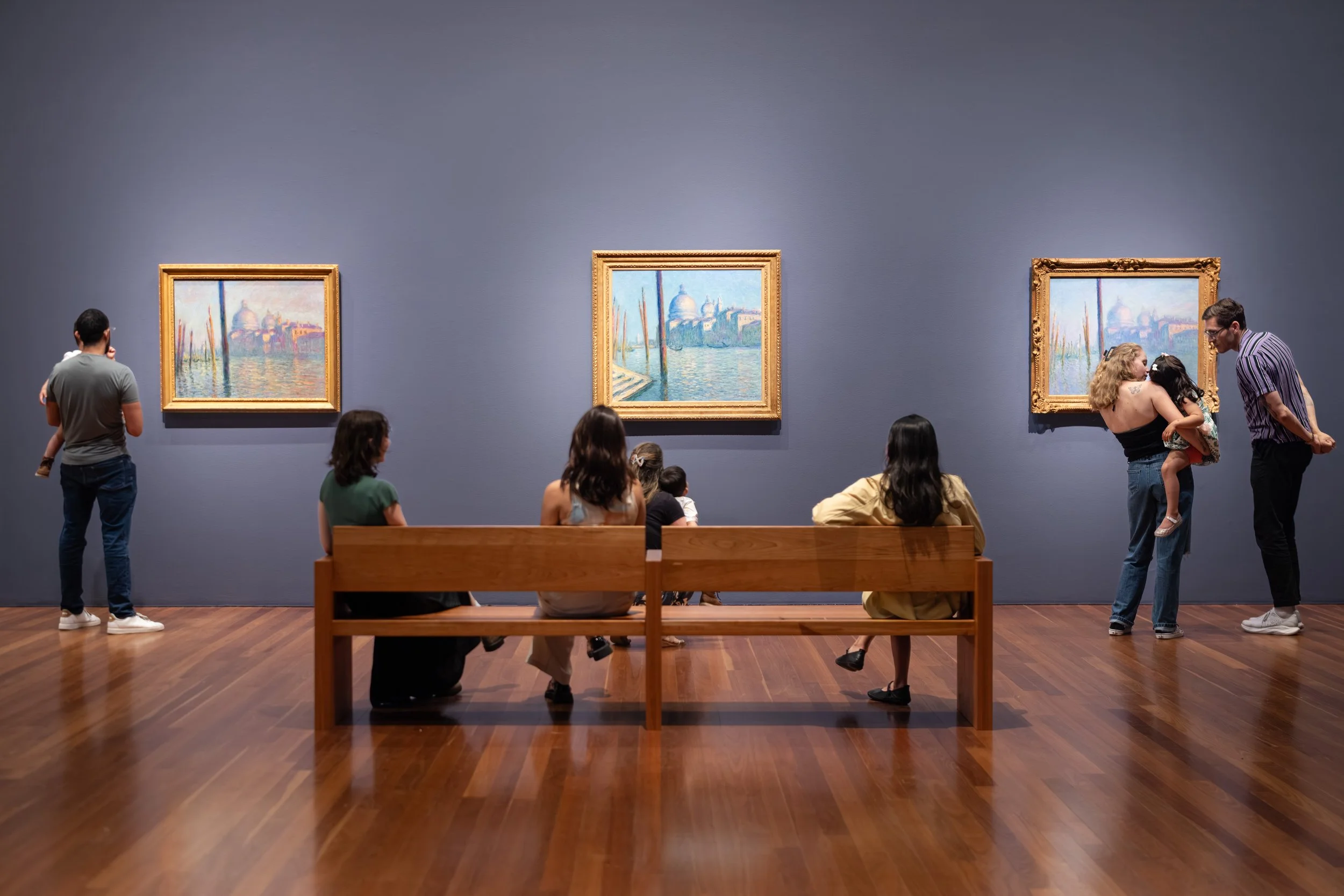
Installation view of "Monet and Venice," de Young museum, San Francisco, 2026 Photography by Gary Sexton Image courtesy of the Fine Arts Museums of San Francisco.
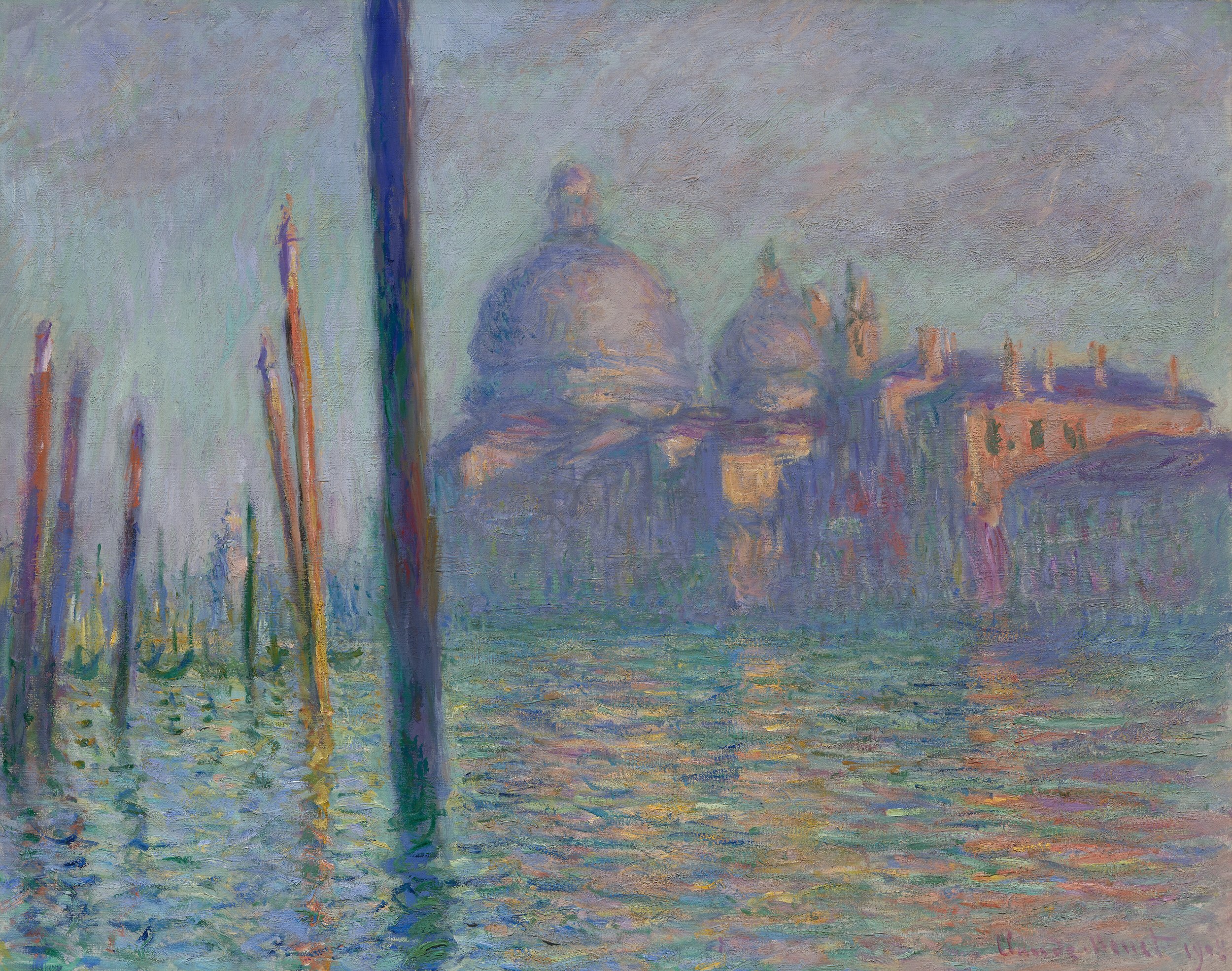
Claude Monet, "Grand Canal, Venice," 1908. Oil on canvas, 29 x 36 3/8 in. (73.7 x 92.4 cm). Museum of Fine Arts, Boston. Bequest of Alexander Cochrane. Photograph © 2025 Museum of Fine Arts, Boston.
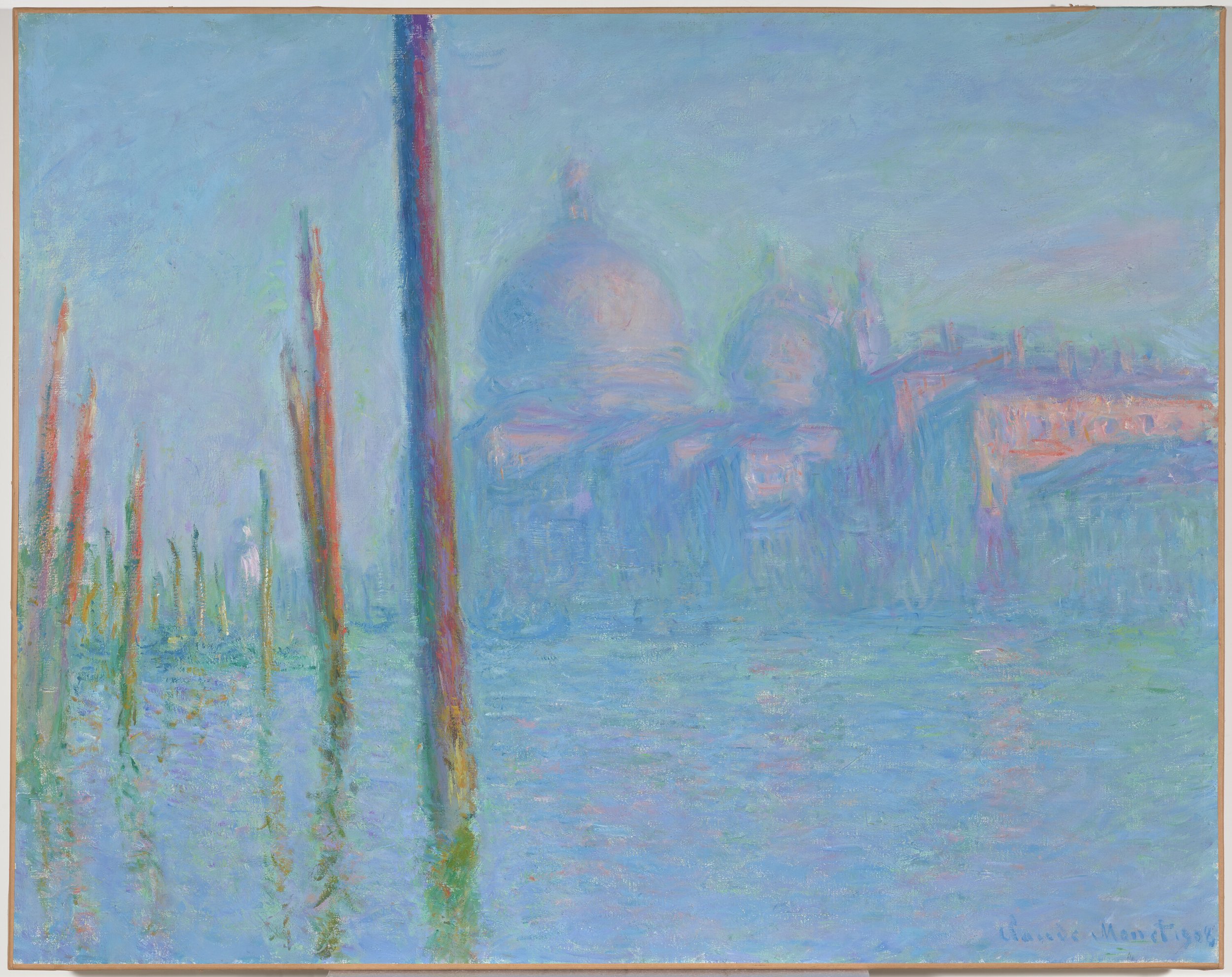
Claude Monet, "The Grand Canal, Venice," 1908. Oil on canvas, 28 13/16 x 35 5/16 in. (73.2 x 89.7 cm). Fine Arts Museums of San Francisco, Gift of Osgood Hooker, 1960.29. Photograph by Randy Dodson, courtesy of the Fine Arts Museums of San Francisco.
My own relationship with Venice began long before I encountered Claude Monet's Venetian paintings. As a college student, I visited the city for the first time during a Catholic pilgrimage through Western Europe. My mother had long hoped I would experience Europe, and that journey marked my first time on the continent. We attended the canonization of Mother Teresa in Vatican City before continuing north through Italy, with Venice serving as one stop along the itinerary.
Like many first-time visitors, my encounter with the city was brief. We wandered through narrow calli, crossed stone bridges, and followed one another through an endless procession of piazzas and canals, absorbing only fragments before moving on. At one point, I became separated from the group and found myself wandering alone, instinctively drifting away from the city's busiest thoroughfares. That detour led me to the Museo Vivaldi and eventually to Caffè Florian in Piazza San Marco, where I lingered as the orchestra performed beneath the arcades. I left Venice believing I had seen the city. Looking back, I realize I had only met it.
In the years that followed, Venice slowly became familiar. What began as a single afternoon evolved into weeks spent returning for the Venice Biennale, where the city gradually revealed itself beyond the familiar routes between Piazza San Marco and the Rialto. I came to know Venice through friends as much as through museums. Afternoons were often spent in my friend's palazzo overlooking the Peggy Guggenheim Collection, where a slashed Lucio Fontana hung quietly on the wall, reminding me that the history of Italian art was never far from everyday life. Days unfolded between the Giardini and the Arsenale, where each Venice Biennale transformed the national pavilions into an Olympic Village of art, bringing together artists, curators, collectors, critics, and museum directors from around the world. On the Lido, I learned another rhythm of Venice altogether. I would borrow a bicycle and ride past the Palazzo del Cinema, home of the Venice International Film Festival, continuing south toward the quiet village of Malamocco, where I invariably ordered spaghetti al nero di seppia, a dish that has become inseparable from my memories of the lagoon. Like many places of enduring significance, Venice revealed itself gradually. It is not a city that gives itself away in a day.
Remembering those years in Venice often leads me to wonder what Claude Monet paid attention to when he arrived in the city in the autumn of 1908. His choice of subjects offers clues, but ten weeks in Venice afforded him the luxury of wandering beyond the principal monuments, crossing to quieter islands and returning to the same views under changing conditions of light. During the last Biennale, after visiting a Helmut Newton retrospective, my mother and I stood on the Isola di San Giorgio Maggiore looking back toward the Palazzo Ducale. I later realized that I had been standing in nearly the same place where Monet painted The Palazzo Ducale, Seen from San Giorgio Maggiore (1908). It was one of those rare moments when art history collapsed into the present. More than a century earlier, Monet had stood on that very shoreline with Alice, quietly observing the lagoon while translating its shifting atmosphere into paint.
Although our circumstances were separated by more than a century and shaped by entirely different lives, there is something universal about a first encounter with Venice. The city unsettles ordinary perception. Water replaces streets, gondolas replace automobiles, architecture appears to float rather than rest upon the earth, and even the wake of a passing cruise ship can alter the reflections cast across the lagoon. Here, certainty gives way to atmosphere. Daily life is governed as much by the tides and reflected light as by the vaporetticrossing the canals. For Monet, already celebrated as one of history's great painters of atmosphere, Venice was not merely another destination. It became an invitation to see differently.

Claude Monet, "Venice, Palazzo Dario," 1908. Oil on canvas, 26 1/16 × 32 3/16 in. (66.2 × 81.8 cm). The Art Institute of Chicago, Mr. and Mrs. Lewis Larned Coburn Memorial Collection, 1933.446 Photo: The Art Institute of Chicago / Art Resource, NY.
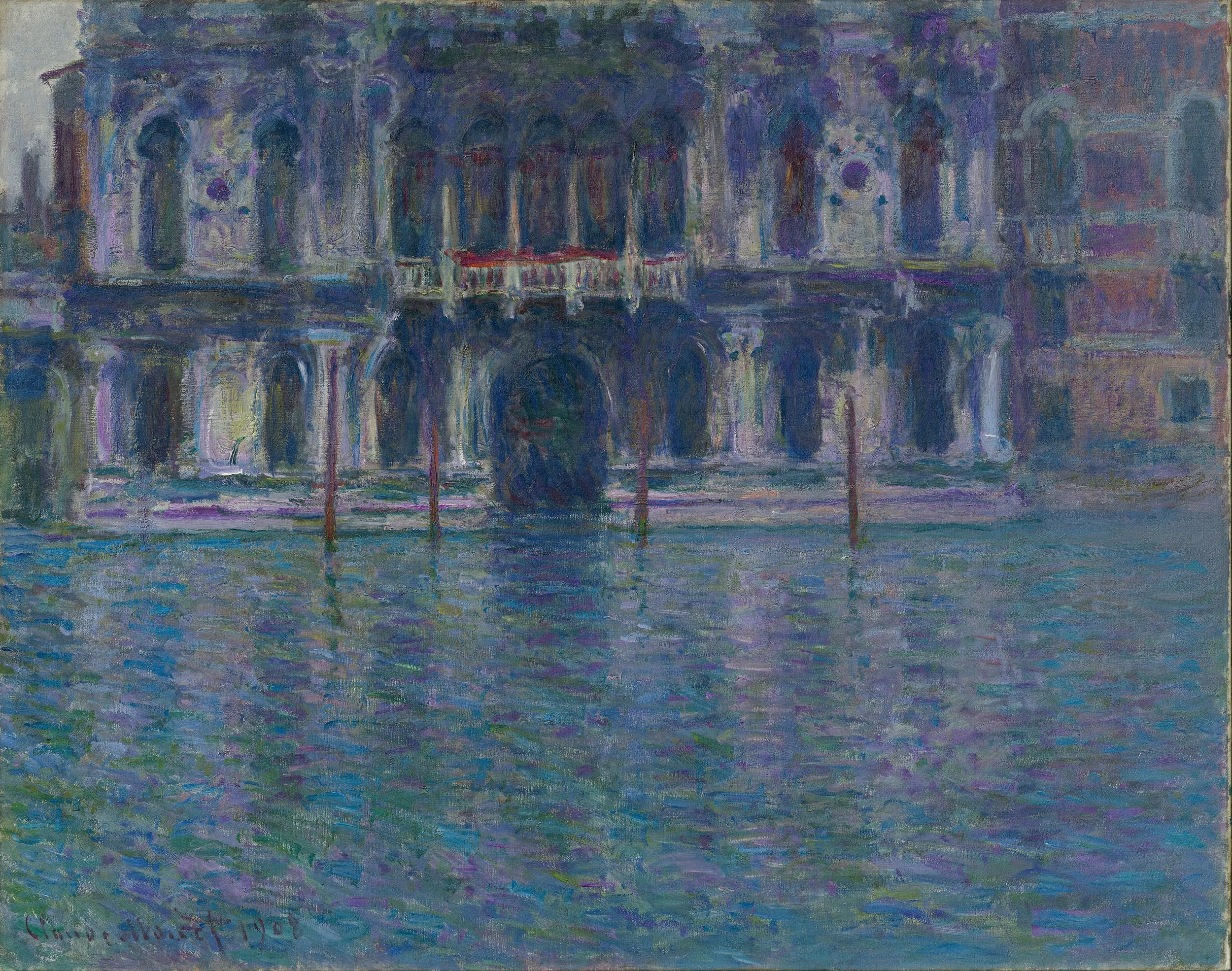
Claude Monet, "Palazzo Contarini," 1908. Oil on canvas, 28 3/4 x 36 1/4 in. (73 x 92 cm). Hasso Plattner Collection / Sammlung Hasso Plattner Courtesy Hasso Plattner Collection / Sammlung Hasso Plattner.

Claude Monet, "The Rio della Salute," 1908. Oil on canvas, 31 7/8 x 25 9/16 in. (81 x 65 cm). Hasso Plattner Collection / Sammlung Hasso Plattner Courtesy Hasso Plattner Collection / Sammlung Hasso Plattner.
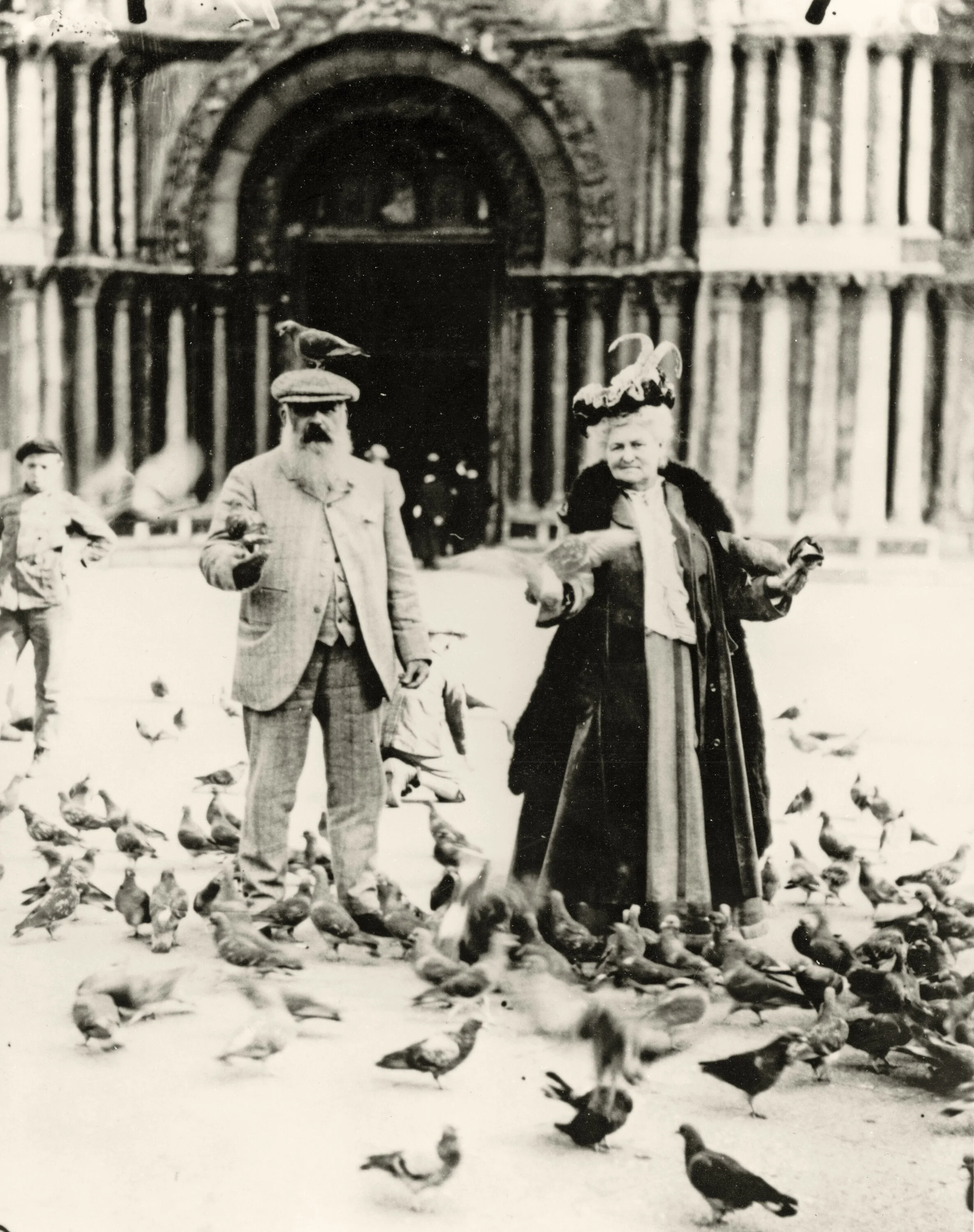
Claude Monet and his wife, Alice, St. Mark's Square, Venice, October 1908 (b/w photo), French Photographer, (20th century), Musee Marmottan Monet, Paris, France / Bridgeman Images.

Claude Monet, "The Palazzo de Mula, Venice," 1908. Oil on canvas, 25 9/16 × 36 1/4 in. (65 × 92 cm). National Gallery of Art, Washington, Chester Dale Collection, 1963.10.182. Courtesy National Gallery of Art, Washington.
The recently concluded exhibition Monet and Venice at the de Young Museum in San Francisco offered a rare opportunity to see Claude Monet's Venetian paintings as they were intended to be experienced: in conversation with one another. Normally dispersed among museums and private collections across Europe and North America, the paintings were reunited to reveal the serial logic that connects them. Rather than presenting Venice as a picturesque destination, the exhibition demonstrated that Monet treated the city as an ongoing investigation into perception itself.
Among the exhibition's most compelling installations were the multiple paintings of the Grand Canal. At the center was the Fine Arts Museums of San Francisco's The Grand Canal, Venice (1908), displayed alongside related versions of the same composition. Standing before them, one gradually realizes that the true constant is not the canal itself but Santa Maria della Salute. The great Baroque basilica anchors each composition while nearly every surrounding element changes. Designed by Baldassare Longhena (1598–1682), a pupil of Vincenzo Scamozzi (1548–1616), construction of Santa Maria della Salute began in 1631 following one of the darkest chapters in Venetian history. As a votive offering for the city's deliverance from the devastating plague of 1630, the Republic of Venice vowed to erect and dedicate a church to Our Lady of Health (Santa Maria della Salute), creating a monument that would forever symbolize healing, resilience, and gratitude. Rising at the entrance to the Grand Canal, the church has since become one of Venice's defining landmarks, its monumental dome serving as both a spiritual beacon and an unmistakable point of orientation across the lagoon. Santa Maria della Salute had occupied my imagination long before I ever entered its doors. For years, the Papal Throne of St. Pius X (1908) served as the wallpaper on my computer, admired from thousands of miles away before I ever visited Venice. Only later did I stand beneath the basilica's soaring dome and encounter the throne in person. Looking back, I find it remarkable that the throne was completed in the very same year Monet was painting the church from across the Grand Canal. While one belongs to the sacred interior and the other to the luminous exterior, both belong to the same extraordinary moment in Venice's cultural history.
For Monet, however, Santa Maria della Salute was never simply architecture. It became an optical constant. Morning mist cools the palette into silvery blues and violets. Afternoon sunlight briefly restores structural clarity before dissolving the church once more into shimmering reflections. By evening, the Grand Canal becomes a haze of amber, rose, and lavender. The basilica remains physically unchanged, yet every painting proposes an entirely different experience of seeing. The de Young exhibition encourages viewers to slow down. Standing before Monet's Venetian series, the question gradually shifts. Rather than asking which painting is the most successful, one begins to ask why each appears so different despite depicting the same subject. The answer extends beyond color alone. Monet understood that the identity of a place is never fixed. It is continually reconstructed through atmosphere, weather, reflection, memory, and the passage of time. Venice becomes a city that is painted not once, but endlessly.
Today, science provides a vocabulary for many of the perceptual phenomena Monet observed intuitively. The Purkinje effect, first described by the Czech anatomist Jan Evangelista Purkyně in 1825, explains how the human eye's sensitivity to color shifts as daylight fades. Reds and yellows gradually lose their brilliance while blues and blue-greens appear increasingly luminous during twilight. Looking across Monet's Venetian paintings, one begins to recognize this same visual experience. Morning and evening scenes are not simply darker versions of midday; they are fundamentally different chromatic worlds. The atmosphere itself participates in this transformation. Rayleigh scattering, the physical process responsible for the blue color of the sky and the warm oranges and reds of sunrise and sunset, continually alters the quality of light falling upon Venice. Water compounds this effect. Unlike solid ground, the lagoon reflects, refracts, and fragments light into countless shifting surfaces, allowing architecture to dissolve into reflections that never remain still for more than a moment. The city itself becomes a collaborator in the act of painting. Monet, of course, knew neither the terminology of neuroscience nor atmospheric physics. He was not attempting to illustrate scientific principles. Yet his extraordinary discipline as an observer led him toward remarkably similar conclusions. Through sustained looking, he discovered that vision itself is unstable. Light does not simply illuminate architecture; it transforms it. Reflection does not merely mirror reality; it reconstructs it.

Claude Monet, "The Palazzo Ducale," 1908. Oil on canvas, 22 7/16 x 36 1/4 in. (57 x 92 cm). Hasso Plattner Collection / Sammlung Hasso Plattner Courtesy Hasso Plattner Collection / Sammlung Hasso Plattner.
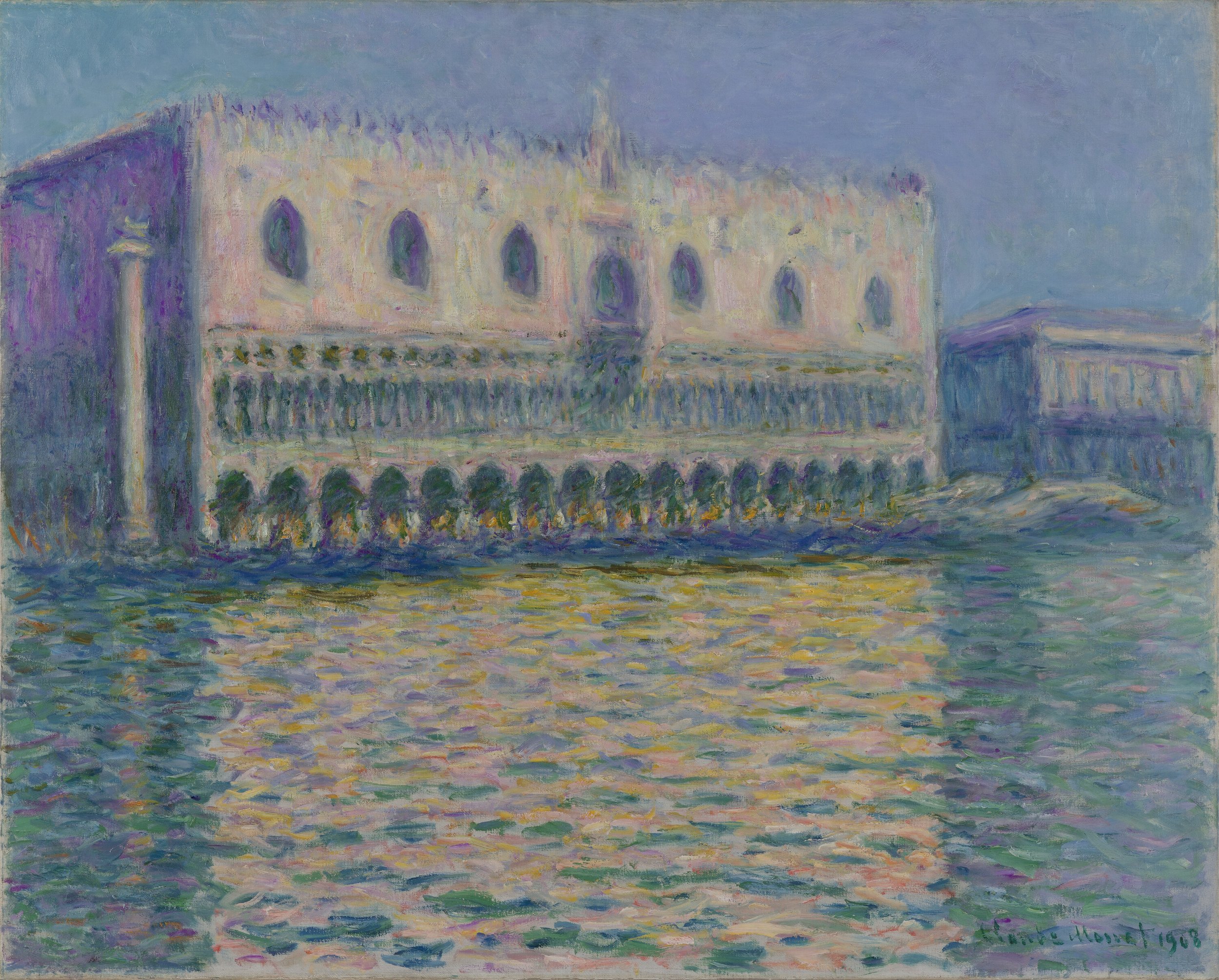
Claude Monet, "The Doge’s Palace (Palais ducal)," 1908. Oil on canvas, 32 × 39 in. (81.3 × 99.1 cm). Brooklyn Museum, Gift of A. Augustus Healy, 20.634 (Photo: Brooklyn Museum).
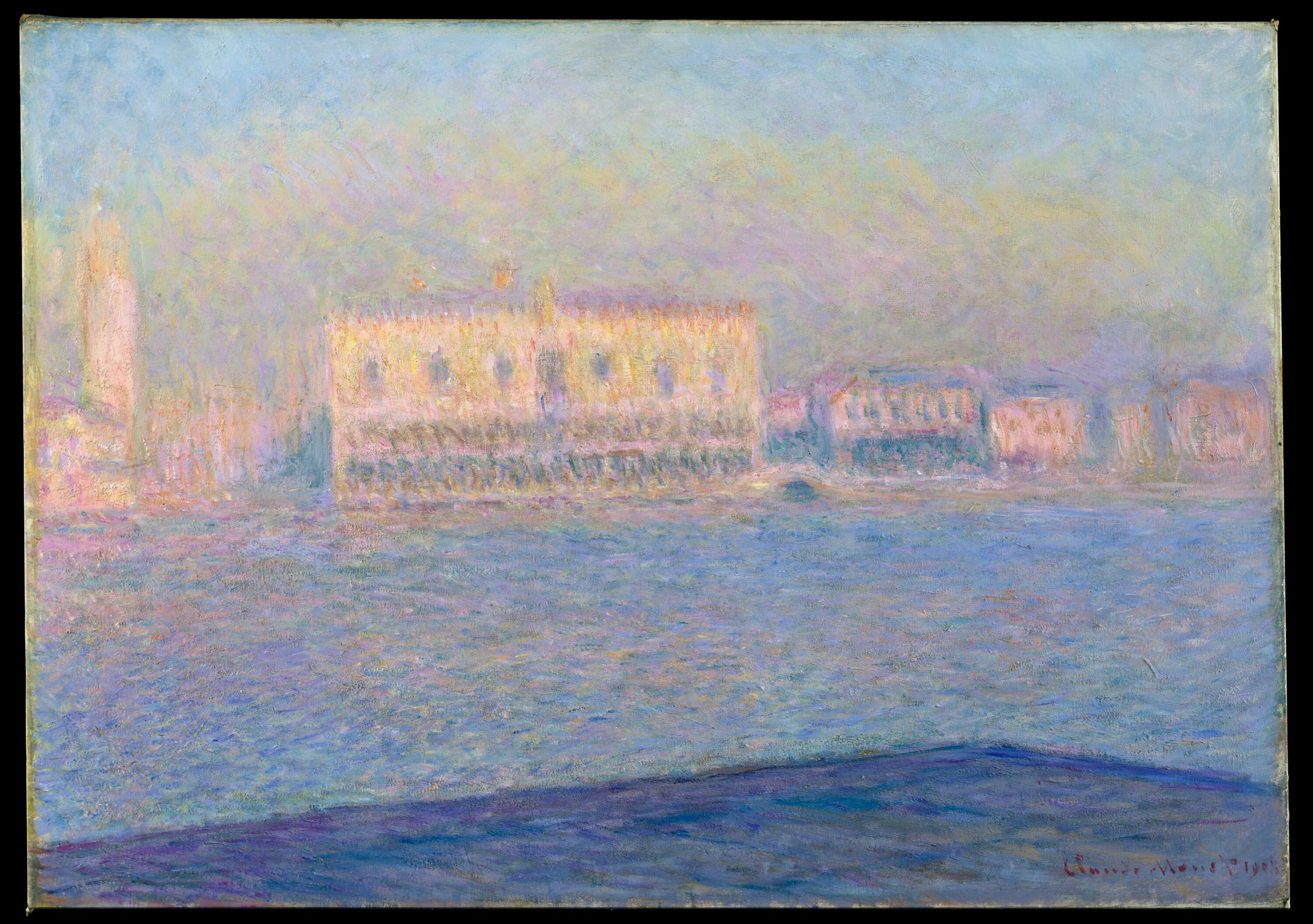
Claude Monet, "The Doge's Palace Seen from San Giorgio Maggiore, 1908. Oil on canvas, 25 3/4 x 36 1/2 in. (65.4 x 92.7 cm). The Metropolitan Museum of Art, Gift of Mr. and Mrs. Charles S. McVeigh, 1959 (59.188.1). Image copyright © The Metropolitan Museum of Art. Image source: Art Resource, NY.
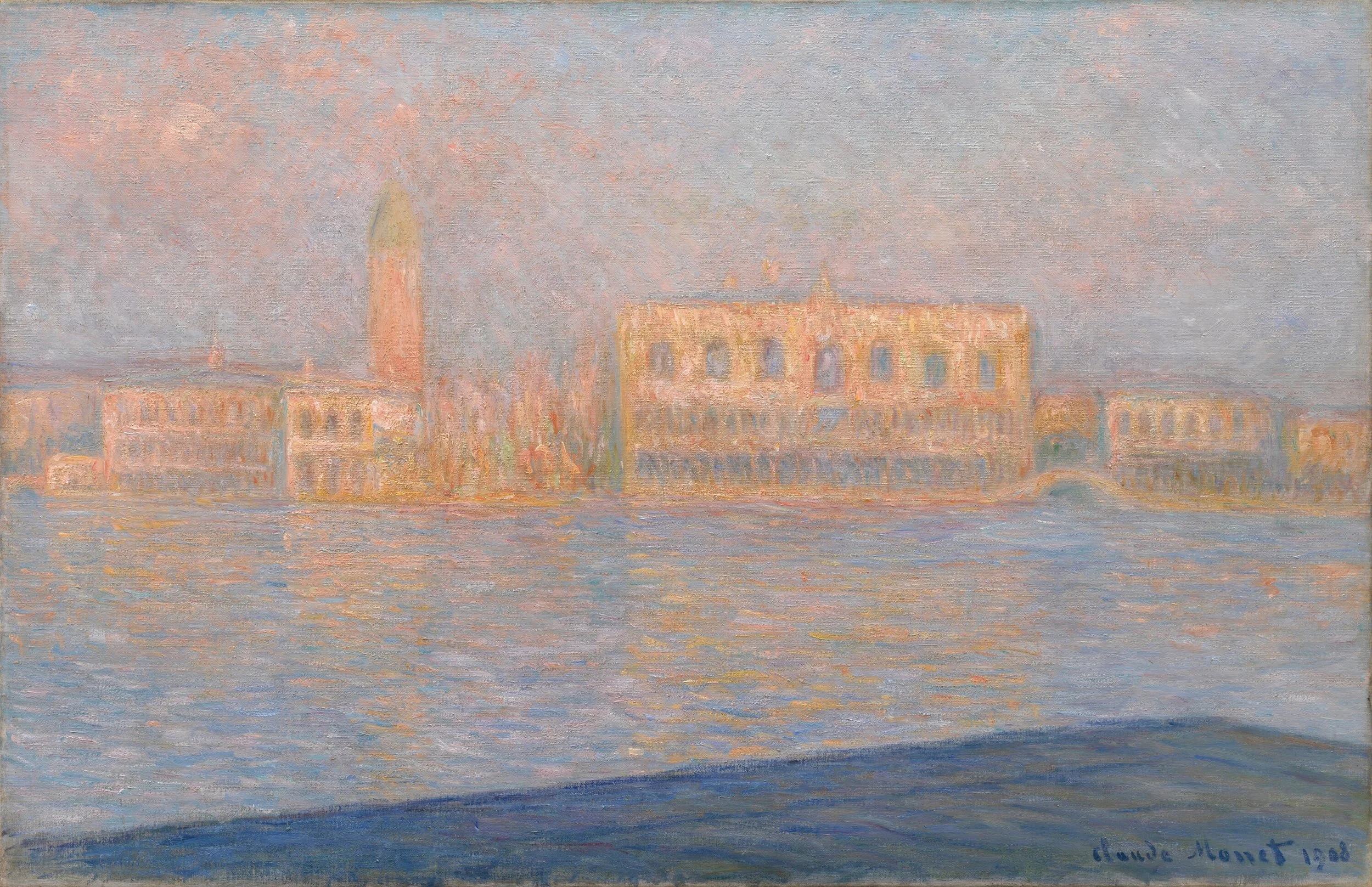
Claude Monet, "The Palazzo Ducale, Seen from San Giorgio Maggiore," 1908. Oil on canvas, framed: 32 3/8 x 46 1/8 x 3 1/4 in. (82.233 x 117.158 x 8.255 cm). Solomon R. Guggenheim Museum, New York, Thannhauser Collection, Bequest, Hilde Thannhauser, 1991 Solomon R. Guggenheim Foundation / Art Resource, NY.
In The Church of San Giorgio Maggiore, Venice (1908), the Palladian church, designed by Andrea Palladio (1508–1580), appears to hover effortlessly between sky and lagoon. Its chalk-white façade is softened by atmosphere until its buttery reflection becomes almost indistinguishable from the architecture itself. The building no longer functions as a monument alone, but as a trumpet through which light announces its triumph over stone. A similar transformation occurs in The Palazzo Ducale, Seen from San Giorgio Maggiore (1908) and The Palazzo Ducale(1908). For centuries, the Doge's Palace had been celebrated for its Gothic tracery, rhythmic arcades, and architectural precision. Monet was interested in something else entirely. Rather than describing the palace with linear certainty, he permits veils of crushed amethyst violet, cobalt blue, and travertine rose to accumulate until the Gothic façade begins to resemble the weathered cliffs of his Cliffs at Étretat series (1883–1886), as though the Doge's Palace had surrendered its masonry to the slow geology of light.
The same visual language continues in Venice, Palazzo Dario (1908), where the Renaissance façade relinquishes its accustomed solidity, melting almost imperceptibly into the gondola moored before it, much as the distant aspect of a mountain is surrendered to the last melancholy light of evening. In The Rio della Salute (1908), canal, sky, and the adjoining dwellings are united beneath a single veil of colour. As a painter myself, I cannot help but behold these passages in quiet conversation with Joaquín Sorolla y Bastida's Hall of the Ambassadors, Alhambra, Granada (1909). I do not suggest a direct correspondence of influence, but rather a sympathy of vision. Each appears captivated by the changing disposition of the day, where architecture ceases to be merely stone and becomes the vessel through which light reveals itself. Working with gold leaf in my own paintings has made me particularly attentive to these hourly transformations, for a surface is never fixed, but perpetually altered by the shifting countenance of the sun. It is perhaps for this reason that I perceive the two artists in tandem, each inviting the spectator to linger before the ordinary until it assumes the character of the extraordinary.
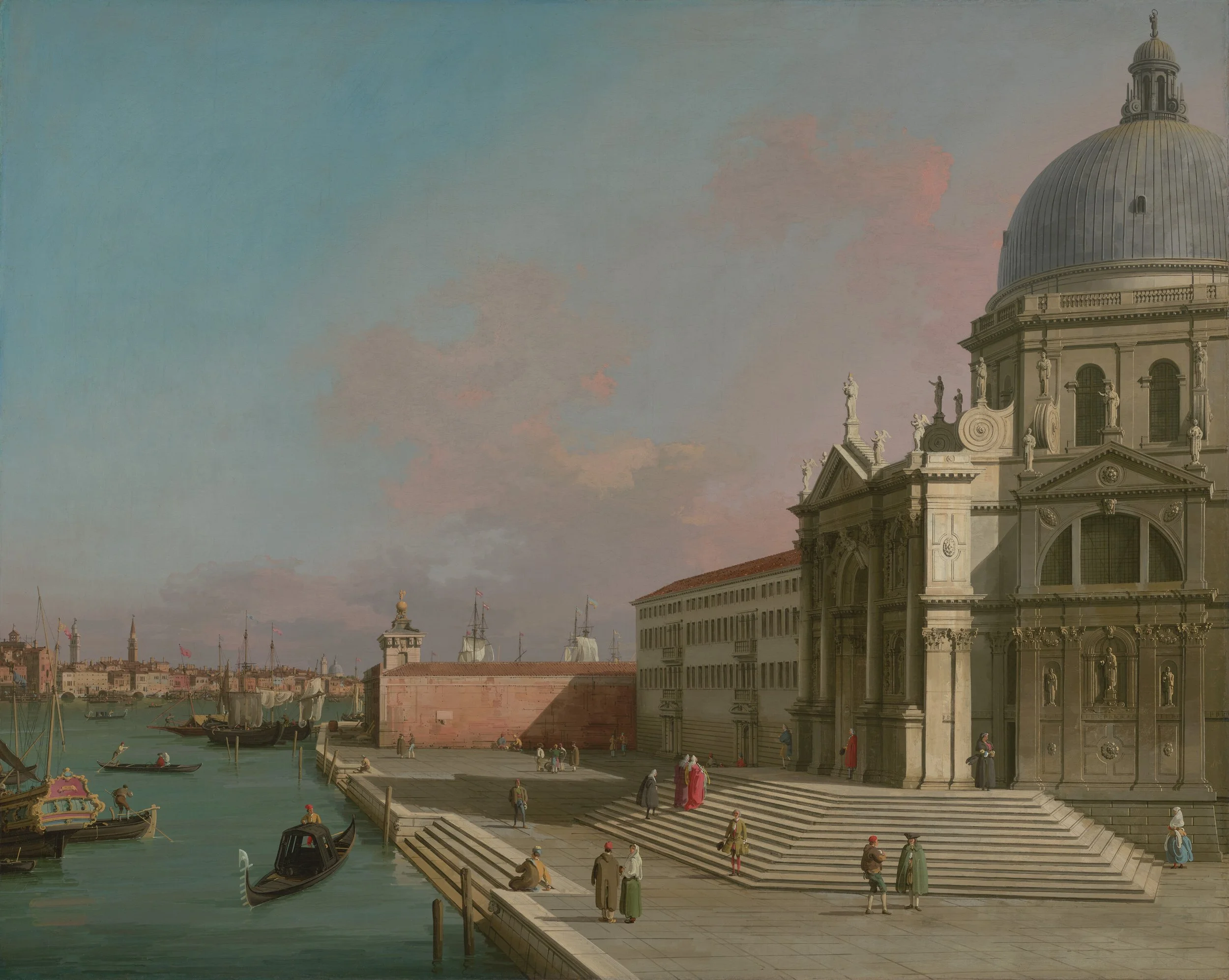
Canaletto (Antonio Canal), "Venice, the Grand Canal looking East with Santa Maria della Salute," 1749-1750. Oil on canvas, 52 x 64 7/8 in. (132.08 x 164.783 cm). Fine Arts Museums of San Francisco, Museum purchase, Gift of Diane B. Wilsey in celebration of the Legion of Honor Centennial and in memory of Ann Getty, 2022.61. Photograph by Randy Dodson, courtesy of the Fine Arts Museums of San Francisco.
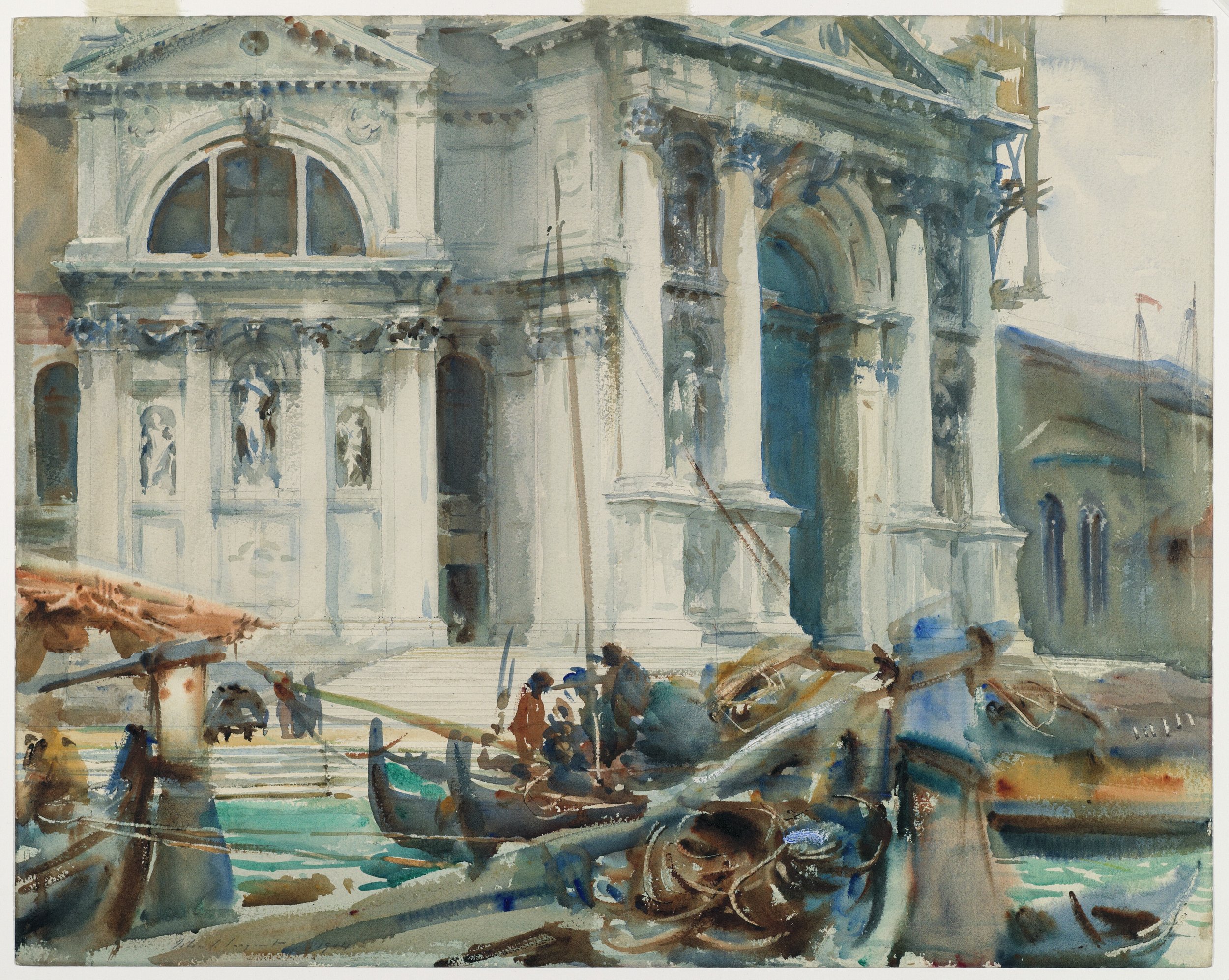
John Singer Sargent, "Santa Maria della Salute," 1904. Oil on canvas, 18 3/16 x 22 15/16in. (46.2 x 58.3cm). Brooklyn Museum, Purchased by Special Subscription, 09.838 (Photo: Brooklyn Museum).
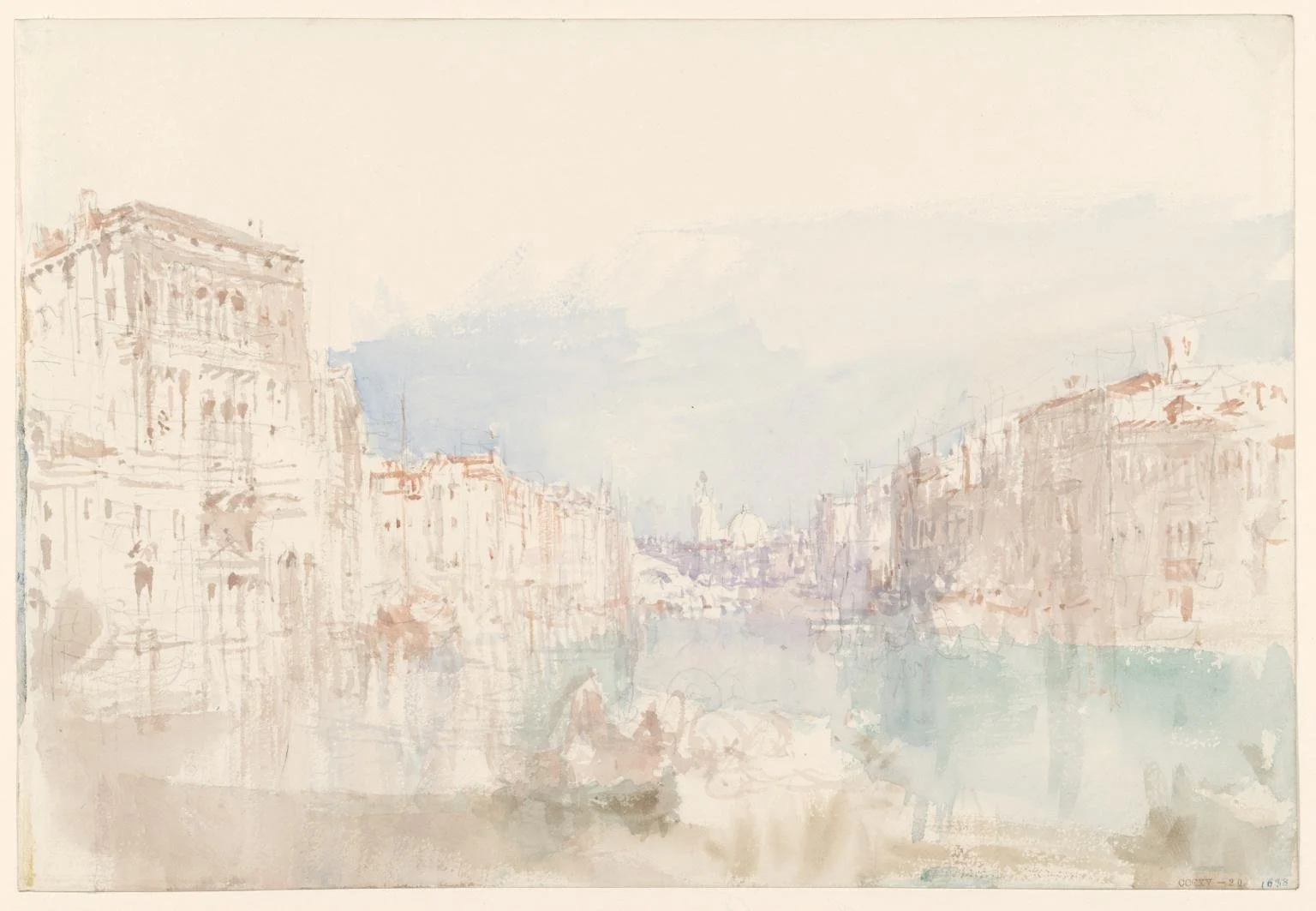
Joseph Mallord William Turner (1775–1851), The Grand Canal, Venice, with the Palazzo Balbi and the Mocenigo Palaces, and the Rialto Bridge in the Distance, 1840. Graphite and watercolor on paper, 221 × 324 mm. Tate, London. Accepted by the nation as part of the Turner Bequest, 1856. (Photo: Tate Modern).
Venice offered Monet something Giverny, for all its magical bounty, could not. It was not a private sanctuary cultivated over decades, but a city of perpetual transformation, where towers dissolved into the lagoon, and every façade shimmered upon the canals. Dirty golden hues, musky aquatic greens, cerulean notes, and deep violet shards dissolved and reassembled with each passing hour. By returning repeatedly to the Grand Canal, Santa Maria della Salute, San Giorgio Maggiore, the Palazzo Ducale, Palazzo Dario, and the Rio della Salute, Monet freed himself from the burden of producing a definitive image. Released from the expectations of academic finish and even from the habits of his own success, he entrusted himself once more to instinct. Venice did not ask Monet to become someone else; rather, it allowed him to become an Impressionist again.
When Monet returned to Giverny, he wrote confidently to his dealer, Paul Durand-Ruel (1831–1922), assuring him that he was ready to work once again. The Water Lilies, so recently threatened with abandonment, resumed with renewed conviction and a spirit of experimentation. It would overstate the historical evidence to claim that Venice alone produced the late masterpieces, yet the journey undeniably marked a decisive turning point. The Venetian paintings now appear to stand at the threshold between two chapters of Monet's life: the years before the deaths of his wife Alice in 1911 and his son Jean in 1914, and the long, increasingly solitary decades that followed. In those years of bereavement, the lily pond became not merely a subject but a place of meditation, remembrance, and renewal.
The spatial dissolutions explored along the Venetian canals—where water, sky, and architecture continually exchange identities—anticipate the immersive worlds of the late Water Lilies. By the time Monet returned to his garden, the horizon itself had begun to disappear. Earth and heaven were no longer divided; the sky descended into the water, and the water became a mirror of the infinite. If one permits a final interpretation, the celestial sky becomes a vision of eternity, the water its instrument of transformation, and the floating lily pads the quiet traces of those who remain.
Throughout the history of art, moments of profound uncertainty are often answered not by abandoning one's practice, but by changing one's surroundings. A new landscape, a new city, or even a different quality of light can fundamentally alter the questions an artist asks. Georgia O'Keeffe rediscovered painting after encountering Arthur Wesley Dow's theories of composition. Marcel Duchamp appeared to leave art for chess while secretly constructing Étant donnés (1946–1966), and Louise Bourgeois withdrew from artistic production before returning to create psychologically charged sculptures, including Maman (1999), that defined her mature work. Their stories differ in circumstance, yet they share a common thread: creative renewal often begins not with certainty, but with interruption, doubt, and the willingness to begin again.
Monet's journey to Venice belongs within that tradition. He did not undertake the voyage in pursuit of a novel manner, but because Alice believed that distance might restore the disposition of mind which Giverny had gradually unsettled. Venice did not resolve his artistic difficulties; it transfigured them, and reactivated his instincts. It became a place liberated from theory, where instinct once more governed the hand and eye. Monet himself later confessed that he wished he had first encountered Venice in youth, for the city awakened in him something of that earlier sensibility. Rather than striving after the definitive picture, he returned to the patient contemplation of the vicissitudes of light, atmosphere, and water, to the extraordinary concealed within the seemingly ordinary. He feared that his Venetian canvases might be mistaken for little more than picturesque views for the traveler, yet they endure because they aspire to something altogether higher. They preserve not merely the appearance of Venice, but the sensation of inhabiting it. In this regard, Monet enters into direct conversation with Canaletto and J. M. W. Turner. Their manners are wholly distinct, yet each apprehended the city through the perpetual commerce of light and water, so that works separated by centuries seem almost contemporaneous. Sometimes an artist requires not a new method, but only another prospect from which to behold the world.
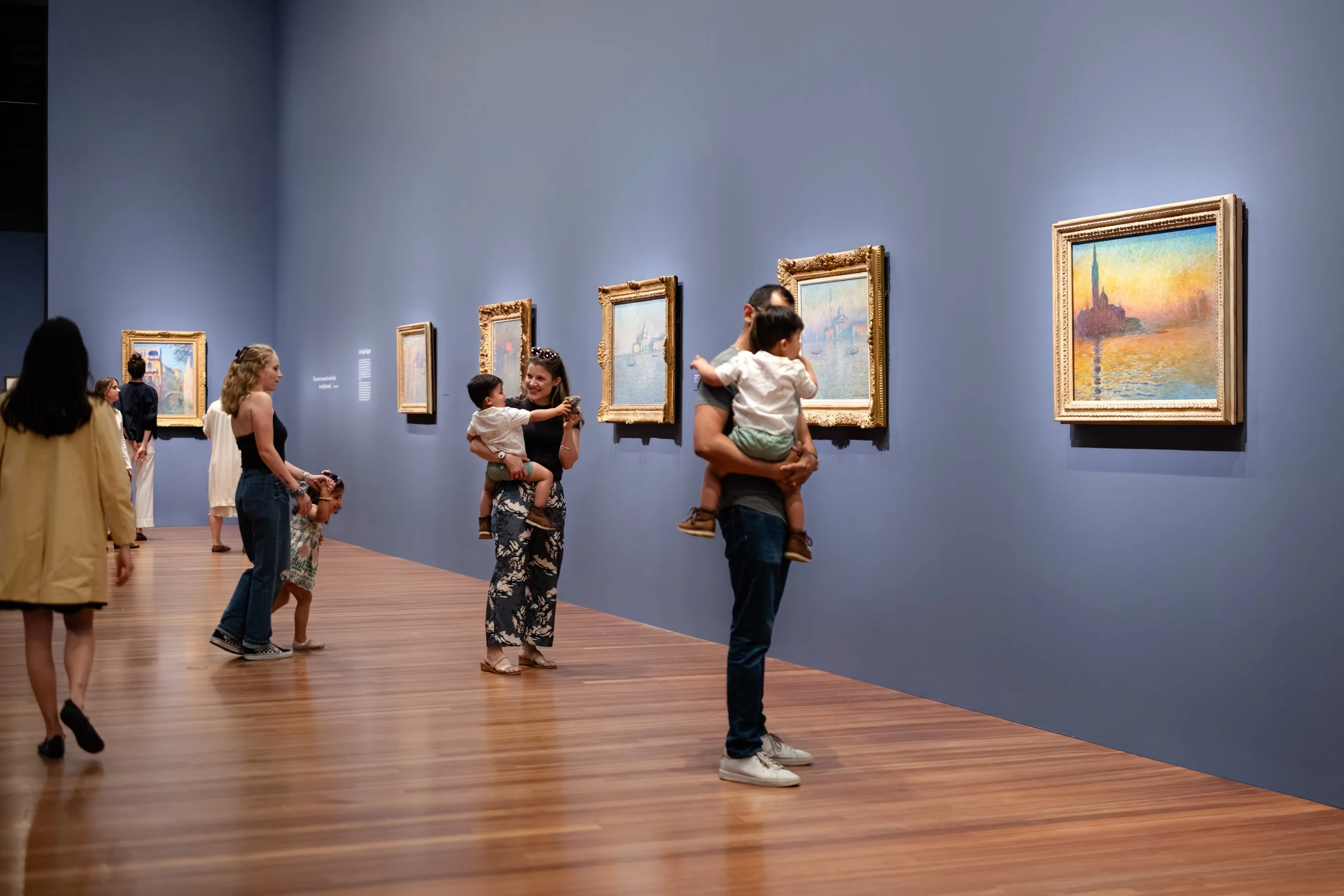
Installation view of "Monet and Venice," de Young Museum, San Francisco, 2026. Photography by Gary Sexton. Image courtesy of the Fine Arts Museums of San Francisco.
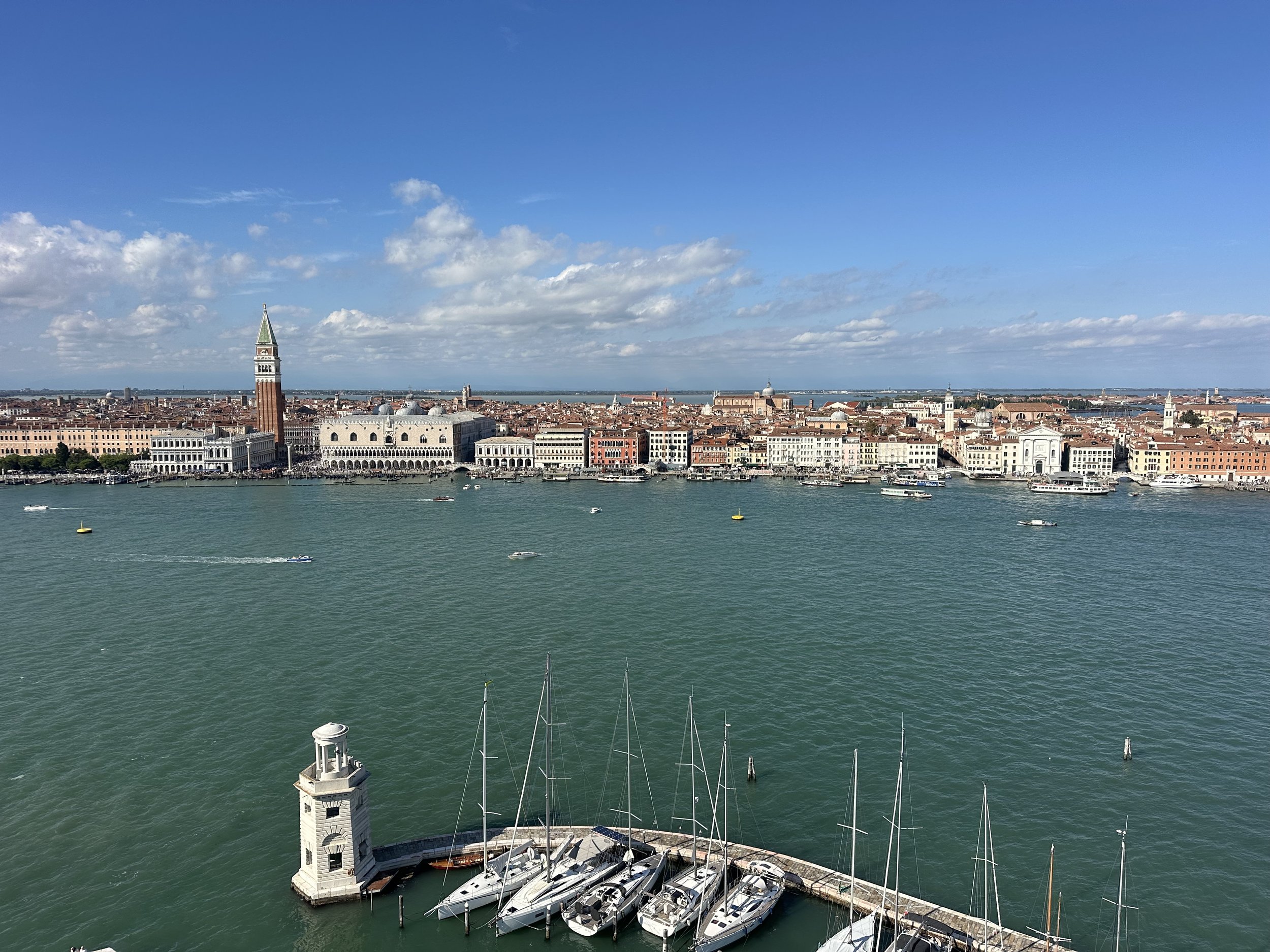
View toward the Doge's Palace and Piazza San Marco from the Campanile of San Giorgio Maggiore, Venice. Photograph by Amadour.
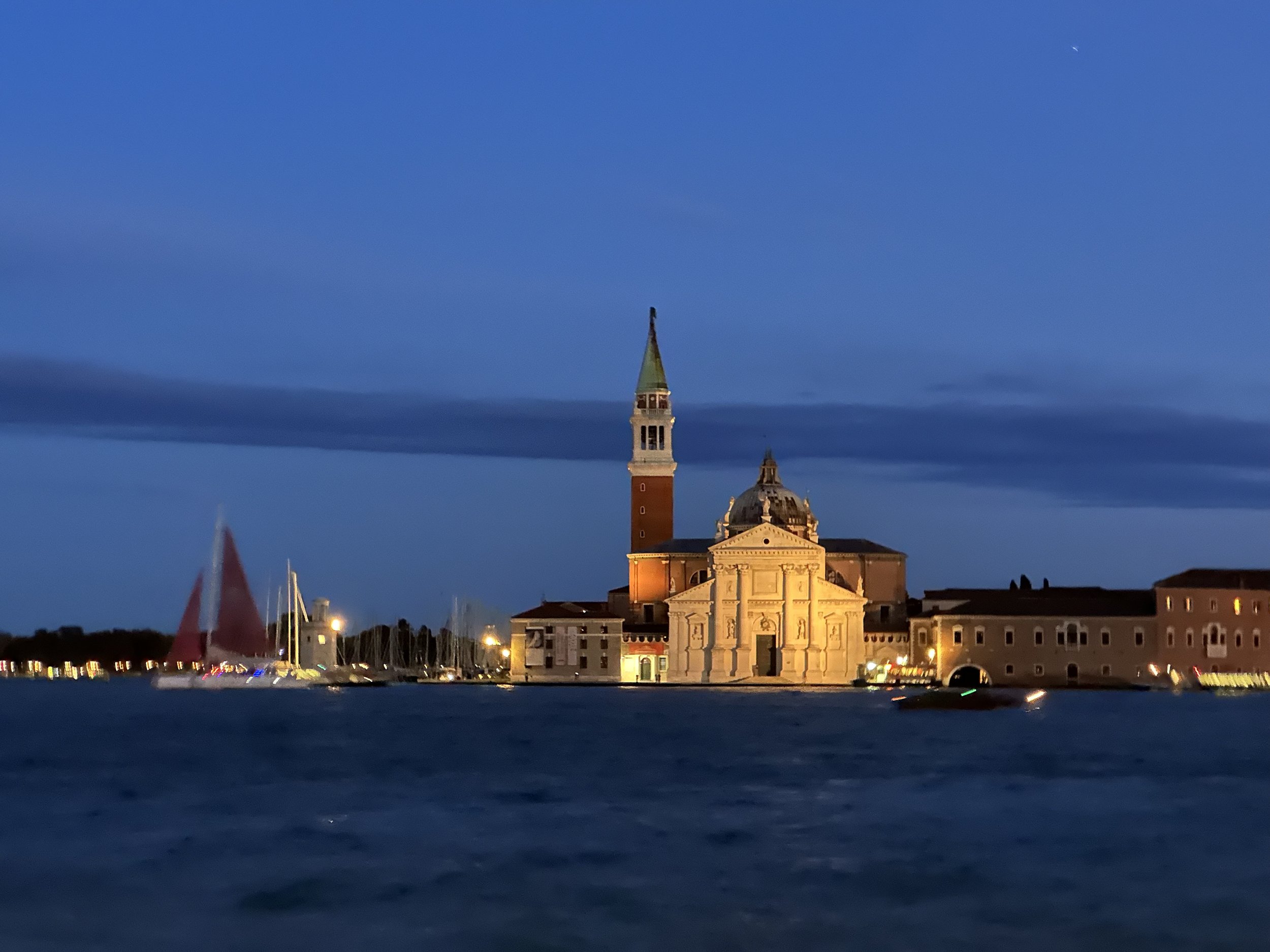
View of the Basilica of San Giorgio Maggiore, designed by Andrea Palladio (1508–1580), 1566–1610. Photograph by Amadour.
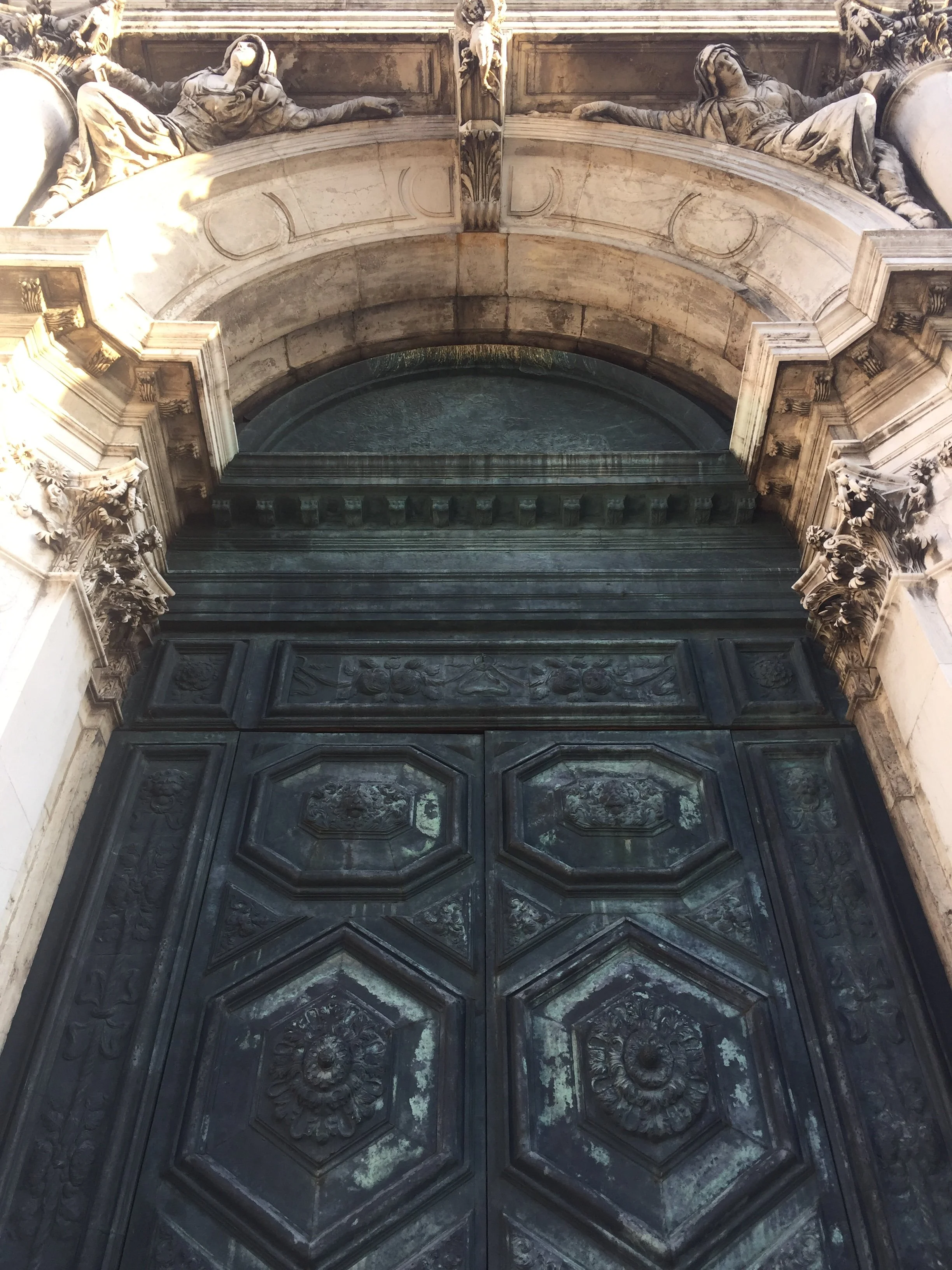
Main entrance, Basilica of Santa Maria della Salute, designed by Baldassare Longhena (1598–1682), begun 1631. Photograph by Amadour.
The Venice of 1908 has, inevitably, changed. Crowds now fill streets where one can scarcely pause to contemplate the city in silence, though moments of solitude remain for those willing to wander beyond the principal routes. I have always been fond of the quieter side of Punta della Dogana, where Venice still seems to breathe at a gentler pace. The MOSE flood-barrier system has altered the city's relationship with exceptionally high tides, while climate change continues to test the fragile equilibrium between land and lagoon. Although the largest cruise ships no longer enter the historic center, the infrastructure of contemporary tourism has transformed the experience of arrival. Many visitors now descend through Venice Marco Polo Airport, crossing long moving walkways before boarding a vaporetto or private water taxi into the city. To arrive instead by train at Santa Lucia Station remains, to my mind, the more romantic approach, provided one avoids the busiest hours of transit. Yet despite these changes, Venice endures as one of humanity's most beloved cities.
I cannot help but imagine Monet lingering in the final gallery of Monet and Venice at the de Young. My first visit to the museum came shortly after its reopening, when I was an eighth grader on a school trip to San Francisco with my art class. I remember climbing the Hamon Observation Tower and taking in the panoramic views of the city below. Outside, the reflecting pool with its lily pads and the sculpture garden seemed, in retrospect, to foreshadow the very world Monet would later occupy in my imagination. In my view, the exhibition represented a remarkable curatorial achievement and perhaps the finest presentation of Monet's work I have encountered outside of permanent installations such as the Musée de l'Orangerie in Paris. Paintings ordinarily dispersed among museums and private collections across Europe and North America were reunited, allowing visitors to experience the serial logic of the Venetian paintings in a way that is rarely possible. Standing before multiple versions of the same canal, church, or palazzo, one begins to understand not simply what Monet painted, but how he sought to arrest upon canvas the most fugitive effects of light and atmosphere.
There is another quiet connection between Monet and San Francisco. Although Monet himself never visited the United States, seven of his paintings did. In 1915, [Vétheuil; La Seine à Port-Villez; La Promenade dans les Prairies à Argenteuil; Le Havre: Terrasse au bord de la mer; Meule, coucher de soleil; Bateaux échoués, Fécamp; and Les Nymphéas, paysage d'eau; I omit dates, as the official exhibition catalog does not identify the years of the individual paintings] were exhibited at San Francisco's Panama-Pacific International Exposition inside the newly constructed Palace of Fine Arts. While there is no evidence that Monet followed the installation of the exhibition in California, he remained closely involved with Durand-Ruel and the international circulation of his work, making it likely that he knew his paintings had crossed the Atlantic. More than a century later, San Francisco continues that relationship. One of Monet's celebrated Water Lilies now resides in the collection of philanthropist Dede Wilsey, whose longstanding support of the Fine Arts Museums of San Francisco has helped make exhibitions such as Monet and Venice possible for new generations of visitors.
Perhaps that is the quiet legacy of the Venice Principle. Cities change. Artists change. The questions remain. Venice changed Monet, and San Francisco continues to change how we understand Monet. Standing in the de Young, surrounded by paintings that had once been scattered across continents, I found myself wondering what he would have thought. I like to imagine he would have appreciated seeing his Venetian paintings reunited, not because they represented a finished body of work, but because together they reveal the pursuit that defined his career: that no landscape, no city, and no moment of light is ever truly the same twice.
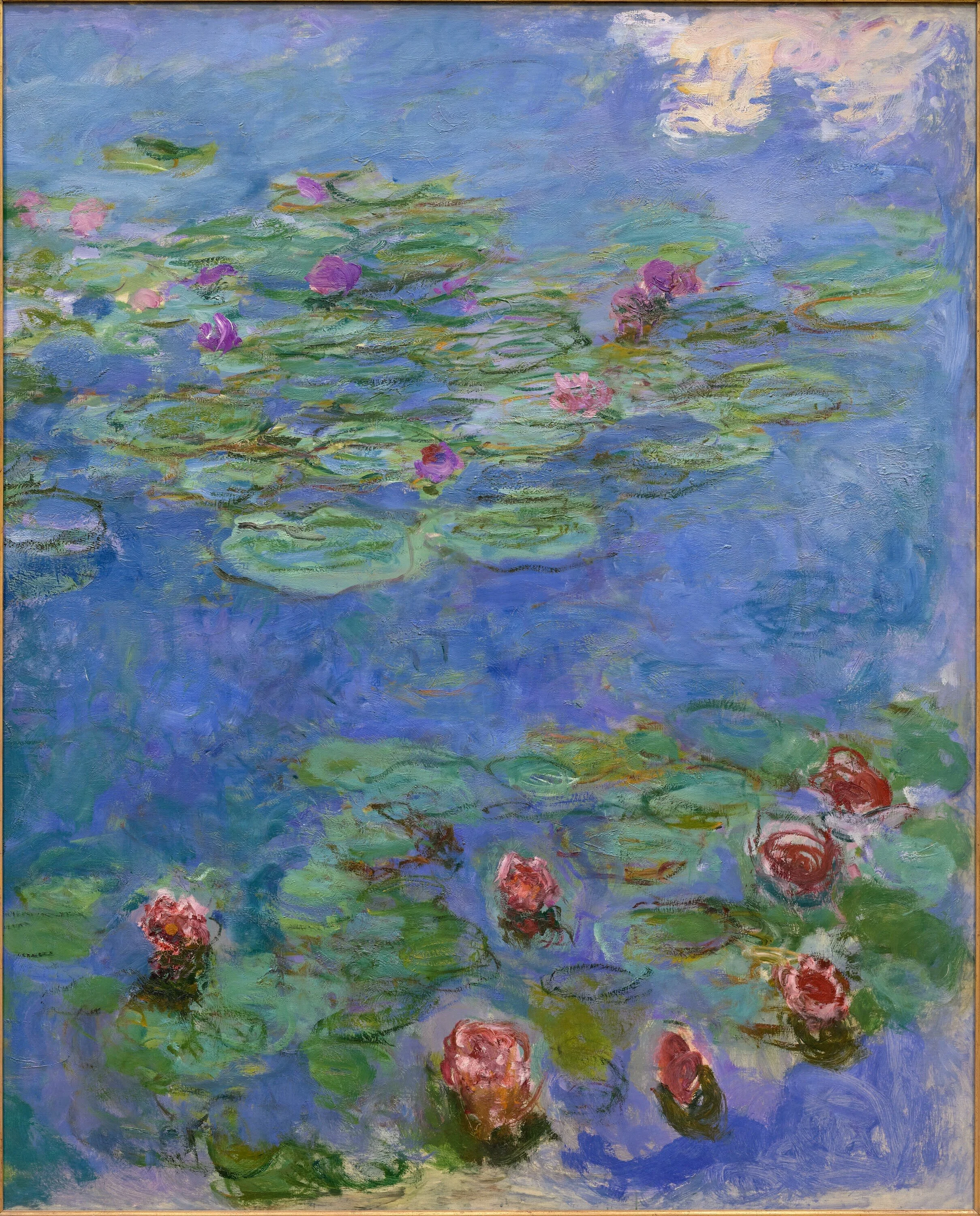
Claude Monet, "Water Lilies," ca. 1914-1917. Oil on canvas, 65 3/8 x 56 in. (166.1 x 142.2 cm). Fine Arts Museums of San Francisco, Museum purchase, Mildred Anna Williams Collection, 1973.3 Photograph by Randy Dodson, courtesy of the Fine Arts Museums of San Francisco.