AN INTERVIEW WITH JOHNNIE CHATMAN: REFRAMING THE AMERICAN WEST THROUGH CONTEMPORARY LANDSCAPE PHOTOGRAPHY
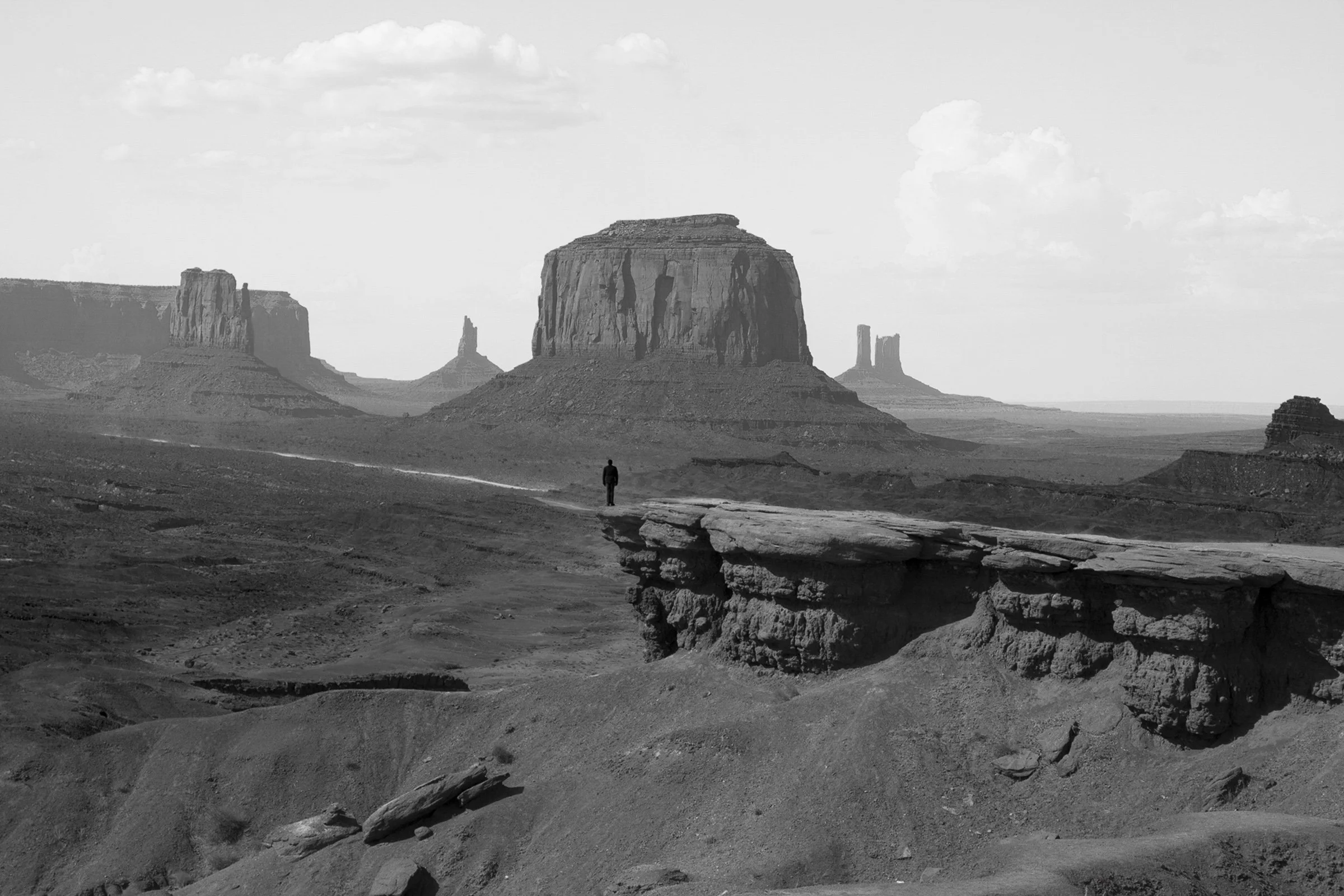
Self Portrait, John Ford Point. Courtesy of Johnnie Chatman.
The landscape has always been sold to us as a promise: open air, open road, open destiny. But the American West, so often photographed as sublime, pristine, and obediently quiet, has never been neutral. It’s been staged, militarized, mythologized, mined, fenced, renamed, and exported as an image. In JohnnIE Chatman’s work, the land turns volatile again: a live archive where nationhood, tourism, propaganda, and personal memory collide: where the “view” can’t pretend it’s innocent.
Chatman’s photographs return, again and again, to a single figure, his own body, held in silhouette against wide-open terrain and the sharp geometry of man-made obstruction. Barriers. Borders. Edges. The effect is seductive and unnerving. You’re drawn in by the elegance of the compositions, then caught by what they refuse: the easy pleasure of distance, the fantasy that the land is empty, the old lie that the photographer isn’t there. His body is unmistakably present, but never simplified: both obvious and elusive, like a signal flare and a question at once.
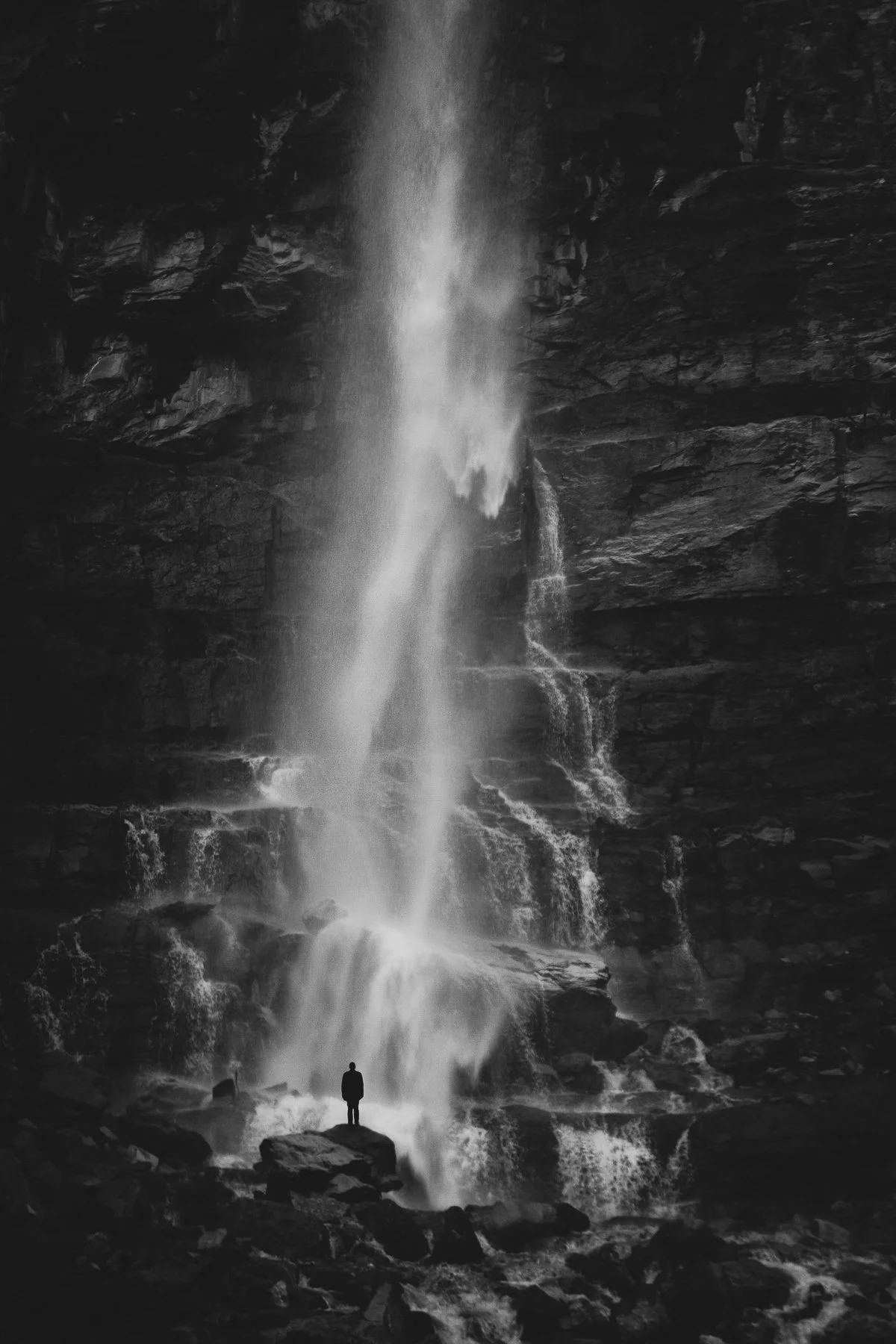
Self Portrait, Cascade Falls. Courtesy of Johnnie Chatman
And that’s where it got personal for me. Looking at his body in the West made me think about my own body in the West; not as some frontier costume, not as conquest, not as romance with a horizon, but as stewardship. Ancient lands, not a “new world.” Extracted lands, not open space. Two figures moving through deep time while history keeps trying to flatten everything into postcard logic. His images don’t let you look away from that. They don’t let you float above the land. They drop you back into it: into accountability, into presence, into the fact that every “beautiful” landscape in America is also a record of power.
It felt serendipitous to hear Chatman [representing the University of California, San Diego art history department] speak at the Getty Graduate Symposium—an event I love attending because it’s one of the rare places where scholarship still feels like electricity, like something that can change how you see the world the moment you walk back outside. His talk sharpened what the photographs already whisper and threaten: the historical photographic lineage of the American West has been reluctant, sometimes willfully, to frame bodies of color as subjects of the land without turning them into a problem to be explained. Either erased entirely or permitted only under the heavy hand of interpretation. Chatman reroutes that inheritance. He makes presence undeniable, and somehow, miraculously, doesn’t overburden it. The work holds complexity without drowning in it.
His institutional story mirrors that shift. Chatman was included in SFMOMA’s Sea Change: Photographs from the Collection, a permanent-collection exhibition that looks at photography as a register of transformation, cultural, political, and environmental, placing historical and contemporary works in dialogue and foregrounding newer acquisitions alongside underrecognized artists. Within that context, his images don’t read like an exception; they read like a correction, a necessary pressure applied to the archive.
And then there’s the rarity of what he is: the PhD scholar-artist in full form. Most artists don’t take on a doctorate—because it’s brutal, because it’s long, because the art world loves speed and clean narratives. And yet: here we are. Chatman is proof that rigorous thinking can be sexy—that analysis can sharpen desire rather than dull it—that the longest route can sometimes be the most direct way to authority. He speaks with the precision of someone who has lived inside the canon and still decided to argue with it. The photographs do the same.
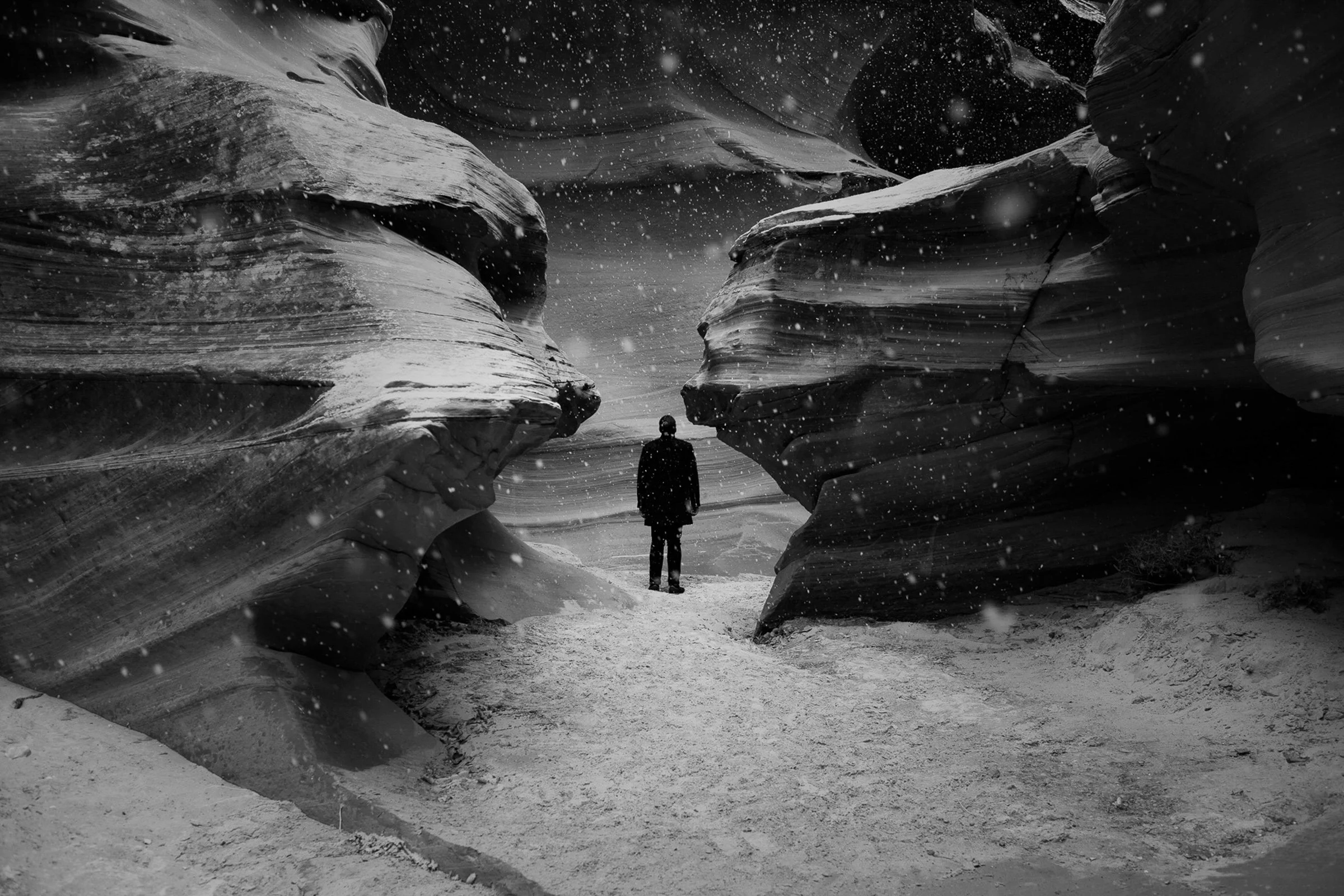
Self Portrait, John Ford Point. Courtesy of Johnnie Chatman.
Interview
AMADOUR: I’m a huge fan of your work. After I heard your dissertation presentation at the Getty Graduate Symposium. Something stayed with me: the way landscape seems to permeate your understanding of the body. There’s a relationship between body and topography that feels foundational in your work. Where did that begin? What was the first moment you recognized that this was your visual language?
JOHNNIE CHATMAN: I came to the body through the landscape.
Growing up in Southern California, the land already felt like a multiple temporal space. As a kid, I went back and forth between here and Las Vegas, and you fantasize about what that landscape could be, what it means, what it holds. Then you start learning about the military connotations of those spaces as you’re driving between cities.
But the deeper shift happened when I was an undergrad in San Francisco. I lived near Fisherman’s Wharf, with a window overlooking the Bay. I watched ships come in and saw how people interacted with the terrain. That view made me curious, not just about what I saw, but about what had shaped it.
You see Angel Island, and then you begin thinking about the many histories that shaped that land. You go to the Presidio, see this forest, and then learn it's man-made. That’s the moment. You start asking: What decisions were made to put this in place? What do we hold as “natural” that is actually the result of human action, decades and decades before we arrive?
From there, the questions deepen, and the landscape returns you to the body—because bodies are always impacted by those relationships.
AMADOUR: I feel a kinship with that geography. I grew up in Reno, Nevada, and Sausalito, California, so I can relate to driving between the two states. That drive between L.A. and Las Vegas is its own kind of mythology. What were the first subtleties that drew you in?
JOHNNIE CHATMAN: It starts with the old mining towns—Calico Ghost Town, places like that. Then there’s a moment when the landscape almost looks like it used to be underwater. It makes you think about natural forces shaping the land. Then you begin asking what the human force is after that, what markings have been made, and what has shifted.
And then you arrive in Las Vegas, which is so unnatural in relation to the desert. Vegas feels like it has a clear beginning and end. But its history is tied to atomic bomb testing and the militarization of the surrounding terrain. I had family in the military, and they would point out sites, histories, and their own personal relationships to those spaces.
So it’s not just the land, it’s how it’s narrated, used, and how that use becomes invisible.
AMADOUR: When I look at your photographs, the silhouette of the body against the terrain creates something powerful—almost like a form of stewardship. Or the feeling of being both of and not of a place. There’s a temporality: the landscape will outlive us, but the body changes everything the moment it appears. How do you choose sites, angles, and conditions? Your locations feel extremely specific.
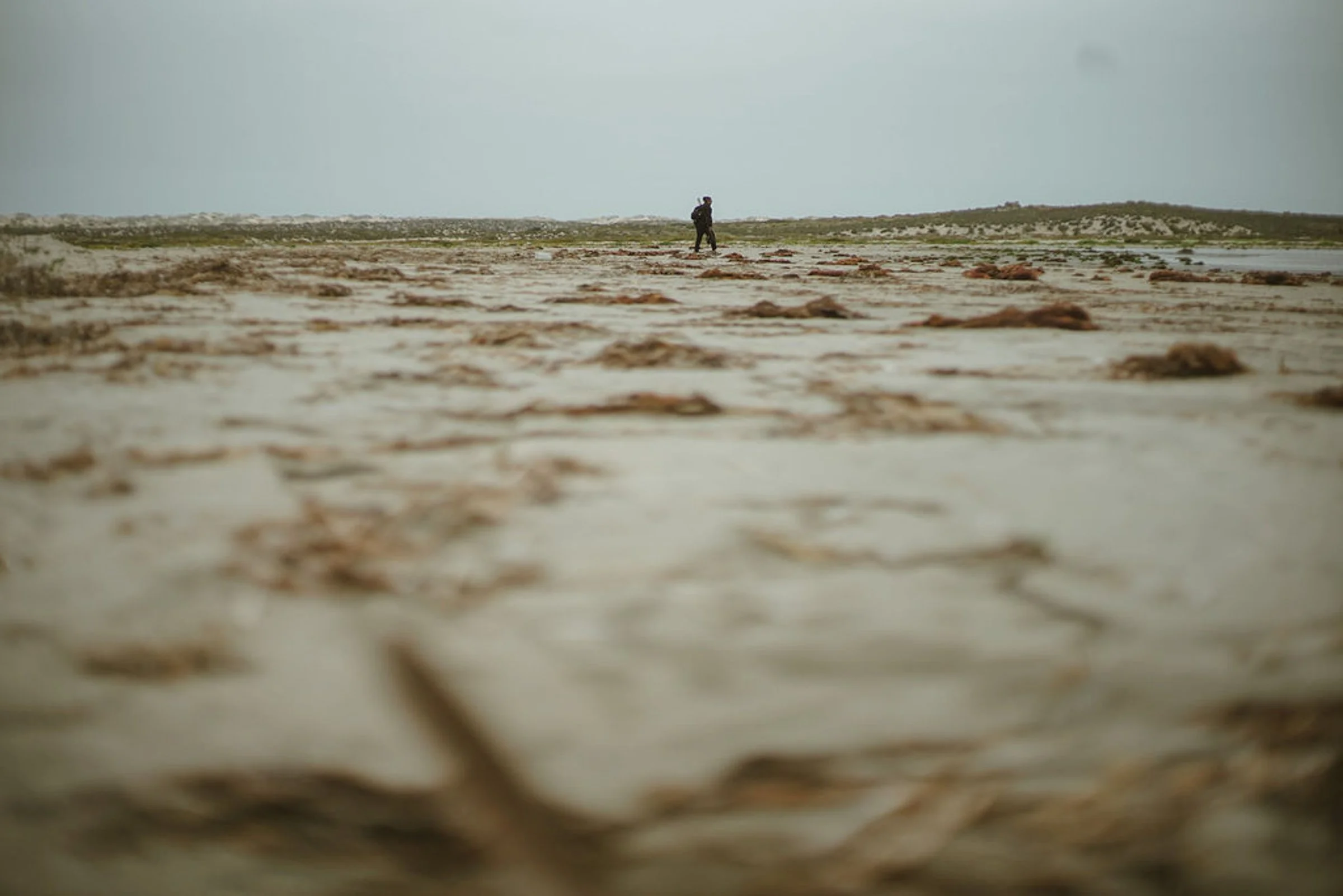
Photograph of Johnnie Chatman by Mirna Borr.
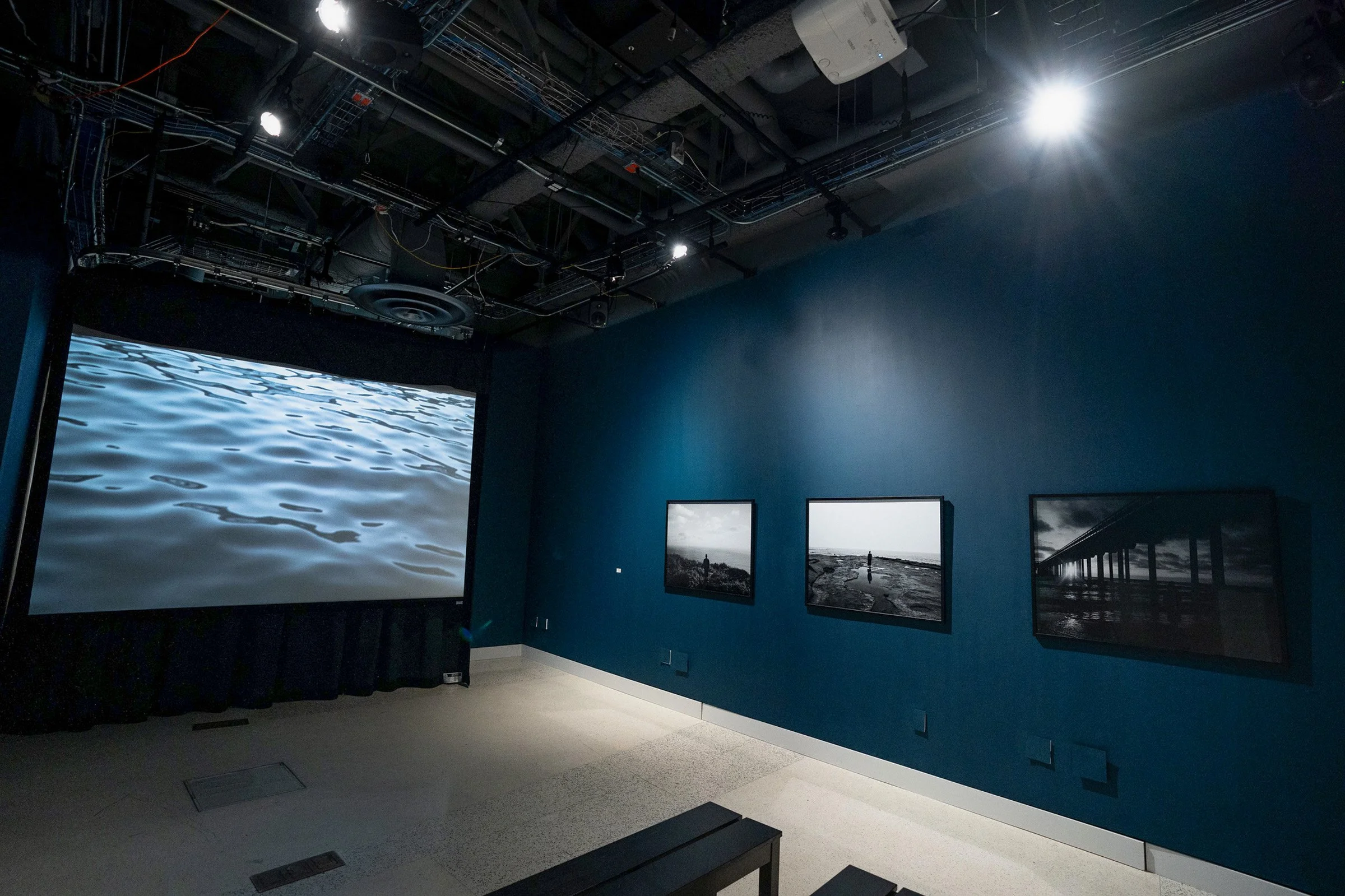
Installation still of Embodied Pacific: Three Lives at Gallery QI at The Qualcomm Institute at University of California San Diego. Curated by Dr. Lisa Cartwright. Image courtesy of Gallery QI.
JOHNNIE CHATMAN: The landscapes come to me through different channels.
Sometimes I’ll see where people are going—especially on social media—places presented as “the site you must see.” And then I’m interested in the reality of that place. What is its actual history? What is its relationship to photography? Is there an image history that preceded that, explaining why people are going there now?
I also consider local history. The perspective of someone who’s lived in a region for decades differs from that of photographers who consume the place. I talk to people. I listen.
I look through the history of film and visual media, too. Nothing is off limits. I’m trying to find sites where multiple connections happen—where national identity, land history, and memory tourism intersect.
National parks are important because they help build national identity. They also represent capital—their images and stories are exported worldwide. All these relationships can be seen within the frame.
AMADOUR: In your dissertation, I was struck by how you positioned historical figures and institutions. You spoke about Ansel Adams, the construction of the American West as frontier mythology, and even the way “America” is imagined through the landscape. How do you situate yourself within the history of photography you’re researching?
JOHNNIE CHATMAN: I think it’s ongoing. I’m in a unique position. I’m an art historian and an artist, and that creates a forced self-reflexivity. I’m watching myself while something is happening.
When I began, I considered lineage. Landscape photographers study the previous generation through workshops, direct mentorship, or simply by drawing inspiration from earlier images and technical traditions.
But I also became aware of what doesn’t get asked.
In landscape photography, people often don’t ask the image maker the kind of questions we ask a documentary photographer. We don’t ask, "How did you get access to that place?" What are your intentions? What is your relationship to what you’re photographing?
Yet landscape images hold ideology. They naturalize certain views of the land, and those views have a tremendous effect.
I remember a talk by artist Trevor Paglen where someone asked about his family history, and suddenly, you realized that personal connections were shaping how he saw the land. He said something that stayed with me: landscape photographers don’t talk about themselves.
There’s a kind of distance built into the language of the medium. For example, the New Topographics [coined by curator William Jenkins in 1975, refers to photographers like Robert Adams and Lewis Baltz, known for banal, formal black-and-white views of the built landscape] often emphasize neutrality and detachment. Still, a key question remains: what is your relationship to this space, and how does that affect what we see?
And then, when I started making images, I realized something. As a Black photographer, the question of who I was in relation to the landscape arrived immediately. People wanted to locate me, to interpret the body first.
So I began thinking: how do I use that? How do I let the figure become a lure, a doorway, into conversations that landscape photography often avoids? People want to “just look at the view.”
AMADOUR: You mentioned the Presidio earlier, and it’s such a fascinating site—military history layered with a kind of erasure. San Francisco is small geographically but dense with history. What drew you into those particular terrains?
JOHNNIE CHATMAN: I lived all over San Francisco for about five years during undergrad. I explored the city constantly. I lived near Lands End and would walk the perimeter of the city.
That exploration became a body of work titled Between the Sea and the City, which examined the Bay Area as a militarized landscape. San Francisco has one of the best-preserved World War II landscapes, but people don’t think of the city that way.
You can go to Baker Beach and see a giant artillery gun. That’s also the birthplace of Burning Man [now encountered in the Black Rock Desert in Northern Nevada]. That’s a point of tension. San Francisco has all these pop-cultural manifestations. But there are historical “elephants in the room” that inform how the city is seen.
People go for photos of the Golden Gate Bridge. They cross the bridge, park, do the walk, and get the shot. And they don’t realize they’re standing on a fort. They’re at a military base. That site literally gives them the viewpoint.
So the Bay Area became a catalyst for thinking about land as non-stable, malleable, because depending on how you turn, you see a drastically different history. Multiple perspectives are layered on top of each other.
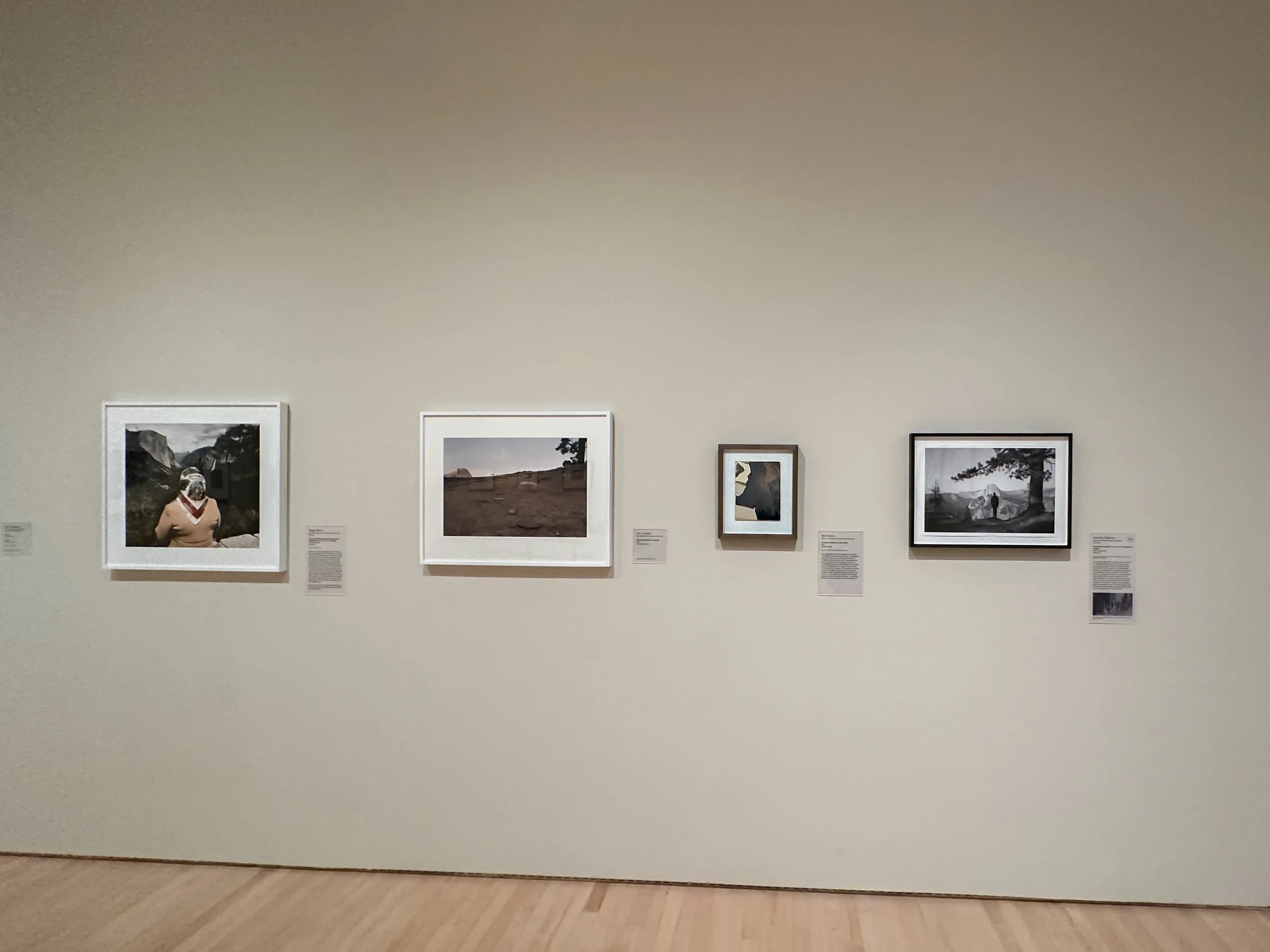
Installation still of Sea Change: Photographs from the Collection at San Francisco Museum of Modern Art. Courtesy of Johnnie Chatman
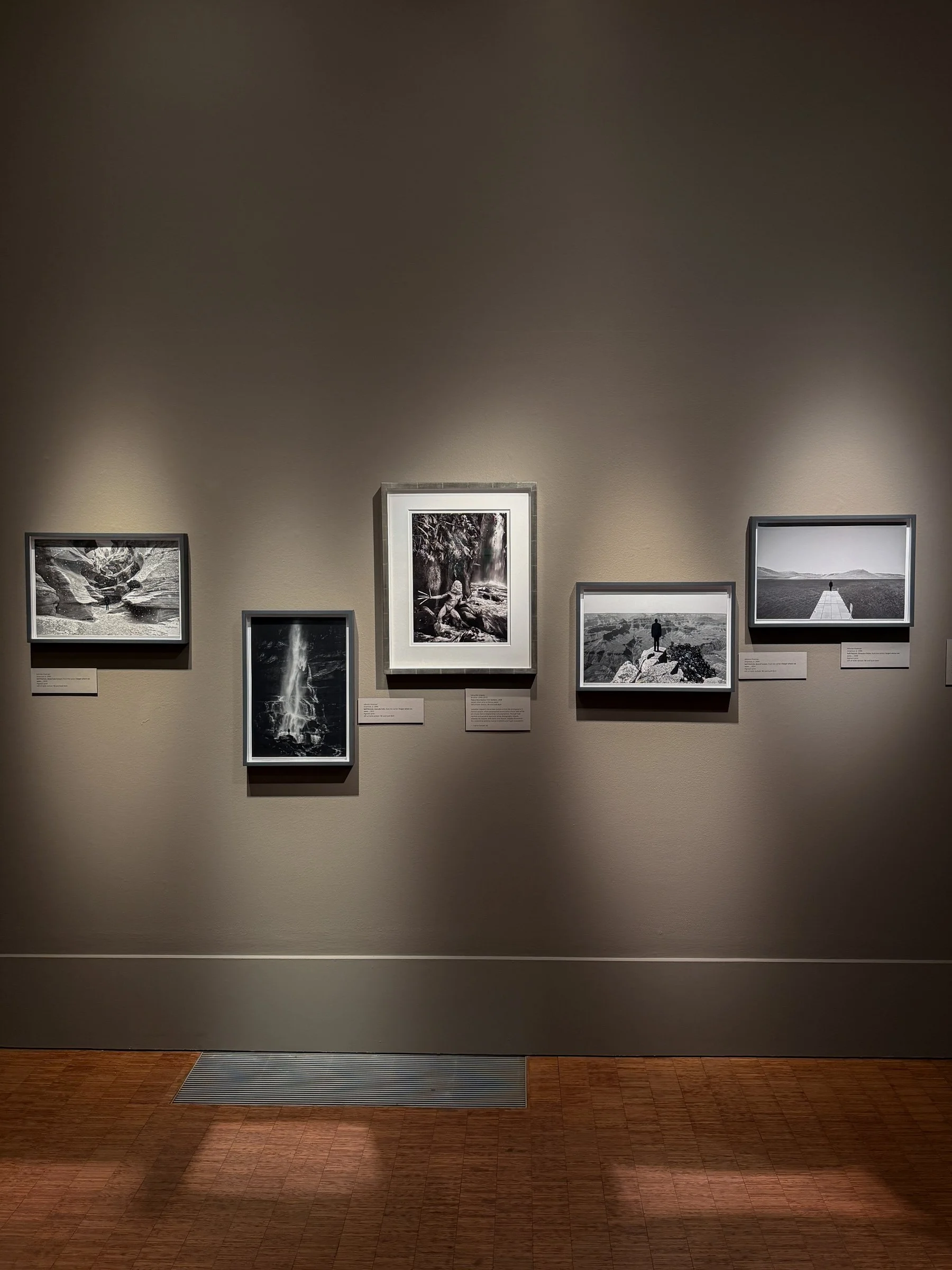
Installation still of Rhizomatic Intimacies: Photography from the Collection of Keith Jantzen ’80 and Scott Beth at Grinnell College Museum of Art. Courtesy of Johnnie Chatman
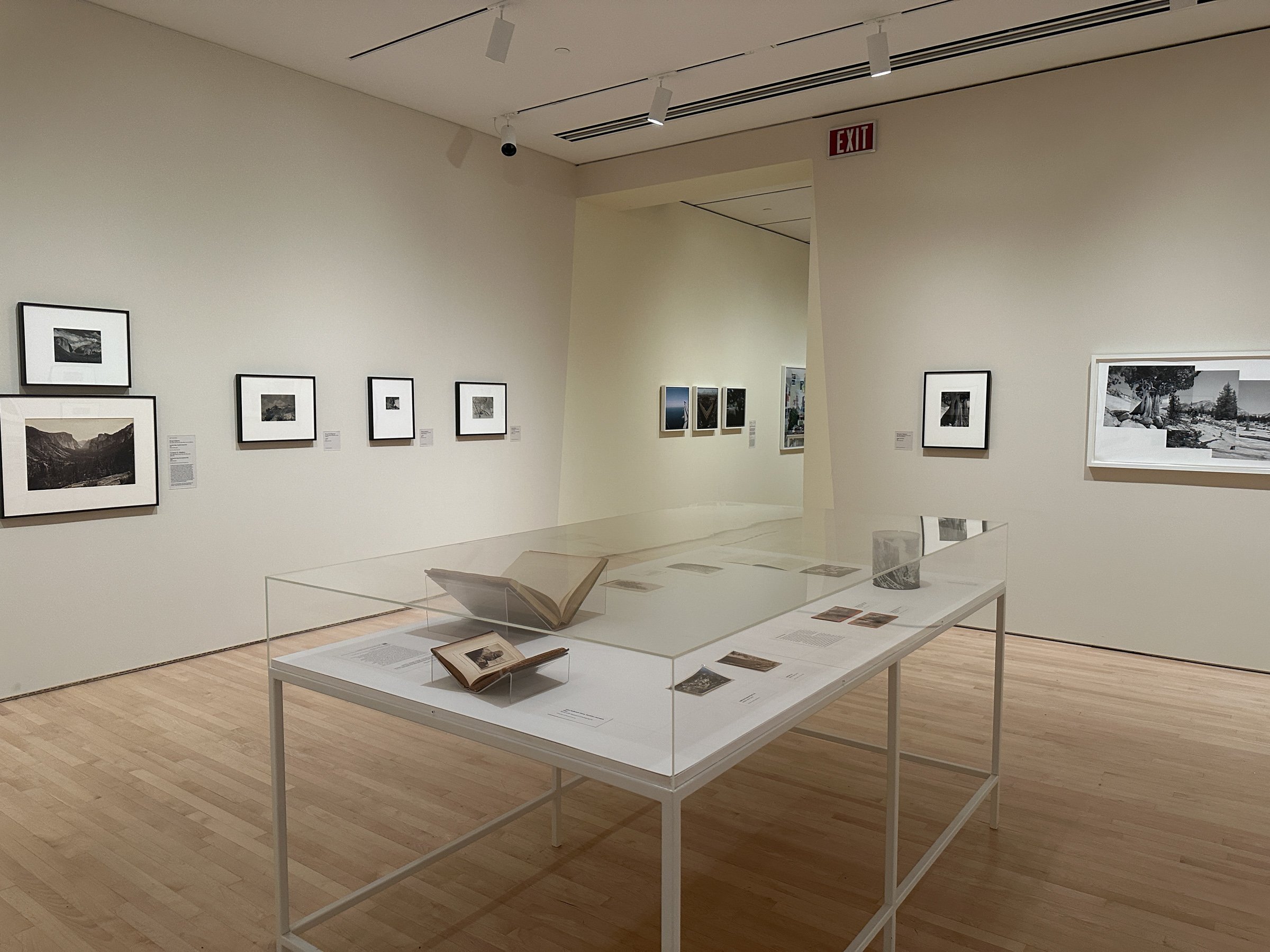
Installation still of Sea Change: Photographs from the Collection at San Francisco Museum of Modern Art. Photograph by Dr. Emilia Mickevicius.
AMADOUR: You’re an artist pursuing a PhD in art history at UC San Diego, which is rare and, frankly, admirable. Many people stop at a certain point, feeling they don’t need institutional research—but for you, it seems monumental, like it expanded your capacity. What would you say to an artist considering that path?
JOHNNIE CHATMAN: It’s a much larger undertaking than it seems. As an artist, you have to ask: Will spending five to eight years studying and doing research affect your career? Can these two paths work together?
For me, it came from my master’s at the School of Visual Arts in New York. I often found myself becoming a historian in order to defend or explain what I was doing as an artist. After graduating and working, I had this thought: I could wait for someone else to write the essay I needed as a student, or I could become the person who writes it. I could help open the doors.
During the pandemic, I was working at the Parsons School of Design and decided to apply. I got admitted, and it set me on this path. My artistic work always included the art talk: bringing people into the histories that shape why I’m photographing certain locations in certain ways. Not just talking about what camera I used, but the forces beneath the image.
The PhD gives grounding—language, history, terminology. Sometimes, as artists, we pull language from everywhere, but here you can trace the history of the language itself.
And it lets you reframe major figures. For example, what happens if we look at Ansel Adams through propaganda? That doesn’t remove the beauty, but it offers another way of seeing it. Beauty can be a lure, an argument, to get people to care about landscapes, and those images influenced public perception, legislature, all of it. So the question becomes: how were images used, and what did they do?
AMADOUR: I loved seeing installation images from your SFMOMA presentation. How did it feel to bring the work into the city where your education took shape?
JOHNNIE CHATMAN: It was a full circle moment. You go there as a student, see work on the walls, and imagine being in those spaces. And then you come back, not even a decade later, and the ideas you were beginning to form are now part of the conversation.
The curators I worked with, Emilia Mickevicius and Shana Lopes, were amazing. They worked with me to get my work into the collection and into the exhibition.
What moved me was the way the show positioned my photographs alongside photographers like Carleton Watkins, Timothy O’Sullivan, and Mark Klett—making the archive not a precious object, but something active. The idea is that the archive is still in conversation, and the work can force a re-examination of the legacy of landscape photography in the region, including Yosemite, and the histories those images often obscure.
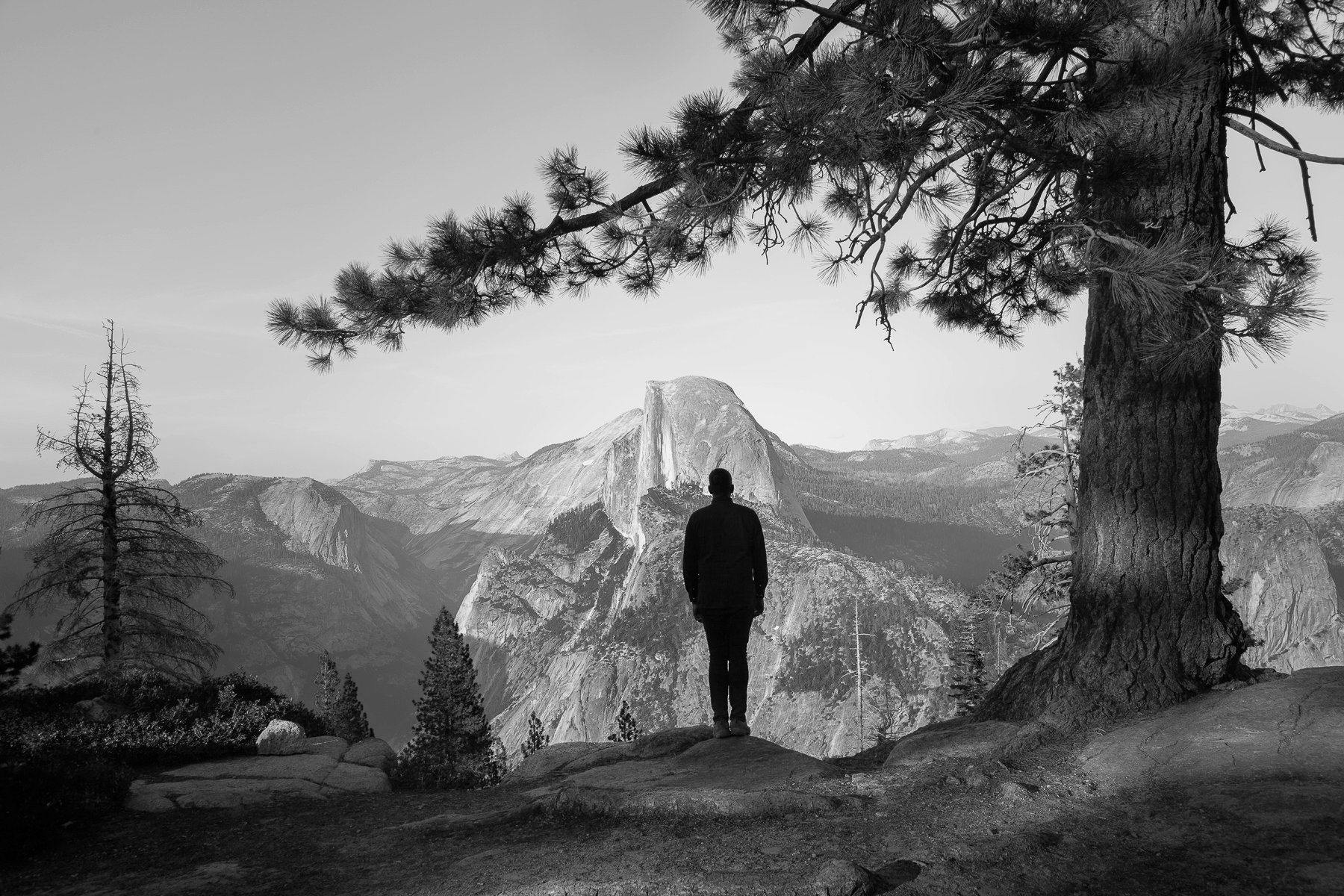
Self Portrait, Yosemite. Courtesy of Johnnie Chatman
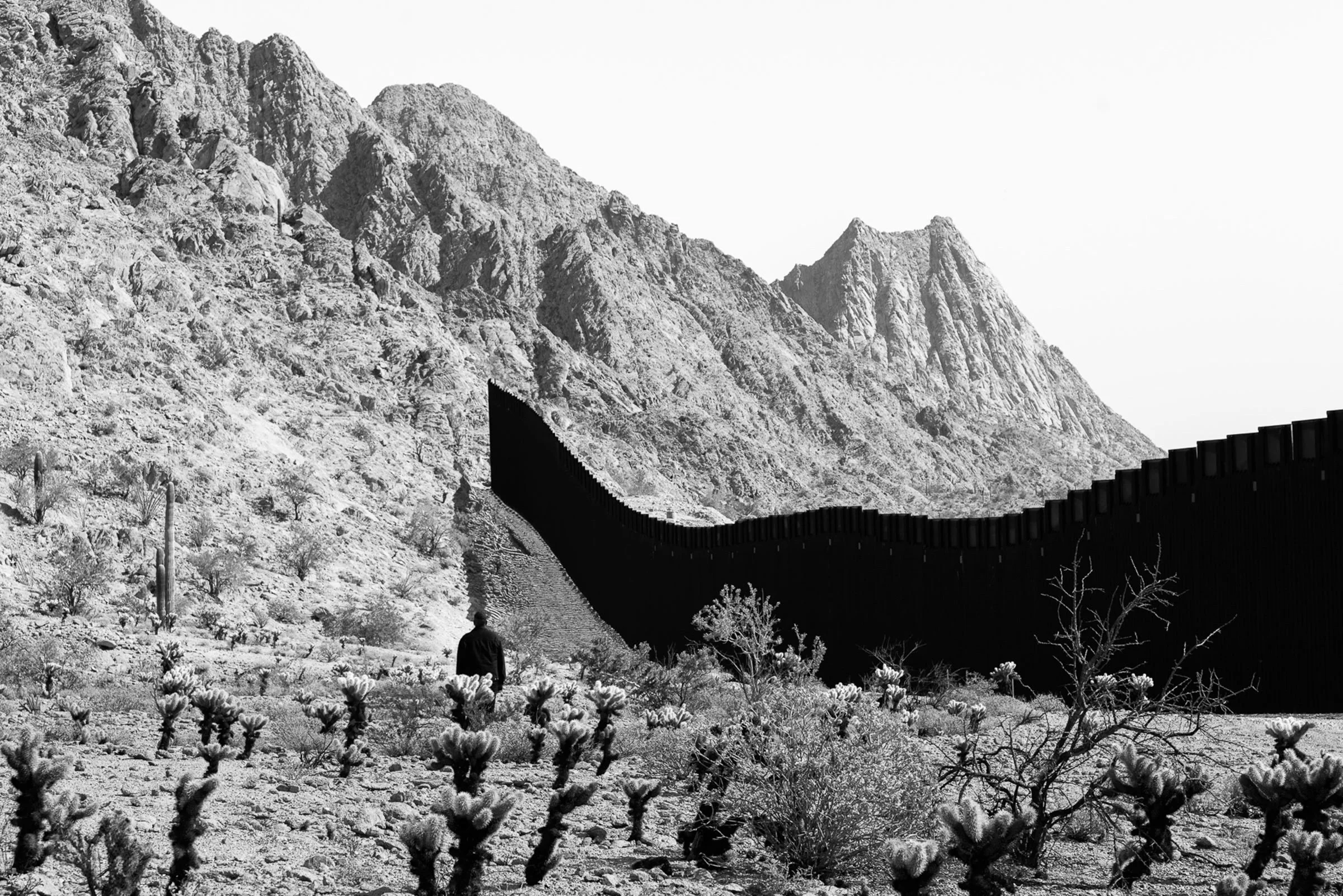
Self Portrait, Sonora. Courtesy of Johnnie Chatman.
AMADOUR: In art history, you can think of the singular figure as a kind of iconic device, one body becoming a persistent presence across contexts. Why do you focus on one body, rather than multiple?
JOHNNIE CHATMAN: When I first began making images of body and landscape, I actually photographed someone else. I was going to do a fashion shoot, and the person couldn’t make it, so I decided to experiment with self-portraiture. I had done some in-studio, but this was different.
Over time, I came to understand the figure as a point of relation—a point of contact. At first, I didn’t even call them self-portraits. But when I showed early work at the Legion of Honor as a student, a curator told me people needed to know it was me. That decision changes everything.
I also became aware of voyeurism and the power of the gaze. When you’re dealing with identity and the American West, the gaze can be intense. I’ve faced pushback, and I didn’t want to place other people in harm's way. Whoever is in front of the camera becomes part of the conversation through their body and language.
So focusing on my own body makes it clear: this isn’t universal. This is subjective. This is my experience of the landscape.
AMADOUR: Your black-and-white feels like it alters the temperature of time. It’s also in conversation with the history of landscape photography—propaganda, expansion, canon. Why black and white?
JOHNNIE CHATMAN: One reason is conceptual: we don’t see the world in black and white. So choosing black and white is already choosing abstraction. It should signal that what you’re seeing isn’t literal documentary reality. It may be dealing with something else.
On a practical level, it unifies the series. These images have been made over the last decade, and the full body of work will be across all 50 states, so black and white helps hold it together as one project.
But I’m also beginning to shift. I’m part of an exhibition opening next month, and it will include my first-ever self-portrait in color. People haven’t really seen me do that, so it will be interesting to see how the response changes.
AMADOUR: Where is the exhibition?
JOHNNIE CHATMAN: It’s at Bread & Salt in San Diego. It’s organized by INSITE Art, which has worked for decades with artists from California and Mexico, especially Baja California. We’ve been working together for around two years, thinking about the region and its shared histories.
The exhibition, “Erratic Fields,” brings together artists they’ve commissioned over the last 30 years. It includes Gary Simmons, Allan Sekula, Anya Gallaccio, and Mark Dion, and commissions new work from local artists such as Lael Corbin, myself, and the artist collective Pastizal Zamudio, working outside of Mexicali.
A lot of it focuses on the Colorado River region, water, military histories, bird migration, shared terrain, and shared consequences.
AMADOUR: To close: when you’re not thinking critically about landscapes, what do you make time for that people might not expect?
JOHNNIE CHATMAN: Live performance. Theater, music, ballet, concerts. Last year, I saw over 250 artists. I go to festivals. I’m interested in the way people travel to gather, almost like a pilgrimage. Multi-day festivals, camping festivals—those spaces also become communities. Events like Coachella, Electric Forest in Michigan, and Lightning in a Bottle. This includes yoga, care practices, panels with indigenous scholars, discussions about land and care, and cooking classes. It’s a community experience in ways that aren’t always attached to immediate capital. I think about collective effervescence, the intense shared energy and unity that happens when people gather for a common purpose.
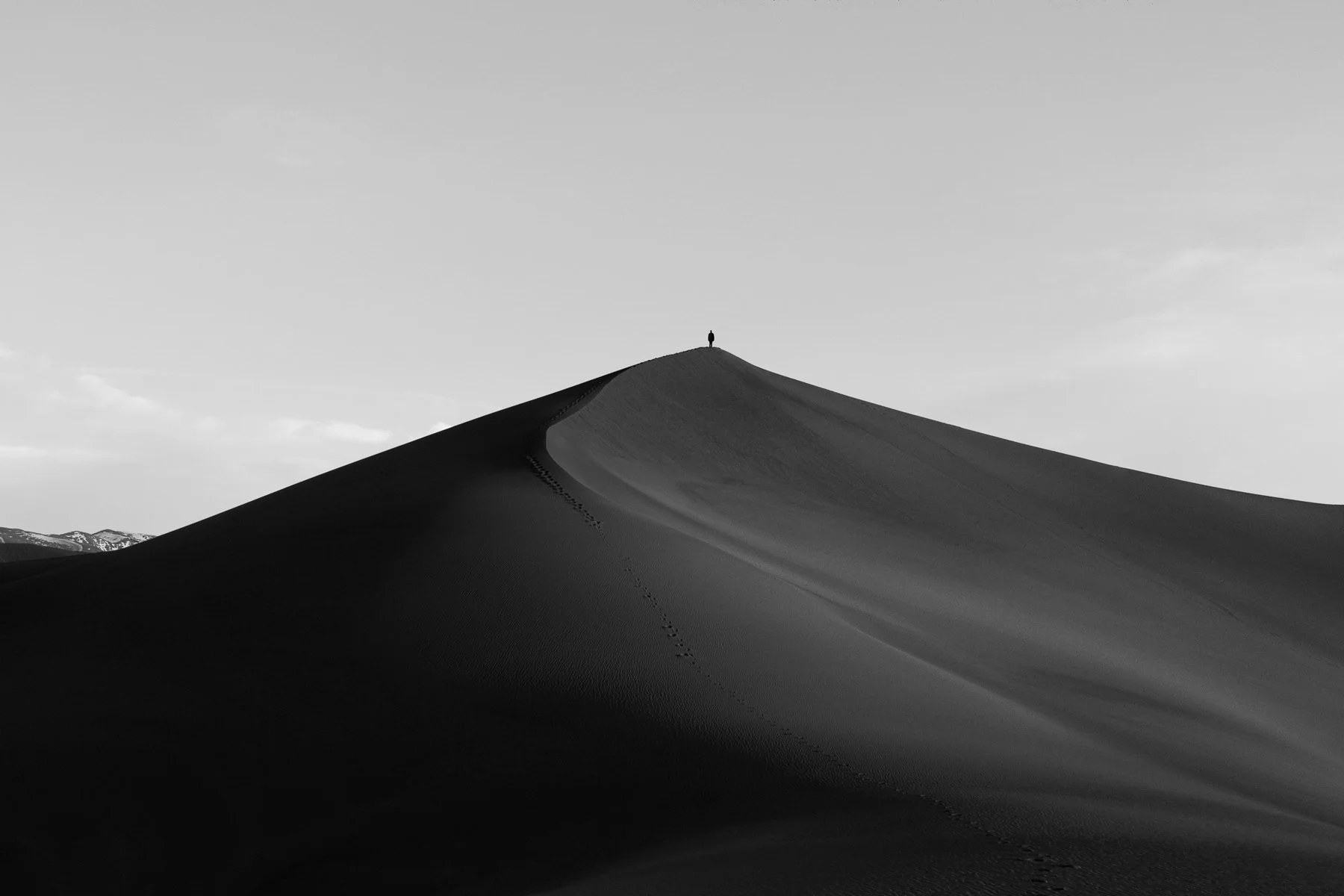
Self Portrait, Great Sand Dunes (South). Courtesy of Johnnie Chatman