INSIDE “KILL DICK”: AUTHOR LUKE GOEBEL ON ART, POWER, IDENTITY, AND THE COLLAPSE OF REALITY IN LOS ANGELES
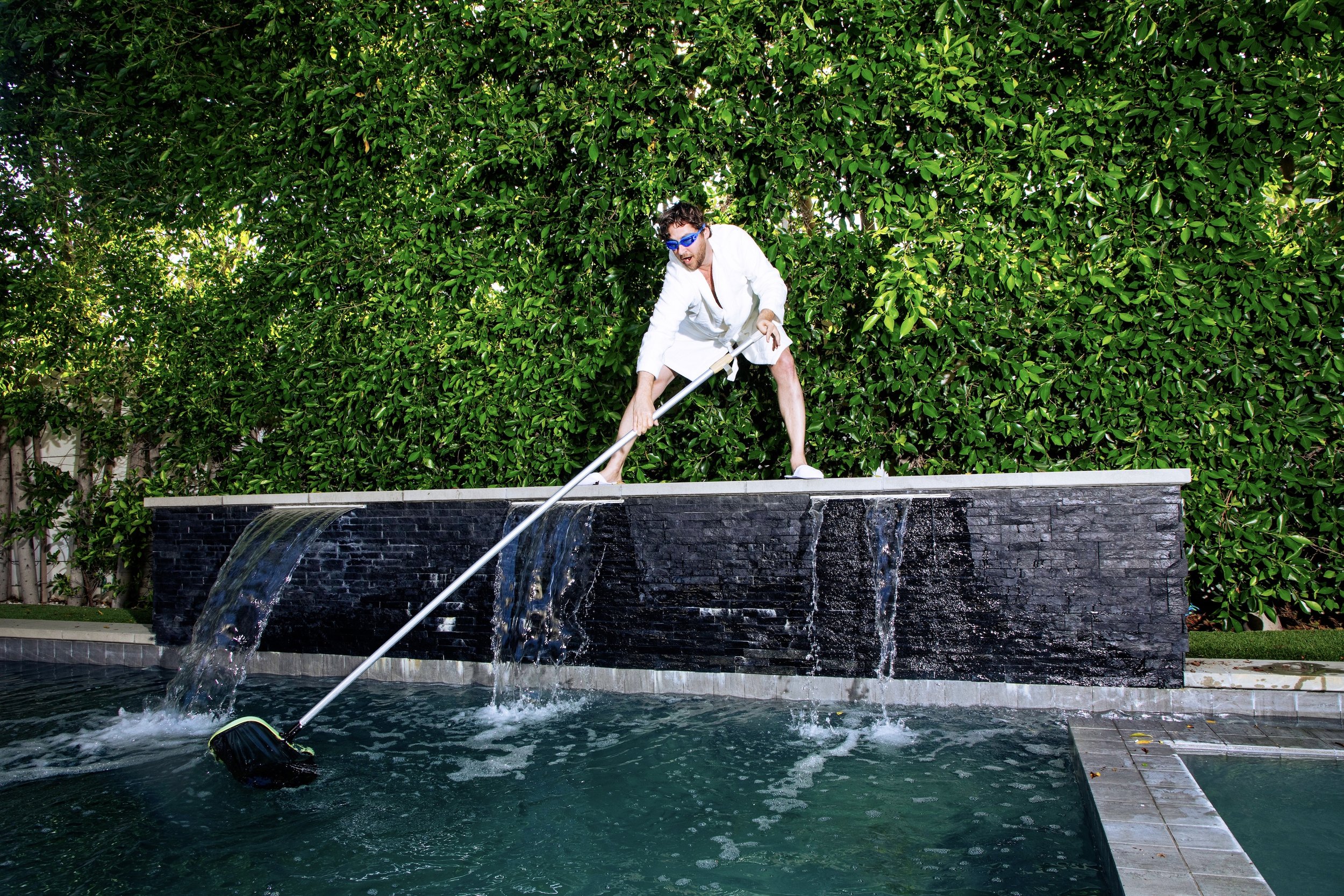
Author Luke Goebel at a swimming pool.
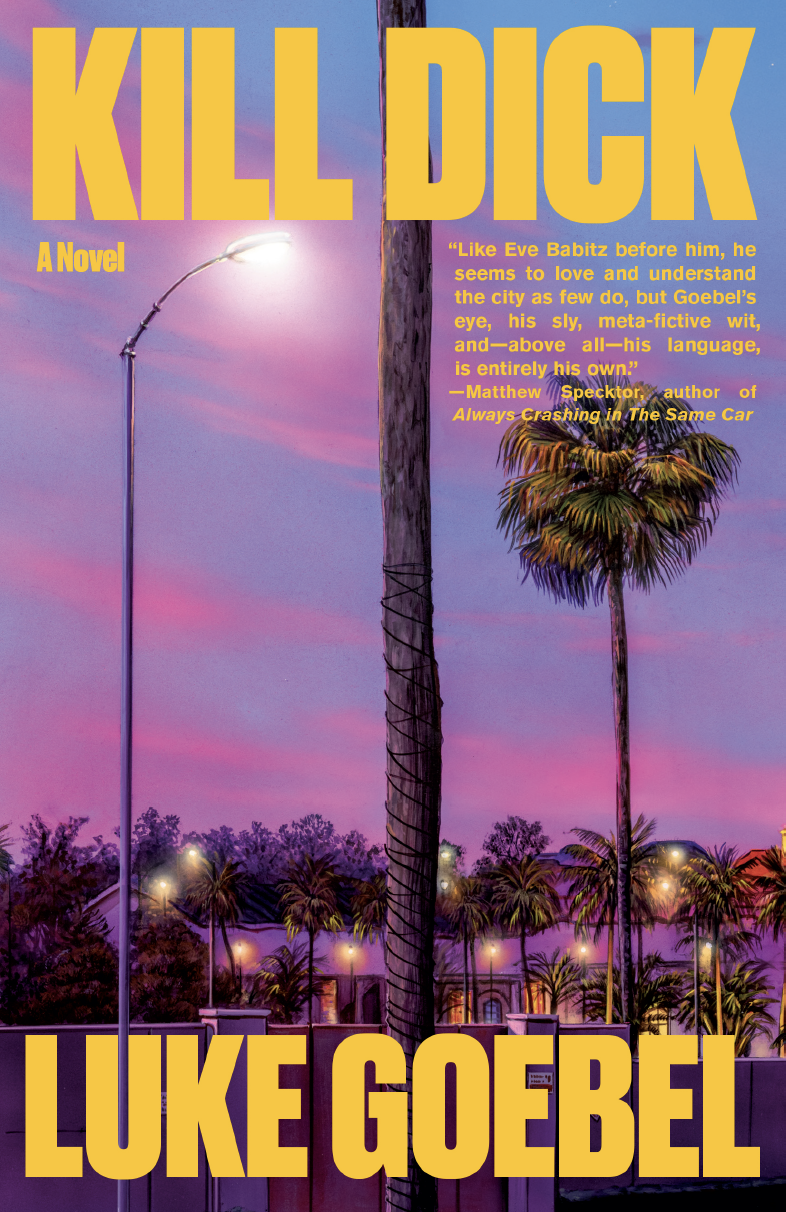
Kill Dick cover art by Alex Israel. Courtesy of Luke Goebel and the artist.
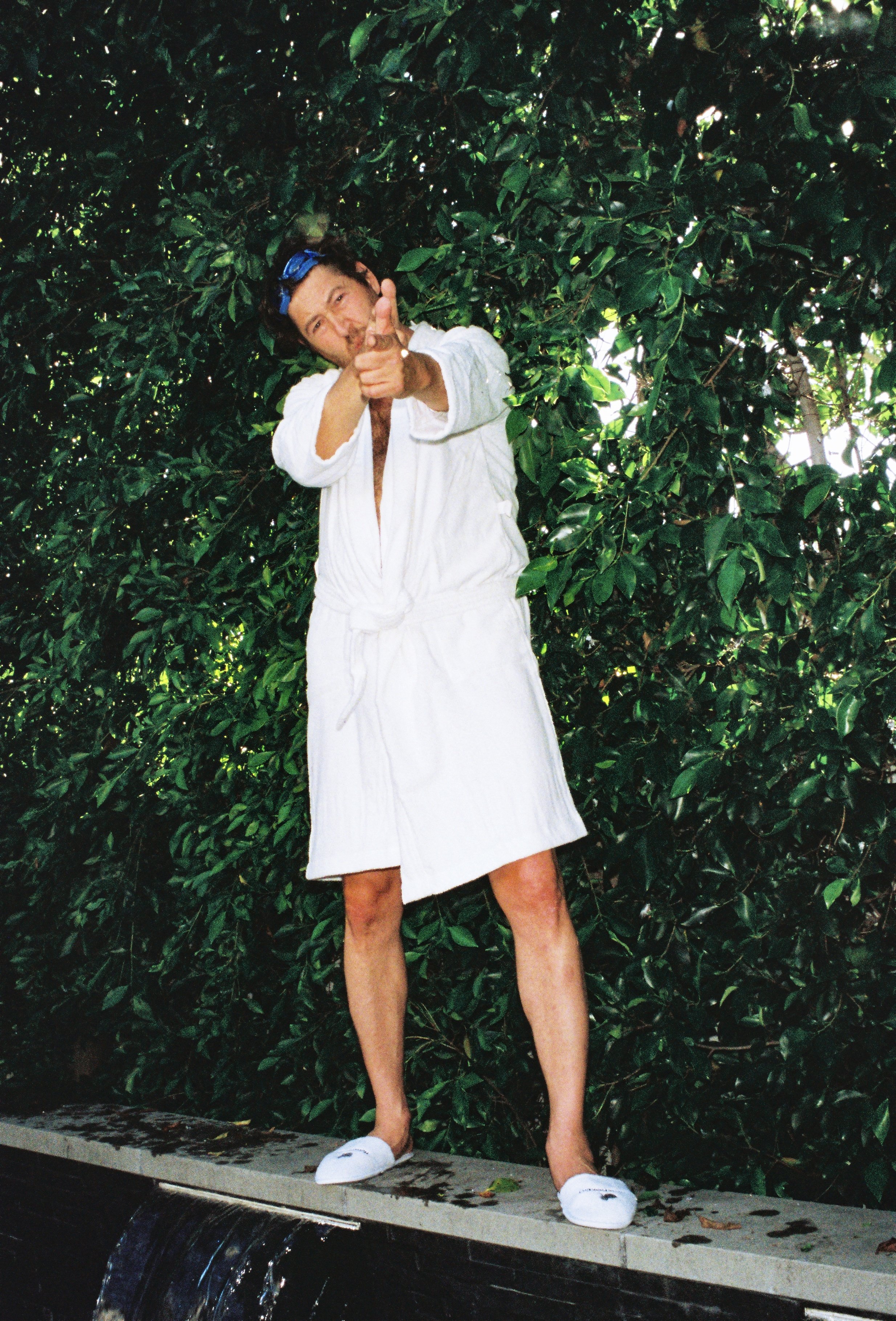
Author Luke Goebel standing at a swimming pool edge.
Luke Goebel’s Kill Dick, recently released by Red Hen Press, has already received significant critical attention for its sprawling portrait of Los Angeles, its treatment of addiction and media culture, and its psychologically destabilized rendering of contemporary American life. I first met Goebel in April when he invited me to the launch party for Kill Dick at Genghis Cohen in Los Angeles, hosted in collaboration with Flaunt Magazine. The newly relocated restaurant sits further down Fairfax from the original location, carrying forward the mythology of old Hollywood while feeling strangely suspended outside of time. Its interiors glowed with deep reds, mirrored reflections, lacquered surfaces, and dim, cinematic lighting that felt almost like stepping into a lost Wong Kar Wai set. The atmosphere itself felt strangely fitting for the world of the novel: artists, writers, musicians, and downtown cultural figures drifting through conversations beneath the haze of late-night Los Angeles.
The following evening, Goebel invited me to attend his talk at Soho House Malibu, where I began to enter more deeply into the philosophical and psychological architecture of his literary universe. I remember parking off Pacific Coast Highway beside a psychic’s storefront and hesitating, unsure whether I was actually allowed to leave my car there. When I stepped inside to ask, she immediately tried to sell me a reading. I declined only because I was rushing to Goebel’s talk, though I still think about returning for one.
After the conversation, we walked briefly along the Malibu shoreline at night, the Pacific nearly disappearing into darkness. I had recently watched The Way We Were for the first time, and I remember thinking about Barbra Streisand while standing there, not in any literal sense, but because Malibu often feels suspended somewhere between lived experience and cinematic projection. Los Angeles has a way of making memory feel staged before it has even fully happened. Later that evening, we ended up at Astro Diner in Silver Lake, eating spaghetti and discussing the book, which I had only just begun reading. By May, when we reconnected by phone for this conversation, I was roughly two-thirds of the way through the novel and increasingly absorbed in its atmosphere of conspiracy, performance, violence, media saturation, and art-world mythology.
Part of what made Kill Dick feel unusually intimate to me was my own proximity to many of the places, behaviors, and social architectures that Goebel maps throughout the novel. I lived in Brentwood, specifically Kenter Canyon, for seven years while attending Santa Monica College and later UCLA. My daily life unfolded within a strange convergence of ordinary student precarity and immense cultural and financial power. Eli and Edythe Broad lived only a few doors down from me. In the mornings before class, I would jog past the homes of figures like Bob Iger or Reese Witherspoon along the same quiet Brentwood streets that appear throughout Goebel’s world. The neighborhood itself often felt suspended between total banality and enormous influence, where the architecture of wealth concealed itself beneath eucalyptus trees, canyon roads, hedges, and an almost oppressive calm. I inhabited the environment into which Kill Dick character Susie Vogelman was born, yet I rarely felt fully inside it. More often, I moved through it as a visitor, observer, or temporary witness to a carefully constructed social landscape whose codes I could sense but never entirely claim as my own.
I was always fascinated by the strange density of history concentrated within that small network of canyon roads and estates. One house nearby had once belonged to Linda Ronstadt, and I remember attending its open house while it was for sale. Shortly afterward, it was demolished entirely to make way for a mega-mansion that, years later, still seems perpetually under construction. That transformation, the erasure of one version of Los Angeles for another increasingly untouchable one, still makes me sad.
The neighborhood carried other strange artistic echoes as well. While working as a student computer lab assistant at Santa Monica College, I remember reading that Adele and Tobias Jesso Jr. had recorded music together on Philip Glass’ piano at a residence nearby. At the time, I became almost fixated on the article, unable to believe that moments connected to my contemporary music heroes had unfolded so quietly within the same small area just down from where I was living. That fixation is partly why I relate to the idiosyncrasies within Kill Dick: the deep, list-like dives into references, names, coded language, and cultural fragments that continuously evolve and dissolve into forms of neighborhood memory and human insight.
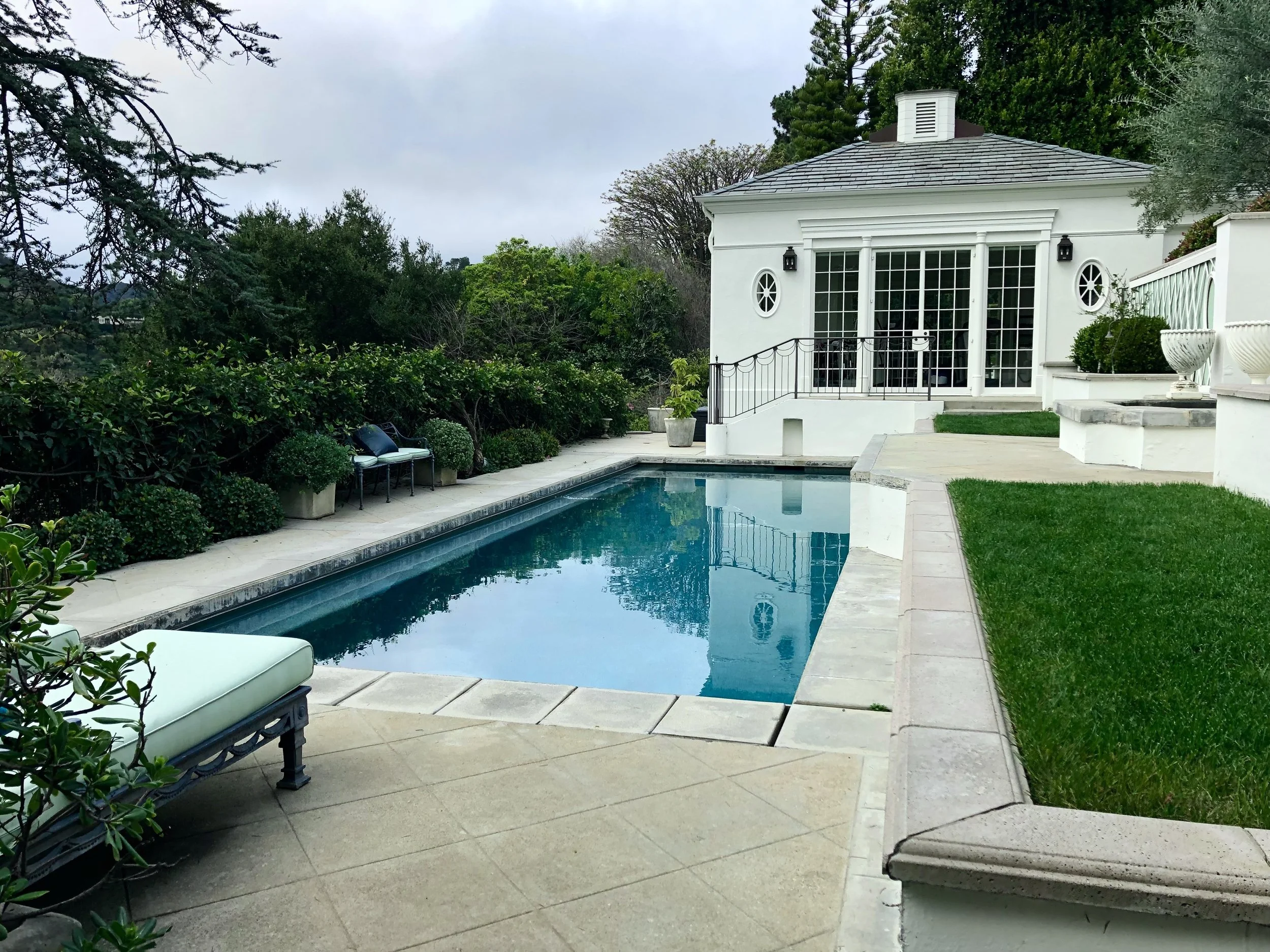
Linda Ronstadt’s Brentwood Home Pool. Photography by Amadour.
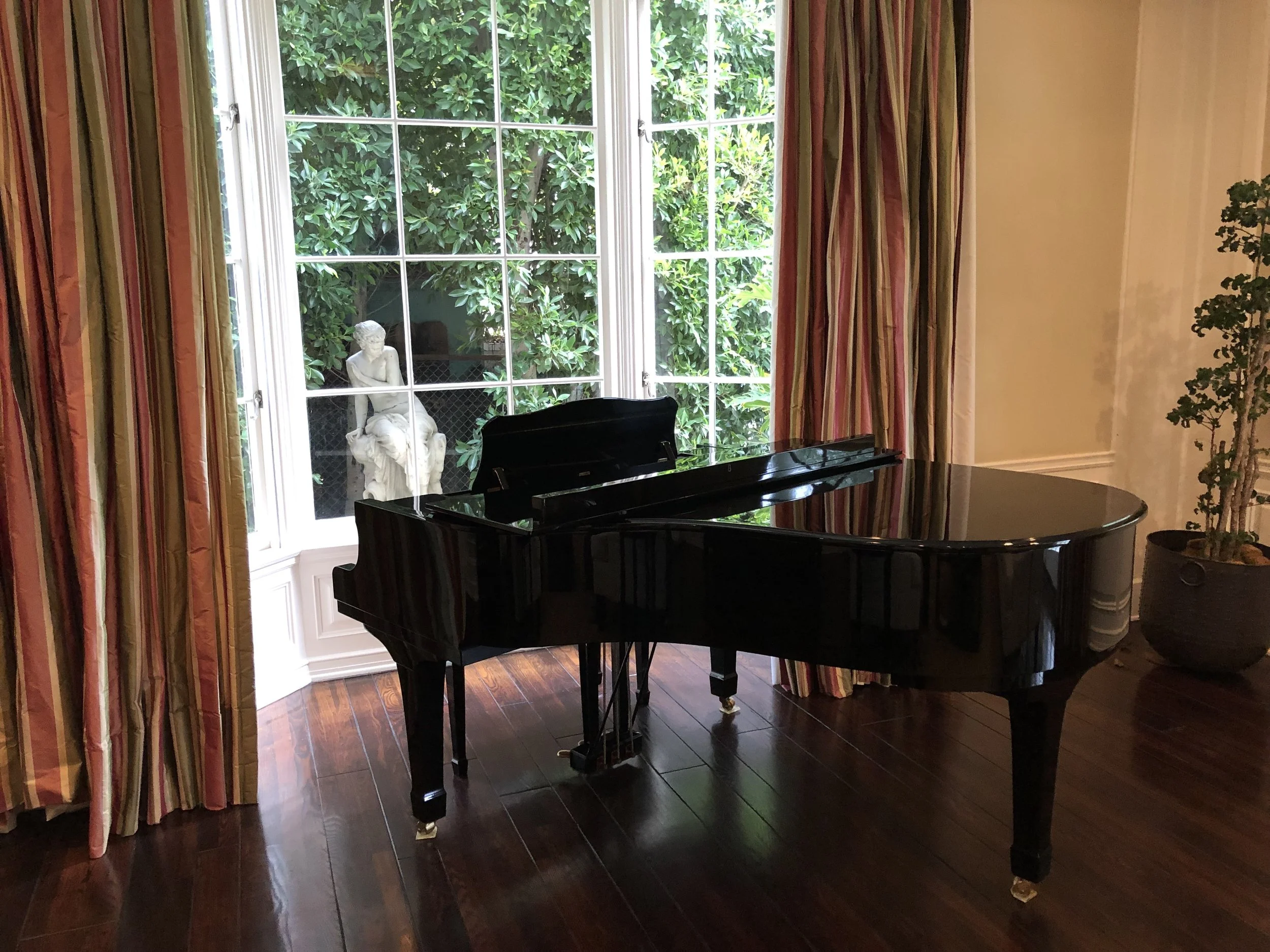
Linda Ronstadt’s Brentwood Home Piano Room. Photography by Amadour.
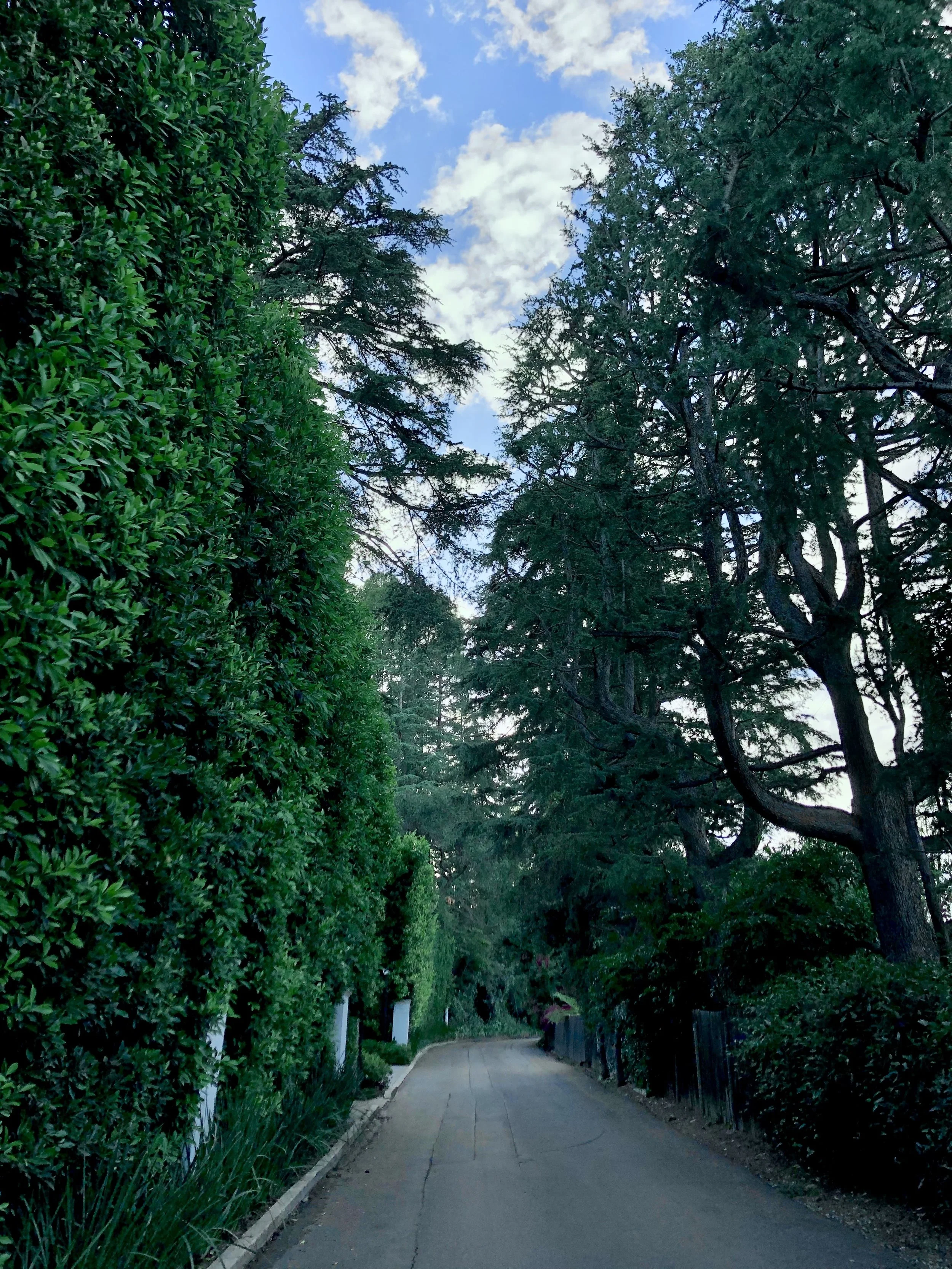
An evening walk on Oakmont Drive in Brentwood. Photography by Amadour.
The following week, I unexpectedly met Tobias Jesso Jr. at the afterparty for the band Wet on the rooftop of the Fonda Theatre alongside Emma Chamberlain and Wet’s Kelly Zutrau. I remember telling him, while still wearing my UCLA hoodie, that I had been reading about those very recording sessions only days earlier while sitting inside the SMC computer lab. It felt like one of those distinctly Los Angeles moments where proximity and coincidence suddenly collapse into each other, much like in Kill Dick, where one character’s foray seamlessly leads into another’s.
That sensation returned again during Art Basel Miami Beach in 2021 while having dinner with my friends Neidy Lizbet Godinez and Alex Perliter at a burger joint on Ocean Drive, who were then running In Lieu Gallery, when I discovered that Alex’s grandparents owned the residence itself, the same house where Philip Glass’ piano remained. Around the same time, Adele’s “To Be Loved” performance video circulated online, filmed inside the residence surrounded by blue-chip artworks and layered traces of cultural history. I remember being almost unable to process how small the world suddenly felt, or how I had somehow spent years orbiting these strange intersections of music, art, architecture, and memory without fully realizing it.
Though I have only known Goebel and his writing for a short time, what immediately struck me about Kill Dick was its obsessive specificity. Los Angeles is rendered not simply as a backdrop, but as a sprawling phrenic terrain mapped through hyper-detailed observations of class, architecture, art, power, and illusion. Bel Air estates, Skid Row encampments, the memory of an Orange Julius in the mall, the Marciano Art Foundation, roadside diners, Nan Goldin, cult-like professors, and failed aspirational figures collapse into what Goebel himself describes as a “sunshine noir.” The city appears less as a coherent geography than as a fragmented mental state, where every surface simultaneously conceals and reveals another system operating beneath it.
What fascinated me most was the novel’s constant oscillation between intellectual rigor and total psychological destabilization. References to artists, philosophers, collectors, and theorists emerge rhythmically throughout the text in ways that feel at once deeply researched and feverishly unstable. A conversation may suddenly pivot from Nietzsche to silk capes, from Linda Nochlin to the Hollywood Stars Inn, from Anselm Kiefer to the Bilderberg Group, and OxyContin dynasties embroiled in LACMA art galas. Characters drift in and out of each other’s realities while constructing elaborate performances of selfhood, often unable to distinguish genuine feeling from the systems manipulating them.
At moments, the novel recalls the labyrinthine psychic drift of Roberto Bolaño’s 2666, particularly in the way intellectual obsession, ruthlessness, disappearance, and paranoia slowly metastasize into the atmosphere itself. I first read Bolaño while traveling through Greece after finding a copy in a small bookstore in Exarchia, and I remember becoming consumed not only by the density of detail but by the subliminal tension quietly accumulating beneath seemingly disconnected encounters. Goebel produces a similarly sabotaged sensation. Like Bolaño, he allows fragmented conversations, digressions, and wandering encounters to accumulate into a sprawling cartography of cultural and existential unease where meaning is perpetually deferred yet obsessively pursued.
Elsewhere, there are shades of Joan Didion’s Play It as It Lays and The White Album, especially in the manner Goebel captures Los Angeles as both seduction and psychic erosion. Like Didion, he possesses an acute sensitivity toward the performative surfaces of California life: freeway systems, wealth, celebrity, architecture, spiritual emptiness, and emotional fragmentation all become inseparable from the landscape itself. I found myself thinking specifically of Didion’s recollections of the Charles Manson era in Los Angeles, where casual house parties, celebrity encounters, Janis Joplin drifting through social circles, sadism, and cultural collapse all seem to coexist within the same strangely numbed firmament. Her writing often captures the unsettling feeling that history is disintegrating in real time while everyone continues behaving as though nothing is wrong. Goebel channels a similarly subverted Los Angeles, though where Didion often writes with surgical restraint, he permits the city to spiral outward into grotesque excess, conspiratorial delirium, and metaphysical disintegration.
In this sense, the novel also feels faintly Cervantian. Like Miguel de Cervantes’ Don Quixote, Kill Dick wanders through unstable realities populated by characters attempting to construct meaning, identity, beauty, and purpose within systems that may already be breaking down around them. I grew up with a large painting of Don Quixote hanging in my family’s living room and remember always feeling strangely small beside it as a child, long before I fully understood the novel itself. Revisiting Cervantes later in life while reading Goebel’s novel produced an uncanny emotional recognition for me.
Through windmills, delusion, wandering episodic structures, and unstable perception, Cervantes interrogated the nature of truth itself. Goebel similarly populates his universe with figures caught between sincerity and hallucination, aspiration and absurdity, constantly attempting to narrativize themselves into coherence. In many ways, character Peter Holiday’s continual reinvention of himself, his philosophical grandiosity, and his hunger for validation within high society systems recall a distinctly contemporary version of Quixotic longing: the desire not merely to be seen but to transform performance itself into reality.
The character I found myself most drawn to was Royal-Lee, whose fluidity, observational distance, and continual process of self-invention became, for me, one of the novel’s emotional and intellectual centers. Through Royal-Lee, I recognized a character deeply attuned to the unstable choreography of identity: the ways gender, sexuality, pronouns, visibility, and selfhood are constantly negotiated, performed, concealed, exaggerated, or rewritten depending on desire, environment, and survival. Royal-Lee moves through Kill Dick with an acute awareness of how perception itself becomes a kind of theater, where intimacy and performance often collapse into one another.
I found the dynamic between Royal-Lee and Peter Holiday particularly affecting because it captures the strange tension between irony and sincerity that defines so much contemporary queer longing. Royal-Lee’s desires can appear excessive, theatrical, even obnoxious, yet beneath them exists an almost disarming innocence. At one point, Royal-Lee imagines being followed by a film crew alongside Peter in Turks and Caicos, riding jet skis hand in hand while dolphins leap from the water to kiss their cheeks. The image is absurd, hilarious, hyper-mediated, and yet strangely moving at the same time. Beneath the fantasy lies a genuine yearning for domesticity, tenderness, visibility, and belonging. In many ways, I recognized parts of myself within Royal-Lee’s oscillation between self-awareness and romantic projection, just as I began to understand figures in my own life through the emotional distance and gravitational pull that Peter Holiday seems to embody throughout the novel.
Then there is Susie Vogelman, a figure I recognized almost immediately from the contemporary art world: someone granted accelerated access through wealth and inherited proximity to power. Yet Goebel avoids reducing her into caricature. Instead, Susie becomes a deeply conflicted figure attempting to locate authenticity inside systems already contaminated by influence. Around her, other characters either spend their time desperately attempting to breach these insulated worlds, as Peter Holiday often does, or remain entirely excluded from them altogether.
Beneath the conspiracies, murders, secret societies, and collapsing realities, Kill Dick ultimately becomes a meditation on longing itself: the desire to create meaning, beauty, intimacy, and truth within systems increasingly incapable of sustaining them. In many ways, reading the novel felt less like entering a conventional narrative than wandering through a destabilized archive of contemporary Los Angeles itself, one where aspiration, paranoia, performance, beauty, violence, and media collapse all coexist within the same twinkling psychological landscape.
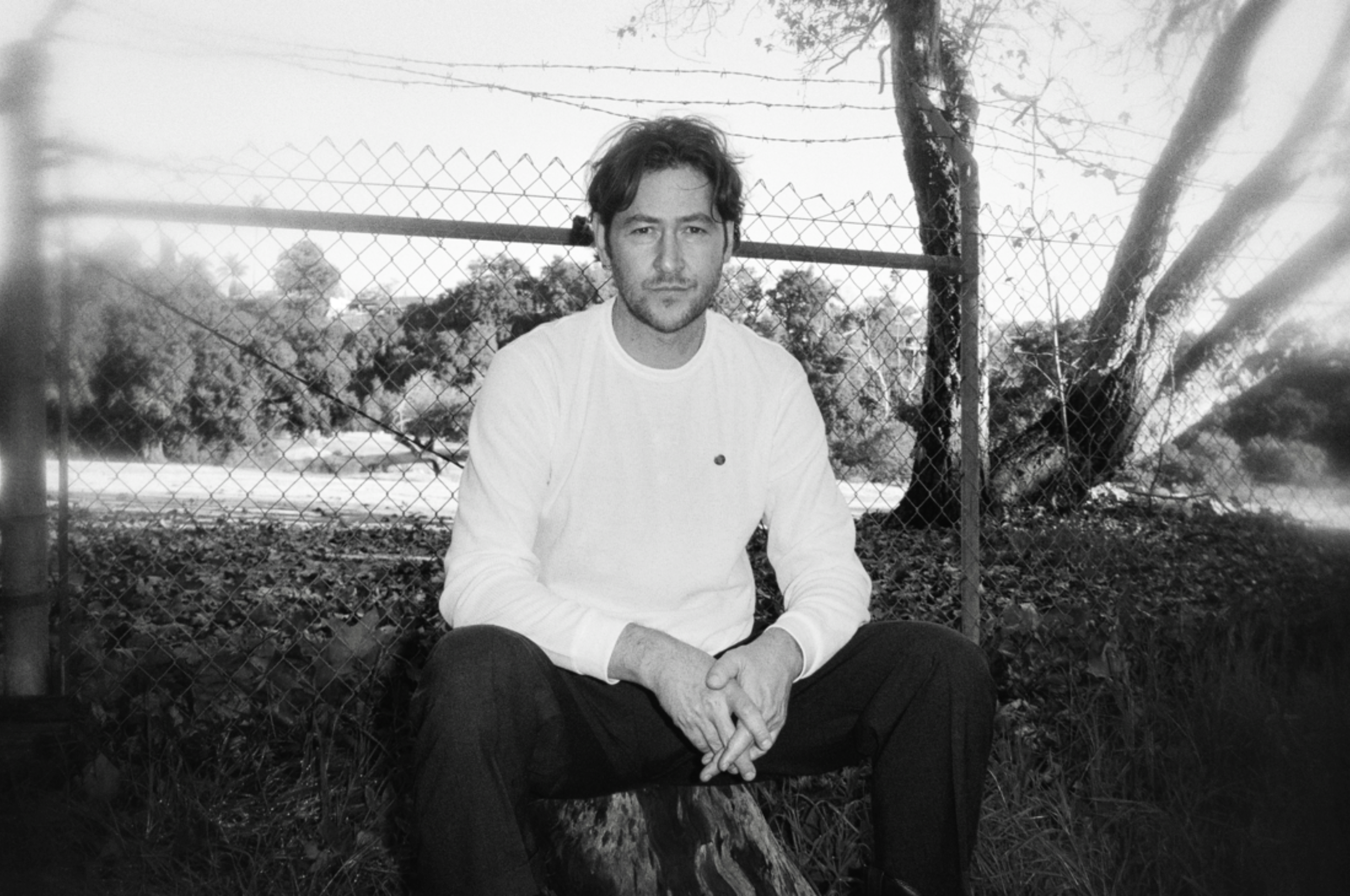
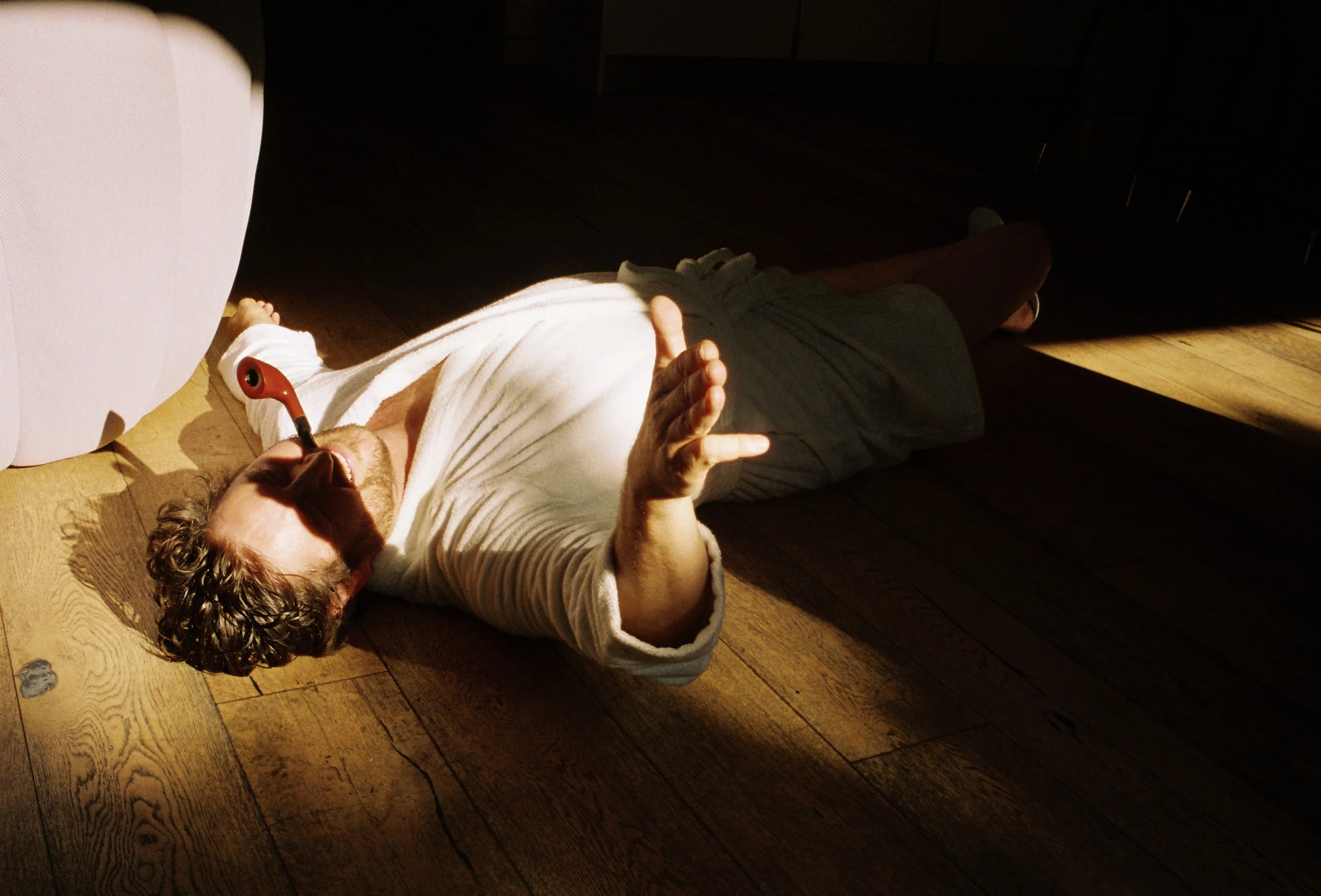
Portrait of Luke Goebel. Photography by Jack Whittington
Interview
LUKE GOEBEL:
My publisher just called and texted me to say, “My guru says your book is being talked about all over New York.” That just popped up on the screen. So that’s good.
AMADOUR:
I’m very close to finishing the book, just so you know.
LUKE GOEBEL:
It’s actually nice to talk about it before you’re done.
AMADOUR:
I’ve been wondering, because the plot feels almost ongoing, whether finishing it even brings closure, or if it continues beyond itself.
LUKE GOEBEL:
You mean it has that shaggy-dog noir quality (a narrative that moves through many digressions and twists before resolving), where you’re not sure if everything will fully come together?
AMADOUR:
Kill Dick took you ten years to create, and your previous book, Fourteen Stories, None of Them Are Yours, was rooted in something deeply personal. This one moves across a wide range of characters and interior lives. What struck me most is that breadth, how many different people you’re holding at once, psychologically and narratively. And within that, how much art and art history is embedded into the text. What led you to build a novel so saturated with art? What was the underlying premise?
LUKE GOEBEL:
The book is something of a miracle object in that it even coheres (holds together structurally and conceptually). It has this twisty, turny, sunshine-noir structure, and the fact that it lands in a final destructive culmination, something that feels specific to Los Angeles, is honestly a gift. The whole book feels like a gift. It began very simply. I met someone who became the basis for Susie Vogelman while I was finishing my last book. She lived across from Reese Witherspoon’s house in Brentwood Circle. She had gone to NYU to be an artist, hadn’t succeeded yet, and was deeply distraught. Her work, amateur but promising, covered the walls of her parents’ estate. But she felt she had failed. That was the beginning: the universality of wanting something you may never get. The desire to offer the world beauty in exchange for your existence, and the possibility that it might not be received. That tension becomes the entry point of a bildungsroman [a literary form focused on personal and artistic development over time, often a coming-of-age narrative]. Later, I developed her further, coming to understand her as the daughter of the primary attorney to Richard Sickler—a pharmaceutical power figure, a fictional counterpart to Richard Sackler. Like Sackler, whose legacy is entangled with OxyContin and an expansive network of philanthropic naming rights, Sickler saturates cultural institutions with his presence, funding museums while inscribing his name into their very architecture.
What emerges is a tension at the heart of art itself: on one hand, a pure ambition rooted in a deeply human and humble impulse to give back; on the other, art as an instrument of power: something ancient, almost occult in its capacity to shape narratives, launder reputations, and exert control. That’s when the central idea emerged. Art as both a pure human impulse and a mechanism of control. I recently had dinner at Cecconi's with Lorenzo de’ Medici, a descendant of the Medici family, and it made me think about the long history of patronage. He was lovely, nonetheless, the surviving heir of the Medici fortune. From temple art onward, art has always functioned in two directions. It can liberate, but it can also reinforce power. And so that became central to the book. Susie emerges as a character who operates within and under these systems of power. She navigates their pressures while also pushing back, ultimately finding agency through her creative work. That creativity becomes her counterforce, a kind of weapon she turns back on the structures that shaped her, allowing her, by the end, to arrive in a position of power and fortune.
In many ways, it was a kind of happy accident, though it drew heavily from my own reflections during the ten years I spent teaching as a professor. That experience informed the creation of the figure I most satirize in the book, Phil Krolik, also known as Peter Holiday. He reinvents himself through a kind of performative intellectualism, eventually founding a cult, joining a secret society, and adopting an alias as he moves deeper into his own constructed mythology. A lot of this thinking came from my time teaching. I spent years reading and teaching Plato, especially Ion [a dialogue about whether artists create through technical skill or divine inspiration] and The Republic [a philosophical text about justice, society, and how images, stories, and art can shape or distort truth]. I also taught Jean Baudrillard, and looking at Baudrillard's concepts of hyperreality, the ways we lose the truth, or lose control to the forces of representation and media, and the way we're doing that now. I became interested in how representation doesn’t just reflect reality, but actively constructs it. I wrote it in 2016, and at the time, I was watching the rise of Pizzagate and what would later become QAnon. I was paying close attention to the broader spread of disinformation, and to figures like Roger Stone, Steve Bannon, and Donald Trump, who I felt played a role in amplifying conspiracy thinking across the country. It struck me as incredibly dangerous, not just politically but culturally as well. What I was really responding to was the sense that media itself was overtaking reality. There was a feeling that something fundamental had shifted, as if the printing press had been reinvented in the palm of our hands through the cell phone. Information was no longer mediated in the same way, and truth felt increasingly unstable. It created a moment of near-total reality loss, in which competing narratives blurred together, making it difficult to distinguish what was real from what was constructed.
AMADOUR:
Yeah, I think that Susie is such an interesting character. I relate to her because while I was at UCLA, I lived in Brentwood, on Oakmont Drive. Eli Broad and Edythe Broad were my neighbors, and historically, that street has held people like Steve McQueen and Herb Ritts. There is something about that area that carries a real sense of legacy. Bristol turns into Oakmont once you pass this semi-gated threshold. It is not actually gated, but it feels like an entry point into another kind of space. So when you talk about Brentwood Circle, I know exactly what you mean. In the mornings, I would jog a loop down Rockingham Avenue, Cliffwood Avenue, Carmelina Avenue, and through that whole area. Rick Caruso lives around there, too. All of those streets hold a kind of quiet mythology. I also wanted to ask about Susie, because at least where I am in the book, she is positioned as a failed artist. It sets up this dichotomy where it feels like you can have everything, but not necessarily what you want.
LUKE GOEBEL:
Was. She was a failed artist.
AMADOUR:
Right?
LUKE GOEBEL:
She becomes a successful artist.
AMADOUR:
Oh, really?
LUKE GOEBEL:
Oh, you haven't gotten there yet? Yeah, she ends up blue-chip represented, top-echelon performance artist. She is operating at that level, like someone in the orbit of Nan Goldin, fighting the good fight, but also navigating fame and infamy. She makes it.
AMADOUR:
I haven't gotten to that part yet. Okay.
LUKE GOEBEL:
Keep going. Keep going.
AMADOUR:
Well, I will omit that so people do not know the ending!
LUKE GOEBEL:
No, you can say it. Books are not about what happens; they are about how it happens.
AMADOUR:
I am enjoying it. You mention things like “Ray Charles or Charles Ray” and all these little slippages. Some of the artists you reference, I did not even know, and I am pretty art historical. I found myself stopping and thinking, “Who is that?” It felt really niche.
LUKE GOEBEL:
Yeah. I mean, I am curious how what I said lands for you as an artist. How do you feel about the way art gets co-opted by power structures, used almost as a tool for influence, for image-making, for tax positioning, by people who are not necessarily invested in the human impulse behind it? And at the same time, how do you reconcile that with the beauty that still exists in the art world? How do you hold both of those realities? And then there is another layer. How do you relate to theorists who critique representation and media while also producing it themselves? Are they sincere, or are they playing with us?
AMADOUR:
I would say that for me, everything that is art is inherently valuable. Nothing actually has a fixed value, but value is assigned through perception, through subjectivity, through what someone finds beautiful or grotesque or meaningful.At the same time, to be a successful artist now, you have to be marketed. You have to exist within the art market, and that market often dictates your worth in very real terms. It creates hierarchies, whether that is blue-chip or even what people now call red-chip, and it can elevate artists very quickly, sometimes through the influence of major galleries. But I do think art history tends to correct itself. There are artists who are suddenly positioned as extremely important, and then over time, the narrative shifts. If you look at Hilma af Klint or Carmen Herrera, their recognition came much later, almost as a correction to earlier omissions. Even artists like Channa Horwitz or Bettina Grossman show how histories can be revised or expanded. I am naming women artists, but that is where my mind goes immediately, because those are some of the clearest examples of that correction happening.
LUKE GOEBEL:
Klint is a good model for Susie in some ways. The use of the occult, then subverting it or turning it into something playful yet powerful. It feels like she is almost reclaiming something that was originally rooted in a kind of goodness, something that got distorted, and then using it again as a form of power. You probably have a much more developed way of speaking about that than I do.
AMADOUR:
I also think Peter is such an interesting character because he is navigating this whole Los Angeles world while simultaneously restructuring himself and changing his identity. I actually see myself the most in Royal-Lee. Royal-Lee feels like someone still figuring out gender, sexuality, and pronouns, and there is a constant loop of observation. Peter is watching Royal-Lee, Royal-Lee is watching themselves. There is this reflexivity that feels very real to me. I was wondering where Royal-Lee really came from for you. At what point did they step into you, or how did you arrive at that character?
LUKE GOEBEL:
That is such a private question. Very few people have even acknowledged Royal-Lee in interviews.
AMADOUR:
I love Royal-Lee. Royal-Lee is my favorite. Come on.
LUKE GOEBEL:
Okay. I will give you the more media-trained version. I grew up in a monoculture in Minster, Ohio, a town of about 2,500 German Catholics. It was very insular. I had lunch yesterday with the adopted brother of my first girlfriend. They're Black and not from the same parents. Their household consisted of five adopted children. We were talking about how strange it was to grow up in that environment, in a place like Minster, where generations of families all traced back to Münster, Germany. We went to church from school on Fridays, even though it was a public school. We had religion class every day. It was a very structured environment, and there was a strong pressure toward conformity. That kind of cultural inheritance, especially in certain Germanic traditions, can lean toward homogenization, toward a kind of enforced sameness. Growing up in that space, I was the kid who didn’t fit in. I was too expressive, too energetic, moving differently, thinking differently from what was expected. So for me, identity never felt fixed. Gender, selfhood, all of it felt fluid. Then you add in later experiences. Psychedelics, experimentation, intuition, a sense of dissolving and re-forming the self. That became part of how I understand consciousness. I do not experience myself as one stable identity.
Royal-Lee became a way to explore that. A way to give form to something I have always felt, which is this resistance to being locked into a single imposed identity. And I think a lot of the destructive forces we see now come from repression, from people being forced into identities that are handed to them instead of discovered. That repression can lead to violence, shame, and a lot of suffering. So Royal-Lee is, in a way, an expression of freedom from that. A refusal to be fixed.
That is a long answer, but it is the closest I can get.
Is that enough of an answer?
AMADOUR:
Yes, that was great.
Also, the fact that you chose Bedford Drive in Beverly Hills as a street felt so random to me. I am currently undergoing full-face electrolysis, and I go to Bedford two or three times a week. So I was reading it and thinking, Brentwood, Bedford, what is all this? It started to feel a little too close, as if I were somehow inside their world.
LUKE GOEBEL:
Good. That is good. The Conduit’s office, which is the source of information from the Church of White Illumination, is meant to evoke the worst kinds of ideological structures. It is satirizing secret societies and the darker sides of power and belief. All of that information gets transferred to Phil Krolik, also known as Peter Holiday, through this woman, the Conduit. That building on Doheny, right off Sunset, the blue and white medical building, that is where my dentist’s office was. Dr. Fouzier, who's an exceptional dentist and, he says, grew up with Picasso's children in France. I would go there for appointments, and I just imagined the top floor as something else entirely. In the book, it becomes a penthouse that houses this secret society. And if you read the description of the Church of White Illumination’s headquarters in Bel Air, you'll see it's actually based on the Marciano Art Foundation. It is essentially that building. [Housed in the former Scottish Rite Masonic Temple on Wilshire Boulevard, the Marciano Art Foundation occupies a landmark of Mid-Century Modern architecture. Designed by Millard Sheets in 1961, the massive travertine structure originally served as a private hub for Masonic activities, featuring a windowless facade adorned with mosaics and sculptures. After sitting vacant for nearly two decades, the building was reimagined by architect Kulapat Yantrasast in 2017, who converted its grand theaters and meeting halls into expansive gallery spaces while preserving historical "relics" from its secret society past.]
AMADOUR:
I was just there for the Bruce Conner and Harald Szeemann shows. But that is exactly what I pictured. I think because I have come to know the landscape of Los Angeles the way you do.
LUKE GOEBEL:
Exactly. And that connection came from being there. I was visiting the Marciano when something difficult happened that day, and I was looking closely at one of the installations. There was a display of wigs, beards, and scripts associated with Masonic traditions. In the basement, there were scrims, these theatrical backdrops used to stage historical and mythological scenes, like the beheading of Marie Antoinette or The War in Heaven. [The War in Heaven is a celestial conflict described in the Book of Revelation where the Archangel Michael and his loyal forces defeat and cast out Satan and his rebellious angels, a theme famously explored in John Milton's epic poem Paradise Lost and depicted in classical works by artists like Peter Paul Rubens and Gustave Doré.]
It felt surreal. I kept thinking, what is actually happening here? Upstairs, you had cloaks, wigs, scripts, all these elements of performance and disguise. It felt like a system of representation, almost like a rehearsal of power. And I thought, this is too perfect for the book. That is when the idea of the secret society really crystallized for me. At the same time, I was reading about Pizzagate, about Comet Ping Pong, about the rise of conspiracy thinking that would later become QAnon. [The controversy, known as Pizzagate, was a completely debunked conspiracy theory that falsely alleged Comet Ping Pong was a front for a child trafficking ring involving high-ranking Democratic officials.] It made me realize how dangerous that moment was. We were entering a period where there was no longer a shared sense of truth. And when that disappears, people turn to conspiracy, to projection, to violence. That realization became part of the novel’s culmination. I do not pretend to know, or to claim, that any of it is definitively good or bad. I am not trying to be a conspiracist. I was more interested in how, as in William Shakespeare, certain elements are deployed in ways that invite endless interpretation. I was drawn to how mystery schools, occultism, Gnosticism, and questions of ontology could shape a book that on the surface feels like noir, or a kind of sunshine noir, or even a thriller or slasher, but underneath is really a book of the mind. [ Gnosticism teaches that salvation comes through acquiring hidden spiritual knowledge that frees the divine spark within humans from the flawed material world (it is based on dualism, meaning the spiritual realm is seen as good while the physical world is viewed as corrupt or lesser).]
AMADOUR:
Yeah. I also liked the references to flowers throughout. I picked up on that, as well as the small intricacies everyone is noticing. The way characters pick up on each other’s tics, their behaviors, and the psychology behind everything. And again, the location-based elements, how you move us through the city. I was wondering, as you were capturing these moments, were you actually going to these places? When you are in Bel Air or in West Adams, were you physically there doing research?
LUKE GOEBEL:
That is a really good question.
About the flowers and what people are noticing, for me, that was about reality itself. Susie loves flowers, and there is almost this hope that something in the world could be fully real, that you could arrive at some absolute point of reality. But then you have artists like Georgia O'Keeffe, who said that no one really sees a flower. And then you realize flowers are not just symbolic, they are also material. Poppies become opium, and opium becomes drugs. Everything starts to shift. The moment you begin to analyze something, you lose its immediacy. Unless you believe that philosophy can lead you back to a higher truth, which is itself another abstraction, another representation, another promise of something beyond this world. So flowers became this symbol of purity, of something that might still be real. Susie wants to hold onto that. She wants to make work that is grounded in craft, something as simple and direct as painting a bouquet, something that could be an offering to the world or even a way of saving herself. But at the same time, flowers become dangerous in the book. They are tied to poppies, to repetition, to harm. She is almost undone by them.
As for what people are noticing, I was thinking a lot about Bret Easton Ellis and his attention to surfaces, especially in works like American Psycho, where clothing and consumer detail become a language of identity. That stands in contrast to a more biblical idea, as in the Sermon on the Mount. Like, you know, "The sparrows don't worry about what they're going to eat, and the flowers don't worry about what they're gonna wear, and yet they're in finer adornment than Solomon's finest," or whatever. I'm paraphrasing, but just that notion. It is that tension between natural existence and constructed identity that I wanted to explore. And also the way that Raymond Chandler can capture a person through the smallest gesture, like the movement of an eyebrow or the tension in a face, in a way that most writers could not achieve in two pages. I was interested in those kinds of signifiers, in that level of artistic awareness that Susie has. It becomes a way of earning her credibility as an artist. She is not just someone who knows art history or theory that was passed down from her former professor, Phil Krolik, also known as Peter Holiday, before he becomes a cult figure. She is someone who can actually see.
She notices what people are doing with their faces, with objects, with clothing, and she can articulate it precisely. She can nail it. There is a sharpness there, a kind of observational intelligence. She knows her references, too. I was thinking of Dorothy Draper, who designed the Carlyle Hotel interiors, though I mixed it up with Dorothy Parker for a second. And Parker, she had that proximity to power, that access to elite spaces, and wrote from within that world. That is part of what I am trying to do in the book as well. But that sensibility, that access to style, wit, and a certain social awareness, is part of Susie’s language. And part of that awareness is tied to class, which is what you are getting at. The novel moves through spaces such as Brentwood, Bel Air, Holmby Hills, the Bird Streets, and Marlborough, and then into institutional settings like schools.
AMADOUR:
It is almost humorous because you pick up on these small idiosyncrasies. If you know people in Los Angeles, you recognize that threshold, that shift between worlds. It is kind of hilarious how people exist within these insulated pockets. Someone can casually say, " Let’s go spend two nights at The Carlyle”, but for someone working as a server, that could be an entire month’s wages for a single night.
LUKE GOEBEL:
Exactly. And to be honest, I have never stayed at The Carlyle. My grandparents did, maybe once or twice, decades ago, but I have not. A lot of that came from research. The same with the presidential bungalow at The Beverly Hills Hotel, the one associated with Howard Hughes. I have never been inside it. But I wrote about it so much, researched it so thoroughly, and placed so many significant moments there in the narrative that it feels like I have been there.
AMADOUR:
It’s the notion of what a place is like, what the feeling is like, even if you haven’t set foot in it before. And the proximity to certain people who inhabited those spaces.
LUKE GOEBEL:
What I was trying to do was write from proximity, even if I was not fully inside that world. I had gotten close enough to feel that someone should be writing a kind of philosophical reflection on power, a book of the mind that looks directly at the people shaping the world around us. I was thinking about writers like Aldous Huxley, Dorothy Parker, T. S. Eliot, and D. H. Lawrence. These were people who often lived among or were hosted by the elite of their time, what we would now think of as billionaires. They were guests in those environments, and their writing reflected the forces shaping that world. So they were documenting, in their own ways, the structures of influence, the psychology of power, and the culture being produced at the top. And today, you could draw parallels to figures like Jeff Bezos or Elon Musk, people whose influence shapes entire systems. When I first encountered the art world, it was through people like Jack Bankowsky and Matthew Marks. Through them, I was invited into these dinner settings. Because Jack runs the ArtCenter Visiting Artist Series, I suddenly found myself at tables with artists like Simone Leigh, Charles Ray, and Barbara Kruger, and with figures like Kim Gordon and Rachel Kushner. I felt completely out of place. I had never had exposure to that kind of environment before. It was like being dropped into a world that I had only read about, and suddenly I was observing it from the inside.
AMADOUR:
I mean, they're just people, but I get how intimidating the art world can be.
LUKE GOEBEL:
Yeah, you’re right. The first night I talked to Charles Ray, we spoke for four hours about party poodles and weaponry. This was before he was attacked in Paris. Later, I asked someone who had been there, “Who was that guy? He was so cool.” And they said, “You idiot. That was Charles Ray.” I knew his work, I just didn’t know what he looked like. I actually prefer it that way. I have a policy of not looking people up, even people I am working with. Like when I was working with Anna Delvey, I never read her story. Or when we were around people like Joaquin Phoenix and Rooney Mara, I did not research them. I prefer to meet people as they are. I think it works better. So there was that exposure to a level of genius and success that I had never imagined, and then at the same time, there was me just driving the freeways with a voice recorder, describing everything I saw. I also went deep into other worlds. Rachel Kushner introduced me to a woman named Teresa, who later died of a drug overdose. She was incredible. She grew up on Skid Row, had been in and out of prison, worked in prison reform, and was brilliant. She took me on a six-hour tour of her neighborhood. I made a donation to her, but really, she guided me through her home and her world.
I remember walking in the rain with a bag of candy bars, offering one to the people who ran different blocks. There is a structure there. Every street has someone who determines who can set up a tent, who can sell what, and who controls the flow of things. It is a serious place. So for me, research came from everywhere. Some of it was online, some was reading, some was talking to people, and a lot of it was going to places in person and observing. I would scout locations, move through spaces, and try to understand how things functioned. Earlier versions of the book were much darker. Three drafts ago, there was a more literal act of violence tied to the Emmys. Now it is still heavy, but it moves toward something closer to nonviolent protest, which feels more meaningful. At one point, I was even going through the back areas of The Beverly Hilton, walking through kitchens and employee corridors, just trying to understand the space. I would put on a hat and move through as if I belonged there, just observing and gathering details. Eventually, I cut that material, but it was part of the process. The book took ten years. It was never just about constructing sentences. I was trying to imbue every paragraph, every movement, every section with three things at once: feeling, sensation, and fact, even if the fact itself is fictional.
AMADOUR:
Since you are thinking about turning this into a film, how do you translate that kind of interiority and detail into something visual? How do you build that character world in a different medium?
LUKE GOEBEL:
That is the challenge. Most adaptations do not improve on the book, though some do. Think of Fight Club, which I think works better as a film. The real question is how to translate interior thought into visual language. Film is collaborative. Writing a novel is solitary, but a film becomes a shared construction. You are creating a blueprint, and others bring it to life. At this stage, my focus is on protecting the material. I do not want it to fall into the wrong hands, where producers, studios, and writers are not aligned, and it just dies in development. I would rather not sell it at all than see it mishandled. The goal is to find the right collaborators and maintain control. When you adapt something like this, you also have to decide what is definitive. The novel allows ambiguity and multiple perspectives, as in Anna Delvey, where competing narratives emerge. But film audiences often want a clearer resolution, even when there is still some ambiguity, as in The Usual Suspects. Ultimately, it comes down to the team. The director, the cinematographer, the casting, the score. Those decisions shape the work. At the end of the day, I would rather build something from the ground up with the right people.