AN INTERVIEW WITH TACITA DEAN: ‘TRIAL OF THE FINGER’ AT MARIAN GOODMAN GALLERY, LOS ANGELES

Tacita Dean. Exhibition view, Trial of the Finger, Marian Goodman Gallery, Los Angeles, 2026. Courtesy of the artist and Marian Goodman Gallery. Photo credit: Fredrik Nilsen.
Tacita Dean’s Trial of the Finger (2026), on view at Marian Goodman Gallery in Los Angeles during Frieze Los Angeles week, did not announce itself so much as it recalibrated the room. Anchored by two major 35mm works, Geography Biography (2023) and Paradise (2022), the exhibition staged perception as something constructed, durational, and materially exact. Each space carried its own internal tempo, yet nothing felt discrete. There was a continuous, almost cinematic drift from one condition of looking to the next, where light, grain, and time became inseparable. The crowd of artists, curators, and filmmakers moved through it with a sharpened attentiveness, as if aware that what was at stake was not simply image, but the terms by which images are allowed to exist. Dean does not make images. She produces the conditions that make seeing possible.
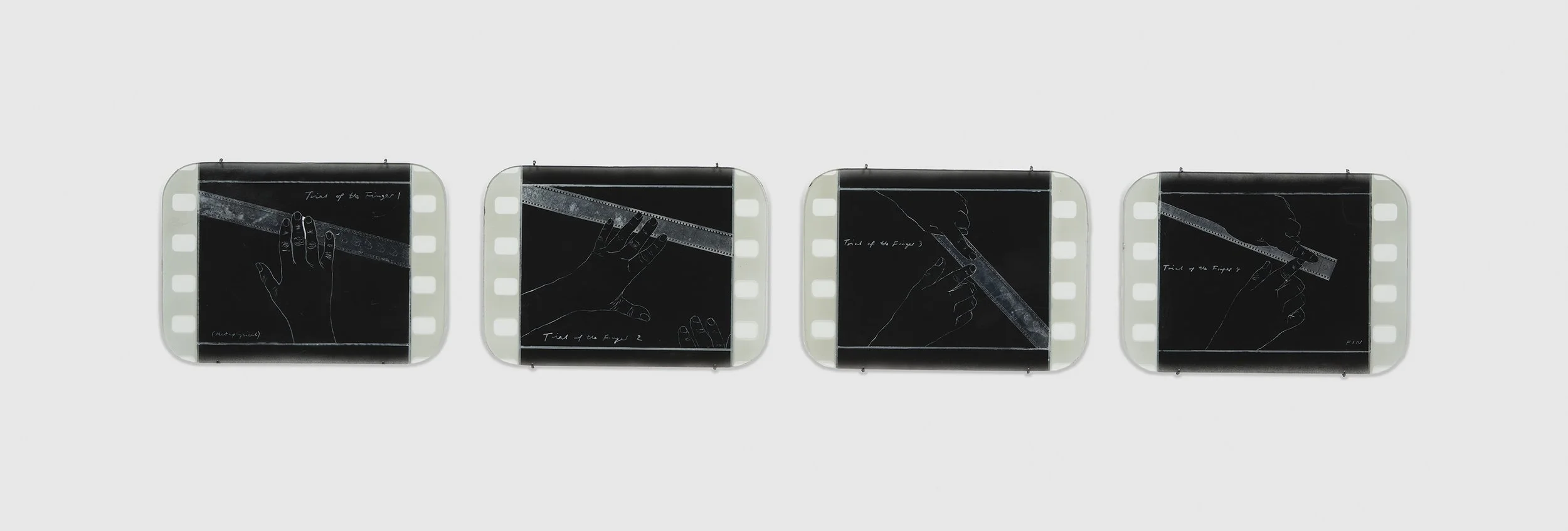
Tacita Dean. Locomotive Drawings: Trial of the Finger 1-4, 2025. Enamel and mirror lacquer on found tarnished steam train windows. 12 1/4 x 17 3/8 in. (31 x 44 cm) (each). Courtesy of the artist and Marian Goodman Gallery. Photo credit: Fredrik Nilsen.
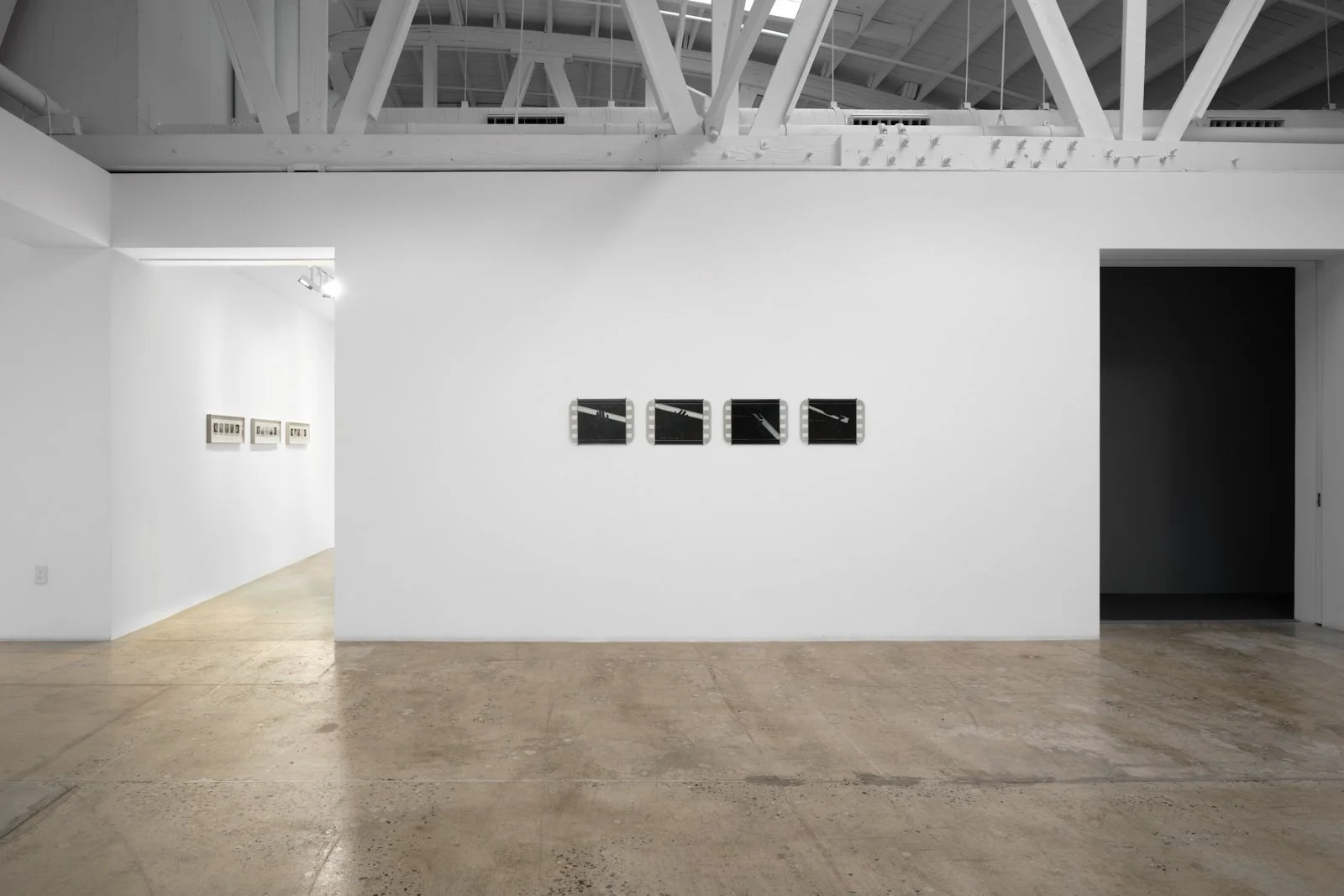
Tacita Dean. Exhibition view, Trial of the Finger, Marian Goodman Gallery, Los Angeles, 2026. Courtesy of the artist and Marian Goodman Gallery. Photo credit: Fredrik Nilsen.
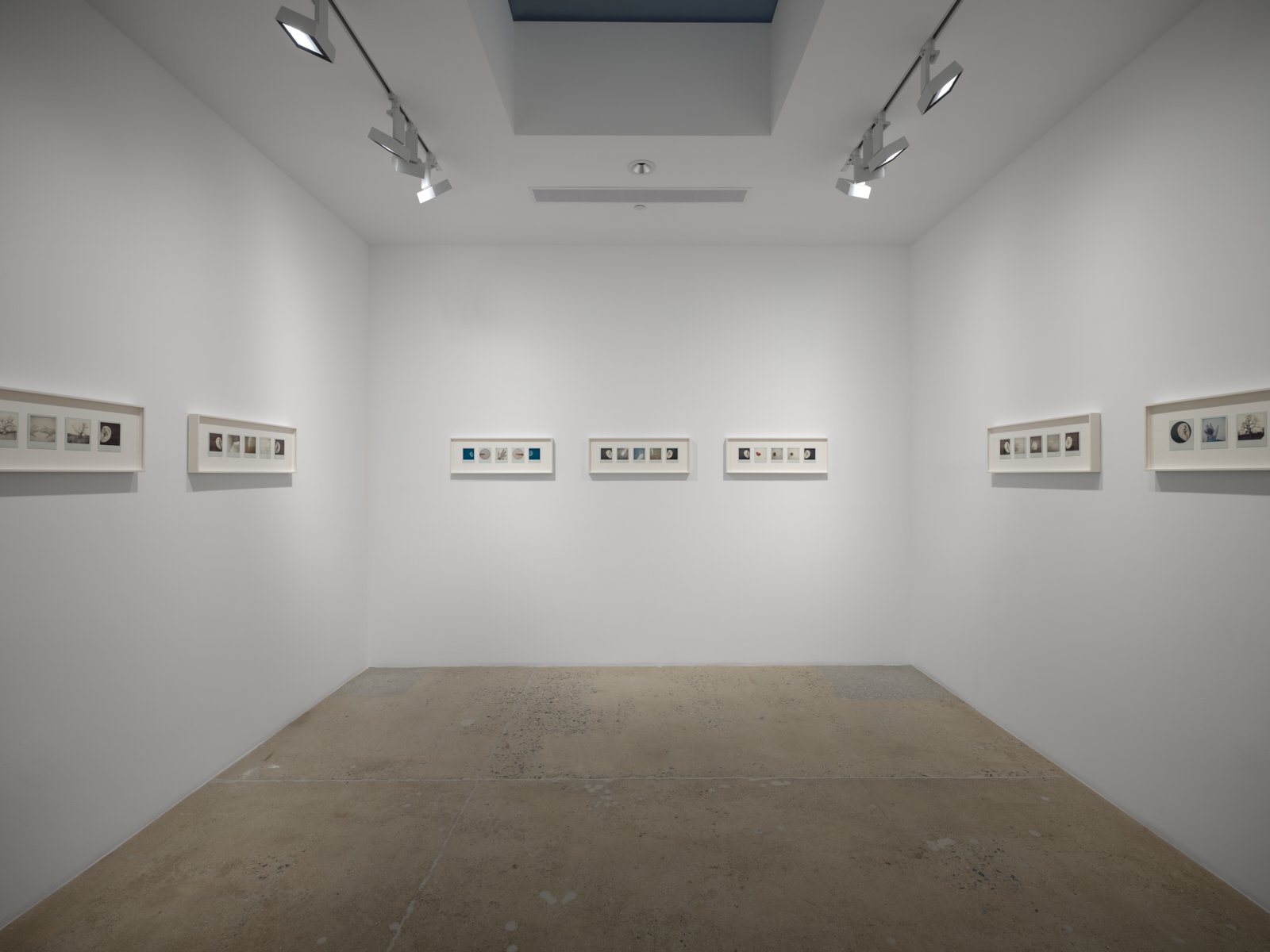
Tacita Dean. Exhibition view, Trial of the Finger, Marian Goodman Gallery, Los Angeles, 2026. Courtesy of the artist and Marian Goodman Gallery. Photo credit: Fredrik Nilsen.
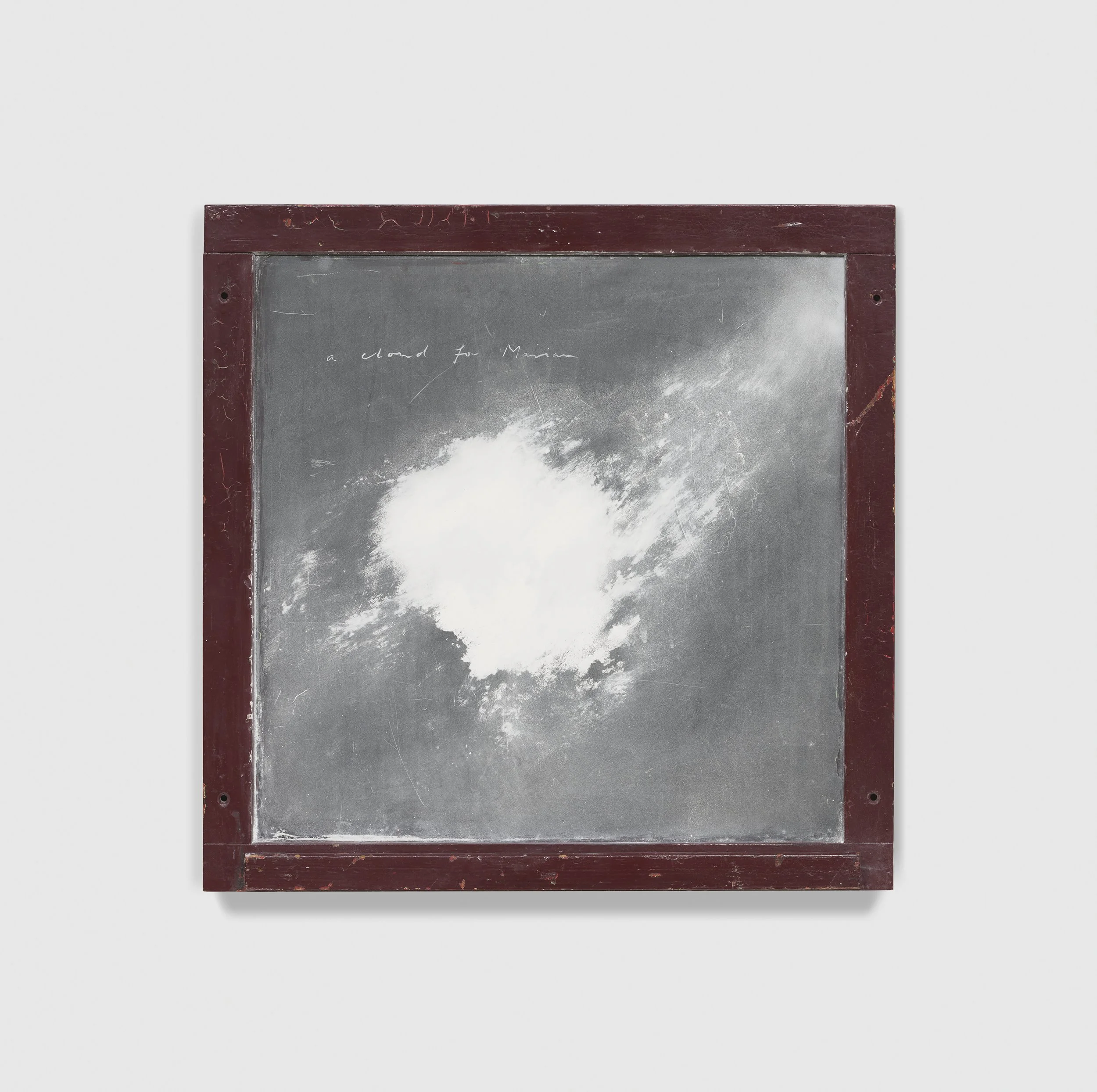
Tacita Dean. A Cloud for Marian, 2026. Spray chalk, gouache and charcoal pencil on found school slate. Slate: 16 1/2 x 16 1/2 in. (41.9 x 41.9 cm). Courtesy of the artist and Marian Goodman Gallery. Photo credit: Angel Xotlanihua.
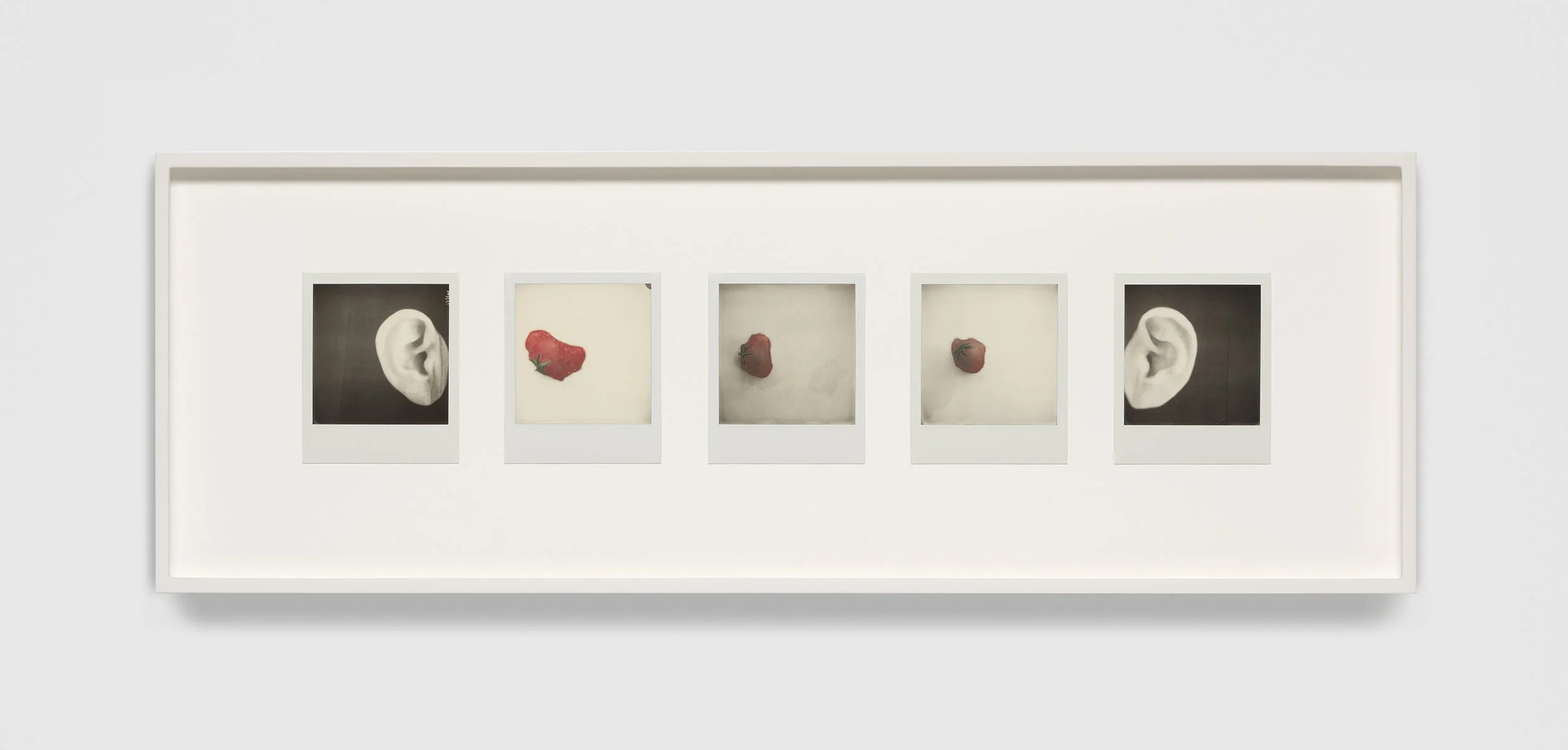
Tacita Dean. Between the Years (SPLAT, 2, 3), 2025-26. 5 polaroids, gouache. Frame: 9 3/4 x 27 7/8 x 1 5/8 in. (24.7 x 70.9 x 4 cm). Courtesy of the artist and Marian Goodman Gallery. Photo credit: Angel Xotlanihua.

Tacita Dean. Between the Years (Concordat), 2025-26. 5 polaroids, gouache. Frame: 9 3/4 x 27 7/8 x 1 5/8 in. (24.7 x 70.9 x 4 cm). Courtesy of the artist and Marian Goodman Gallery. Photo credit: Angel Xotlanihua.
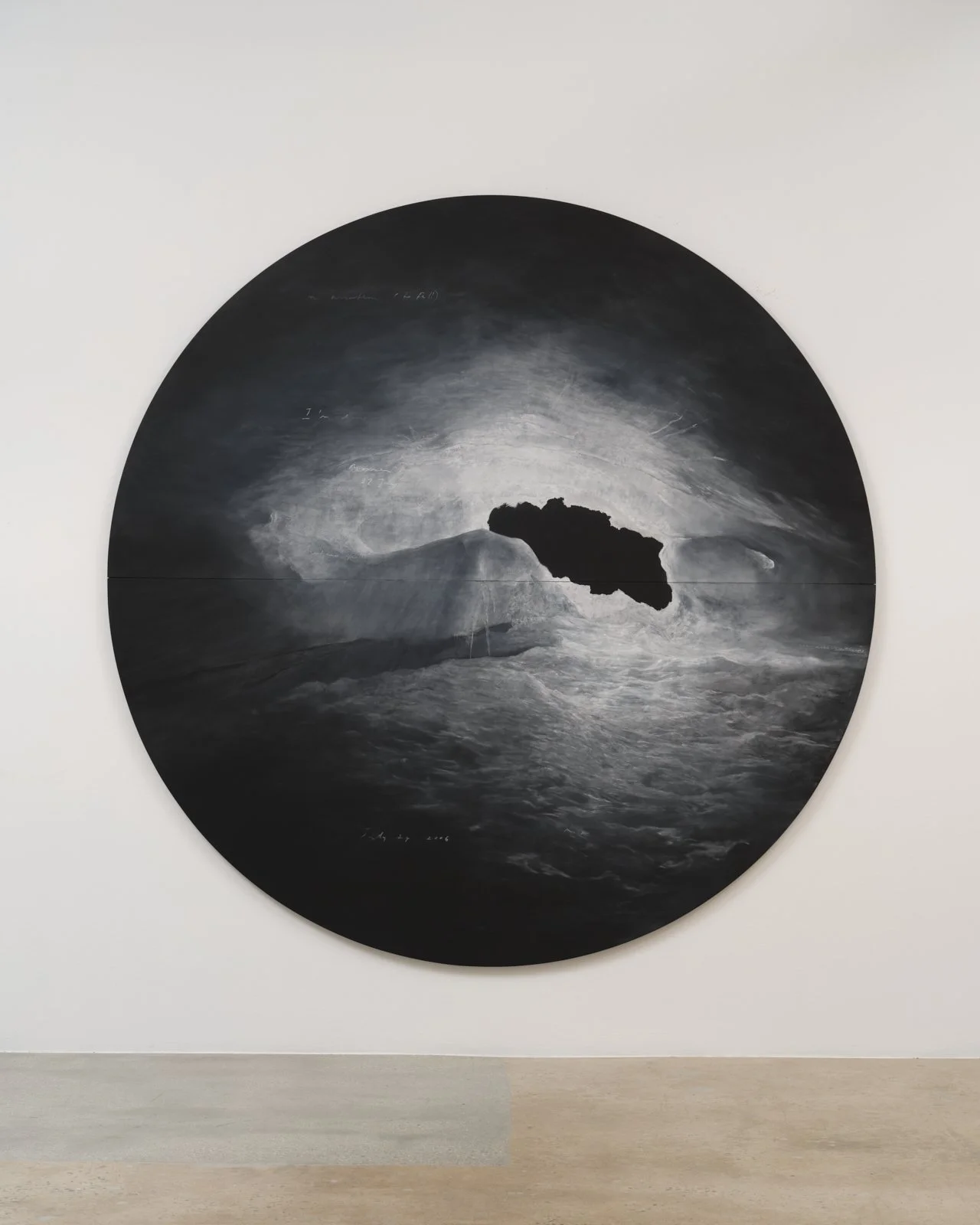
Tacita Dean. In Montem (he fell), 2026. Chalk on blackboard. Diameter: 96 in. (243.8 cm). Courtesy of the artist and Marian Goodman Gallery. Photo credit: Friedrik Nilsen.
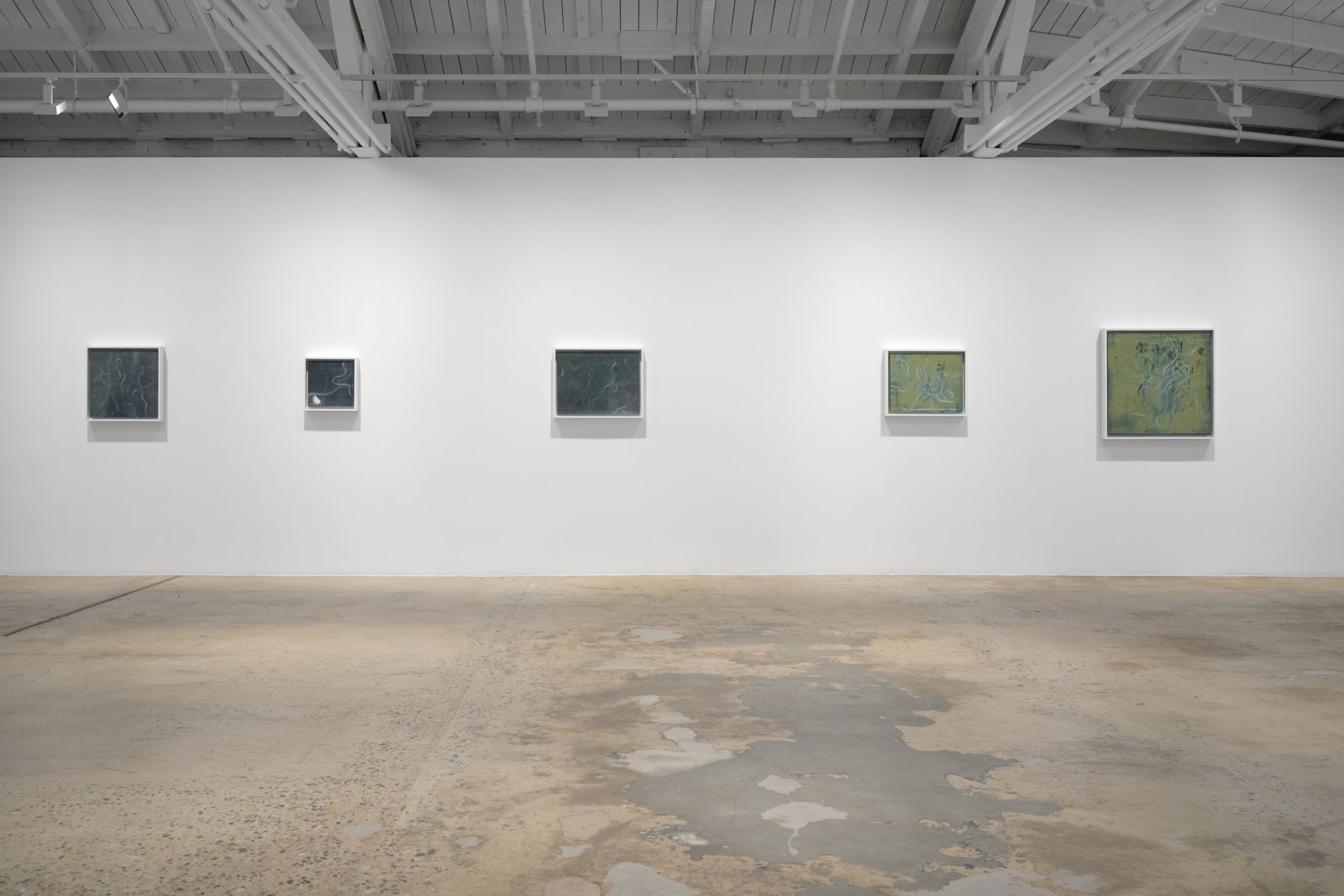
Tacita Dean. Exhibition view, Trial of the Finger, Marian Goodman Gallery, Los Angeles, 2026. Courtesy of the artist and Marian Goodman Gallery. Photo credit: Fredrik Nilsen.
I first encountered Tacita Dean’s work while studying at UCLA Arts, not in a lecture, but in the arts library, pulling monographs that felt, even then, unusually exacting in their sensibility. I remember taking them outside and reading in the sculpture garden beside Cubi XX (1963) by David Smith, the late afternoon light catching the steel as I tried to locate what I was sensing on the page. Smith’s welded surfaces, at once industrial and luminous, register time through accumulation and exposure, a logic not entirely distant from Dean’s commitment to duration and indexical trace. It was not a moment of discovery so much as recognition, the realization that a visual language already existed for something I had been feeling but had not yet articulated.
Standing in Trial of the Finger at Marian Goodman Gallery, that recognition returns with greater clarity, stripped of nostalgia and sharpened by time, as if the work had never altered, only deepened in its historical resonance, awaiting a viewer capable of meeting it at the tempo it has always demanded. In this sense, Dean’s practice resists the acceleration of contemporary image culture, insisting instead on a slower apprehension in which meaning accrues through duration rather than immediacy.
Running parallel to this is her collaboration with Gemini G.E.L., where she translates her eclipse works into prints. These drawings, derived from films such as Antigone (2018) and earlier works like Diamond Ring (2002), function as direct inscriptions of light. They collapse the distance between film and drawing, reinforcing her insistence on medium as materially grounded. Gemini’s role here feels essential. Founded in 1966, it has long served as a crucial site of experimentation, working with artists such as Robert Rauschenberg, Jasper Johns, and Ellsworth Kelly, among many others who expanded the possibilities of printmaking in Los Angeles and beyond. Within this lineage, Dean’s engagement feels both continuous and distinct, extending the workshop’s commitment to material inquiry into the domain of light itself.
It is also difficult not to note how the families who have sustained Gemini, including the Sidney Felsen and Stanley Grinstein families, remain quietly omnipresent across the cultural history of Los Angeles. Their influence moves between workshop, collection, and institution, forming a network that has helped shape the city’s artistic infrastructure over decades. In this sense, Gemini is not simply a site of production but part of a broader ecosystem, one that continues to support and circulate artists across generations while maintaining a distinct commitment to craft, collaboration, and the evolving language of contemporary art.
That same inquiry into time and perception extends across her practice and finds a particularly lucid articulation in Tacita Dean: PORTRAIT (2018) at the National Portrait Gallery, which I saw firsthand. Here, portraiture is refigured not as a fixed image but as a durational proposition. What distinguishes the exhibition is her sustained engagement with art history, not as reference, but as something continually reactivated through film, a sensibility that carries a certain je ne sais quoi in its refusal of closure. Figures such as Merce Cunningham, Cy Twombly, and David Hockney are not held in likeness but unfold through gesture, presence, and sustained attention, situating them within a continuum rather than isolating them as subjects. For me, this aligns closely with how I think about composition across painting and music, where a subject is revealed gradually rather than captured in a single moment.
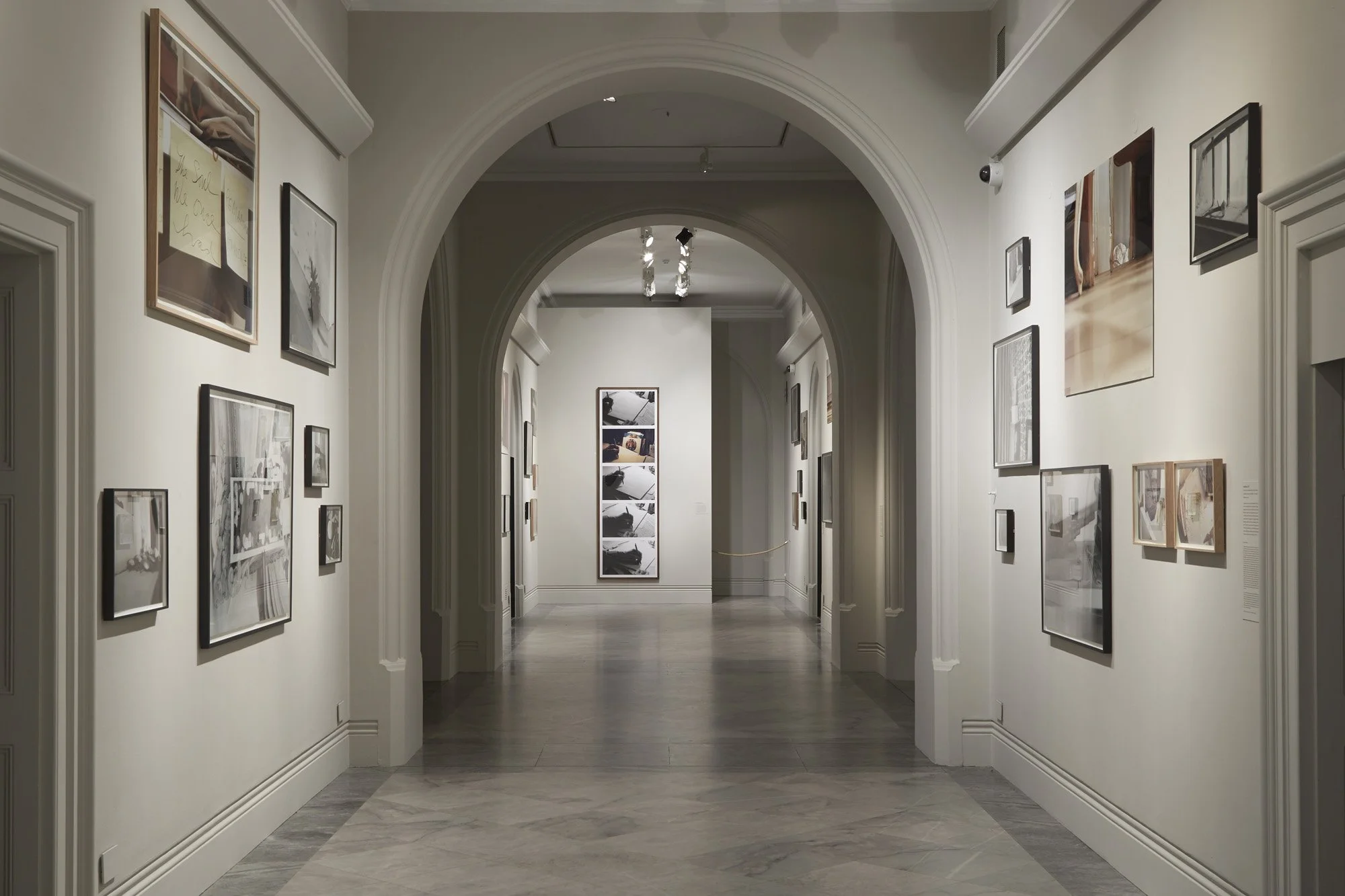
Tacita Dean. Installation view, Portrait, National Portrait Gallery, London, 2018. Courtesy of the artist, Frith Street Gallery, London; Marian Goodman Gallery, New York / Paris/ Los Angeles. Photo credit: Benjamin Westoby.
This logic extends into her large-scale chalk-on-blackboard drawings, particularly those presented at Glenstone Museum, where duration migrates from film into the register of mark-making. Built through cycles of accumulation and erasure, these surfaces stage a temporality that is neither instantaneous nor fixed, but sedimentary. The line holds and withdraws at once. Scale does not assert itself but emerges contingently, apprehended through time rather than given in advance. What is produced is less an image than a condition of looking, in which landscape is not depicted but constituted through attention, decision, and delay. The blackboard, with its capacity for revision and disappearance, becomes a ground for thinking time materially, a surface where each gesture carries the trace of its own undoing.
It is here that the affinity with Chantal Akerman becomes legible. In Jeanne Dielman, 23 quai du Commerce, 1080 Bruxelles (1975) and Les Rendez-vous d’Anna (1978), duration ceases to frame events and instead becomes the event itself. Repetition, transit, and the banal are extended to the point at which they begin to fracture, revealing time as elastic and quietly unstable. The camera does not move toward resolution but remains with the ordinary, allowing it to accumulate into structure. Film here operates as an index of successive moments, persisting as record while remaining irreducibly bound to loss, already receding into memory even as it unfolds. Dean’s films occupy this same threshold. They are not organized by narrative but by attention. What matters is not what happens, but the duration for which one remains with what happens. The image is held in suspension, neither fully present nor entirely past, and it is within this interval that meaning takes form. Dean does not represent time; she structures the conditions under which time can be perceived. Her work also enters into a longer genealogy of film as a perceptual field, one that includes Man Ray, Germaine Dulac, Jean Epstein, and Maya Deren. Across these practices, the image is decoupled from narrative function and reoriented toward rhythm, light, and duration. What unfolds is not a sequence of events but a sequence of perceptions, each provisional, each contingent. At a different register, one might think of Krzysztof Kieślowski or Satyajit Ray, where interiority is structured through delay and subtle inflection rather than exposition. In The Double Life of Véronique (1991) and Charulata (1964), the smallest gestures carry disproportionate weight, allowing affect to surface gradually. What resonates with Dean is not formal similarity but a shared investment in time as the primary agent of articulation.
This becomes particularly acute in relation to Wong Kar-wai’s In the Mood for Love (2000), where desire is dispersed across fragments, gestures, and repetitions. Maggie Cheung’s movement through corridors, the cadence of her steps, the sheen of pearl-painted fingernails, these are not incidental details but the sites through which the film thinks. Narrative is displaced onto the body and its intervals. Meaning accumulates through delay. Something analogous occurs in Dean’s work, where the fragment assumes structural weight. A horizon line, a partial view, a modulation of light, these do not point to a larger whole but constitute it. The image is dispersed, contingent, and always in excess of itself. Like Kar-wai, she recognizes that the banal can sustain an entire work, that passing through space or holding on to a detail can become the organizing principle. The camera does not capture but attends. The drawing does not describe but registers. It brings to mind my grandmother, who wore pearl nail polish in Mexico City during the 1950s. That detail persists less as image than as trace, a fragment that carries time within it, held and already receding. This is the condition Dean’s work makes visible. Her films and drawings do not simply record moments but render their instability perceptible. What emerges is a practice grounded in the image as index, not only of what has been seen, but of time’s passage itself. In Dean, the image persists, documents, and erodes simultaneously. It holds, but only provisionally. To encounter it is to enter that interval where perception, memory, and duration are no longer separable, but coextensive, unfolding in real time.

Tacita Dean. The Montafon Letter, 2017. Chalk on blackboard. 144 x 288 in. (365.8 x 731.5 cm). Installation view, Tacita Dean, Glenstone Museum, Potomac, Maryland, November 2020-October 2022. Courtesy of the artist, Glenstone Museum, Frith Street Gallery, London; Marian Goodman Gallery, New York / Paris/ Los Angeles. Photo Credit: Ron Amstutz.
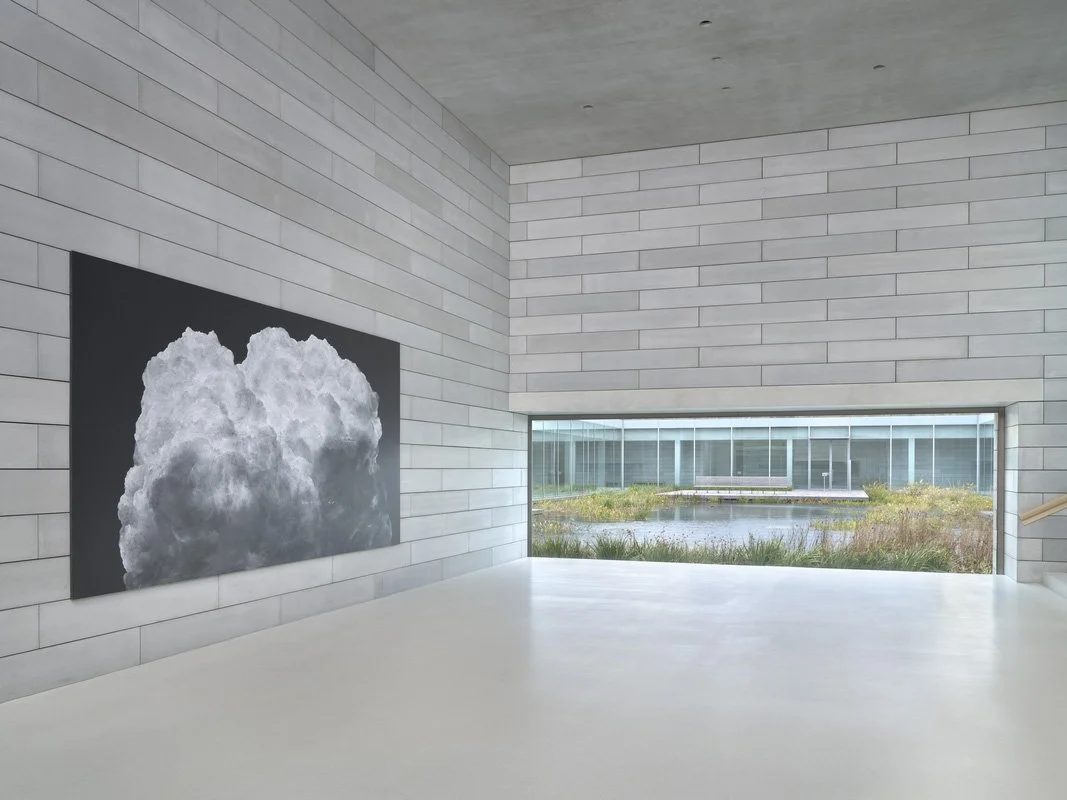
Tacita Dean. Sunset, 2015. Chalk on blackboard. 96 x 192 in. (243.8 x 487.7 cm). Installation view, Tacita Dean, Glenstone Museum, Potomac, Maryland, November 2020-October 2022. Courtesy of the artist, Glenstone Museum, Frith Street Gallery, London; Marian Goodman Gallery, New York / Paris/ Los Angeles. Photo Credit: Ron Amstutz.

Tacita Dean. (from left to right). The Montafon Letter, 2017. Chalk on blackboard. 144 x 288 in. (365.8 x 731.5 cm)/ When first I raised the tempest, 2016. Chalk on blackboard. 96 x 384 in. (244 x 976 cm). /Sunset, 2015. Chalk on blackboard. 96 x 192 in. (243.8 x 487.7 cm). Installation view, Tacita Dean, Glenstone Museum, Potomac, Maryland, November 2020-October 2022. Courtesy of the artist, Glenstone Museum, Frith Street Gallery, London; Marian Goodman Gallery, New York / Paris/ Los Angeles. Photo Credit: Ron Amstutz.
If Tacita Dean structures the conditions through which time can be perceived, then her engagement with the eclipse emerges not as subject matter, but as a concentrated instance of that inquiry. In Montem (he fell) (2026), the film situates itself within a longer cinematic lineage that extends the question of duration into the realm of astronomical event. Richard Fleischer famously delayed production on Barabbas (1961) in order to capture the total solar eclipse of February 15, 1961, in Italy, anchoring the crucifixion scene in an event that was materially real, temporally precise, and irreproducible. Even earlier, Nevil Maskelyne recorded what is now considered the earliest moving image of a solar eclipse on May 28, 1900, in North Carolina, a film that revealed the solar corona and the so-called diamond ring effect and is now preserved by the BFI National Archive. These precedents do not simply document celestial phenomena; they articulate a desire to bring film into contact with an event that exceeds representation, aligning the medium with forces that unfold beyond human control.
I was thinking about this while watching Dean’s work, having experienced the eclipse myself in Dallas, Texas, in 2024, just after the Dallas Art Fair. There was a moment when the landscape shifted and then dropped into night. It was not dramatic in the expected sense. It was quieter, more disorienting, as if time itself had stalled. Afterwards, I drove alone to Marfa, moving through that same terrain while still holding the residue of the experience. What Dean captures, and what these earlier filmmakers were also reaching toward, is not the image of the eclipse but the condition it produces: a reordering of perception, a temporary suspension of the familiar. Her films do not document the event so much as inhabit it, extending its temporal logic into the space of viewing.
A different, though no less significant, lineage unfolds in her work through the question of preservation, through the ways artists assume responsibility for one another across time. Dean’s sustained commitment to Derek Jarman, particularly in securing the future of Prospect Cottage, positions her within a framework in which care itself becomes a structuring gesture. The preservation of Jarman’s archive and lived environment contributes directly to the continuity of queer history, a history that remains precarious and subject to erasure. In this, her work resonates with figures such as Nancy Holt, who safeguarded the legacy of Robert Smithson, or Lee Krasner, who navigated the complexities of Jackson Pollock’s estate after his death in 1956, ensuring the integrity and visibility of his work. More recently, Yto Barrada’s stewardship of Bettina Grossman’s estate extends this lineage into the present. These gestures are rarely framed as artistic acts, yet they decisively shape the conditions through which art history is constructed and sustained. Legacy, in this sense, is not passive but enacted, requiring attention, care, and intervention.
There is also something in Dean’s work that resonates on a more personal register, particularly coming from the West, from Nevada, from a landscape that is already cinematic before it is ever filmed. The desert holds time differently. It stretches it, suspends it, allows it to echo. Her films feel less like images than environments, something to be entered rather than consumed. This is closely aligned with how I think about music, especially in the orchestral compositions I am developing, where a single phrase can sustain an entire emotional architecture. The question is not one of accumulation, but of precision, of knowing when to hold and when to release.
This becomes especially legible in works such as Paradise (2022), created for The Dante Project at the Royal Opera House in collaboration with Wayne McGregor and Thomas Adès. Here, the interplay between digital and analog introduces a layered construction in which MIDI-based compositional frameworks coexist with the material specificity of photochemical film. That translation, from digital structure to embodied form, mirrors the process of orchestration, where notation becomes sound and abstraction becomes experience. Dean’s decision to retain the trace of that structure alongside the film’s material presence suggests an acute awareness of how systems of composition persist across mediums.
Her work has been exhibited widely, including at institutions such as the Getty Research Institute, Tate Modern, and the Bourse de Commerce – Pinault Collection. Yet beyond this institutional framework, what remains most compelling is the consistency of her position. She continues to insist on film as a medium, on duration as a condition, and on attention as a form of inquiry. In speaking with Dean, it becomes clear that this is not a constructed stance. It is not a strategy. It is simply how she works, how she sees, how she moves through the world. And that, more than anything, is what endures.
For me, this also extends into the question of sound, and the ways in which temporal structure is articulated collaboratively. In my own orchestral compositions in collaboration with Alan G. Frausto, composition does not begin as a fixed score but as a set of temporal propositions, fragments, intervals, and tonal gestures that only fully resolve once they are distributed across an ensemble. What interests me is not the melody as such, but the duration it occupies, the way a phrase can be held just beyond expectation or allowed to dissolve before it stabilizes. In that sense, the orchestral field becomes analogous to Dean’s filmic space, a site in which time is not measured but shaped through attention, accumulation, and release.
This collaborative logic situates the work within a longer lineage of artists working across disciplines to construct time collectively. One might think of Jean Cocteau’s collaboration on Parade (1917) with the Ballets Russes, where visual, choreographic, and musical structures were conceived as interdependent systems. A similar reconfiguration of temporal experience emerges in the collaborations between Philip Glass and Robert Wilson, where repetition, duration, and visual staging operate as a unified compositional field. What emerges in such contexts is not a hierarchy of mediums but a shared temporal architecture, one in which sound, image, and movement co-produce the conditions of experience. My collaboration with Frausto operates within that same register, where composition becomes less about authorship and more about attunement, about recognizing when to extend, when to withhold, and how to allow a work to unfold across bodies, instruments, and time.
It is within Trial of the Finger, presented at Marian Goodman Gallery in Hollywood, Los Angeles, that these threads begin to behave less like references and more like conditions. The work resists settling into an image and instead produces a situation in which looking becomes durational, almost contractual. What first appears as fragment—a trace, a surface, an isolated gesture—refuses completion, insisting on its own incompleteness as a mode of structure. The “finger” is not an object but a point of pressure, an index that both marks and withholds, touching the image without ever securing it.
That this unfolds in Hollywood is not incidental. In a place engineered to compress time into spectacle, to circulate images faster than they can be registered, Dean introduces a drag on perception. The work does not oppose cinema so much as it exposes its limit, slowing the image until it resists legibility. At a certain point, you are no longer looking at the work so much as waiting with it, held in an interval that refuses to resolve. It becomes unclear whether the image is unfolding in time or whether time itself is being reorganized around the act of looking.
In this sense, Trial of the Finger does not culminate the exhibition so much as destabilize it. It gathers eclipse, cinema, preservation, and collaboration only to suspend them, holding each in a state of partial emergence. What remains is not an image, not even a memory of one, but a duration that persists beyond the work itself, as if the piece had quietly shifted the terms under which perception takes place and then withdrawn, leaving its conditions behind.
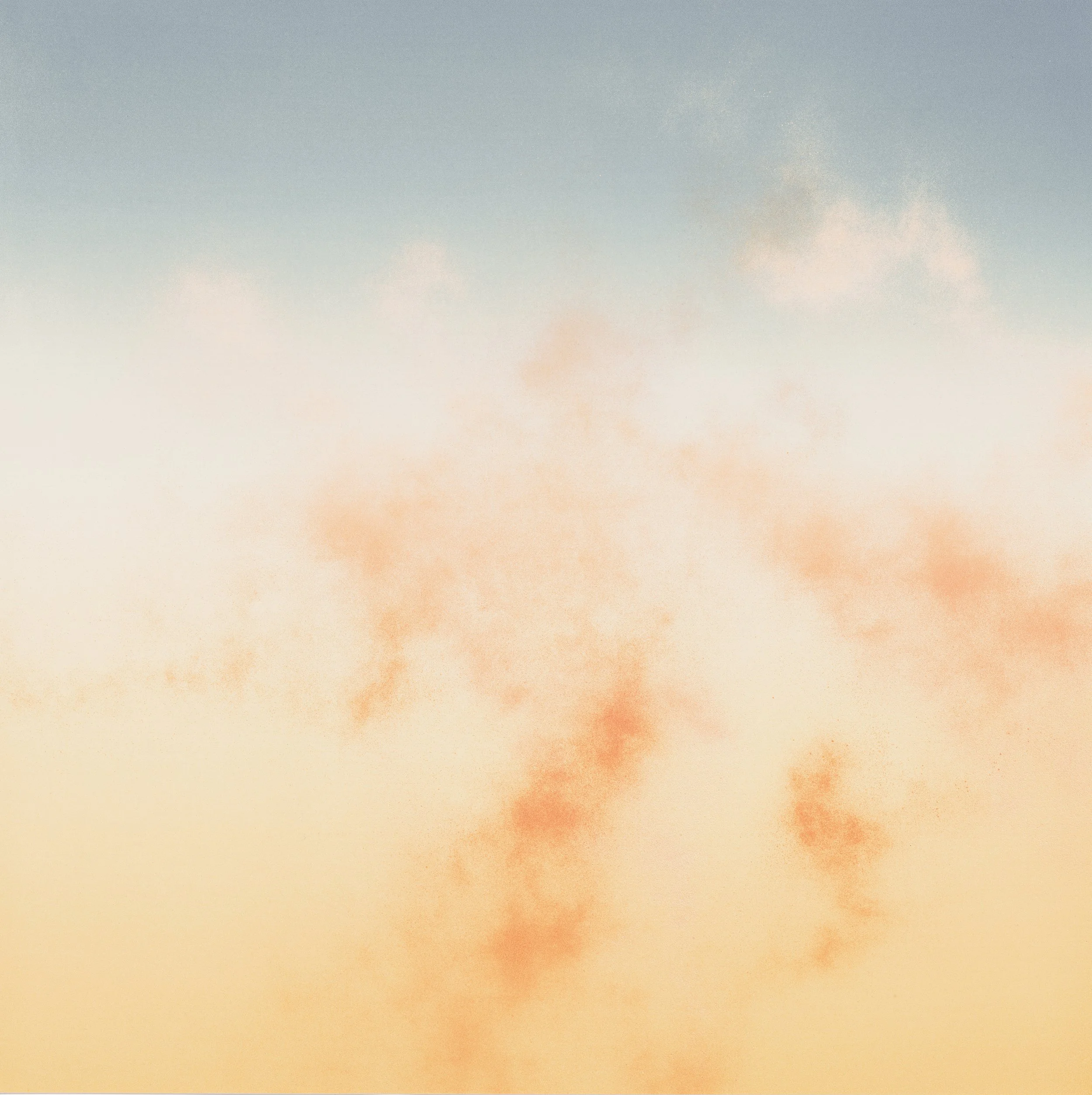
Tacita Dean. LA Magic Hour 6, 2021. Hand drawn 3-color blend lithograph. 29 7/8 x 29 7/8 in. (75.9 x 75.9 cm). Courtesy of the artist, Gemini G.E.L., Frith Street Gallery, London; Marian Goodman Gallery, New York / Paris/ Los Angeles.
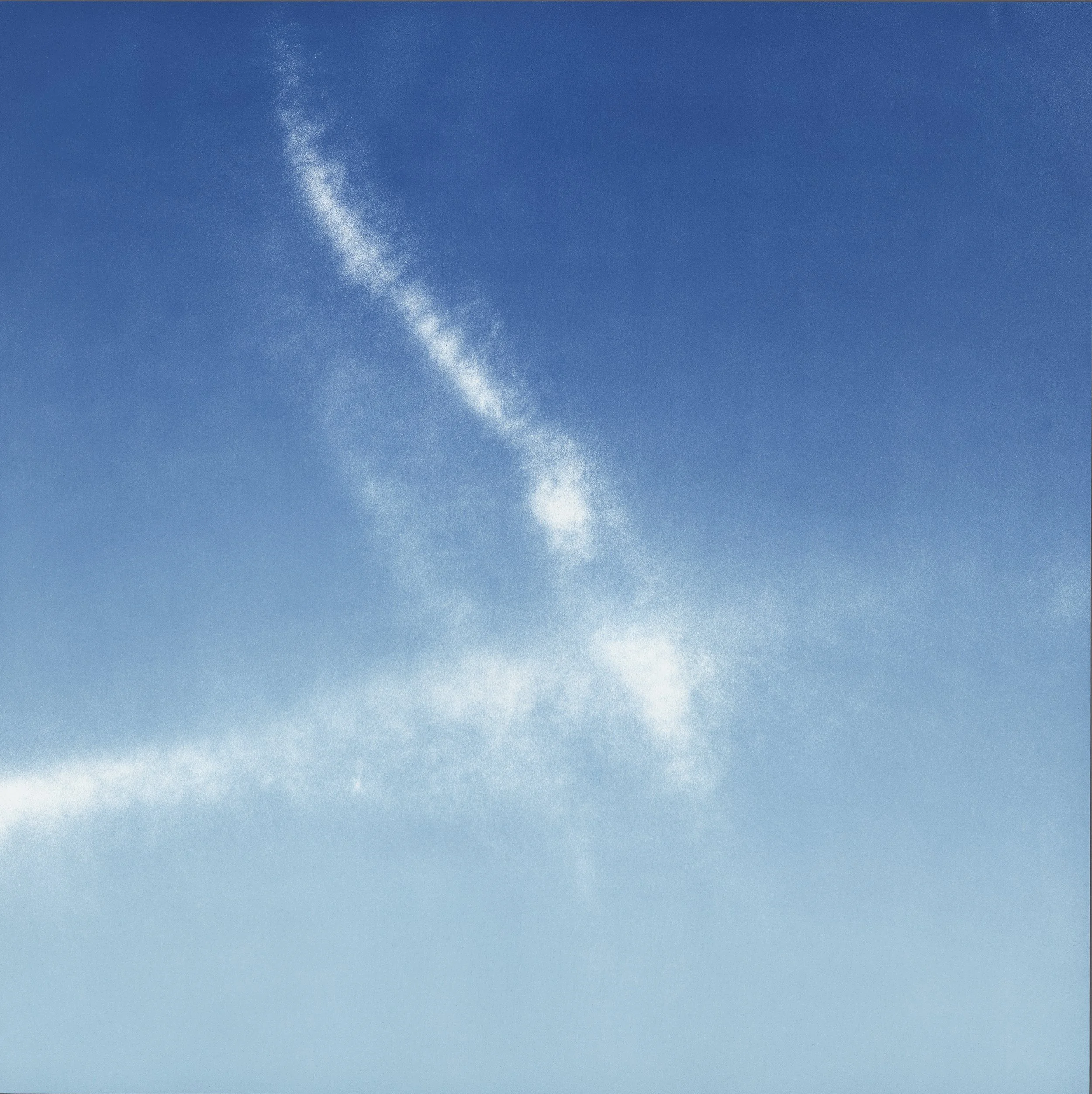
Tacita Dean. LA Exuberance 10, 2016. Hand-drawn 3-color blend lithograph. 29 7/8 x 29 7/8 in. (75.9 x 75.9 cm). Courtesy of the artist, Gemini G.E.L., Frith Street Gallery, London; Marian Goodman Gallery, New York / Paris/ Los Angeles.
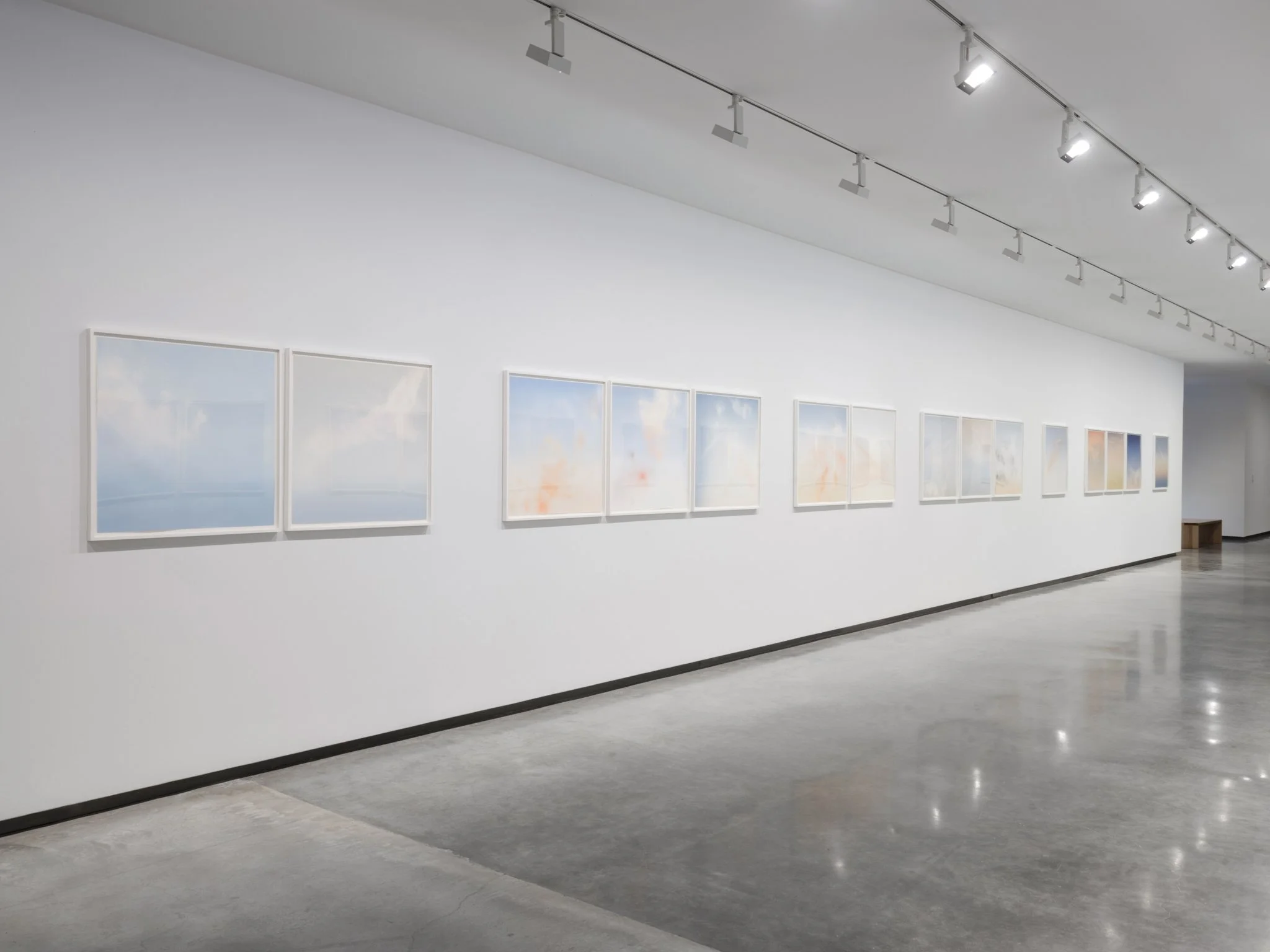
Tacita Dean. LA Magic Hour 1-15, 2021. Hand drawn 3-color blend lithograph. 29 7/8 x 29 7/8 in. (75.9 x 75.9 cm) (each). Exhibition view, Tacita Dean, Museum of Contemporary Art Australia, MCA, Sydney, 2023-2024. Courtesy of the artist, Gemini G.E.L., Frith Street Gallery, London; Marian Goodman Gallery, New York / Paris/ Los Angeles. Photo credit: Hamish McIntosh.
Interview
AMADOUR: Hello, Tacita. Where do I find you today?
TACITA DEAN: I’m just outside Florence, on the edge of the city. I’m at I Tatti, Bernard Berenson’s house, which is now part of Harvard. They invite artists and scholars to come and be here and work, though I don’t really have a defined project. I’m just… here. It’s extraordinarily beautiful.
AMADOUR: That’s amazing. I want to say, from the beginning, that I’ve been a longtime admirer of your work since I first encountered contemporary art at UCLA. Your process has always felt deeply attentive, almost durational in its sensitivity. When I saw Trial of the Finger in Los Angeles, what struck me was how each space produced a distinct experience, almost as if the works recalibrated themselves architecturally. I was wondering how you think about that relationship, the one between the work and the space it inhabits.
TACITA DEAN: Those films weren’t made for that space, which you clearly understood. They were conceived elsewhere. But installation inevitably becomes a form of recalibration. You have to consider how a work survives beyond its original conditions, how it translates without losing its internal logic.
Geography Biography (2023), for example, was made for the Bourse de Commerce – Pinault Collection, a rotunda, and, in that context, rotated continuously along a curved wall, with the projectors positioned at the center. That curvature wasn’t incidental; it was fundamental. So when you remove that condition, you have to find a way to retain a sense of spatial coherence. The curved wall in Los Angeles became a way of approximating that original logic, allowing the work to breathe again in relation to architecture. This evolution in installation highlights how adapting to new spaces becomes necessary for the work's integrity.
I had tried something similar once before in Sydney at the MCA, though not in a true rotunda, and that experience made me realize that the work could exist beyond such a specific spatial condition. A rotunda is rare; that kind of volume and continuity of space is very particular, but it allowed me to begin imagining how the work might travel and be rearticulated without losing its structure. This realization linked the works conceptually, showing how each installation builds on the previous one.
AMADOUR: Yes, I remember seeing your Paris exhibition at the Pinault Collection, your chalk works were incredible too.
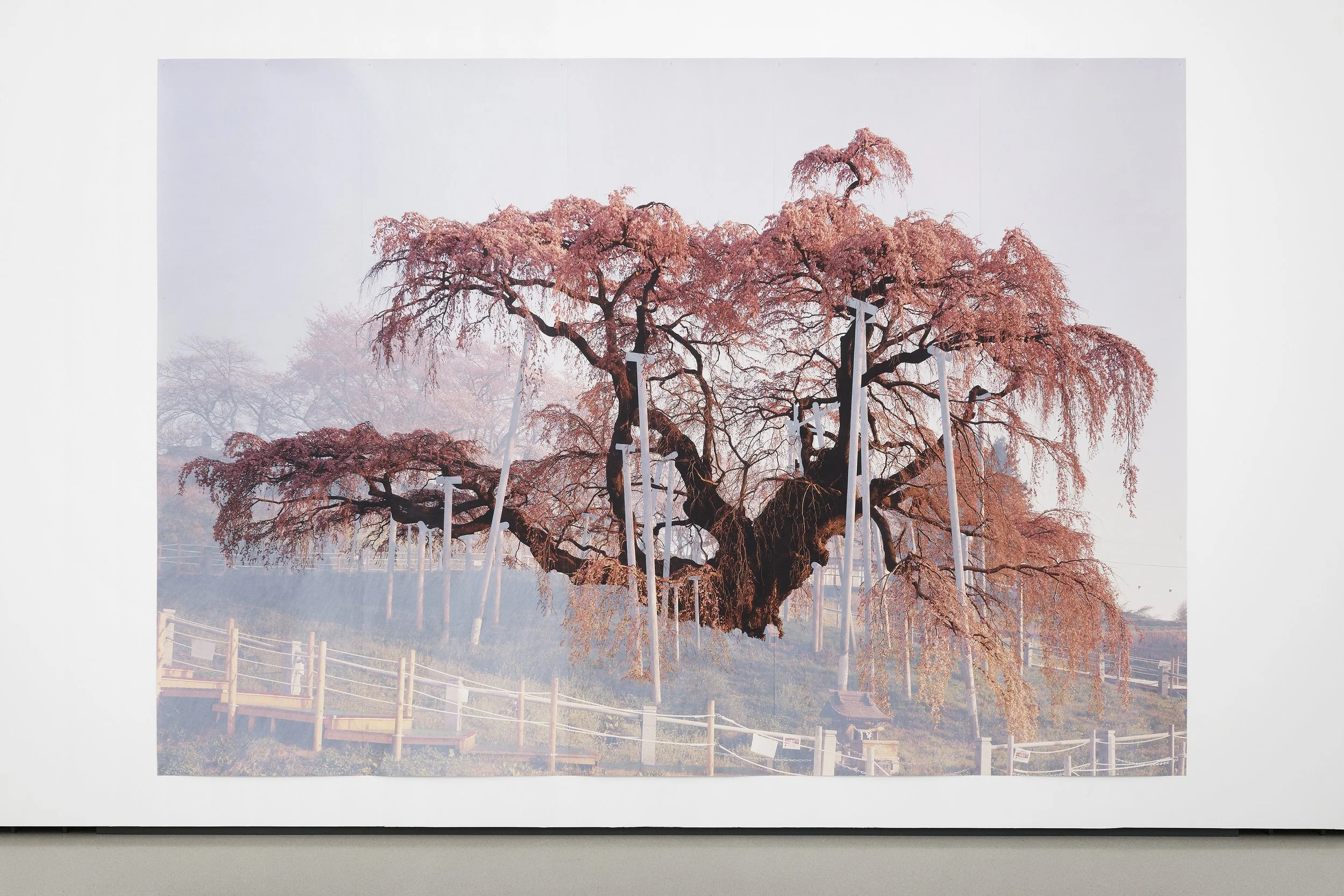
Tacita Dean. Sakura (Taki I), 2022. Colored pencil on Fuji Velvet paper mounted on paper. 137 x 196 7/8 in. (348 x 500 cm). Exhibition view, Tacita Dean Geography Biography, Bourse de Commerce, Paris-Pinault Collection, 2023. Photo credit: Aurélien Mole. Courtesy of the artist, Frith Street Gallery, London; Marian Goodman Gallery, New York / Paris/ Los Angeles and Pinault Collection.
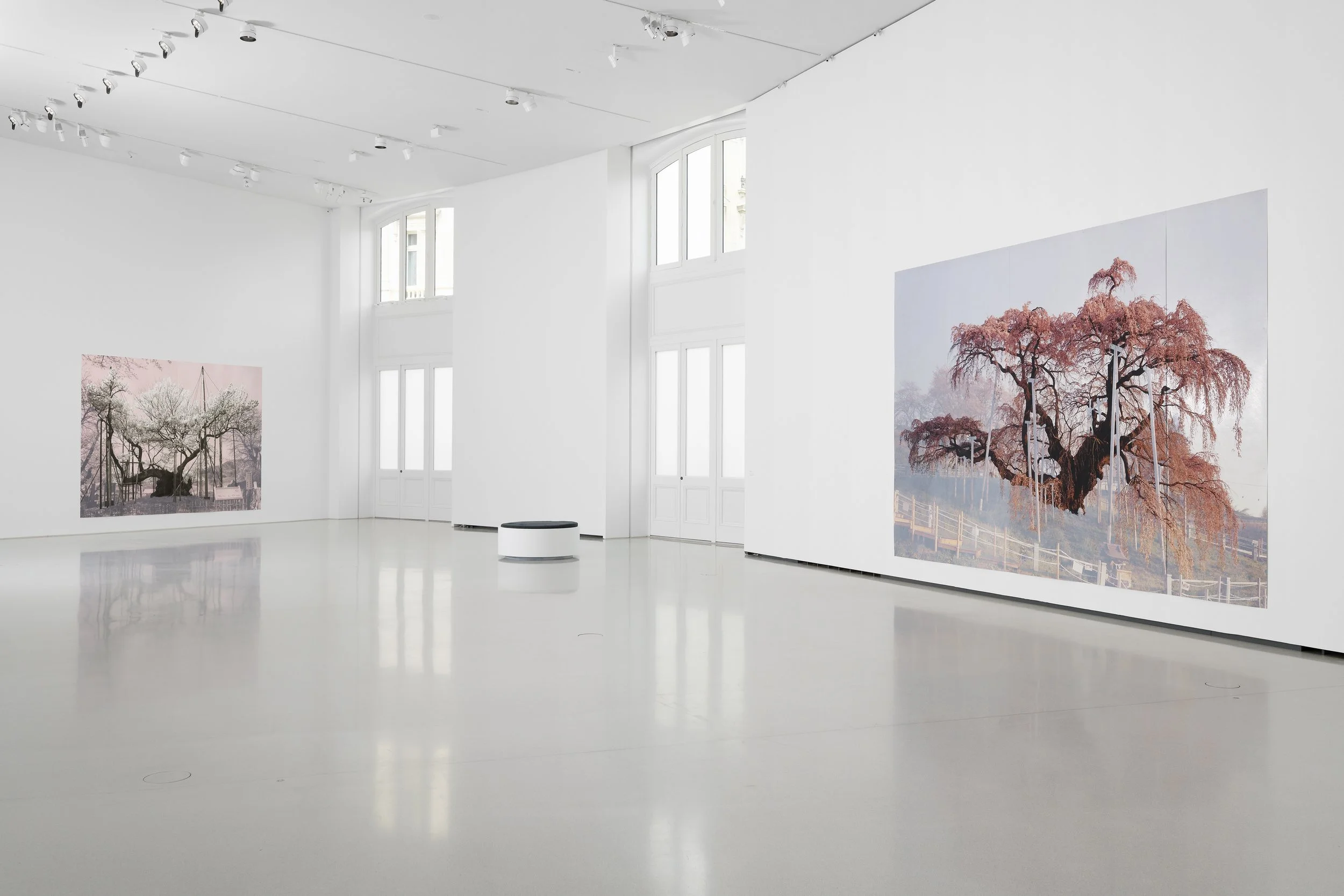
Tacita Dean. Sakura (Jindai I), 2023. Colored pencil on handprinted Foma matte silver gelatin photograph mounted on paper. 116 1/2 x 150 3/8 in. (296 x 382 cm). / Sakura (Taki I), 2022. Colored pencil on Fuji Velvet paper mounted on paper. 137 x 196 7/8 in. (348 x 500 cm). Exhibition view, Tacita Dean Geography Biography, Bourse de Commerce, Paris-Pinault Collection, 2023. Photo credit: Aurélien Mole. Courtesy of the artist, Frith Street Gallery, London; Marian Goodman Gallery, New York / Paris/ Los Angeles and Pinault Collection.
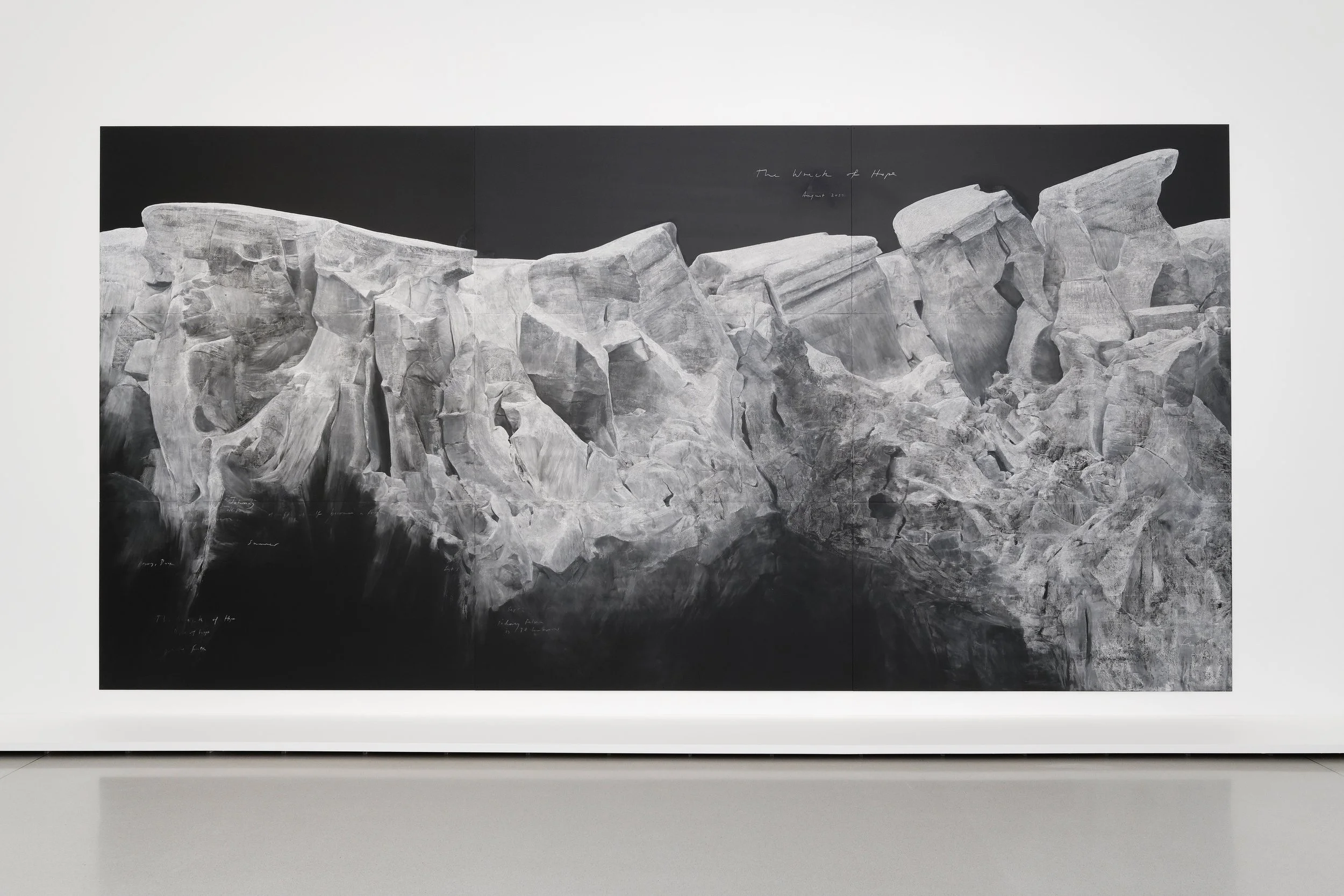
Tacita Dean. The Wreck of Hope, 2022. Chalk on blackboard. 144 x 288 in. (365.8 x 731.5 cm). Exhibition view, Tacita Dean Geography Biography, Bourse de Commerce, Paris-Pinault Collection, 2023. Photo credit: Aurélien Mole. Courtesy of the artist, Frith Street Gallery, London; Marian Goodman Gallery, New York / Paris/ Los Angeles and Pinault Collection.
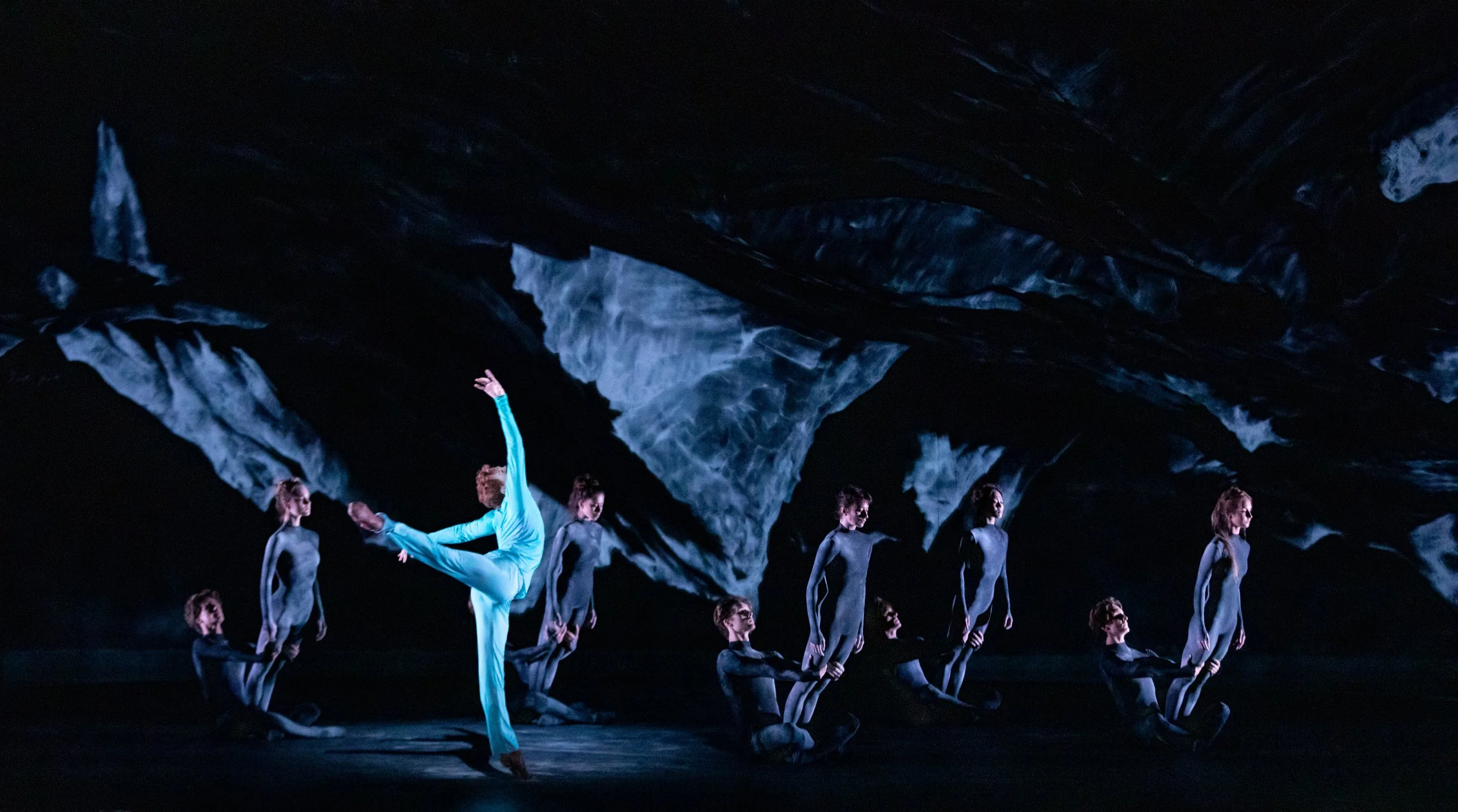
Tacita Dean, set and costume design for The Dante Project Part 1 [Inferno] 2019. Choreography by Wayne McGregor set to music composed by Thomas Adès; performed by dancers of The Royal Ballet, London. Courtesy of the artist, Frith Street Gallery, London; Marian Goodman Gallery, New York / Paris/ Los Angeles. Photo credit: Cheryl Mann.
TACITA DEAN: Well, Paradise (2022) was even more specific. It was made for the final act of a ballet at the Royal Opera House, conceived as part of The Dante Project with Wayne McGregor and Thomas Adès, based on The Divine Comedy (c. 1320). It functioned as the final movement, following Inferno and Purgatory. The film was projected above the dancers, not behind them, suspended almost like a celestial plane, with the dancers positioned beneath it. It was incredibly moving in that context, the image hovering, the bodies below it, the whole composition held in tension. Transitioning from these site-specific works reveals the challenges and possibilities when adapting art across different venues.
But then the work has to survive beyond that moment. When it enters a gallery, it inevitably becomes something else. That transformation is not a compromise; it is part of the work’s ongoing life. Each new context presents a transformation, and the question is always how to allow it to endure across different contexts without collapsing its internal structure.
AMADOUR: That sense of endurance, or afterlife, is exactly what I felt. I wanted to ask you about In Montem (he fell) (2026) and your experience of the eclipse in Eagle Pass. I was also in Texas for it, so reading about your process felt strangely personal. I’m curious how that experience unfolded materially—especially how it evolved into these works with Gemini G.E.L.
TACITA DEAN: Well, I’ve always loved total eclipses. I’ve actually made a number of films around them. The first was Banewl (1999), which takes its name from a Cornish transcription of the farm where it was filmed. That eclipse was completely overcast, so we didn’t see anything at all, which was profoundly disappointing at the time. I had set up four 16mm anamorphic cameras expecting to capture the event directly, but instead, what emerged was something else entirely.
The cows lay down, the birds went quiet, the plants closed. It became a film about the ground, about the atmosphere responding to something just out of sight. The eclipse itself remained largely unseen, only briefly visible at the very end, but totality was still extraordinary. The light shifted into this strange, darkened day, and suddenly certain elements, like the lighthouse, became visible in ways they hadn’t been before. It became less about spectacle and more about perception, about how the world reorganizes itself under those conditions.
That experience gave me a very strong desire to properly witness totality. So for the next eclipse, I traveled to Morombe, Madagascar, with my 16mm camera. The conditions were perfect, completely clear, but just as totality began, my friend realized he hadn’t loaded his camera and knocked mine over. These moments are incredibly brief, two or three minutes at most, and by the time I recovered and reframed the image, the moon had already passed, and the frame was essentially bleached. What remained became a small film, Diamond Ring (2002), which holds that fleeting transition. This leads into how process and chance shape both the result and my ongoing approach.
Then in 2017, I approached it very differently with Antigone (2018), where the eclipse became embedded within the structure of the film itself, functioning almost as a temporal mechanism, a kind of clock. It was much more controlled, involving masking and pre-exposed material carried across locations, with the constant risk that conditions might fail again. It was quite terrifying in that sense, though ultimately successful. This shift in working method reveals the evolution in my thinking about how eclipses can shape a film's structure.
So with this most recent eclipse, I decided I wasn’t going to do anything at all. I thought I would simply sit and watch. But of course I couldn’t entirely let go of the impulse. I was in Eagle Pass, sitting in a deck chair, having just come from working on Why Sigh (2024) at the Menil Collection, where I had spent the night in the Cy Twombly galleries [Her Menil Collection exhibition was titled Tacita Dean: Blind Folly]. I had hoped to write something in response to that experience, but found myself unable to do so, almost paralyzed. Instead, I began working with long exposures, rotating the camera and allowing the image to dissolve into abstraction. This marked another turning point in how I respond artistically to these rare events.
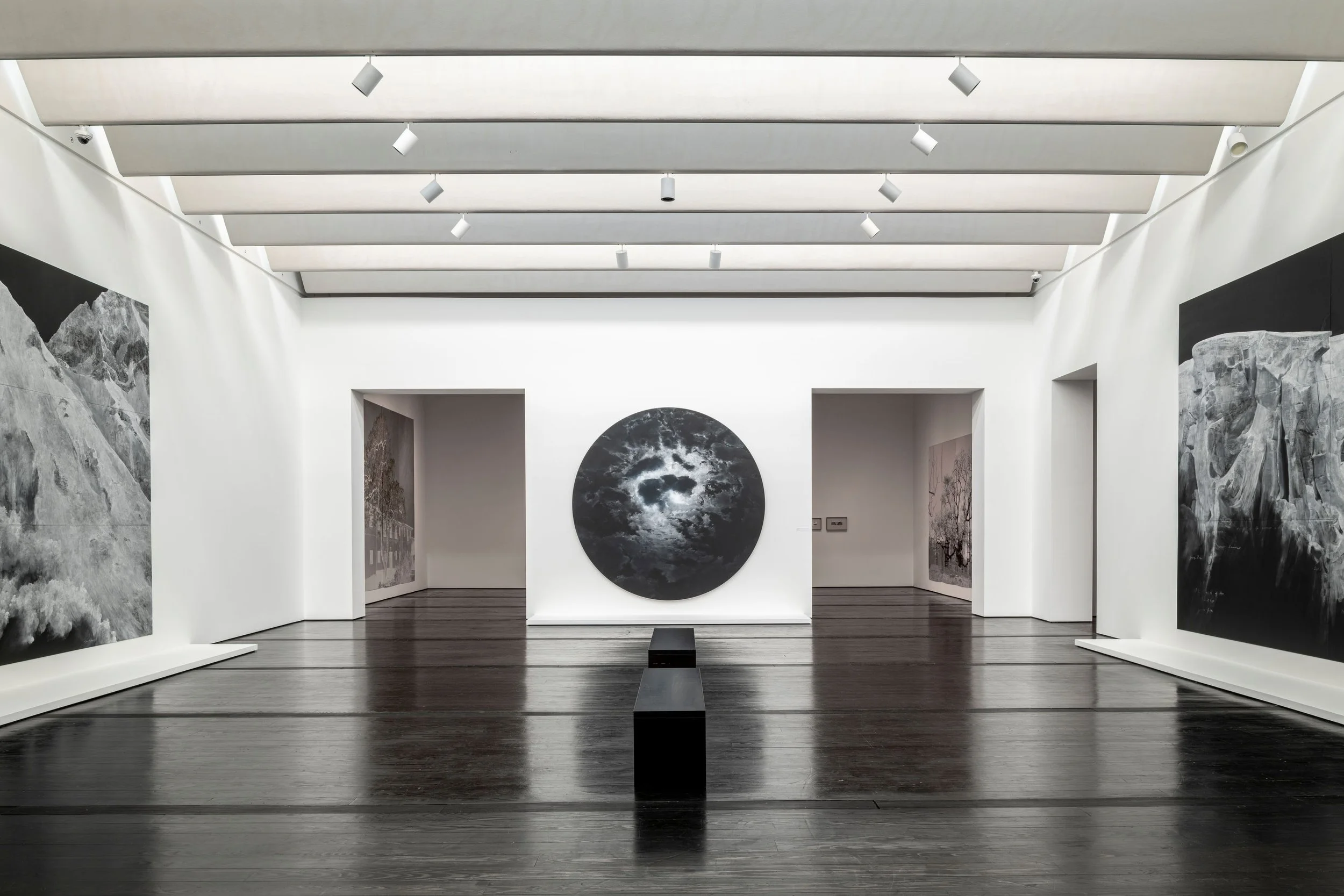
Tacita Dean. Exhibition view, Tacita Dean: Blind Folly, The Menil Collection, Houston, Texas, 2024-2025. Courtesy of the artist, Frith Street Gallery, London; Marian Goodman Gallery, New York / Paris/ Los Angeles. Photo credit: Paul Hester / The Menil Collection.
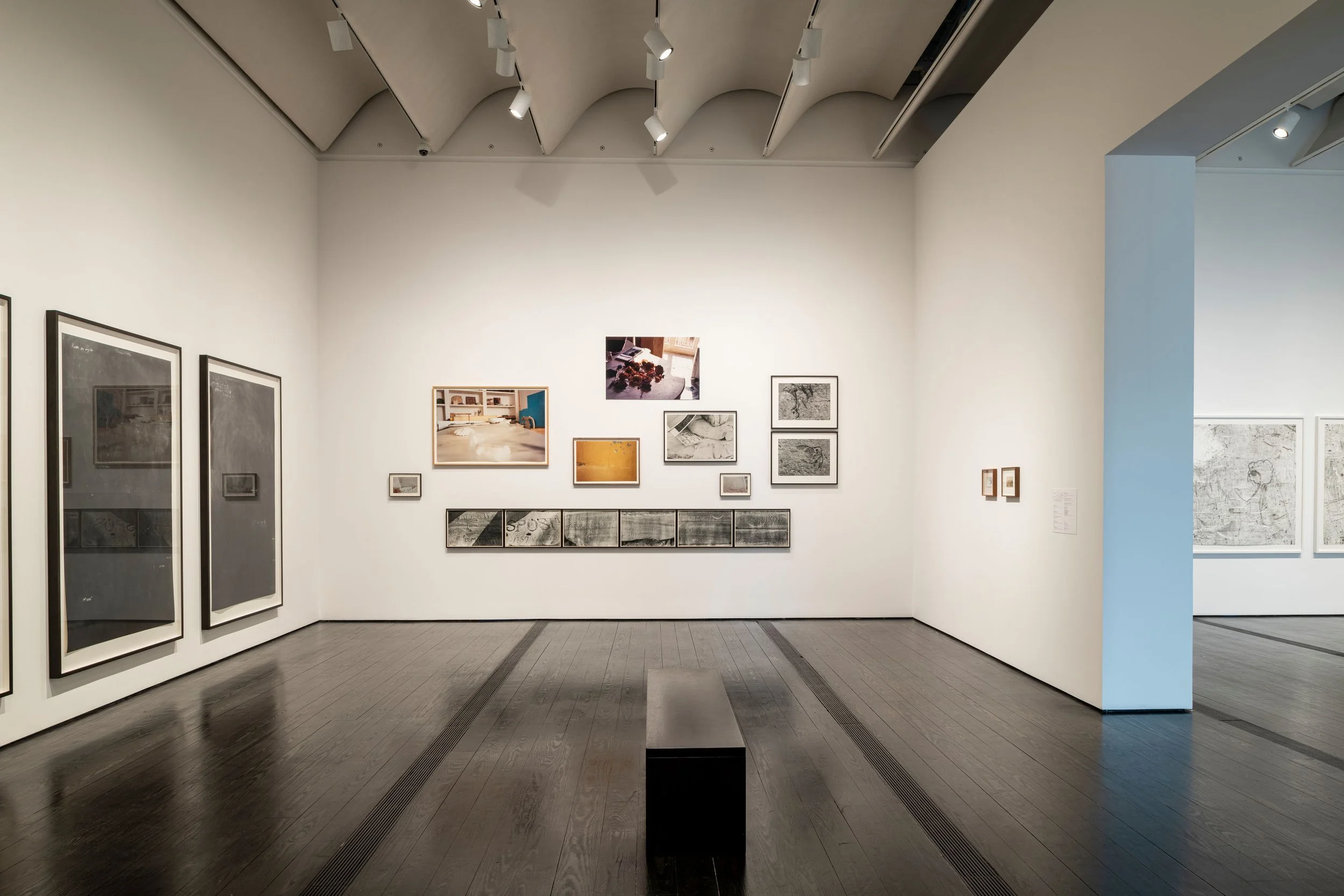
Tacita Dean. Exhibition view, Tacita Dean: Blind Folly, The Menil Collection, Houston, Texas, 2024-2025. Courtesy of the artist, Frith Street Gallery, London; Marian Goodman Gallery, New York / Paris/ Los Angeles. Photo credit: Paul Hester / The Menil Collection.
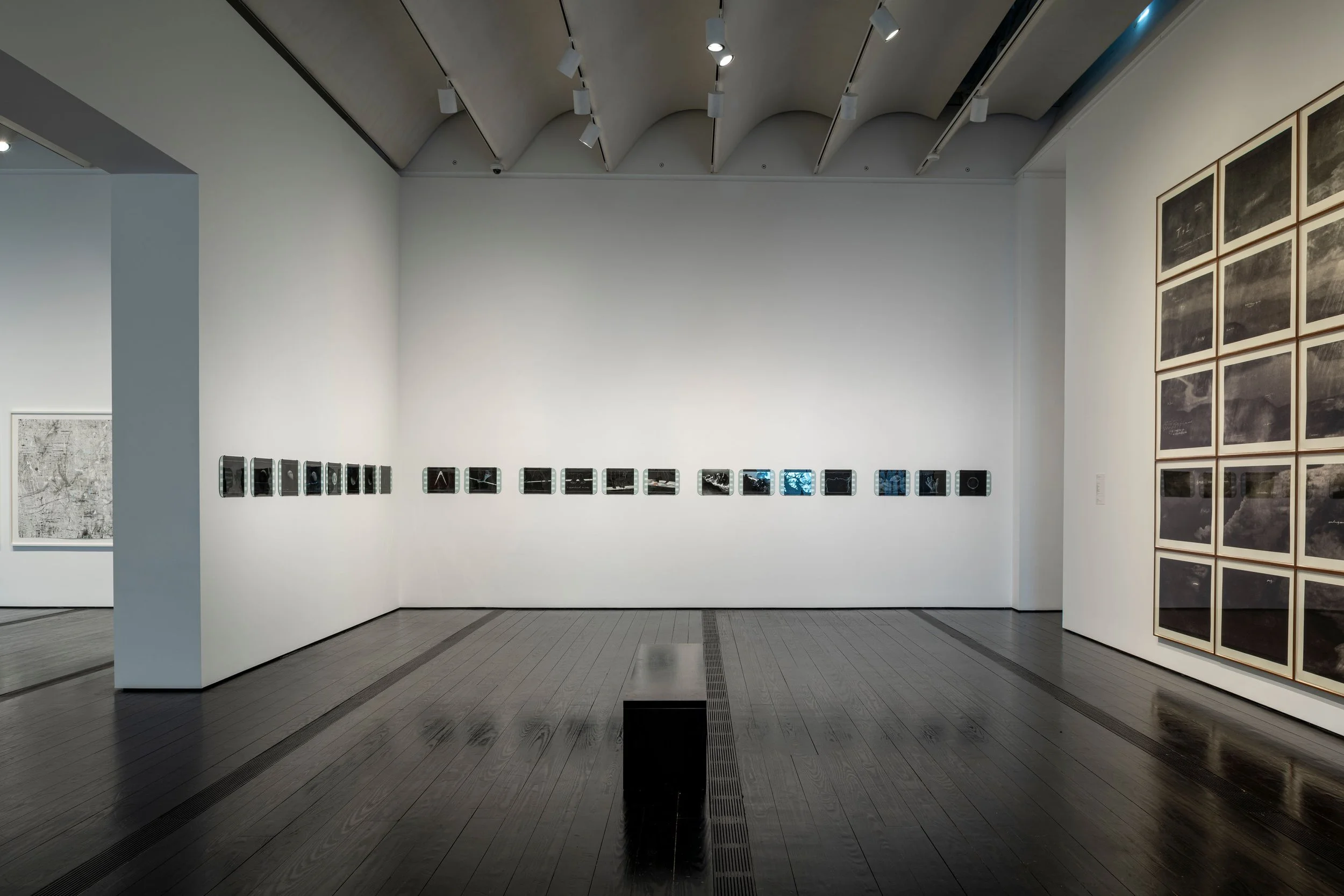
Tacita Dean. Exhibition view, Tacita Dean: Blind Folly, The Menil Collection, Houston, Texas, 2024-2025. Courtesy of the artist, Frith Street Gallery, London; Marian Goodman Gallery, New York / Paris/ Los Angeles. Photo credit: Paul Hester / The Menil Collection.
That gesture carried over into the eclipse. Because you can’t look through a viewfinder during it, it’s too dangerous, I began spinning the camera blindly without any real intention of capturing a coherent image. I didn’t really care, because I had already made what felt like the necessary films on eclipses. This demonstrates a transition from deliberate effort to a freer, more experimental process.
What emerged were these extraordinary forms, what I think of as drawings made by light. The quality of eclipse light is very particular. It becomes sharper, almost like a pinhole, which is why you see those fragmented shadows through leaves. That sharpness inscribes itself onto the emulsion, producing lines and gestures that feel closer to drawing than to photography. I’ve since been working with Gemini G.E.L. to translate them into prints. It was entirely unplanned, really a matter of luck, but that has always been part of the process.
From there, the work began to shift. I became interested in moving away from clouds, from the sky as subject, and instead thinking more in terms of line and movement, how light traces itself across a surface. That became a starting point, though it quickly developed beyond that initial idea.
In Montem (he fell) (2026), though, it is slightly different, though still connected in a more oblique way. That work began with the idea of the tondo, the circular form, which I had explored previously in relation to the sky. This time, I wanted to invert that and move inward, into the earth. It was prompted in part by an image my husband, Mathew, took after he fell into a crevasse. He was unharmed, he had a rope, and the snow was soft, but the image stayed with me. I began thinking about that descent, about the body falling into the mountain, into its interior.
So the work became less about the sky and more about that internal space, the bowels of the earth, the movement downward rather than upward. It isn’t directly about the eclipse, but nothing is ever entirely separate. Everything connects, even if only indirectly.
AMADOUR: That idea of light as a drawing instrument is incredibly compelling. I was also deeply moved by Sidney Felsen Decorates an Envelope (2025). There’s something so precise and intimate about that gesture, especially considering the stage of life he was in.
TACITA DEAN: The idea was to make a series of short films of nonagenarians engaged in one task. I know—it is a beautiful thing. Julie Mehretu introduced me to Sidney Felsen and to Gemini G.E.L., and when I finally asked him to do it, I asked him to dedicate the envelope to her. We’ve all received those envelopes from Sidney—they exist within this very curated, highly creative universe, and yet that was his own particular gesture, his own form of authorship within it. He used to take photographs as well, so there was always this quiet, personal creativity there.
I had known him for a long time, but I’d avoided asking, partly because people often assume all sorts of intentions. But I’ve become increasingly interested in what I think of as “personages”, figures who carry a certain weight of history, and in the importance of capturing them in real time, contemporaneously, while they are still alive, still vital. Because once they die, everything shifts; the image becomes archival, historical, something fixed. But in those moments, they are present, active, and alive.
I had wanted to make a whole series of films around this idea, nonagenarians in Los Angeles performing a single, simple task. I tried, for instance, to film Roger Corman mixing a martini, but that never came to fruition. And so it became Sidney Felsen Decorates an Envelope—this very small, precise action. I had a whole list of others, these modest gestures I wanted to document, each one a kind of distilled portrait.
In the end, Sidney’s is really the only one that exists. He was ninety-nine and a half when I filmed him. And there’s a similar presence in my film One Hundred and Fifty Years of Painting (2016), where Luchita Hurtado, who was ninety-nine at the time, appears in conversation with Julie. These extraordinary figures—ninety-nine, almost a century—and yet neither of them quite made it to one hundred.
There’s something very moving in that proximity to time, to the edge of it, and in the attempt to hold onto a gesture, however small, before it disappears.
AMADOUR: It feels complete in itself, though. I wanted to revisit your connection with Derek Jarman. That relationship feels important, not just personally but historically.
TACITA DEAN: Well, with Derek Jarman, he was hugely important to my generation, very present, not just through his films but politically and culturally as well, particularly with ACT UP. He was a real figure, a presence. We all went to his films, and he felt very close to the world we were inhabiting at the time.
I knew he lived in Dungeness, and I come from Kent, so there was already that proximity. I had gone to the premiere of The Garden (1990). I was at the Slade then, as he had been years before, and the next day, I was taking the train back to Kent to see my parents when I realized he was on the same train, heading to Ashford.
I didn’t sit next to him at first; I was too nervous. I sat a few seats away. But Margaret Thatcher had just resigned, and there was this rather unbearable man nearby loudly lamenting it, and I remember thinking I couldn’t possibly sit there any longer. So I got up, and that irritation gave me the courage to go and sit with Derek. We ended up talking the entire journey.
After that, I would occasionally go down to Dungeness. I once brought fruit to Prospect Cottage, though he wasn’t there, and over time, I became friendly with Peter Fillingham, who was close to him. We did a show together, and Derek died while that was happening. I remember going to Prospect Cottage shortly after his death, and it was then that I became close to Keith Collins.
Keith and I remained close for years, until he very suddenly died of a brain tumor, which was devastating. Before he passed, he asked if there was anything I could do to help look after the cottage, to ensure its future in some way. That became something I felt deeply responsible for. Over time, I became quite involved in the effort to secure it, and eventually, we were able to have Prospect Cottage acquired for the nation, so that it would be protected.
Now it exists as a place people can visit, even stay in, with a residency program. It’s something I’m very glad we managed to do, and much of that effort actually came together during COVID. In a way, I think that period made people more aware again, of loss, of AIDS, of what Derek represented.
I didn’t know him extensively while he was alive, but in a strange way, I ended up working with him more after his death than during his lifetime. But he remains a huge figure in my life.
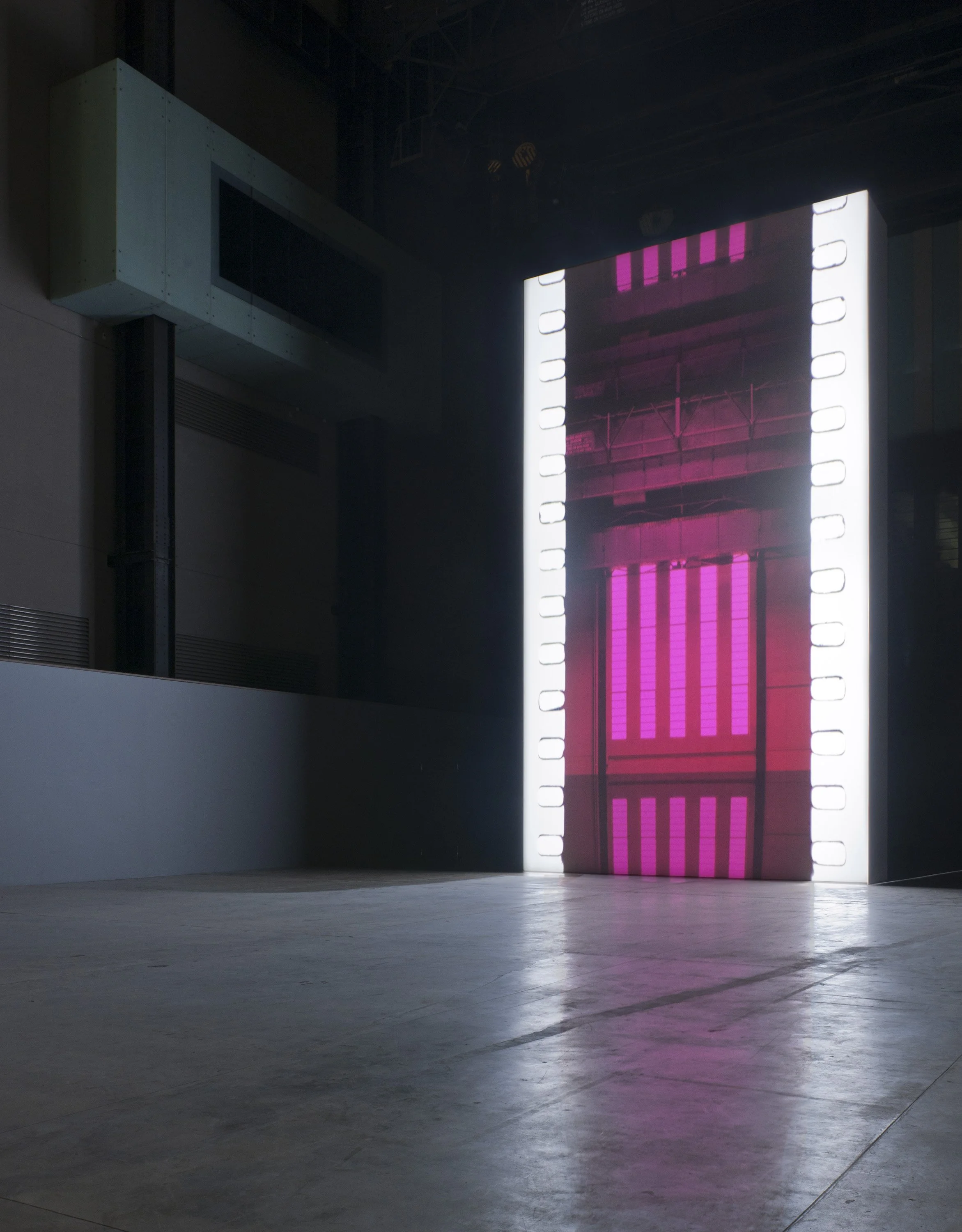
Tacita Dean. FILM, 2011. 35mm color and black and white portrait format anamorphic film with hand-tinted sequences, silent, 11 minutes, continuous loop. Installation view, Tacita Dean, Tate Modern, London, 2011. Courtesy of the artist, Frith Street Gallery, London; Marian Goodman Gallery, New York / Paris/ Los Angeles. Photo credit: Marcus Leith & Andrew Dunkley.
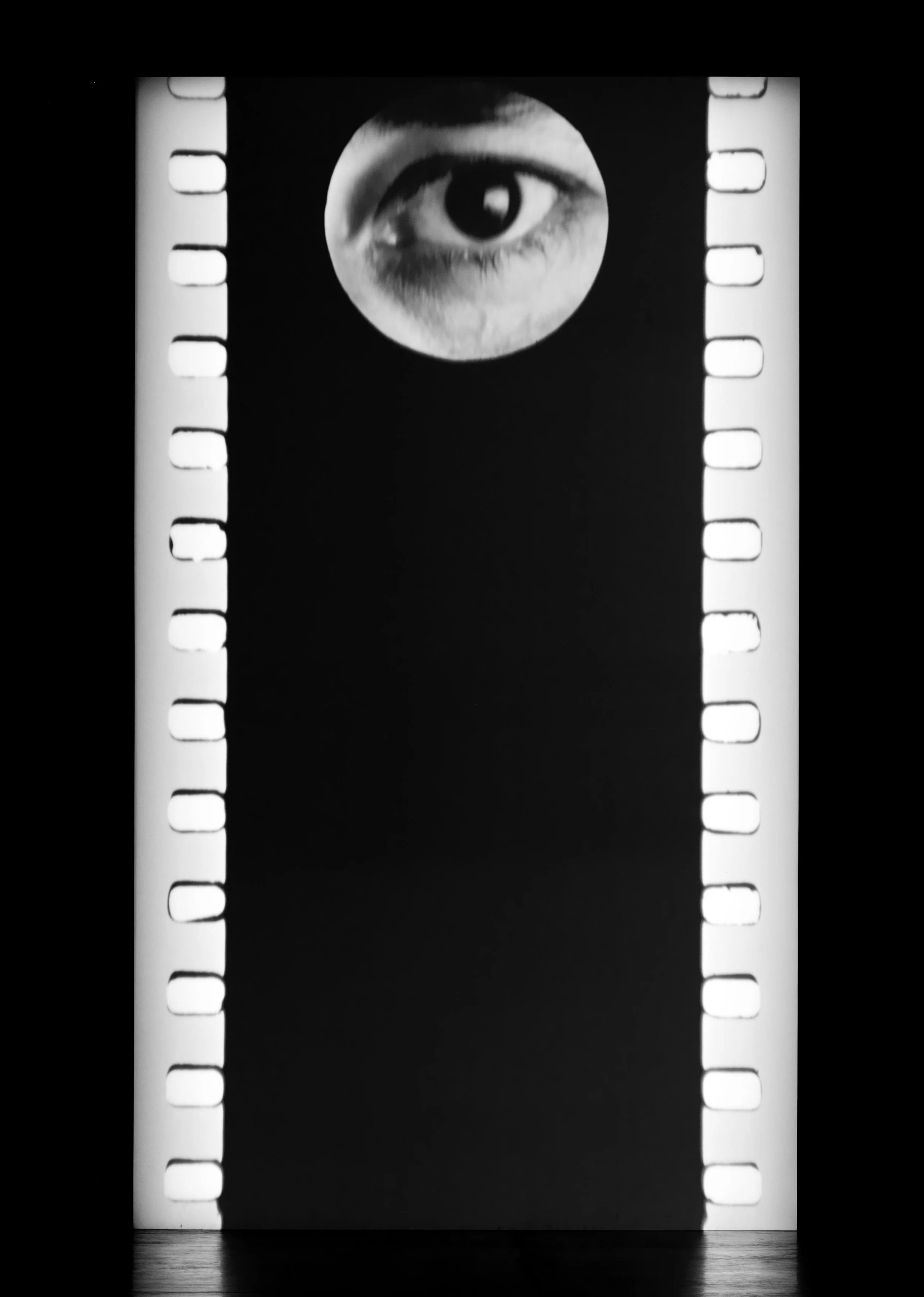
Tacita Dean. FILM, 2011. 35mm color and black and white portrait format anamorphic film with hand-tinted sequences, silent, 11 minutes, continuous loop. Installation view, Tacita Dean, Tate Modern, London, 2011. Courtesy of the artist, Frith Street Gallery, London; Marian Goodman Gallery, New York / Paris/ Los Angeles. Photo credit: Marcus Leith & Andrew Dunkley.
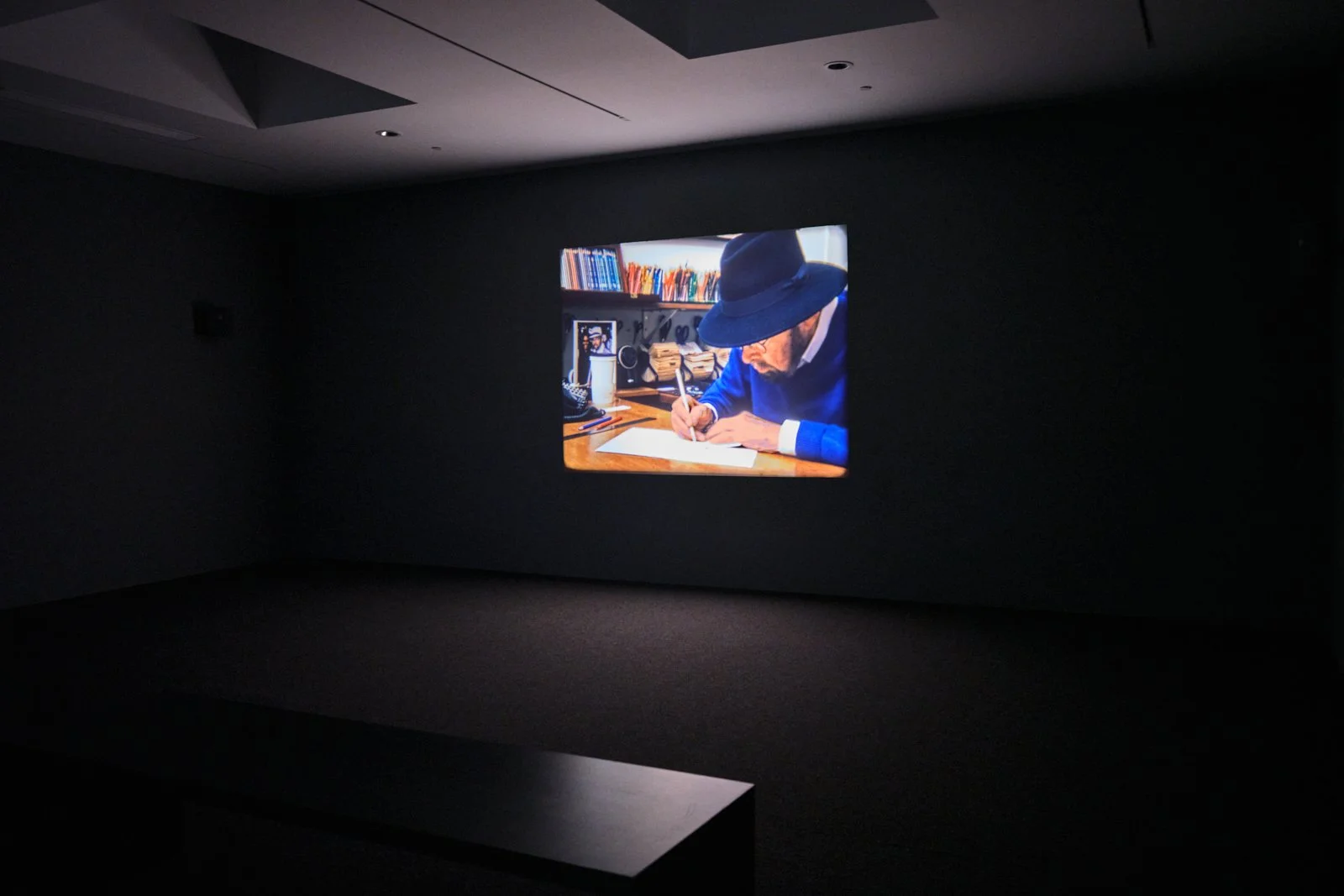
Tacita Dean. Sidney Felsen decorates an Envelope, 2025. 16mm color film, optical sound,14 min. Exhibition view, Trial of the Finger, Marian Goodman Gallery, Los Angeles, 2026. Courtesy of the artist, Frith Street Gallery, London; Marian Goodman Gallery, New York / Paris/ Los Angeles. Photo credit: Fredrik Nilsen.
AMADOUR: You know, that’s something I find really compelling because I recently wrote an essay for the Holt/Smithson Foundation, and I keep thinking about how Nancy Holt was so instrumental in preserving not only Robert Smithson’s legacy, but also her own. There’s something powerful in that, how artists actively shape the conditions through which their work, and the work of others, continues to exist over time.
I think about that in relation to more recent figures as well, like Bettina Grossman, who lived in the Chelsea Hotel for over half a century, and whose work is now being preserved by Yto Barrada. I recently saw the exhibition honoring Grossman’s work at the Ruth Foundation for the Arts in Milwaukee, and it really stayed with me: the idea of legacy as something living, something actively carried forward.
But I also wanted to shift toward filmmakers, because I know how important cinema is to your practice. I’ve read that you love Chantal Akerman, who is probably my favorite filmmaker as well—especially Les Rendez-vous d’Anna (1978), which I find incredibly moving in its structure and emotional restraint. I was curious how you think about her work, and more broadly, what draws you to certain films or filmmakers.
TACITA DEAN: Well, I’m living in something of a film-free condition at the moment, being outside Florence, it’s not a place where I really see cinema. But I’ve always loved Chantal Akerman. Jeanne Dielman, 23 quai du Commerce, 1080 Bruxelles(1975) was hugely important to me when I first saw it at the ICA, and I’ve remained deeply attached to her work ever since. In fact, if I’m honest, I still think it’s the greatest film, an absolute masterpiece.
Beyond that, Derek Jarman, of course, and Alain Resnais—Providence (1977) is one of my favorite films. And then, being here, I’ve found myself returning to Italian cinema. Pier Paolo Pasolini’s La Ricotta (1963) is extraordinary—so precise, so sharp—and I’ve also been watching Roberto Rossellini’s historical films, particularly the Medici cycle. Though I have to admit, I’m mostly watching them digitally, which isn’t ideal. I don’t particularly enjoy seeing films on a computer, but it’s often the only option. In a way, I have to be in America to really experience cinema properly. Still, even in this fragmented way, I remain very attached to film. I do love it.
AMADOUR: When you spoke in Los Angeles, you made a distinction between “mediums” and “medium” that really stayed with me.
TACITA DEAN: What became crucial for me, especially when film was under threat, was the distinction between calling it a technology and calling it a medium. At the time, everyone was speaking about film as a technology, and technologies are, by definition, destined to become obsolete; there’s a kind of inevitability built into them, a technological determinism. But I realized that, for me, film is not a technology at all. It is a medium.
That shift in language was actually quite powerful. Once you assert film as a medium, it no longer belongs to that cycle of obsolescence. Mediums don’t disappear, we still carve marble, we still paint with oil. And so the question becomes: why should cinema be limited to a single medium, or forced to abandon one for another? The argument was never about choosing between film and digital, but about allowing both to coexist.
It took a long time for that idea to gain traction, but you can see it now—Kodak adopting the language, filmmakers like Christopher Nolan insisting on film as a medium. And for artists, that distinction is essential. “Media” has become a weakened term, diluted by its association with digital culture, whereas “medium” retains a certain rigor, a specificity.
Much of the work I’ve been doing recently, particularly with aperture gate masking, is about exploring what film can do that digital fundamentally cannot. These works are entirely photochemical, constructed within the mechanics of the camera itself. The mask in the gate becomes a kind of template, shaping the image, concealing and revealing parts of the frame. It’s about engaging with the physical constraints and possibilities of film as material.
Geography Biography brings together Super 8, 16mm, and Standard 8, all embedded in a 35mm structure. It’s all made inside the camera. Paradise as well. There’s something almost magical about working this way. Once you fully engage with the mechanics and the essence of film, the possibilities become incredibly rich. It becomes a language in itself.
And that, for me, is why the word “medium” matters so much, because it allows that language to persist.
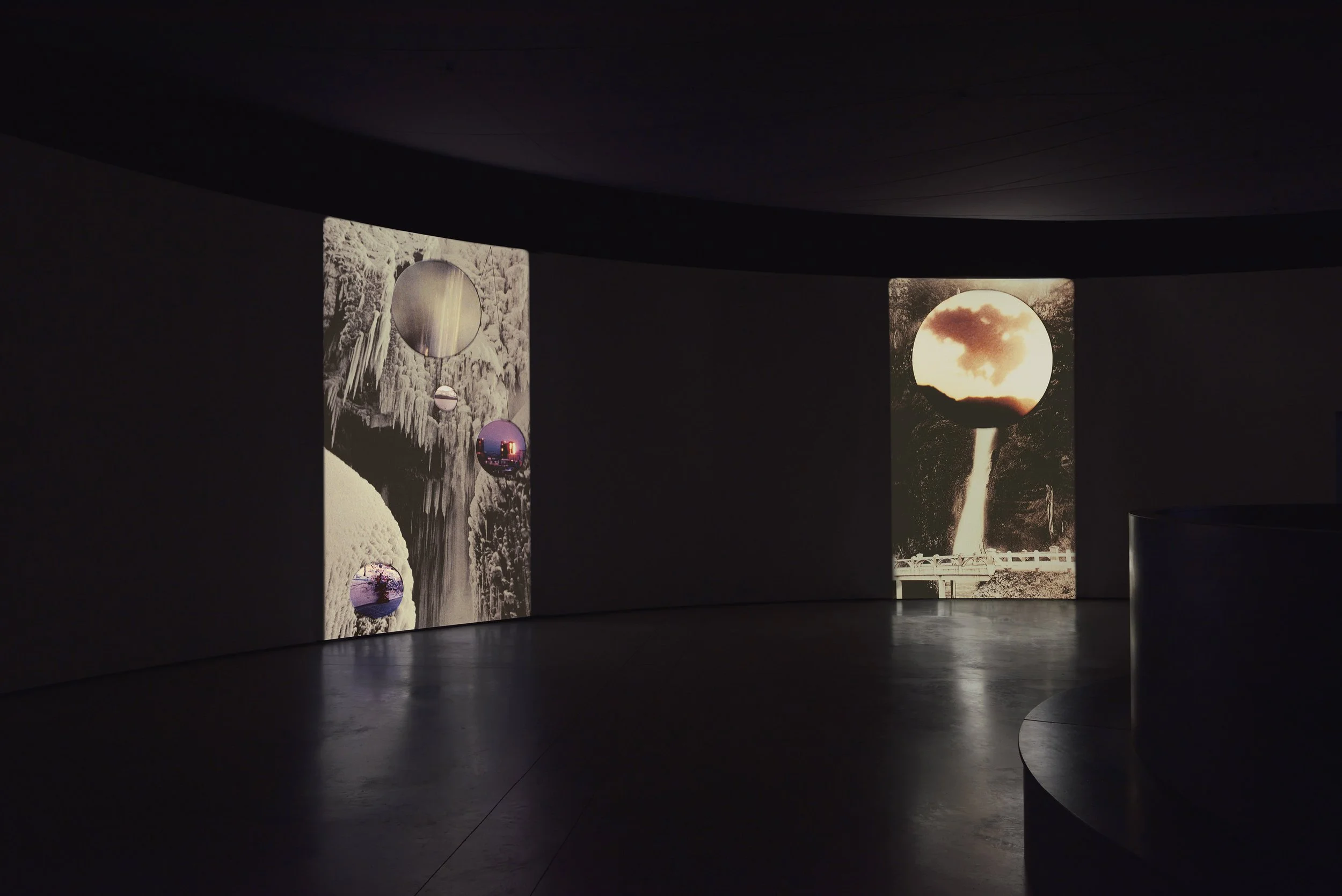
Tacita Dean. Geography Biography, 2023. 35mm portrait-format anamorphic film diptych, color with black and white, silent; 18 1/2 min.
Exhibition view, Tacita Dean, Bourse de Commerce, Pinault Collection, 2023. Courtesy of the artist and Marian Goodman Gallery. Photo credit: Rebecca Fanuele.
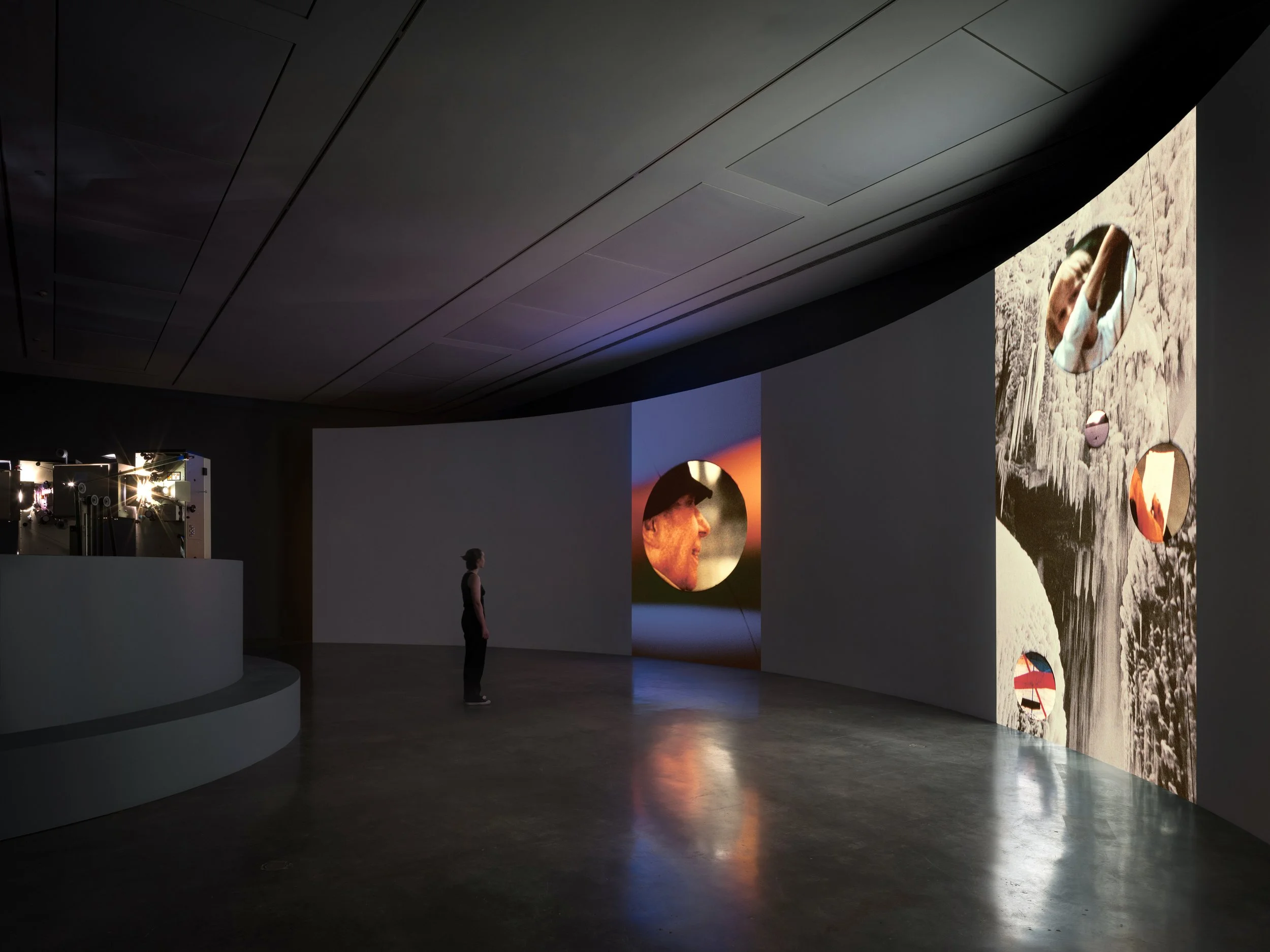
Tacita Dean. Geography Biography, 2023. 35mm portrait-format anamorphic film diptych, color with black and white, silent; 18 1/2 min. Exhibition view, Tacita Dean, Museum of Contemporary Art Australia, 2023. Courtesy of the artist and Marian Goodman Gallery. Photo credit: Hamish McIntosh.
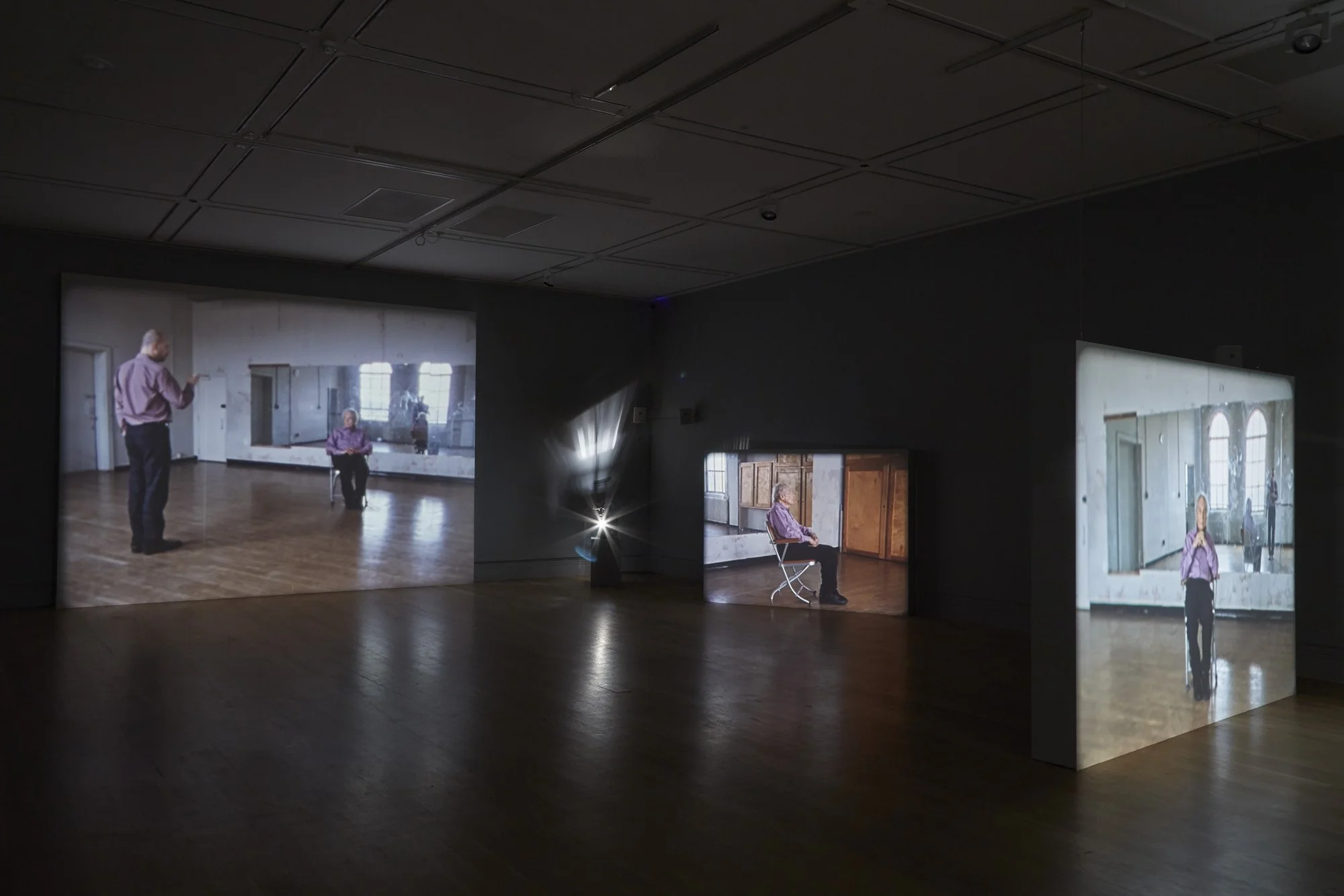
Tacita Dean. Merce Cunningham performs STILLNESS… (six performances, six films), 2008. Installation view: National Portrait Gallery, London, 2018. Courtesy of the artist, Frith Street Gallery, London; Marian Goodman Gallery, New York / Paris/ Los Angeles. Photo credit: Benjamin Westoby.
AMADOUR: There’s also a strong sense, in your work, of dialogue with art history, consciously or not. That’s incredibly resonant. I also feel that your work carries this deep engagement with art history—whether it’s Claus Oldenburg, Claude Monet, Cy Twombly, or Caspar David Friedrich. How do you think about that relationship in your practice?
TACITA DEAN: It’s… I mean, of course, art history is important to an artist, to any maker. What’s strange is that I’ve never really thought, consciously, about how connected I am to it, how much it has shaped me. But when you list those references, it becomes very clear that I am. I love the material of art, the substance of it, and I love artists themselves, how we exist in the world, how we behave, how we inhabit our studios. I’m actually working on a project right now that revolves around that very idea.
So yes, my references inevitably come from there. Perhaps that’s what I should be doing more of here at I Tatti, engaging directly with that history. I’ve filmed Giotto’s frescoes in Assisi, for instance, but it’s never been a fully conscious pursuit. It’s more instinctive than that. I can’t entirely explain it; it’s simply where my attraction lies.
And of course, artists come from their predecessors. We’re not working in a vacuum—we’re always in dialogue, whether in alignment or in resistance. That context is essential. The notion that artists must always produce something entirely new is, frankly, a fallacy. It’s not how it works. By virtue of making something, it already becomes new. But to pretend that it emerges from nowhere is impossible.
We are shaped by what came before us, even when we push against it. So yes, art history matters, not as a constraint, but as a condition of being.
AMADOUR: As a final question, I wanted to ask about your time in Athens when you went to school at the Supreme School of Fine Arts. It feels like an important formative moment.
TACITA DEAN: Yeah, I went to the Scholi Kalon Technon – School of Fine Arts in Athens. It was such a long time ago, really not just another century, but another millennium, it felt like. It was an entirely different era, a completely different way of being as an artist. I was extremely young then, just a student, and I lived on the island of Aegina, commuting into Athens by ferry or hydrofoil.
I had a very solitary, slightly eccentric life, but I completely immersed myself in Greece. I consumed everything I could; I had this small card that gave me free access to all the ruins and museums, and I used it relentlessly. I was quite intrepid, taking ferries out to all these satellite islands that the school had connections to, moving constantly through these landscapes, these histories.
And really, I just absorbed. That’s probably what I’m doing now as well. It’s a strange kind of work, absorption, because it can feel as though you’re not doing anything at all; there’s always that slight sense of being a fraud. But it was an incredibly rich period, even if it was, in many ways, profoundly solitary.
AMADOUR: Thank you so much, Tacita. I really appreciate your time.
TACITA DEAN: My pleasure. I hope we meet again in person at some point.
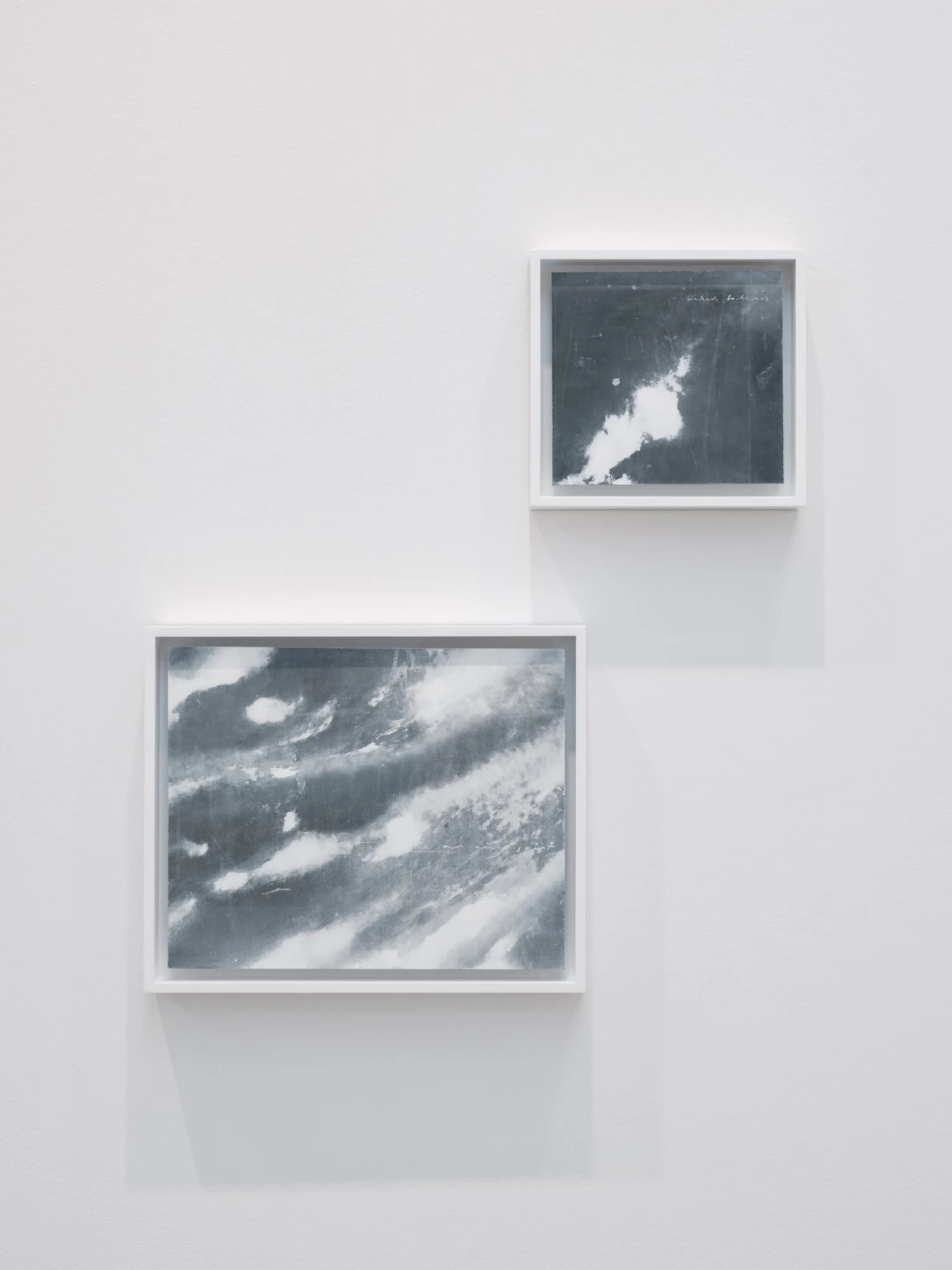
Tacita Dean. Linked Loiterers, 2023. Spray chalk, gouache, and charcoal pencil on slate. Frame: 14 1/2 x 15 1/2 x 3 in. (36.8 x 39.4 x 7.6 cm). Like an airy spirit go, 2023. Spray chalk, gouache and charcoal pencil on slate. Frame: 18 1/8 x 22 1/2 in. (46 x 57.1 cm). Courtesy of the artist, Frith Street Gallery, London; Marian Goodman Gallery, New York / Paris/ Los Angeles. Photo credit: Hamish McIntosh.
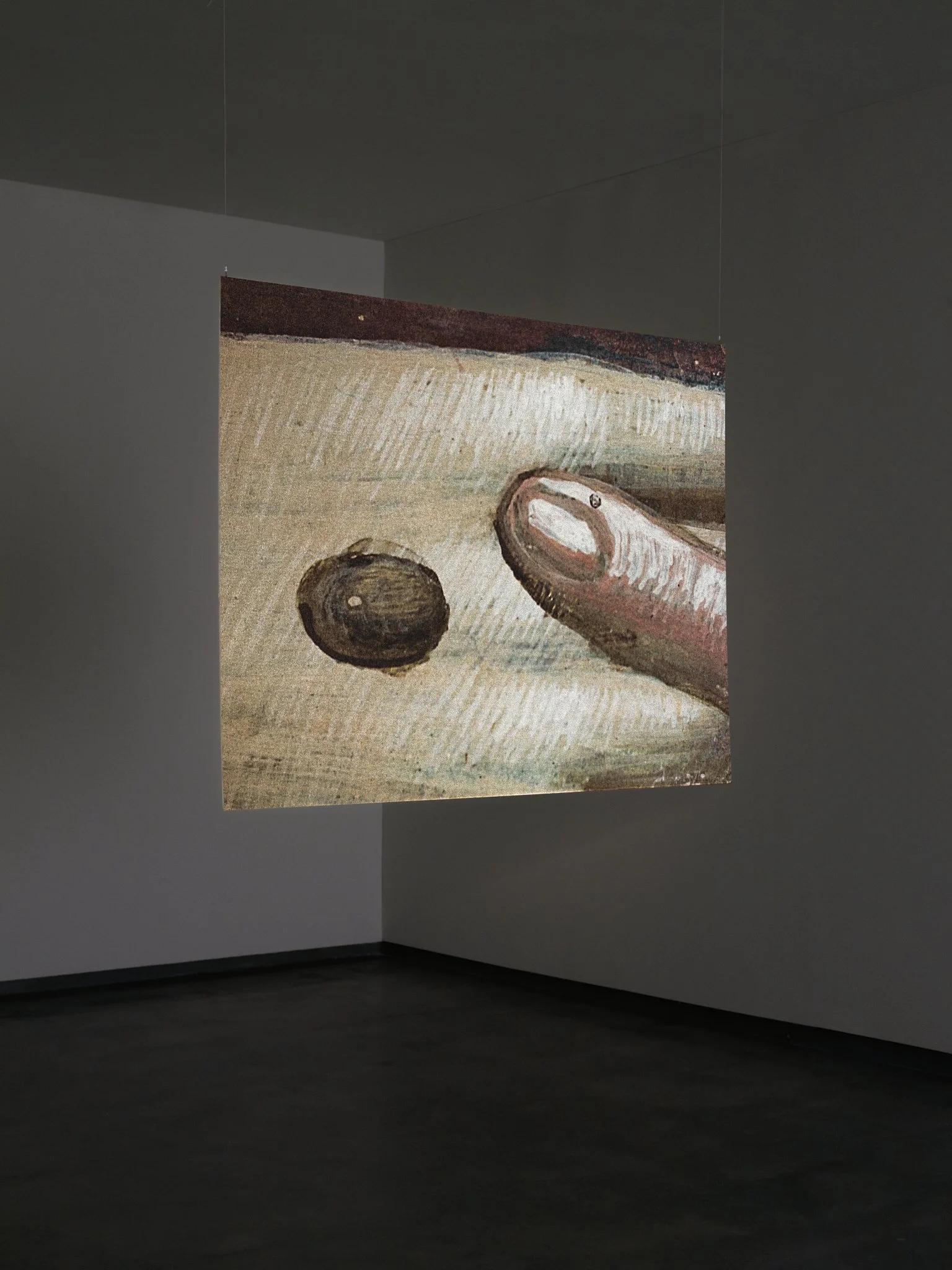
Tacita Dean. Buon Fresco. 16mm colour film; back projection, suspended screen; 33 min. Exhibition view, Tacita Dean, Museum of Contemporary Art Australia, MCA, Sydney, 2023-2024. Courtesy of the artist, Frith Street Gallery, London; Marian Goodman Gallery, New York / Paris/ Los Angeles. Photo credit: Hamish McIntosh.
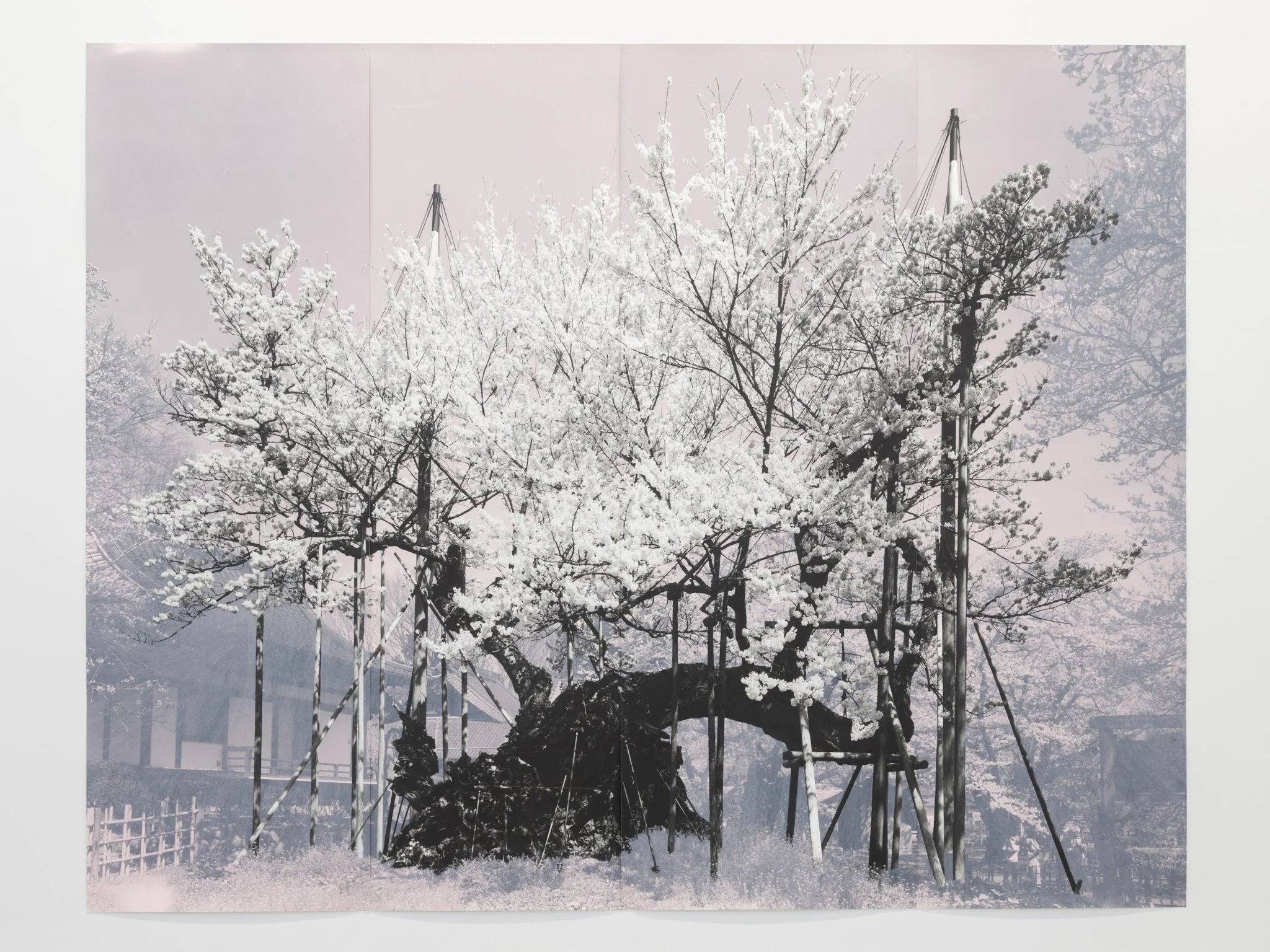
Tacita Dean. Sakura (Jindai II), 2023. Colored pencil on hand-printed Forma matte silver gelatin photograph mounted on paper. 115 3/4 x 146 1/2 in. (294 x 372 cm). Courtesy of the artist, Frith Street Gallery, London; Marian Goodman Gallery, New York / Paris/ Los Angeles. Photo credit: Hamish McIntosh.