‘HARRY FONSECA: PORTRAIT OF THE ARTIST AS A YOUNG COYOTE’ AT THE PACIFIC DESIGN CENTER: QUEERNESS, INDIGENOUS SURVIVAL, AND THE STAKES OF PAINTING IN AMERICAN ART HISTORY
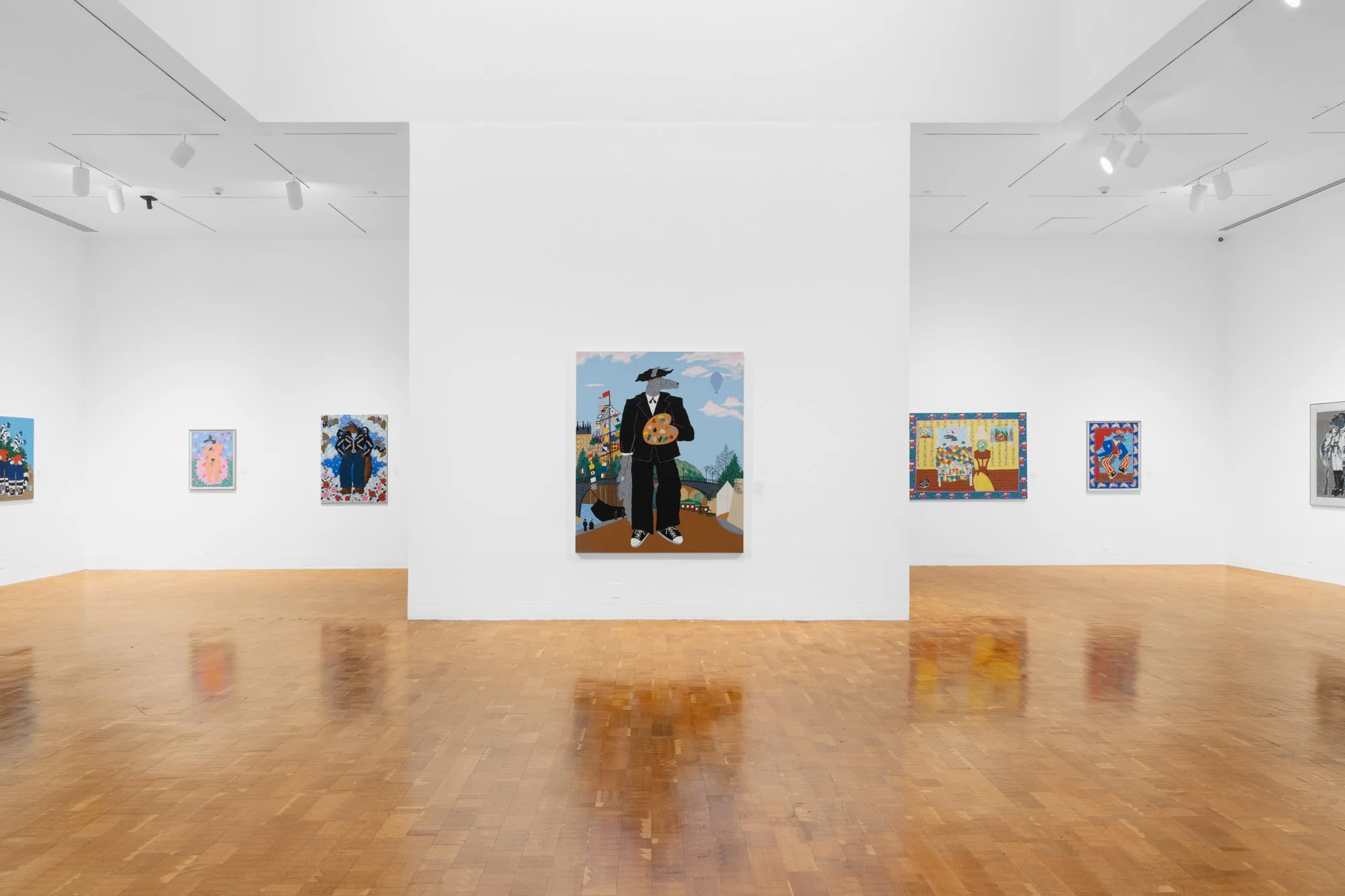
Installation image of Harry Fonseca: Portrait of the Artist as a Young Coyote. PDC Design Galleries, West Hollywood, CA. Courtesy of the Harry Fonseca Trust and Babst Gallery. Photography by Benjamin Turner.
At the Pacific Design Center in West Hollywood, Harry Fonseca: Portrait of the Artist as a Young Coyote presents a body of work that insists on being read beyond painting, even as it remains bound to it. Presented by Babst Gallery, Los Angeles, The exhibition stages a confrontation between narrative urgency and formal restraint, between a history that demands visibility and a medium that does not always fully carry its weight. What emerges is not a failure but a productive tension that exposes the limits of art-historical frameworks themselves.
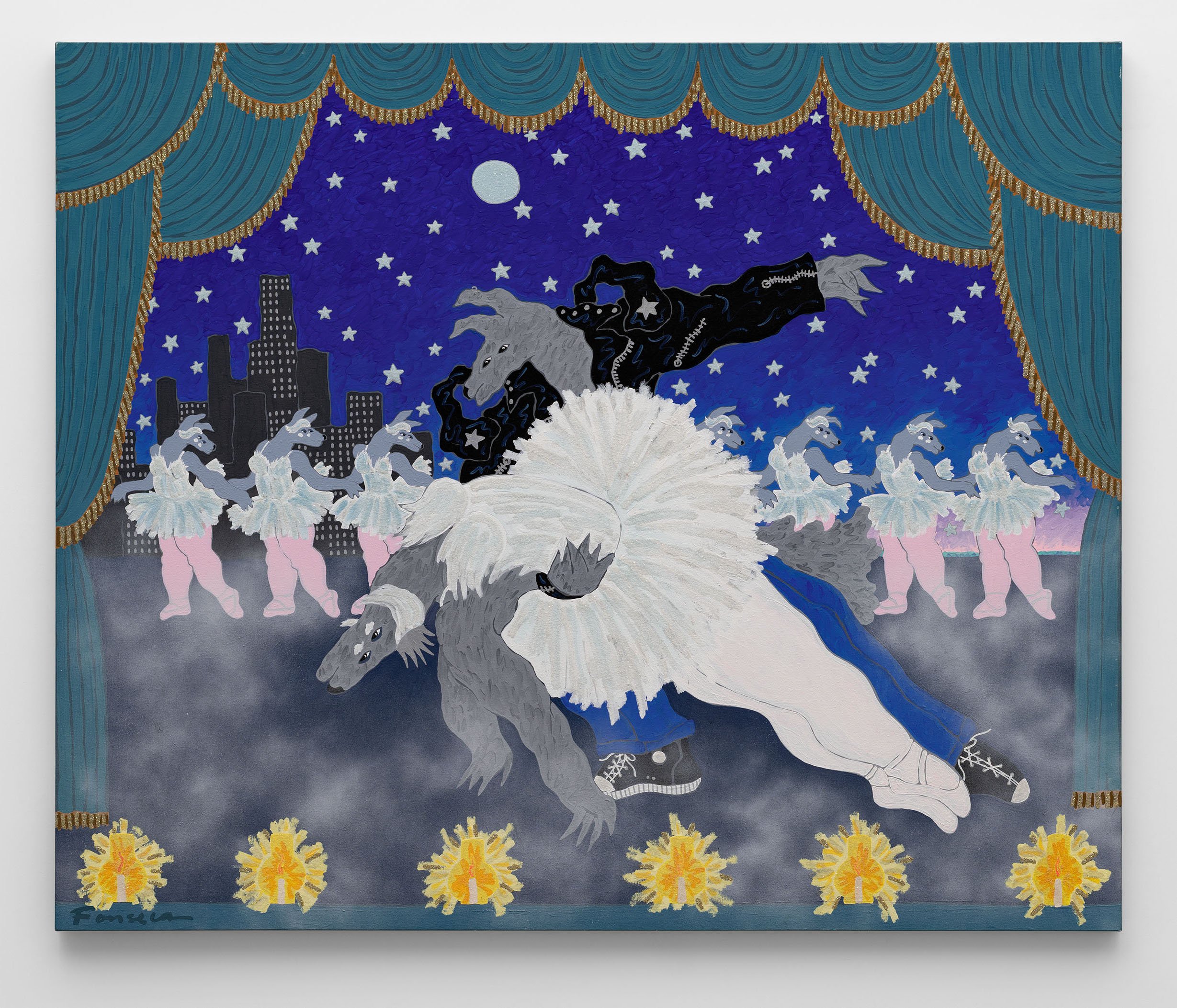
Harry Fonseca, Swan Dive Swan Lake Act II, 1984, Acrylic on canvas with glitter, 60 x 72 inches. Courtesy of the Harry Fonseca Trust and Babst Gallery. Photography by Benjamin Turner.
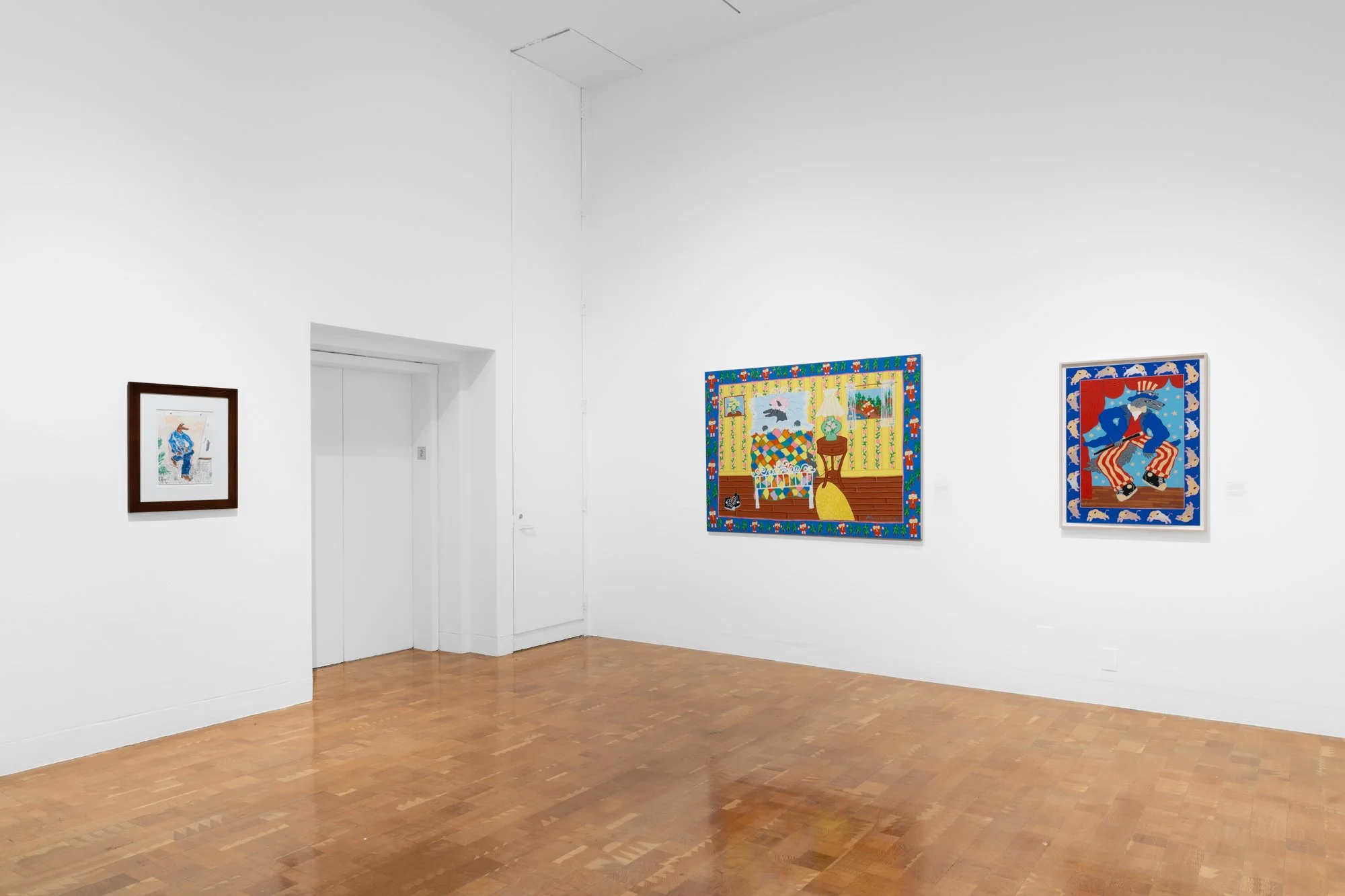
Installation image of Harry Fonseca: Portrait of the Artist as a Young Coyote. PDC Design Galleries, West Hollywood, CA. Courtesy of the Harry Fonseca Trust and Babst Gallery. Photography by Benjamin Turner.
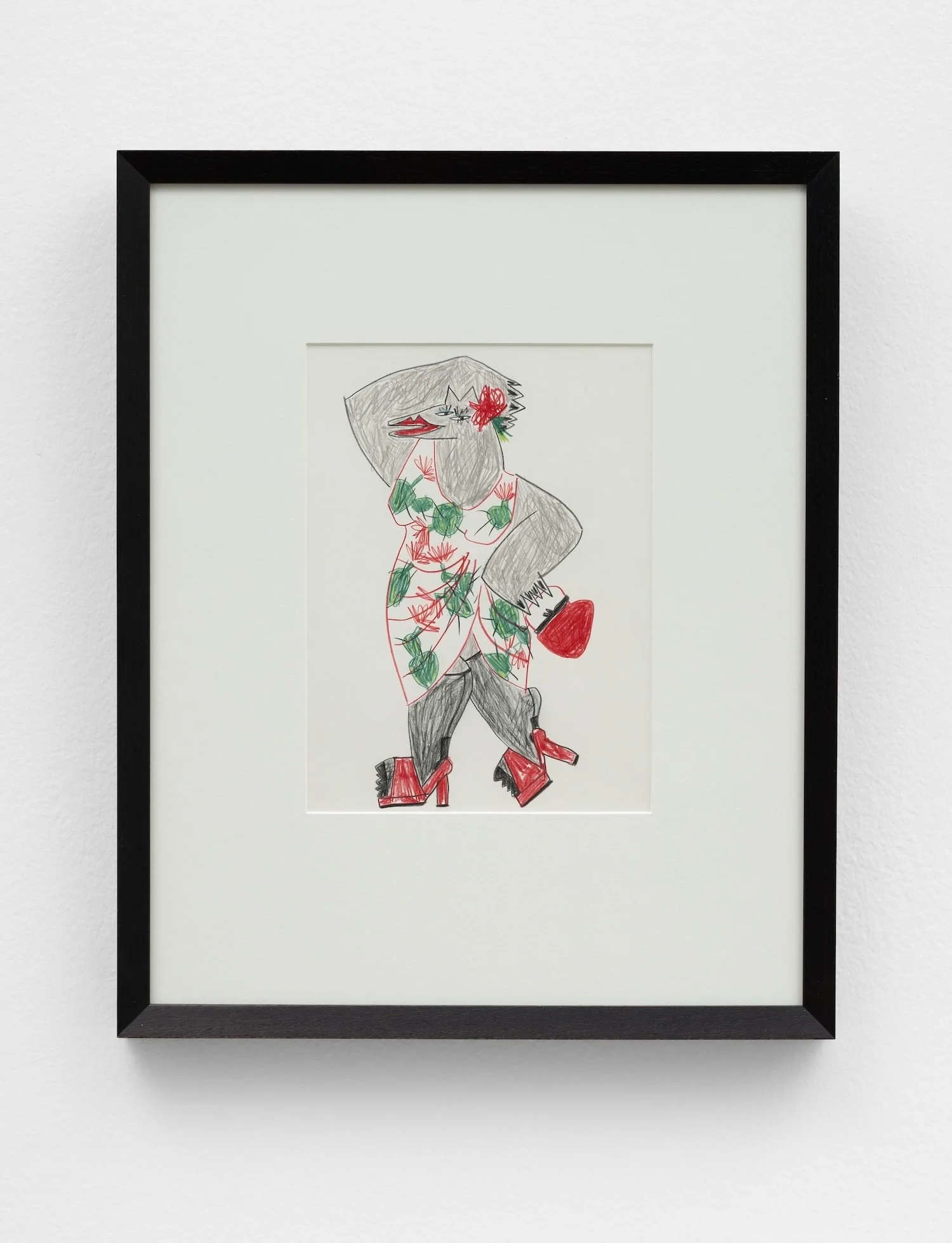
Harry Fonseca, Rose, 1976, Conte crayon on paper, 14 × 11 inches, 1957. Courtesy of the Harry Fonseca Trust and Babst Gallery. Photography by Benjamin Turner.
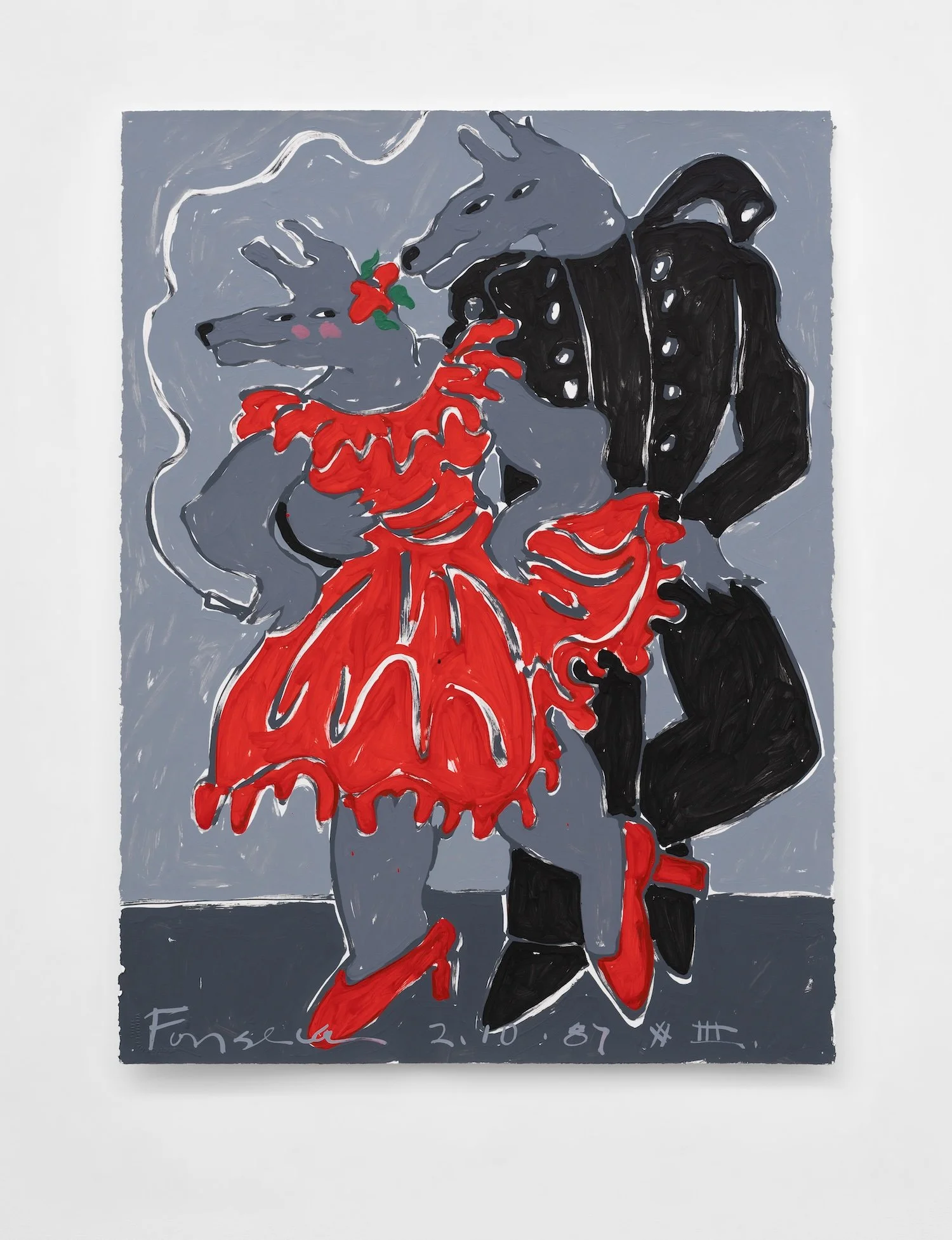
Harry Fonseca, Carmen 1st Act 2.10.87 # III, 1987, Acrylic on paper 30 × 22 inches, 1917. Courtesy of the Harry Fonseca Trust and Babst Gallery. Photography by Benjamin Turner.
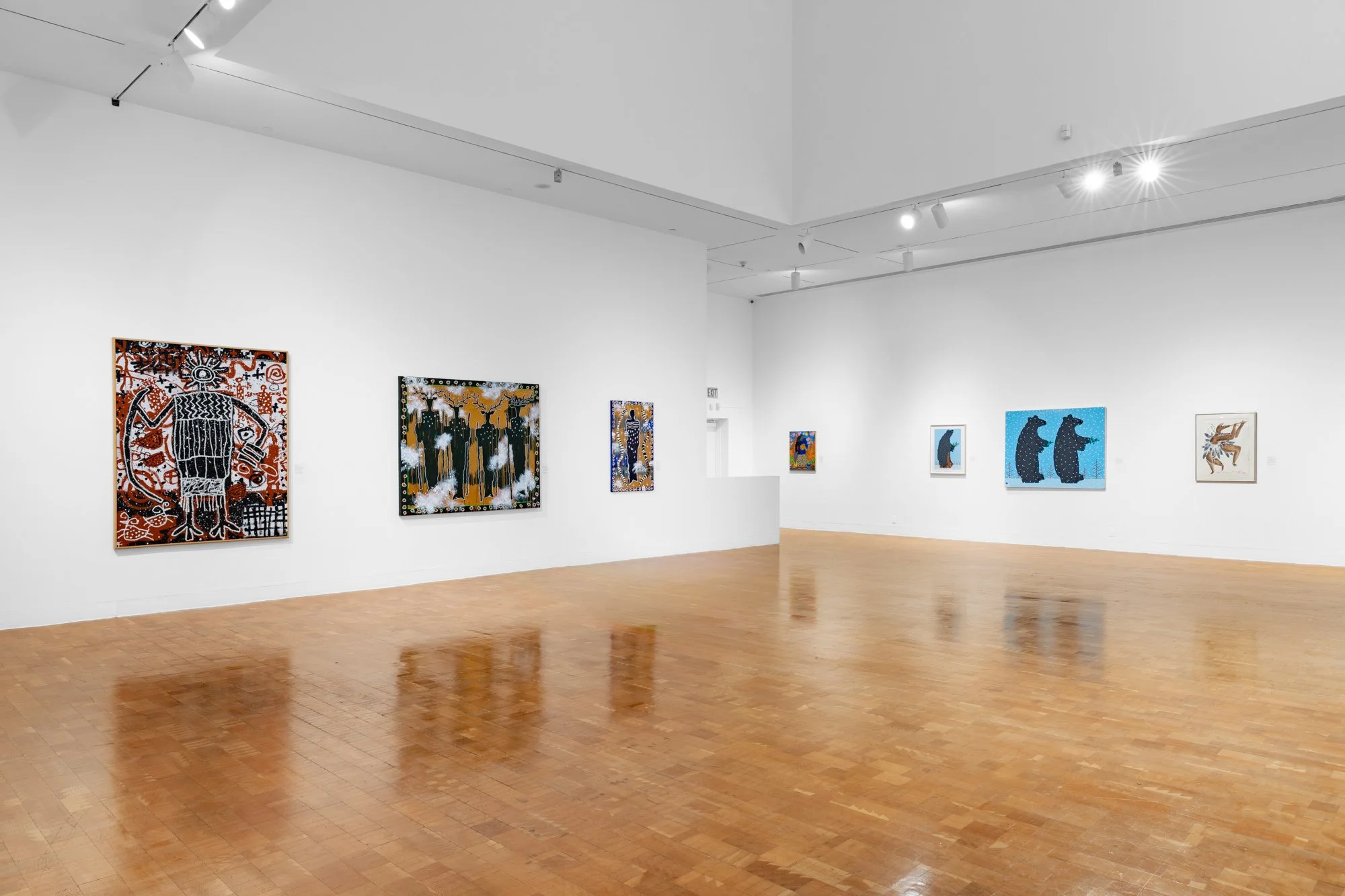
Installation image of Harry Fonseca: Portrait of the Artist as a Young Coyote. PDC Design Galleries, West Hollywood, CA. Courtesy of the Harry Fonseca Trust and Babst Gallery. Photography by Benjamin Turner.
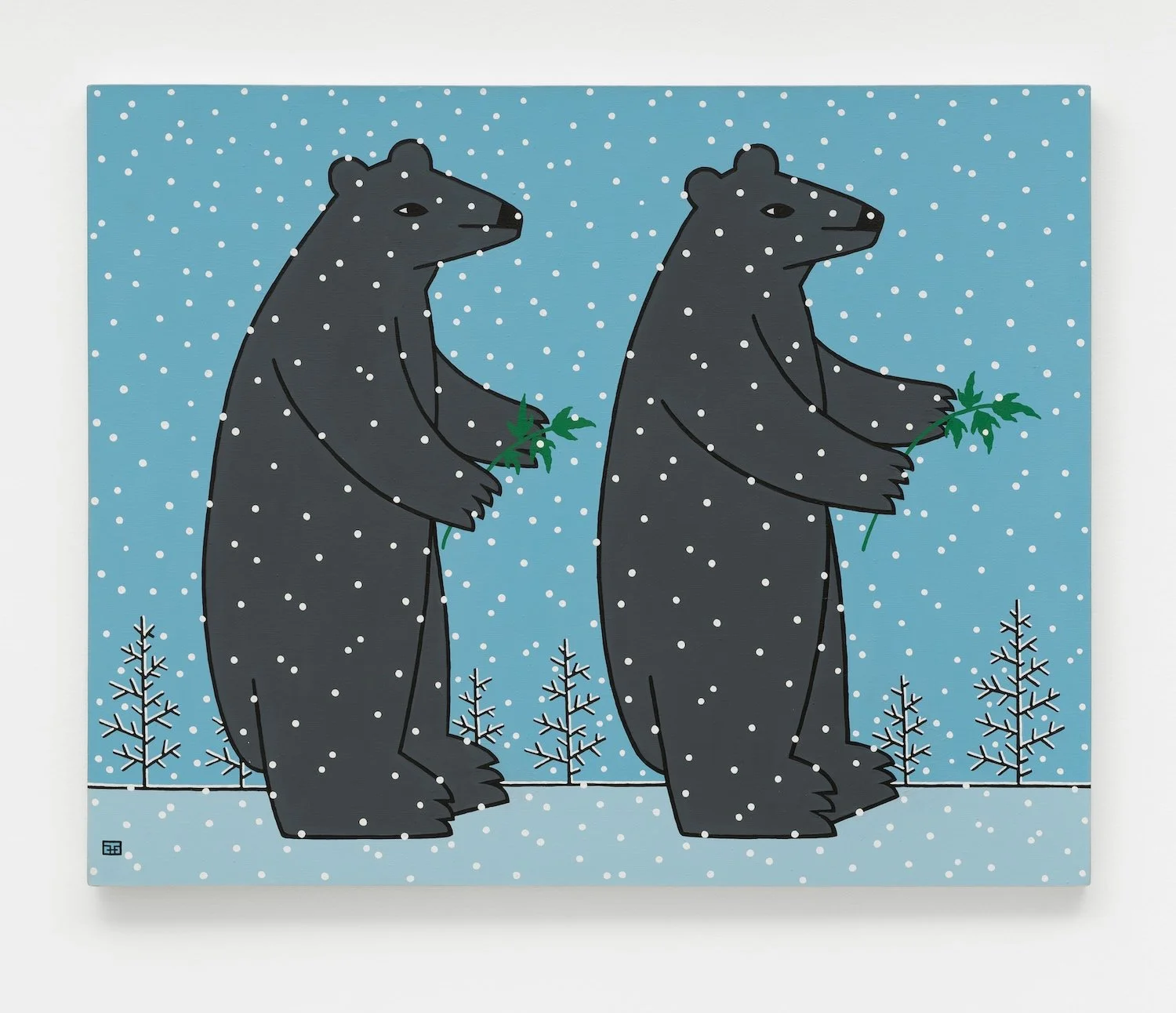
Harry Fonseca, Bear Dancers, 1984, Acrylic on canvas. 48 × 60 inches. Courtesy of the Harry Fonseca Trust and Babst Gallery. Photography by Benjamin Turner.
Fonseca’s practice must first be situated within the longer history of appropriation that structures American art, a history in which Indigenous figures have been repeatedly mobilized as symbolic devices within narratives that exclude them as subjects. From the late eighteenth through the nineteenth century, Euro-American painters developed a visual language that positioned Indigenous presence as allegory rather than lived reality. In Benjamin West’s The Death of General Wolfe(1770), a fictionalized Native figure appears in a contemplative pose derived from classical sculpture, functioning as an emblem of the “New World” rather than as a participant in the historical event itself. This logic persists in the landscape tradition, where artists such as Thomas Cole embed small Indigenous figures within expansive environments, as in The Clove, Catskills (1826), where the figure operates as a marker of a pre-industrial past already imagined as disappearing. By the mid-nineteenth century, this symbolic reduction becomes more explicit: George Catlin’s Wi-jún-jon, Pigeon’s Egg Head Going To and Returning From Washington (1837) stages Indigenous identity as spectacle for a white audience, while Albert Bierstadt’s The Rocky Mountains, Lander’s Peak (1863) situates Indigenous life within an idealized wilderness constructed in the studio, reinforcing the fiction of a vanishing frontier. This trajectory culminates in James Earle Fraser’s End of the Trail (1918), where the slumped figure of a Native rider consolidates the “vanishing race” narrative into a singular and widely reproduced image of exhaustion and defeat.
Fonseca’s work operates as a direct refusal of this visual and ideological framework. Rather than positioning Indigenous figures as symbols of disappearance, he insists on their presence within contemporary life, collapsing the temporal distance that earlier artists worked to construct. His Coyote is not a passive marker within a landscape or a nostalgic trace of a lost world, but an active protagonist who moves between histories, geographies, and identities. Where West and Cole render Indigenous figures as silent witnesses, and Catlin and Bierstadt translate them into consumable imagery for white audiences, Fonseca reclaims authorship by inserting his figure into both Indigenous narrative structures and the Western canon itself. In doing so, he disrupts the foundational premise of American art history that Indigenous culture belongs to the past. Coyote does not signify disappearance. Coyote signifies continuity, adaptation, and survival, refusing the conditions that once rendered Indigenous presence as something to be observed rather than something that speaks.
In California, this visual language intersects with the mission system and the romanticization of colonial ruin. Painters such as Edwin Deakin rendered missions as picturesque sites populated by stylized Indigenous figures who functioned primarily as atmosphere. Works like American Indian Assistant to a Mass of the Dead position, Indigenous presence within imposed religious frameworks that erase spiritual autonomy. Later painters such as Grace Hudson, including The Seed Conjurer (1896), offered images that appeared empathetic yet reinforced the narrative of disappearance. In Nevada, my home state, Maynard Dixon’s Paiute Man (1929) anonymizes its subject within the landscape, while his use of the Thunderbird as a personal emblem reflects a broader pattern of appropriating Indigenous symbolism for artistic identity.
Fonseca’s work emerges directly against this lineage.
Beginning in the mid 1970s, he develops Coyote from Maidu oral tradition into a contemporary alter ego. In early works such as Gift from California (1979) and California Bear Dance (1979), the compositions are frontal, symmetrical, and governed by repetition. Figures are flattened into pattern, their bodies integrated into geometric systems that resonate with both Indigenous design and modernist abstraction. These works establish a visual language that is clear and controlled, though already constrained by a reliance on surface resolution.
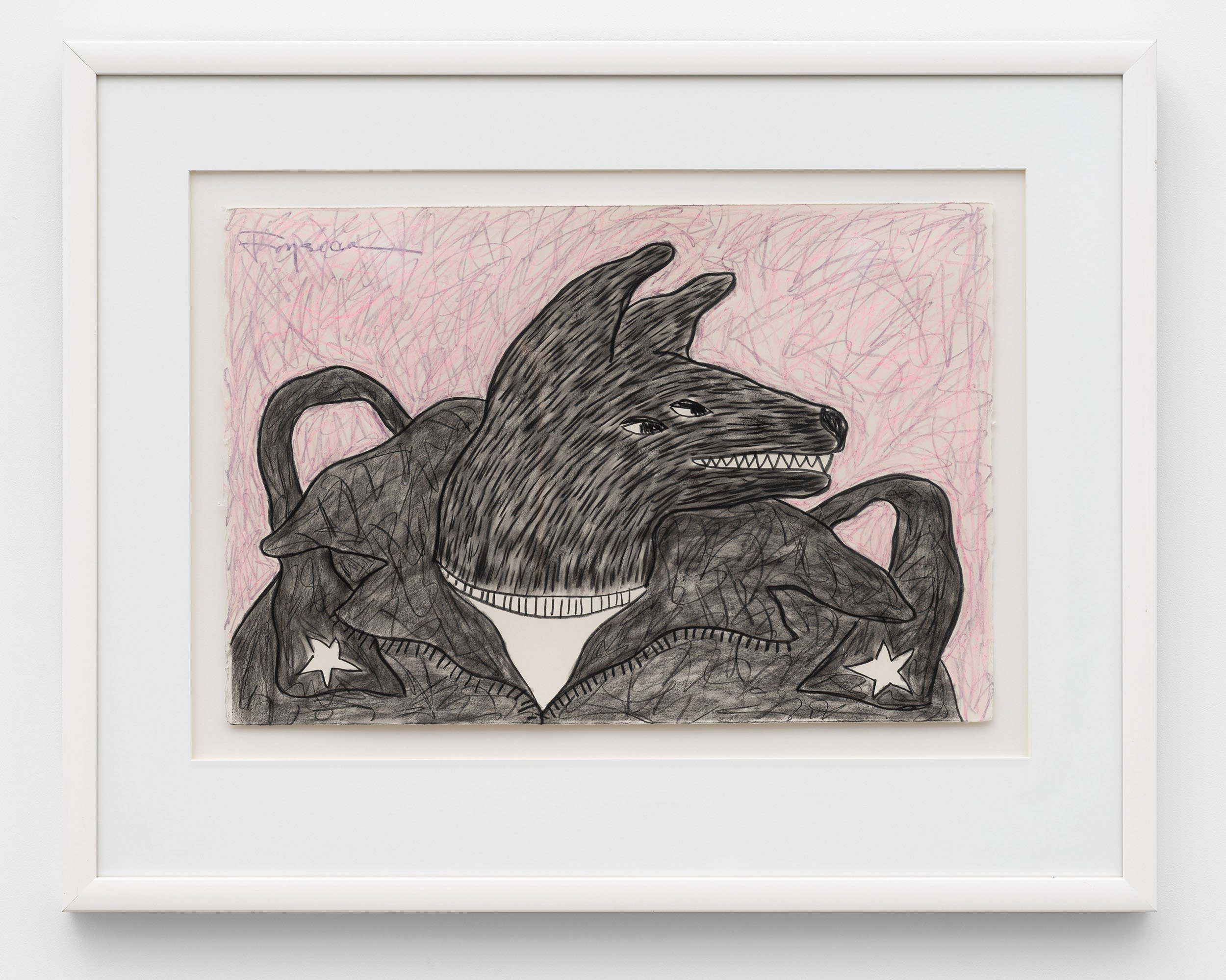
Harry Fonseca, Portrait of Coyote, 1981, Conte crayon on paper, 15 1/4 x 22 1/12 inches unframed; 25 1/2 x 32 ¼ inches, framed. Courtesy of the Harry Fonseca Trust and Babst Gallery. Photography by Benjamin Turner.
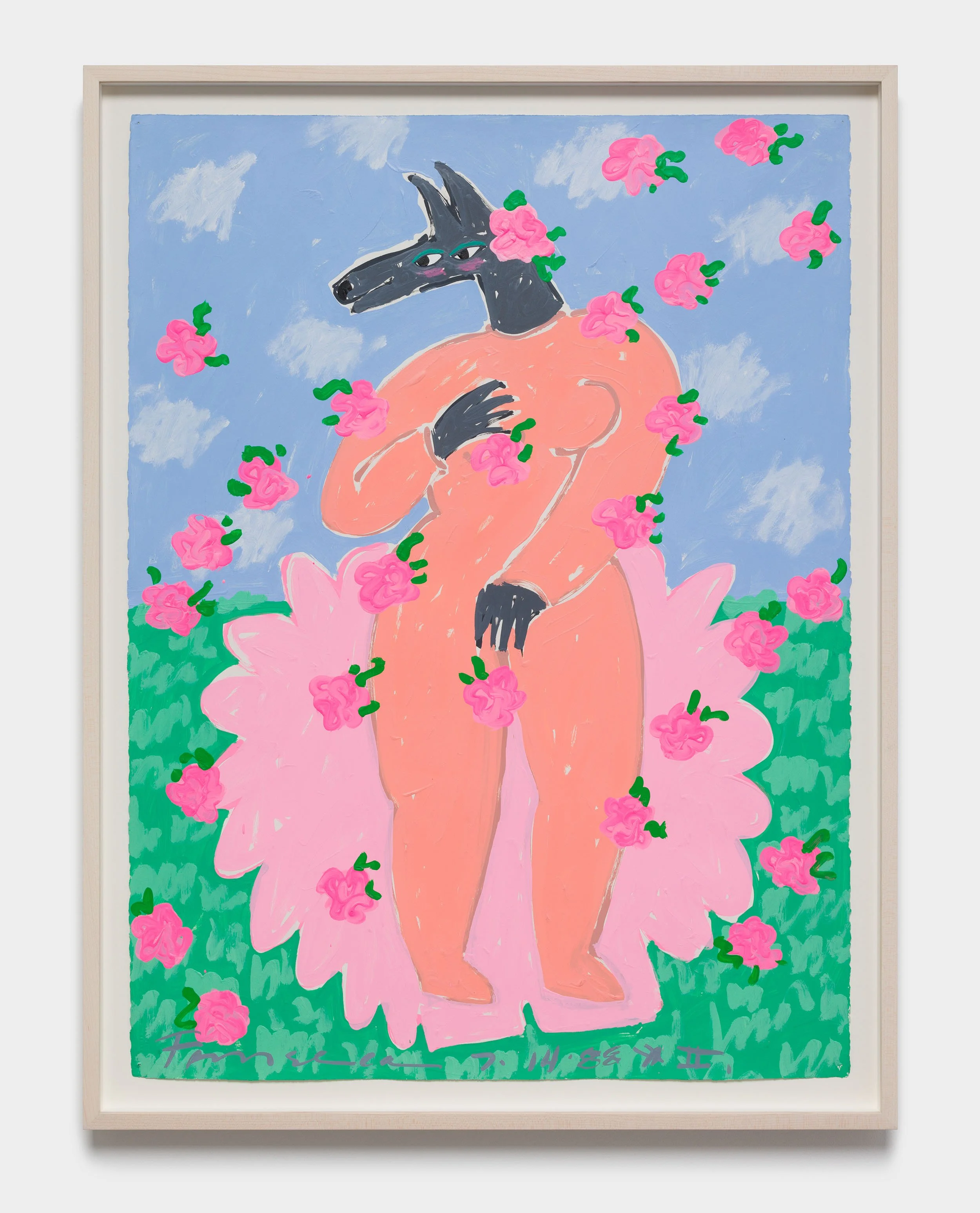
Harry Fonseca, Rose on the Half Shell III, 1988, Acrylic on paper, framed, 33 x 25 1/4 inches, framed. Courtesy of the Harry Fonseca Trust and Babst Gallery. Photography by Benjamin Turner.
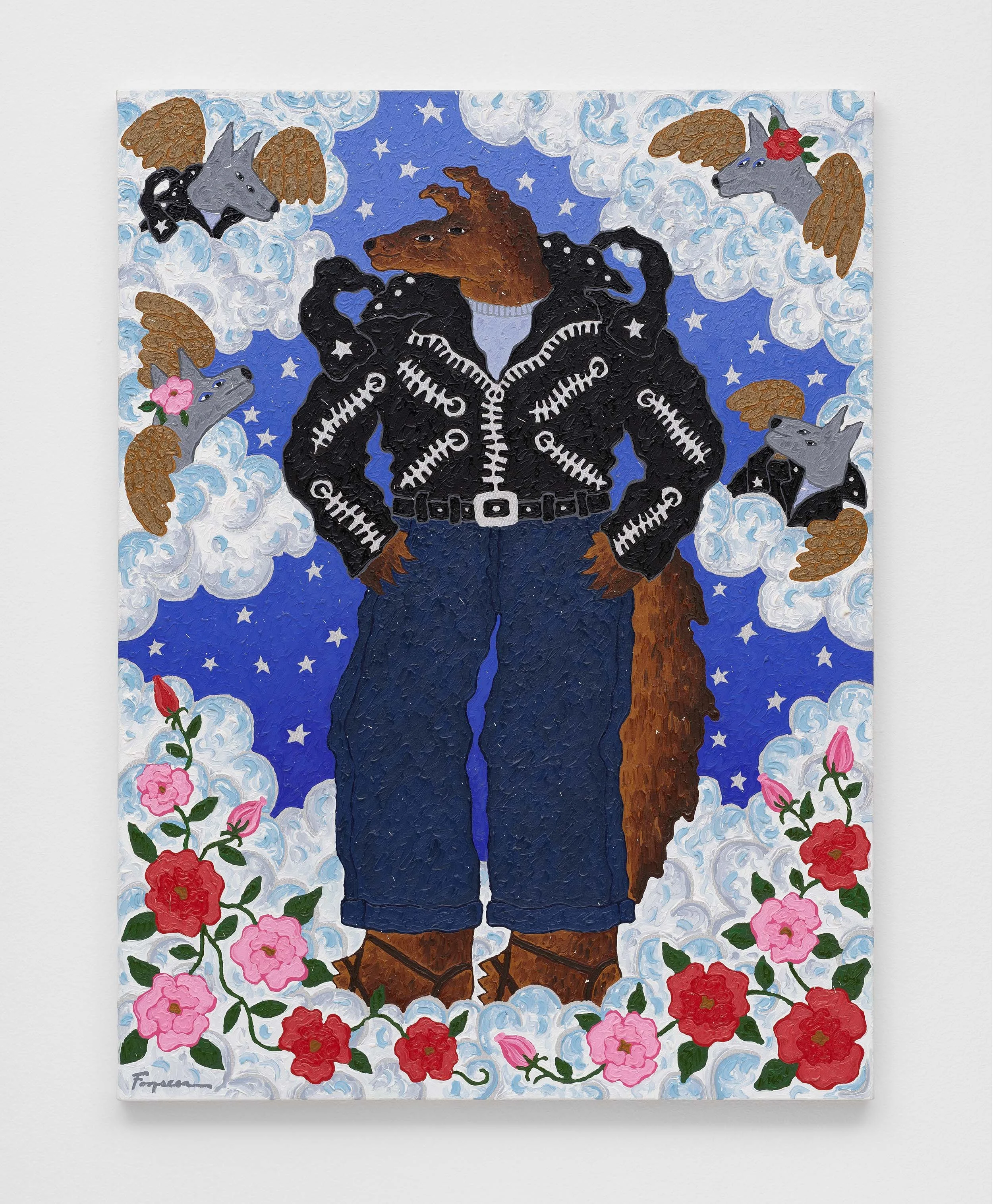
Harry Fonseca, Saint Coyote, 1988, Acrylic on canvas, 48 x 36 inches. Courtesy of the Harry Fonseca Trust and Babst Gallery. Photography by Benjamin Turner.
The introduction of Coyote marks a decisive shift in Fonseca’s practice, transforming the figure from a cultural reference into a site of confrontation. In When Coyote Leaves the Res (1979), Coyote appears in a leather jacket, chains, and denim, positioned against a brick wall with the posture of a subcultural icon, drawing directly from the visual codes of postwar leather culture and the underground networks of queer gay men shaped by artists such as Tom of Finland, whose drawings established a language of coded visibility, erotic autonomy, and self-determined identity. This visual language emerged in the 1940s and 1950s across cities such as Los Angeles, New York, and Chicago, where queer veterans and bikers reclaimed hyper-masculine aesthetics, influenced in part by figures like Marlon Brando in The Wild One (1953) and James Dean in Rebel Without a Cause (1955), transforming leather jackets, boots, and denim into a coded system of sexuality, power, and resistance. Shaped by motorcycle clubs such as the Satyrs, founded in Los Angeles in 1954, and early institutions like the Gold Coast in Chicago, opened in 1958 by Chuck Renslow and Dom Orejudos, this subculture developed a distinct aesthetic and social structure grounded in mentorship, chosen kinship, and the unapologetic performance of masculinity.
Fonseca’s Coyote enters this language but refuses to be contained by it. The figure does not simply adopt a style; it reclaims and redirects a visual system historically tied to white masculine fantasy toward an Indigenous subjectivity that has long been denied agency within both art history and broader cultural narratives. As a gay Native artist, Fonseca mobilizes Coyote as an alter ego through which queerness and Indigeneity are not reconciled but held in productive tension, producing a figure that resists both ethnographic containment and assimilation into dominant queer iconographies. This gesture finds a later resonance in artists such as Catherine Opie, whose Portraits series in the 1990s documented queer leather communities in Los Angeles and San Francisco with the compositional gravity of Old Master painting. Opie’s works such as Self-Portrait/Cutting (1993) and Self-Portrait/Pervert (1994), in which vulnerability and inscription function simultaneously as exposure and resistance, parallel Fonseca’s practice in their reliance on forms of coded legibility intended to be deciphered most fully within their respective communities. Where Indigenous figures in American art have been repeatedly positioned as passive, vanishing, or subordinated, Fonseca’s Coyote stands upright, self-possessed, and insistently contemporary, refusing the historical imposition of silence or submission. The work operates not only as representation but as defiance, asserting presence where absence has been constructed and reclaiming visibility on terms that remain fluid, performative, and unapologetically unresolved.
In Coyote Woman (1979), the performative dimension of Fonseca’s work becomes unmistakable. The figure appears in high heels, its body flattened into patterned surface, posed with a theatrical exaggeration that reads as both stylization and stance, entering the space of drag and aligning with a lineage of artistic alter egos that includes Marcel Duchamp’s Rrose Sélavy, Claude Cahun’s staged self-portraits, and Jean Cocteau’s fluid movement between persona and myth. This logic is articulated in Lex Morgan Lancaster’s book Dragging Away, where identity is understood not as fixed but as something enacted, displaced, and continually reassembled through gesture and image. Fonseca’s use of alter ego, however, is distinct in its grounding within Indigenous narrative structures, where Coyote already exists as a shapeshifter. Rather than inventing fluidity, Fonseca activates it, bringing that condition into a contemporary space where queerness and Indigeneity are not reconciled but held in tension. This becomes especially clear in Rose on the Half Shell III (1988), which recalls Sandro Botticelli’s The Birth of Venus (1484–1486) while refusing its idealized body, presenting instead a stylized figure whose contours and decorative surroundings emphasize artifice over naturalism, shifting the image from beauty to construction. Read through a trans lens, the work moves beyond parody into inhabitation, where identity becomes something projected, negotiated, and contingent on the viewer, a condition that recalls artists such as Greer Lankton. Fonseca extends this strategy through theatrical and staged imagery in works like Swan Dive Swan Lake Act II (1984), drawing on the history of ballet shaped by Pyotr Ilyich Tchaikovsky, where the body is disciplined into beauty and tragedy, and in Untitled Rousseau Revisited(1985), which references the imagined jungles of Henri Rousseau, constructed not from lived experience but from observation, fantasy, and projection. In both cases, Fonseca exposes how Western art has long staged worlds that feel natural but are deeply fabricated, and how those same mechanisms have been used to construct and contain Indigenous identity. By inserting Coyote into these environments, Fonseca turns painting into a site of performance where identity is neither stable nor resolved, but constantly moving across roles, histories, and expectations. Coyote does not settle into these structures. It moves through them, revealing how they were built in the first place.
Despite the conceptual clarity of these gestures, the paintings themselves remain formally restrained. Fonseca relies on flat planes of color, simplified figuration, and direct composition. The pictorial space resolves quickly, often at the surface, where figure and ground meet without sustained tension. Color organizes the image but rarely destabilizes it, and the surface does not accumulate enough pressure to fully carry the conceptual weight being placed upon it. The figures compress together not as a radical strategy, but often as a default condition. In works such as In the Silence of Dusk He Began to Shed His Skin With the Dawn He Would Never Be the Same (1995), the symbolic content is dense, yet the execution remains illustrative. The imagery communicates, but it does not resist.
This produces the central tension of the exhibition. Fonseca’s work is powerful as narrative, as intervention, as cultural assertion. It is less persuasive when evaluated according to the criteria of contemporary painting that prioritize material complexity and spatial tension. This is not only a limitation of the work. It is a limitation of the framework through which it is judged.
Fonseca, a Nisenan Maidu artist from Sacramento, works within a geography that is inseparable from the histories his paintings confront. His use of Coyote as a figure of survival, adaptation, and continuity emerges not as metaphor alone, but as a response to the conditions that have shaped Indigenous life in California and the Great Basin. Within this context, Coyote operates as a refusal of disappearance, asserting presence where Indigenous figures have historically been rendered as symbolic, passive, or already gone. Fonseca’s work aligns with a broader lineage of Indigenous artists, including Dat So La Lee, whose baskets carry the knowledge and continuity of Washoe culture, sustaining histories that have long existed outside the frameworks of mainstream art discourse. In this sense, Fonseca’s practice does not seek to restore what has been lost, but to insist on continuation, positioning Indigenous identity as active, adaptive, and ongoing.
The stakes of this framework extend beyond the work itself and into the land it inhabits, and this is something I understand through my own experience moving through California and Nevada as both a witness and a researcher of the region’s specific histories. In Nevada, where I am from, the Washoe Tribe, the original caretakers of Lake Tahoe and the greater Reno area, no longer hold land along the shoreline that once sustained their cultural and environmental systems. In California’s Central Valley, the transformation is equally profound. What was once Tulare Lake, the largest freshwater lake west of the Mississippi River, has been drained and converted into agricultural land, obscuring both ecological systems and Indigenous histories. Yet the lake continues to reemerge through cyclical flooding, revealing a landscape that resists complete control and recalls what has been altered. The productivity of this land, sustained in part by the labor of Latinx workers, overlays a deeper Indigenous presence that remains largely unacknowledged.
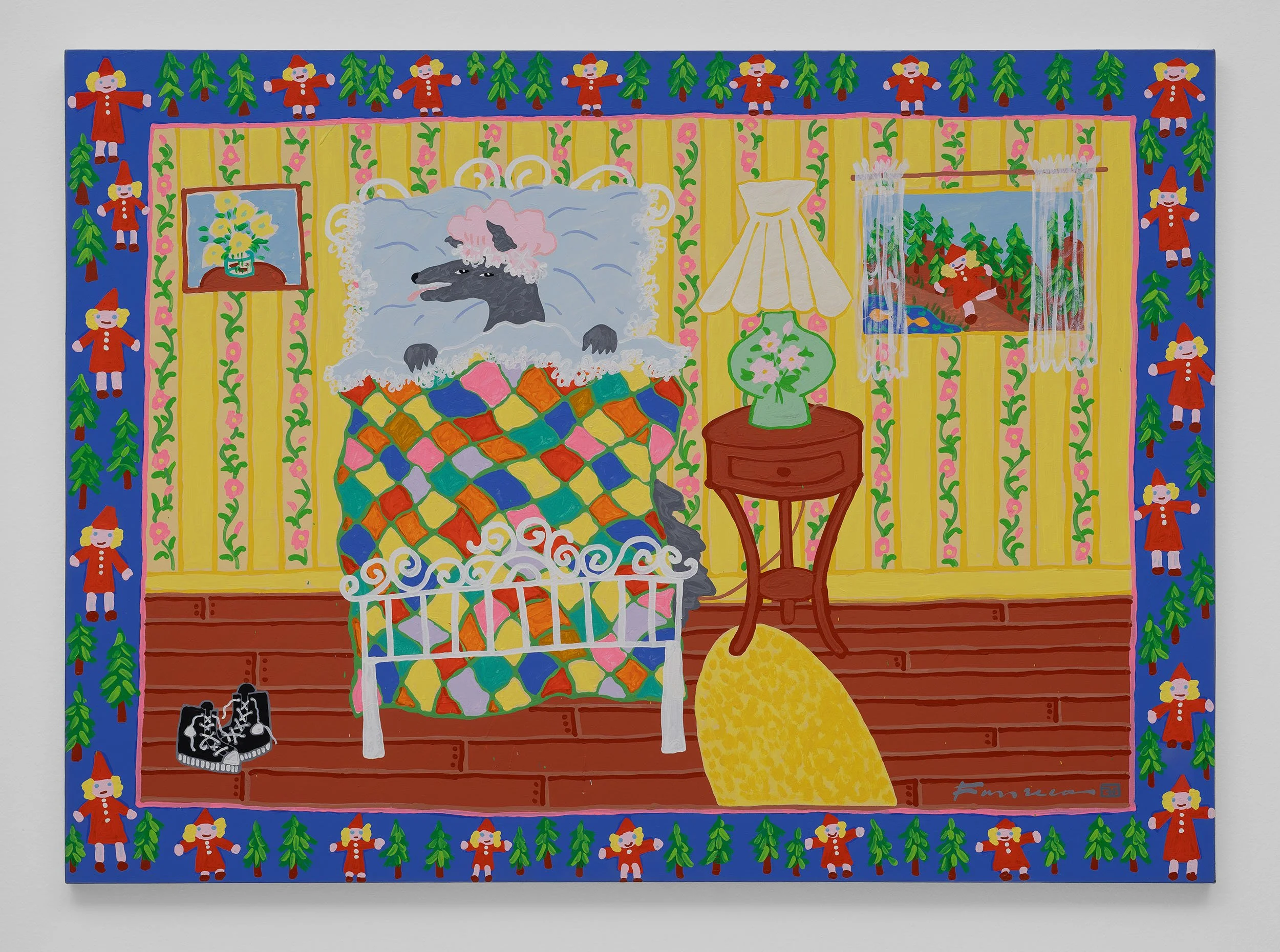
Harry Fonseca, Once Upon a Time, 1985, Acrylic on canvas, 47 1/2 x 65 1/2 inches. Courtesy of the Harry Fonseca Trust and Babst Gallery. Photography by Benjamin Turner.
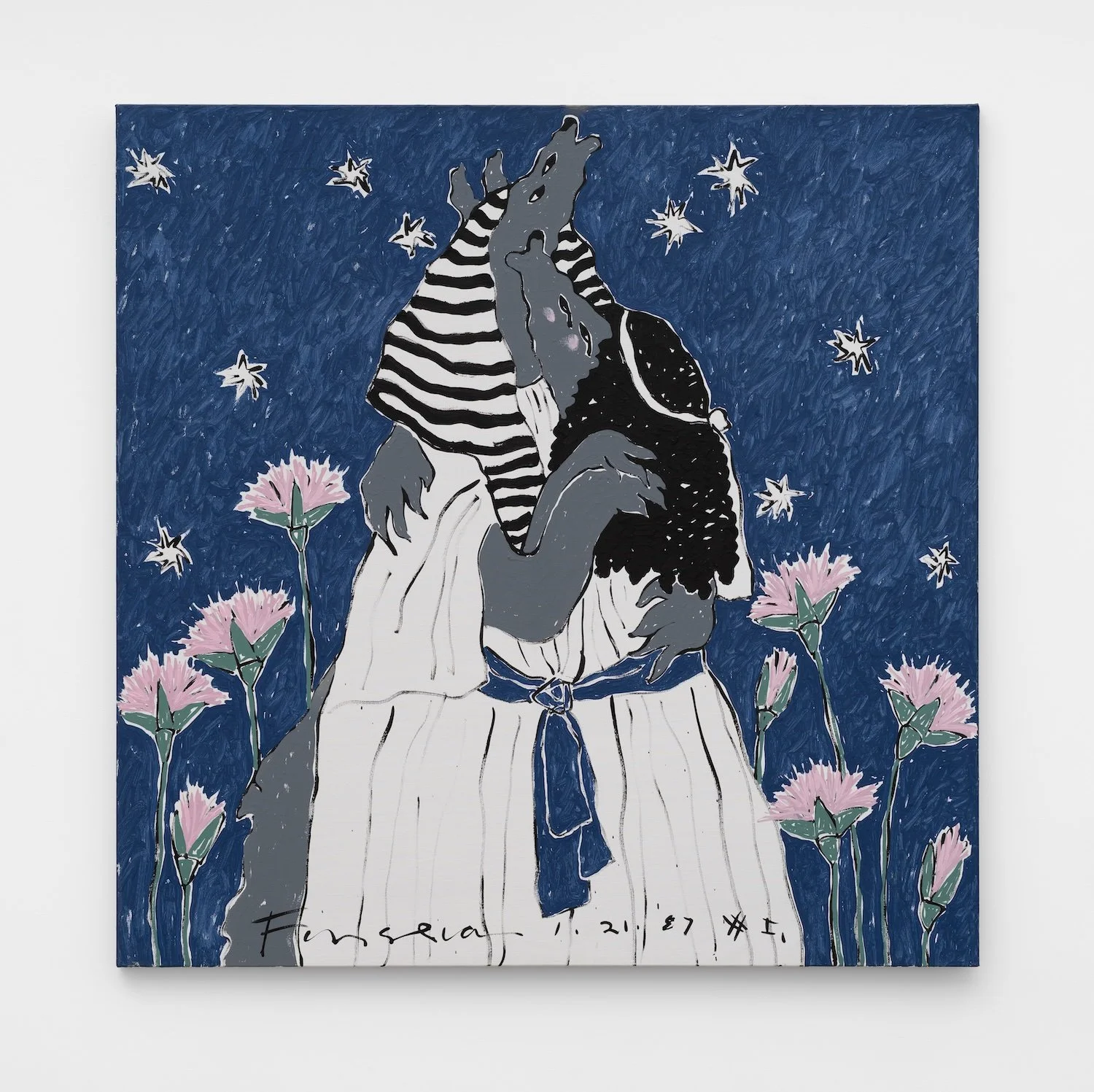
Harry Fonseca, Aida Last Act 1.21.87 #I, 1987, Acrylic on canvas, 36 × 36 inches. Courtesy of the Harry Fonseca Trust and Babst Gallery. Photography by Benjamin Turner.
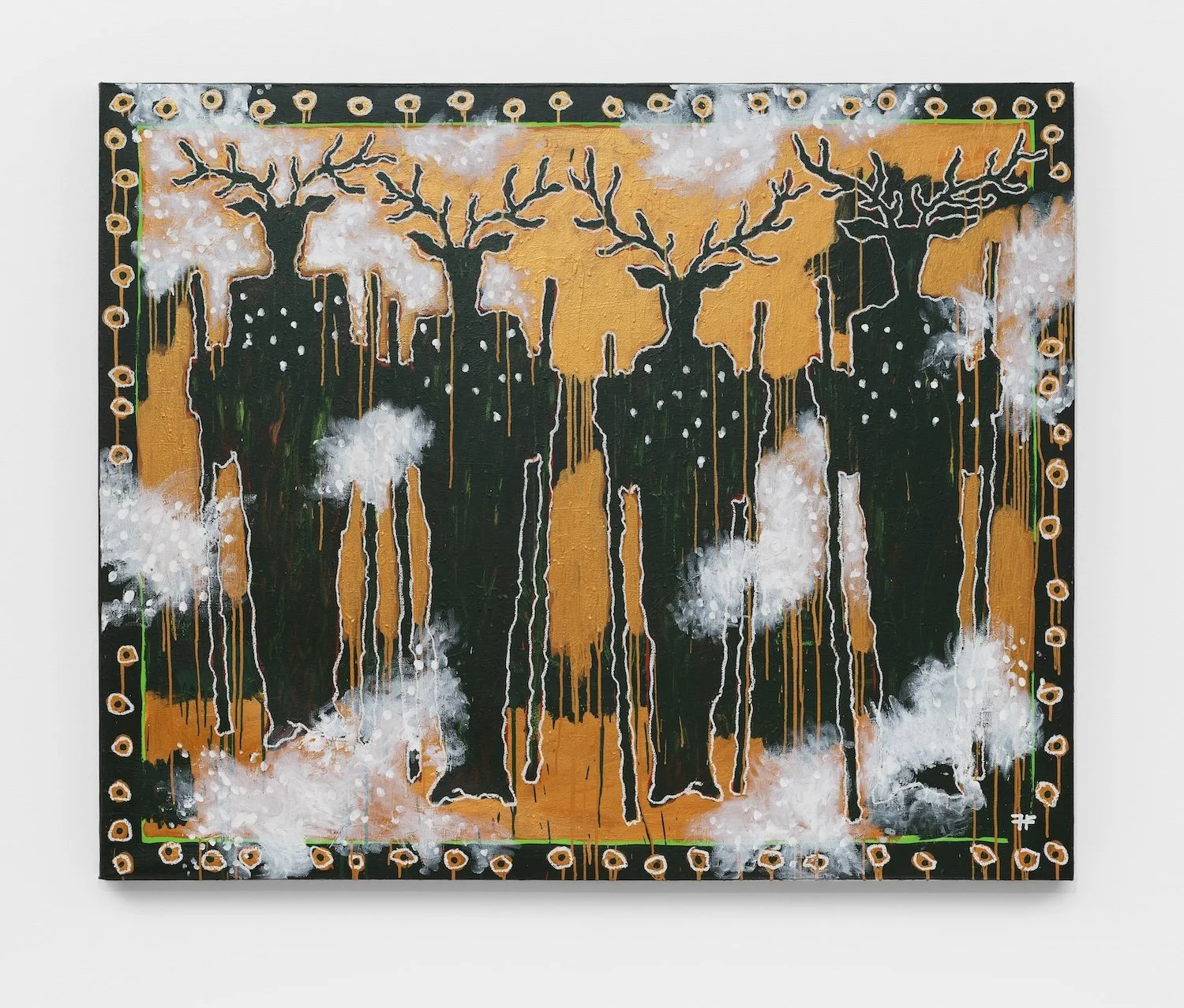
Harry Fonseca, Dialogue with Deer, 1996, Acrylic on canvas, 60 × 72 inches. Courtesy of the Harry Fonseca Trust and Babst Gallery. Photography by Benjamin Turner.
This condition is not only encountered through the land itself, but through the ways it has been documented, classified, and institutionalized. At The Huntington Library, Art Museum, and Botanical Gardens, the exhibition brings these histories into sharp focus through works such as Sandy Rodriguez’s Rodriguez-Mondragón’s Federal Indian Boarding Schools Map of the United States and Child Migrant Detention Centers (2022–26), which draws upon historical maps, federal reports, and personal field study to trace ongoing cycles of colonial violence across the United States. By juxtaposing the locations of Indigenous boarding schools with contemporary migrant detention centers, Rodriguez collapses time, revealing how systems of forced removal, assimilation, and displacement persist across generations. Nearby, nineteenth-century cartographic works such as Map of the United States of America… (J. H. Colton & Co., 1860) present the expansion of American territory through a language of neutrality that masks the violence of shifting borders. The designation of lands as “uninhabited” or “desert” erases the presence of Indigenous communities, transforming inhabited and culturally rich territories into blank spaces available for occupation. Similarly, documents such as William H. Emory’s Report on the United States and Mexican Boundary Survey (1857–59) reveal how scientific and governmental narratives were mobilized to legitimize territorial control following the Treaty of Guadalupe Hidalgo. Read together, these works expose the mechanisms through which land is not only taken, but rewritten, its histories reframed through systems of measurement, mapping, and classification that continue to shape how it is understood today. In this context, Fonseca’s Coyote operates as a form of counter-mapping, moving across and against these imposed systems, reasserting presence within landscapes that have been repeatedly redrawn to erase it.
What unfolds across California and Nevada is not isolated, but part of a broader national pattern of erasure that becomes visible in sites such as the Cahokia Mounds. Having passed the site while traveling between Petoskey, Michigan, where I have family, and Dallas, Texas, it has remained a point of personal fascination, not only for its scale, but for its resemblance to other monumental Indigenous architectures across the Americas, from earthen mounds to the cliff dwellings of Mesa Verde National Park. These structures, often compared to pyramidal forms, mark sophisticated systems of knowledge, governance, and cosmology, yet their survival into the present often feels less like preservation and more like accident. Once the largest pre-Columbian urban center north of Mexico, Cahokia was home to a complex Mississippian society that constructed over one hundred earthen mounds, forming a monumental civic and ceremonial landscape. By the mid-fourteenth century, environmental pressures and social upheaval led to the city’s decline, leaving behind a vast but vulnerable terrain. What followed was not disappearance, but destruction. Throughout the nineteenth and early twentieth centuries, as nearby urban and suburban expansion intensified, many of these mounds were leveled for agriculture, road construction, and commercial development. The second-largest mound at the site, Powell Mound, was entirely destroyed in 1930 to make way for a parking lot, its contents removed without preservation, its structure reduced to fill. In this sense, Cahokia becomes not only an archaeological site, but a record of erasure, where the physical destruction of the mounds parallels a broader history of physical, emotional, and spiritual genocide enacted across Indigenous communities in the United States. What remains today is monumental yet incomplete, a fragment that points as much to what has been lost as to what endures.
For many Indigenous communities, the preservation of history has never depended solely on physical structures, but on oral traditions that carry memory across generations, sustaining relationships to land even when the land itself has been altered. Within this framework, loss is not only material but narrative, and it is here that Fonseca’s work becomes especially resonant. A citizen of the Shingle Springs Band of Miwok Indians, he draws from cultural knowledge systems that persist despite systemic erasure, translating them into a visual language that moves between Indigenous storytelling and Western forms. His Coyote, already a shapeshifter within Maidu cosmology, operates as a kind of living archive, carrying memory across time, space, and cultural systems. It holds not only Indigenous narrative, but also the accumulated imagery of Western art, queer identity, and popular culture, navigating the impositions placed upon it while refusing to be fixed by them. In this sense, Coyote preserves what has been displaced, moving through histories that have been fragmented, and reasserting presence within systems that have sought to diminish it.
What has been lost cannot be restored. Sacred sites have been altered. Burial grounds have been erased. The histories embedded in these places cannot be reversed. Yet what remains possible is not repair, but refusal. Refusal of further erasure, refusal of silence, refusal of a historical narrative that positions Indigenous presence as past tense. Fonseca’s work operates within that refusal, not because it resolves the conditions it addresses, but because it continues to move through them. Coyote does not return to repair the past. Coyote returns because nothing has ended.
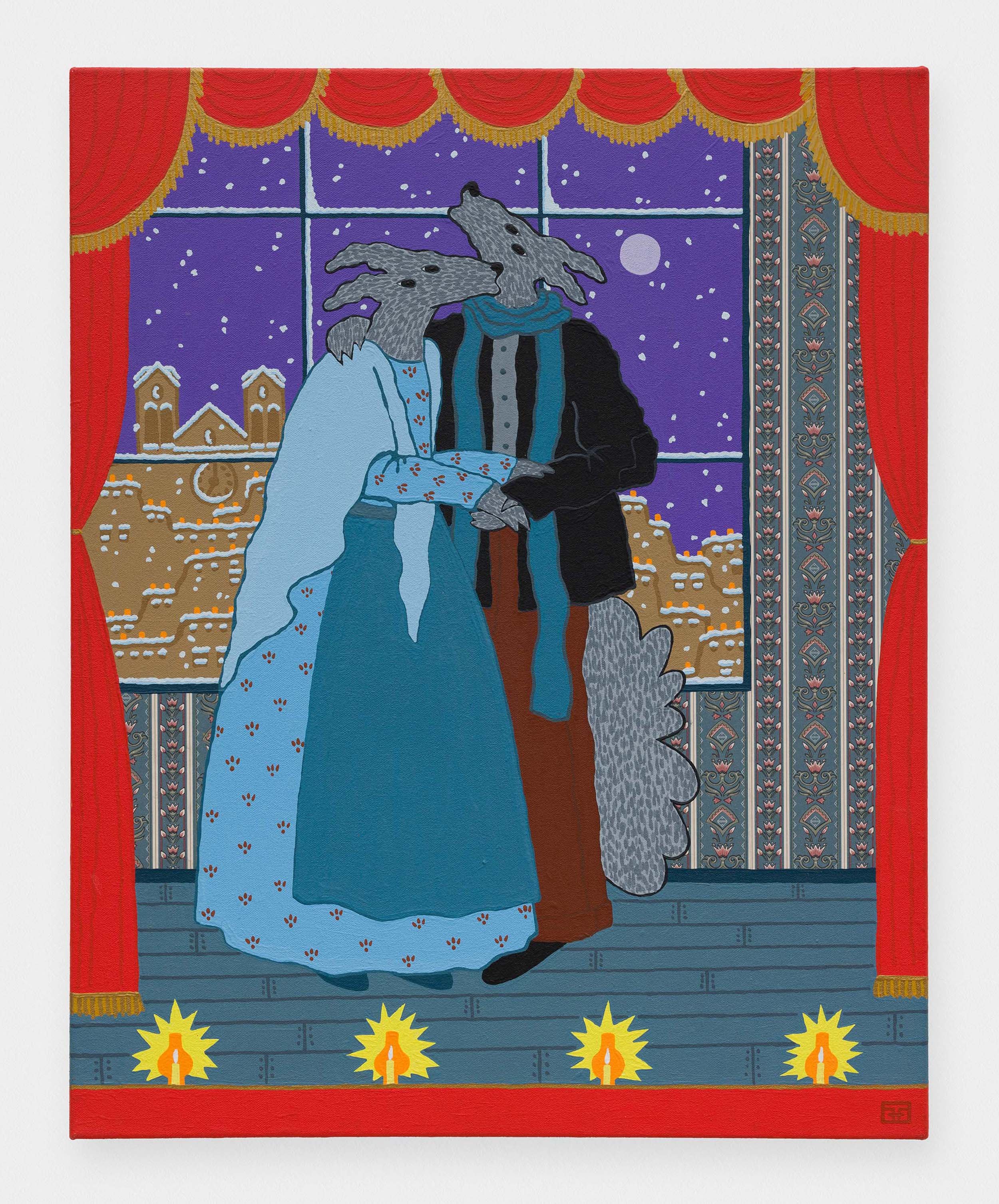
Harry Fonseca, Mimi & Rodolfo #III (La Boheme, Act I), 1993, Mixed media on canvas, 30 x 24 inches. Courtesy of the Harry Fonseca Trust and Babst Gallery. Photography by Benjamin Turner.
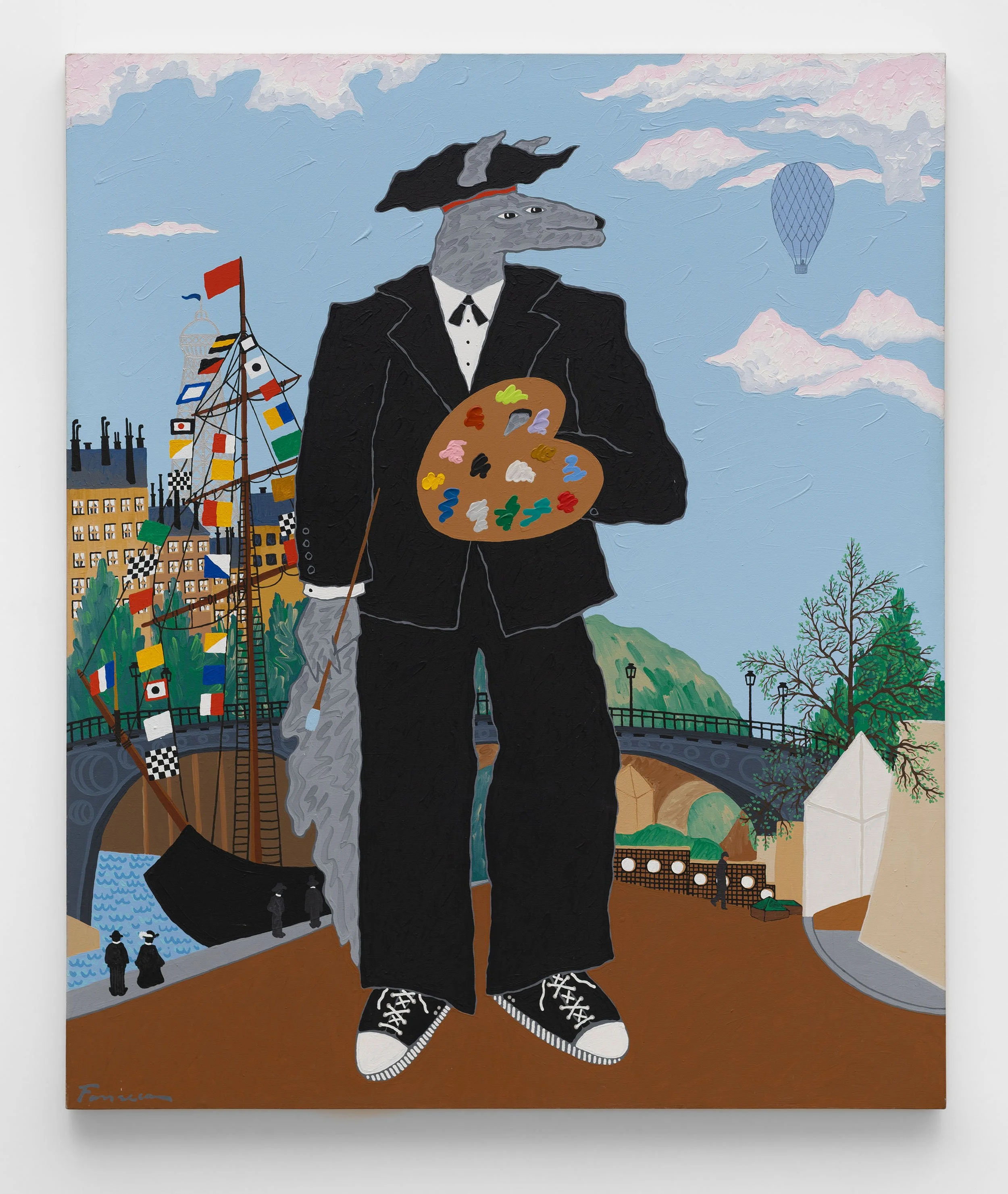
Harry Fonseca, Untitled--Rousseau Revisited, 1985, Acrylic on canvas, 72 x 60 inches. Courtesy of the Harry Fonseca Trust and Babst Gallery. Photography by Benjamin Turner.
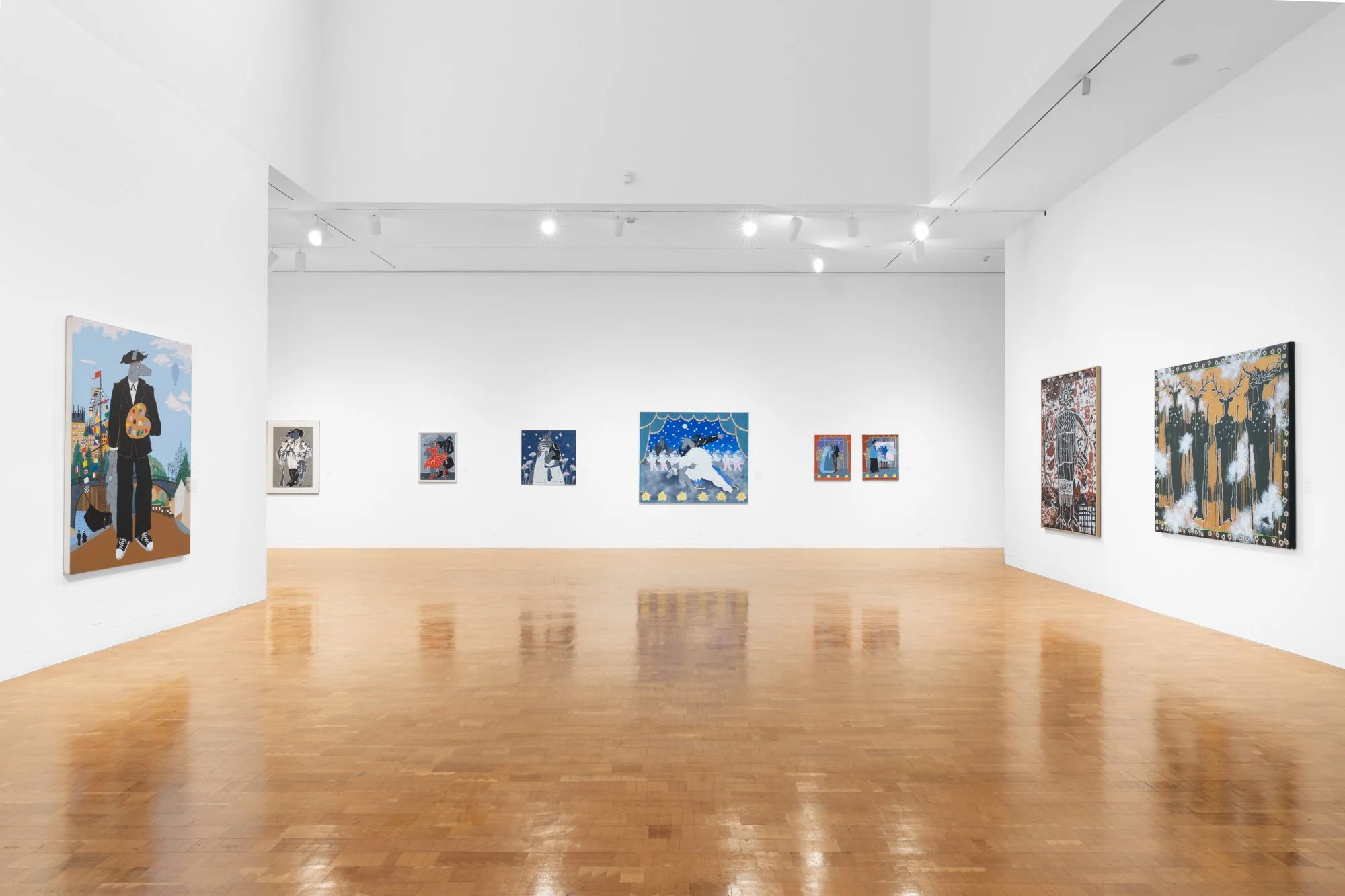
Installation image of Harry Fonseca: Portrait of the Artist as a Young Coyote. PDC Design Galleries, West Hollywood, CA. Courtesy of the Harry Fonseca Trust and Babst Gallery. Photography by Benjamin Turner.