AMADOUR: THREE YEARS OF “WESTERN MOVIE DREAM”: NEVADA, FIRST LOVE, FIRST MYTH, FIRST RETURN
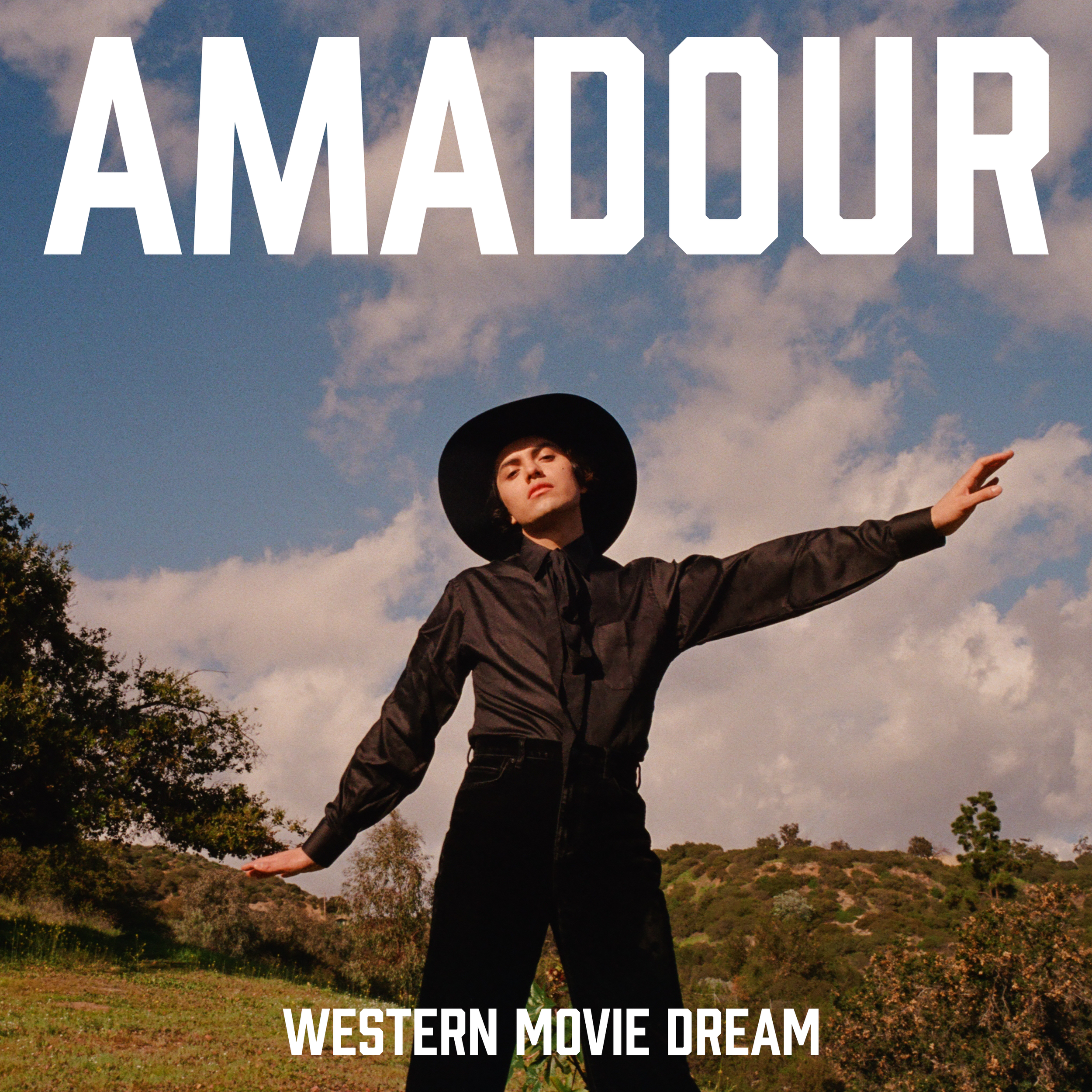
Western Movie Dream (2023) EP cover art. Photography by Justin Reissman
Three years is long enough for a song to stop behaving like a diary and begin functioning as a document. When I made Western Movie Dream, I believed I was writing about love. About first love. About the kind of longing that rearranges time, where a single afternoon expands until it feels like an era. But distance clarifies structure. What I made was not only a record of feeling. It was a first world. A first proof-of-life of my voice. And, without realizing it, the earliest architecture of my return to Nevada, before I understood that return would become central to everything I do. Sometimes the first true work is not about what happened. It is about who you were becoming while it happened.
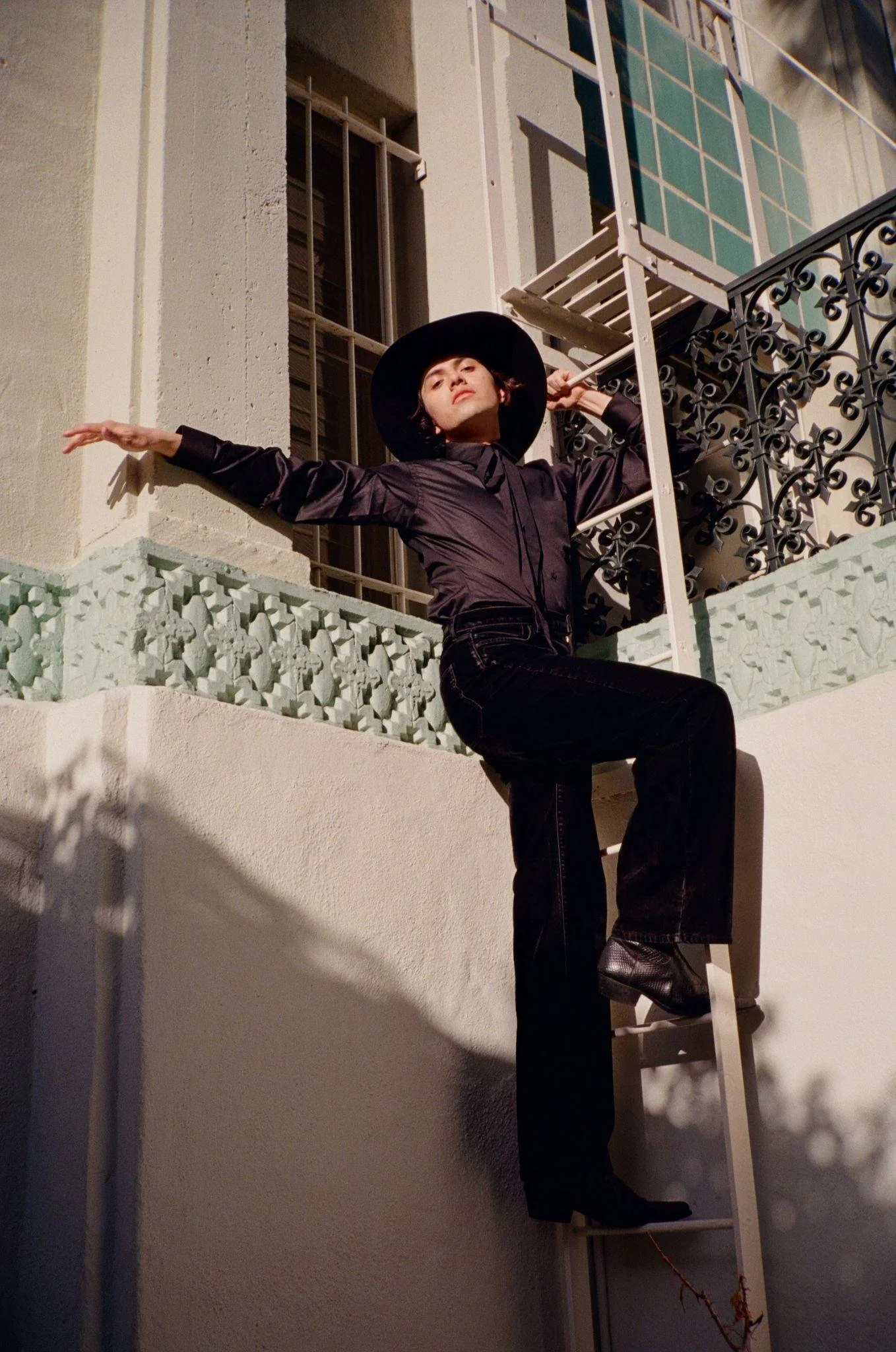
Amadour perched on the Los Feliz Manor building in Los Angeles. Photography by Justin Reissman.
THE TITLE AS THESIS
The title was never ornamental. It was precise.
in my western movie dream.
A private cinema running parallel to reality.
Un film intérieur. Una película que no termina.
I remember walking along the River Thames, along Riverside Park in New York, along the Seine, projecting a life forward.
The air carried a soft metallic blue, like twilight reflected on glass. Footsteps echoed in a slow rhythm, almost percussive, almost like a heartbeat learning its tempo. Somewhere in the distance, a train. Somewhere closer, laughter that did not belong to me.
Love, at its most convincing, edits the future in real time.
Comme si le temps acceptait d’être réécrit.
Small domestic scenes. A hand resting on a table. A glass of water left half-finished. The sound of keys turning in a door that opens to something shared.
Nothing extravagant.
Everything illuminated from within.
And because I am an artist, I have never experienced love in isolation. My mind locates it inside a longer lineage, where devotion, image, and memory collapse into one another.
Jean Cocteau and Jean Marais, where desire becomes authorship, where the beloved becomes both subject and mirror.
Coco Chanel and Boy Capel shaped my understanding early on. In my late teens, I returned to her life again and again, memorizing the architecture of her love story, how devotion and ambition could coexist, how absence could become permanence.
Helmut Newton and Alice Springs revealed something else to me. When I was in Melbourne, standing inside their studio, I felt how two lives could generate a single gaze.
In Venice, love dissolves into atmosphere. Stone, water, echo. I hear Dalida singing “Gondolier” as I move along the Grand Canal, through the Arsenale, through the Biennale. Lovers accumulate there, encounters that feel singular and endless at once. Dalida follows me across my life, her music a time capsule of my memories. I listen to “Aime-moi” and “Il venait d’avoir dix-huit ans” on repeat.
Etel Adnan shaped how I understand landscape, her love for Simone Fattal is that of literature meets art meets the lonely docks of Sausalito. Walking on the ridges of Adnan’s greatest love, Mount Tamalpais, I feel inside a painting, a soft, suspended world that floats between reality and a drift into a film.
And alongside all of it, something closer.
My grandmother, Lourdes, in Roma Sur in the 1950s, before immigrating to the United States. That Mexico City amber light saturating the skyline of a newly opened Torre Latinoamerica, the air warm with music drifting through open windows, forty years before I was born.
She loved a Swiss businessman named Rudy.
Quietly. Across time. Across borders.
Not myth.
Inheritance.
When nothing is taken for granted, love becomes exact.
“WESTERN MOVIE DREAM”: THE ORIGIN
The title track holds the origin in its most exposed form.
Reno. A body in space. Another body near it. The distance between them collapsing and expanding at the same time.
Lake Tahoe appears briefly in the song.
But what mattered was time.
There is a line.
“We layed down in a yellow paint-brushed meadow.”
It was not a meadow.
It was a small park near a golf course in Reno. The grass uneven, the green slightly artificial. A stream nearby, catching light in fragments.
We spent hours there.
At one point, I was lifted, carried across what I believed was a bridge, my body suspended, the world briefly tilted, everything held in that single gesture.
Years later, I returned.
There was no bridge.
And that absence did not undo the memory.
It revealed it.
The emotion had been so large
it built its own architecture.
I wrote the song later, far from Nevada.
In Des Moines, where I had traveled to curate an exhibition on displacement.
I was in a basement. A room of vintage pianos.
I sat down and began.
And I didn’t stop.
I wrote it in one sitting, in tears.
At the end of the song, I say:
“Night falls in my hotel, and I think of you.”
I was staying at the Surety Hotel.
A large bed. White sheets. A clean robe.
And inside, nothing was resolved.
I knew it was ending.
It was a mess.
“TWO HANDS HOLDING ME”: A PRIVATE ATMOSPHERE
Before the EP had form, there was a single atmosphere.
“Two Hands Holding Me.”
I wrote it in Sausalito, inside a Presbyterian church that feels like both sanctuary and studio. A place where sound arrives without pressure. Where silence does not need to be filled.
I grew up with this architecture, pews, hymns, repetition. At Star of the Sea Church, I would sit beside the Virgin of Guadalupe and let devotion become simple again. No performance. No explanation. Just a rosary.
Just presence.
That day, after writing, I took the ferry across the bay. The Golden Gate Bridge appeared through the fog, and something shifted.
It was not only romantic love.
It was the sensation of being held by the world itself.
The song carries that. Even when the lyrics are personal, the subject is atmosphere.
The feeling of being held
by the idea of being held.
“BEFORE GRAPES RIPEN”: BEFORE KNOWING LOSS
“Before Grapes Ripen” began when I was younger, on the steps leading up Russian Hill in San Francisco.
Before strategy. Before defense. Before understanding consequence.
Love then was unarmored, playful, precise in its innocence.
I carried the song across years, across cities, across versions of myself, until it reached a point where it no longer needed to grow. Only to be recognized.
First love introduces you to narrative.
It lets you believe you are the center of something unfolding.
And then it teaches you that being the center does not mean control.
RETURN: LANDSCAPE AS BODY
And Nevada,
it began to change shape.
Not as geography, but as presence.
The mountains held a posture. The horizon moved like breath. The light arrived and withdrew without warning.
It stopped being something I looked at
and became something that looked back.
The figure dissolved into it.
Into air. Into distance. Into dusk.
I had not only loved a person.
I had loved a landscape through them.
And when they were no longer there, the landscape remained.
Unchanged.
Unanswered.
Still open.
Je ne sais pas si c’était réel.
No sé si era amor o invención.
Non so se era destino o illusione.
And even now,
I don’t know if I believed in something that wasn’t there,
or if I simply felt it more completely
than it was ever meant to be held.
bronze face with your nose on my cheek
tell me it’s all a dream
two hands holding me
I can’t wait to share the next chapter,
Angel Eyes (You Are Watching Me).
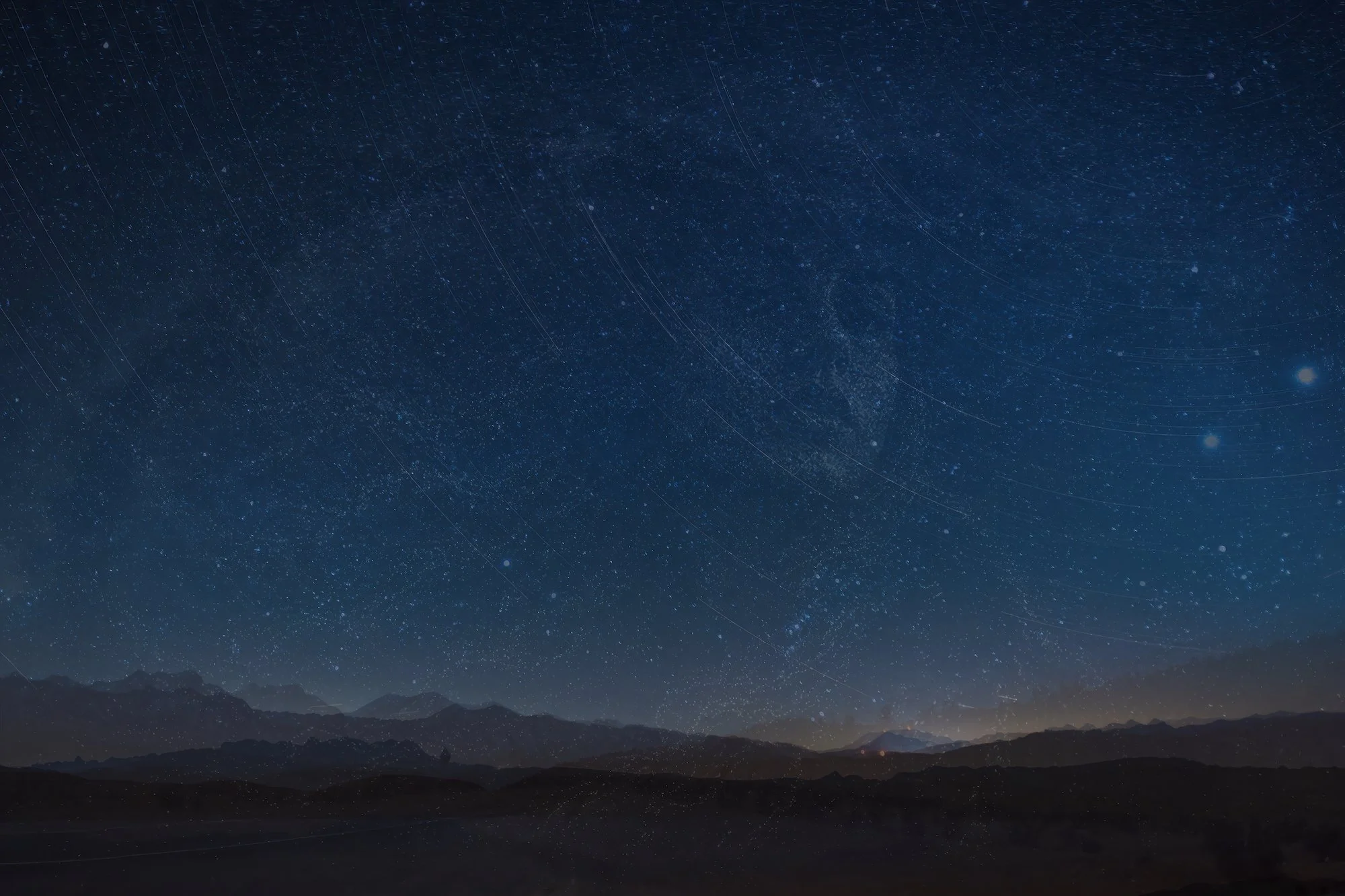
Amadour over Nevada, Preface to Angel Eyes (You Are Watching Me) (2026). Courtesy of the artist.