
Damian Loeb, Tycho, 2013. Oil on linen, 48 × 48 in. (121.92 × 121.92 cm). Installation view of The Dark Side of the Moon, guest curated by Todd Bradway, at Acquavella Galleries, Palm Beach, 2026. Photo: Oriol Tarridas. Courtesy of Acquavella Galleries.
I first caught sight of The Dark Side of the Moon (November 23, 2026–January 10, 2027), an exhibition guest curated by Todd Bradway at Acquavella Galleries in Palm Beach, through a striking announcement that arrived in my inbox. Its timing was particularly fortuitous, as I had recently become increasingly attentive to the moon and its many manifestations. It is eleven in the morning on Thanksgiving Day, and I am writing from the sunroom of my brother's home in San Rafael, California. Among the prevailing news stories in Marin County this week have been the extraordinary king tides affecting Corte Madera and Sausalito. On Tuesday, I witnessed some of the flooding while in Sausalito, where I interviewed Bradway over Zoom from the piano room of Sausalito Presbyterian Church, the church I attended growing up. I often return here to take a deep breath.
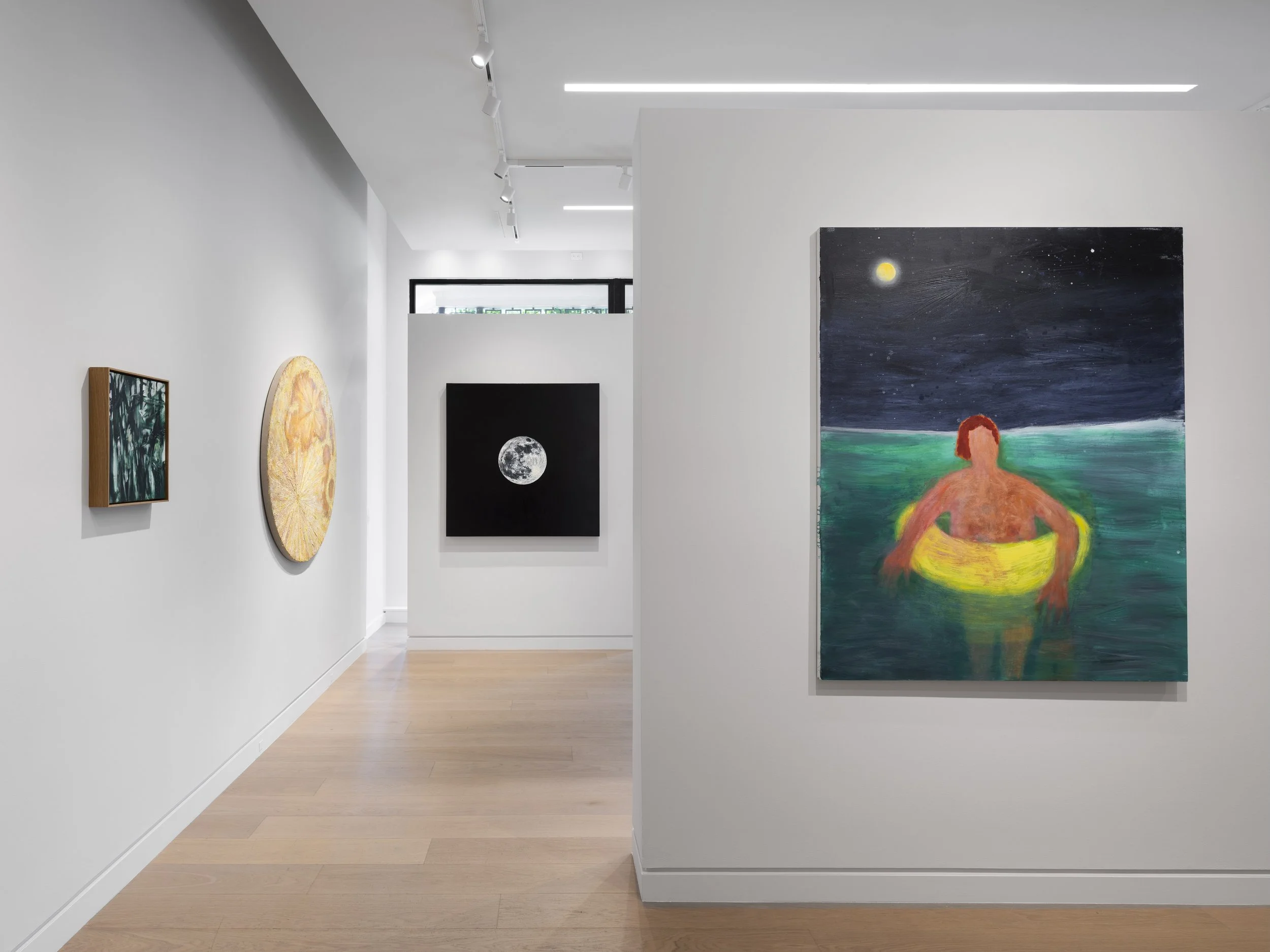
Installation view of The Dark Side of the Moon, guest curated by Todd Bradway, at Acquavella Galleries, Palm Beach, 2026. Photo: Oriol Tarridas. Courtesy of Acquavella Galleries.
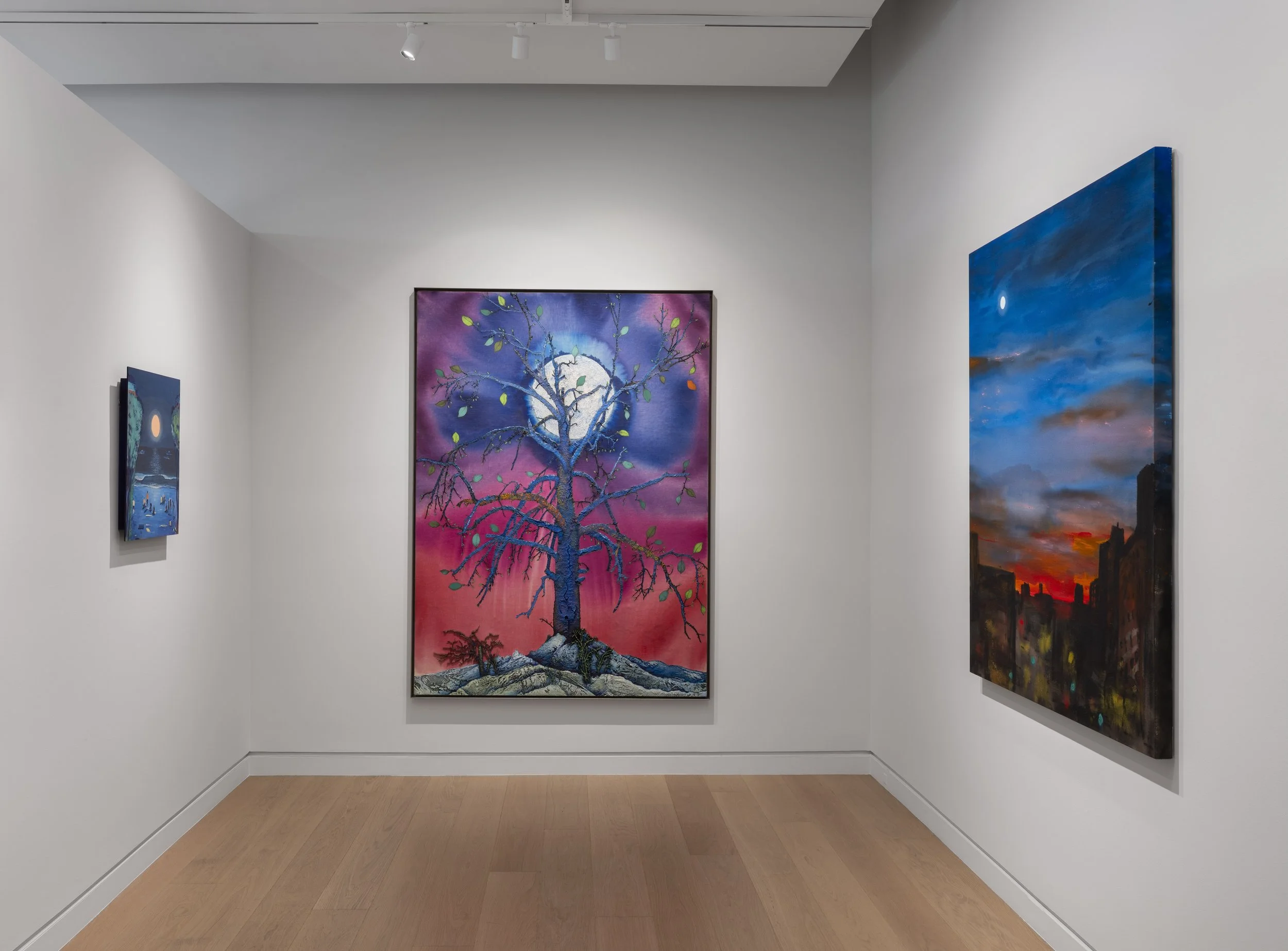
Installation view of The Dark Side of the Moon, guest curated by Todd Bradway, at Acquavella Galleries, Palm Beach, 2026. Photo: Oriol Tarridas. Courtesy of Acquavella Galleries.
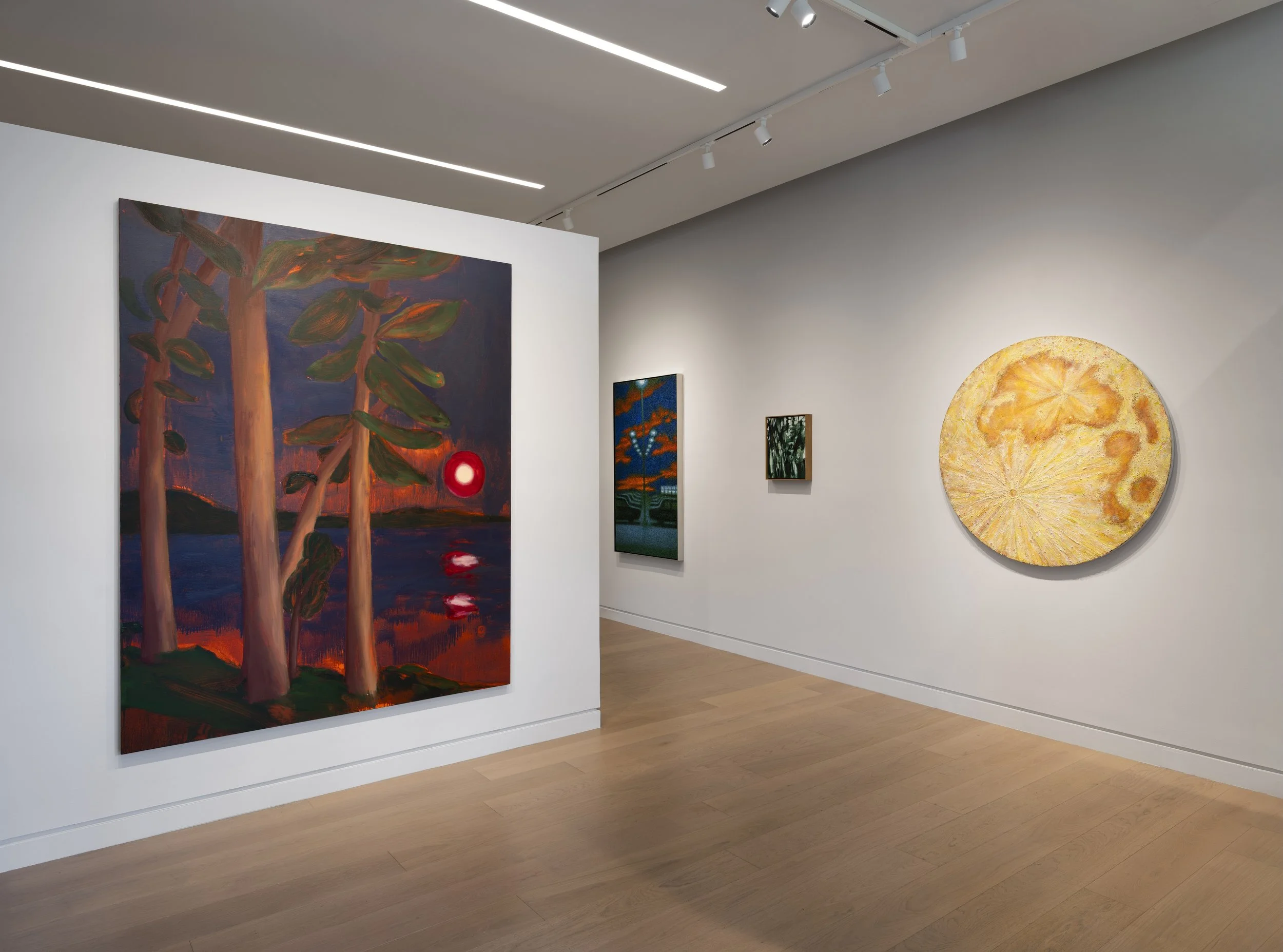
Installation view of The Dark Side of the Moon, guest curated by Todd Bradway, at Acquavella Galleries, Palm Beach, 2026. Photo: Oriol Tarridas. Courtesy of Acquavella Galleries.
There is something extraordinary about the gravitational relationship between the Earth, the moon, and the sun, and how their alignment, when compounded by the atmospheric conditions of a coastal storm, can inundate the landscapes we inhabit. Streets familiar since childhood momentarily become extensions of the sea. The moon, an object we associate with romanticism, contemplation, and the imagination, is simultaneously an agent of considerable physical consequence. For Bradway, it presents an equally compelling proposition within the history of painting.
Bringing together nocturnal landscapes and moonscapes by sixteen international contemporary artists, Bradway's exhibition inevitably recalls Pink Floyd's The Dark Side of the Moon (1973), one of the most influential albums in the history of recorded music. Its celebrated cover, designed by Hipgnosis, notably Storm Thorgerson, with graphic artwork by George Hardie, depicts the dispersion of white light through a triangular prism against an expansive black field. Represented in the collection of the Museum of Modern Art in New York, the design has acquired a cultural presence nearly independent of the music it originally accompanied. Its economy of form makes visible a phenomenon that ordinarily escapes our attention.
Coincidentally, one of my earliest associations with Pink Floyd is also rooted in Sausalito. At the Casa Madrona Hotel, where I held my first job as a teenage front desk agent and concierge, there was a photograph of the band taken by Baron Wolman, the first chief photographer of Rolling Stone, during their first American tour in November 1967. Wolman photographed the musicians on the property's exterior stairways and railings. Their visit was among the historical anecdotes we would share with hotel guests. Returning home and encountering Bradway's exhibition brought these seemingly disparate memories into unexpected proximity.
For Bradway, however, the exhibition's title extends beyond its musical associations. The nocturnal landscape presents a site of perceptual uncertainty in which the absence of light can be as consequential as its presence. Raised in Shelton, Connecticut, and now living in New York City, Bradway spoke of a growing sense of loss in relation to the natural environment, particularly the diminishing visibility of the night sky.
His observations recalled the extraordinary visibility of the stars in the deserts of Nevada, where I was born and raised, and, more recently, in the Sahara near Merzouga, Morocco, where I spent time among the dunes of Erg Chebbi and encountered the region's Amazigh culture. In both landscapes, the relative absence of artificial illumination reveals the extent to which darkness can facilitate vision. For much of the world's urban population, however, the experience of looking upward has been fundamentally altered. The moon remains visible, but its presence can become almost banal, a familiar object deprived of the celestial environment through which earlier generations understood it. How does one paint the night when access to the experience of darkness has become increasingly unequal?
From the calendrical systems of Mesoamerica and the woodblock prints of Katsushika Hokusai to European Romanticism, the moon has structured human conceptions of time, spirituality, navigation, and the natural world. In Caspar David Friedrich's Two Men Contemplating the Moon (ca. 1819–20), the act of looking becomes the subject of the painting. The figures, seen from behind, offer the viewer a position from which to contemplate the immensity of the landscape. In James McNeill Whistler's Nocturne: Blue and Gold – Old Battersea Bridge (ca. 1872–75), darkness facilitates a dissolution of representational specificity, anticipating some of the formal concerns that would occupy painters well into the twentieth century.
The nocturne, a term shared by painting and musical composition, provides a particularly expansive framework through which to reconsider the relationship between perception and atmosphere. From John Field's early nineteenth-century piano nocturnes and Frédéric Chopin's Nocturne in E-flat Major, Op. 9, No. 2 (ca. 1830–32) to Claude Debussy's orchestral Nocturnes (1897–99), the night has furnished composers with possibilities for tonal and expressive experimentation. Whistler's adoption of musical terminology likewise suggests an understanding of painting in which chromatic harmonies and atmosphere could assume greater significance than descriptive fidelity. Darkness can obscure the material world, but it can also disclose its subtler relationships.
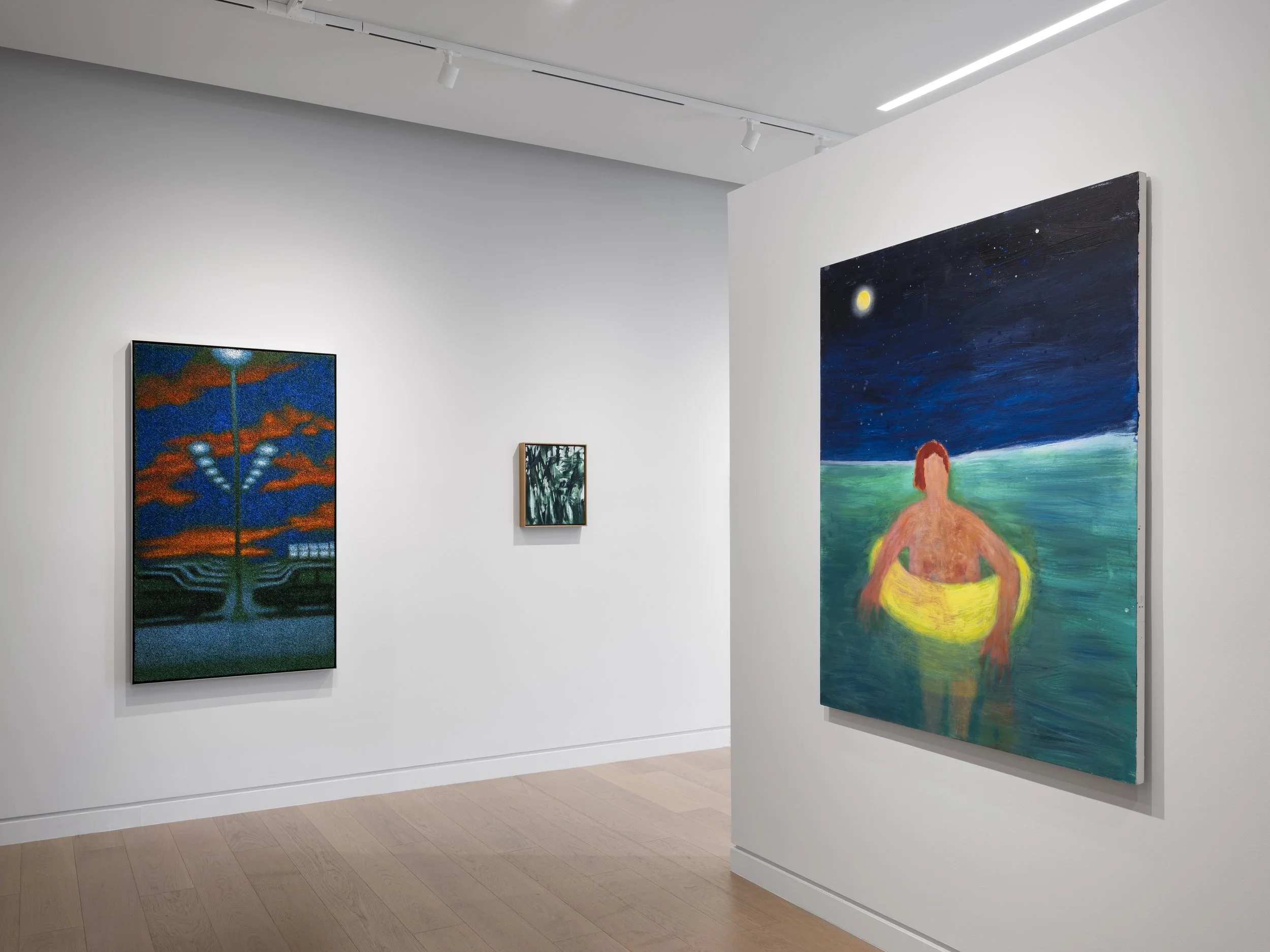
Installation view of The Dark Side of the Moon, guest curated by Todd Bradway, at Acquavella Galleries, Palm Beach, 2026. Photo: Oriol Tarridas. Courtesy of Acquavella Galleries.
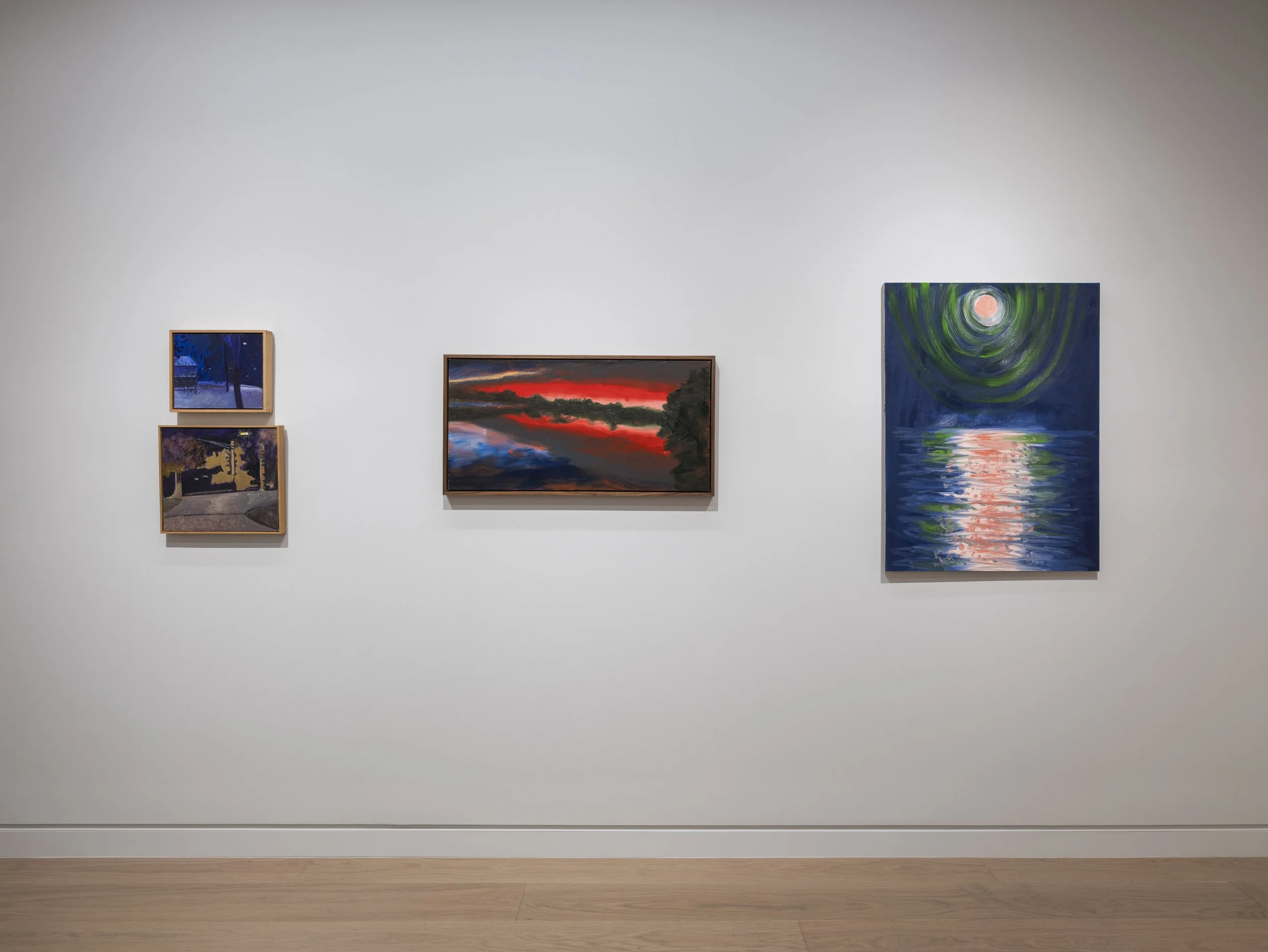
Installation view of The Dark Side of the Moon, guest curated by Todd Bradway, at Acquavella Galleries, Palm Beach, 2026. Photo: Oriol Tarridas. Courtesy of Acquavella Galleries.
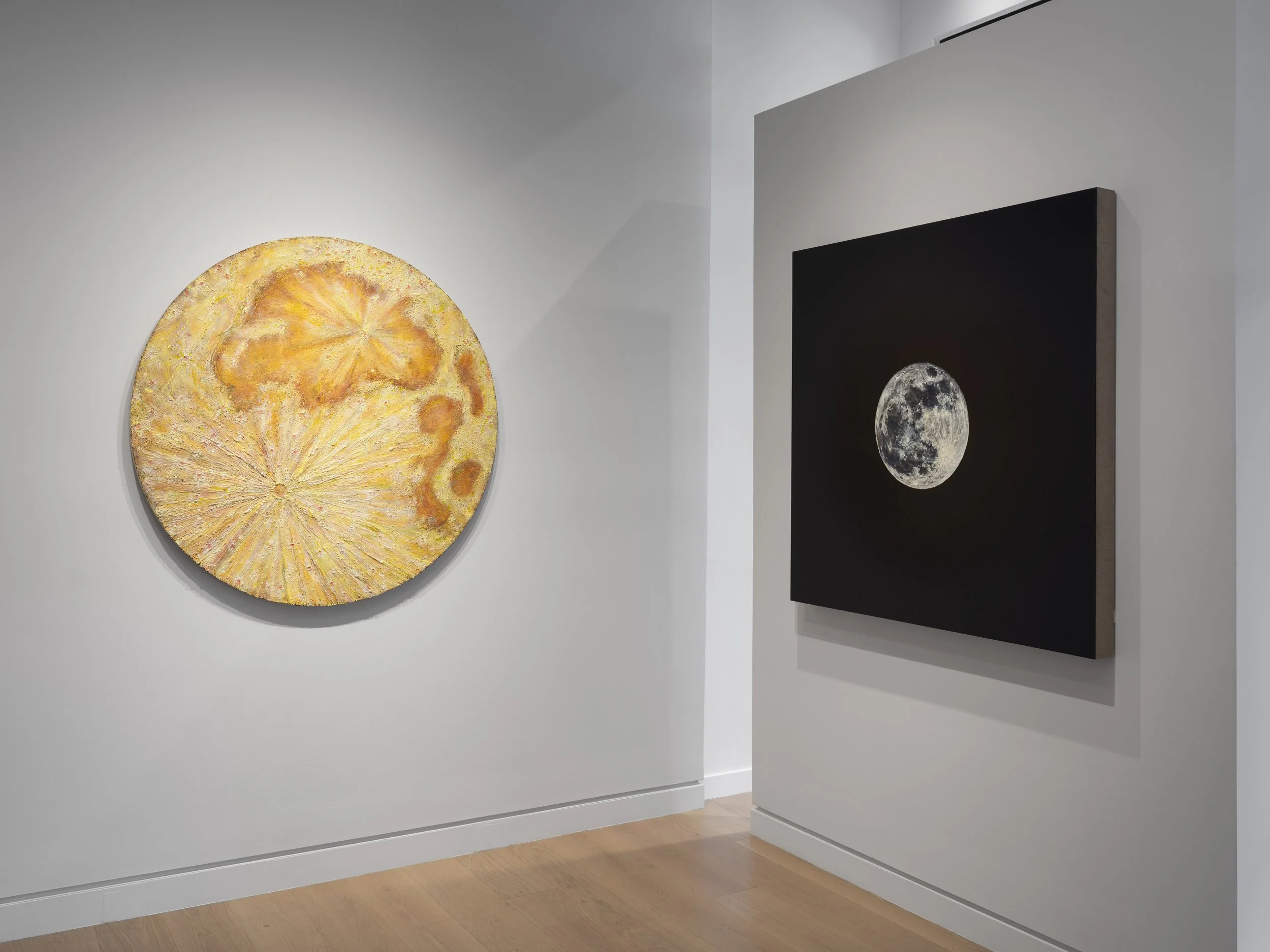
Installation view of The Dark Side of the Moon, guest curated by Todd Bradway, at Acquavella Galleries, Palm Beach, 2026. Photo: Oriol Tarridas. Courtesy of Acquavella Galleries.
Among the works in Bradway's exhibition, I was particularly drawn to Damian Loeb's Tycho (2013), an oil on linen in which the lunar surface emerges from an enveloping darkness. Its apparent simplicity belies the complexity of its making. Working from photographic source material, Loeb translates the optical information afforded by contemporary technology into the historically established language of painting. Having only recently begun wearing prescription glasses, I found myself contemplating the work in relation to my own changing visual acuity. The moon I had looked upon throughout much of my life was substantially less defined than the one I see today. An object commonly assumed to be universally recognizable is, in fact, experienced through innumerable individual conditions of perception.
Bradway's gathering of artists offers a kind of painterly consolation for some of these increasingly inaccessible experiences. The phosphorescent surfaces of Jon Joanis's Rose (Mare Nectaris) (2026) and Yellow (Mare Undarum)(2026), the chromatic expanses of Wanda Koop's Moon Walk #3 (2024), and Jane Dickson's use of AstroTurf in Houston Street Parking Pier 2 (2022–24) articulate fundamentally different relationships to nocturnal visibility. Where Joanis extends the experience of his paintings beyond the illuminated gallery, Koop approaches a formal language reminiscent of Color Field painting, and Dickson confronts the material resistance of an unconventional surface. Alongside artists including Ann Craven, Lois Dodd, Alex Katz, Nicole Wittenberg, Yvonne Jacquette, and Kiki Smith, these works reflect Bradway's interest in slow painting, asking us to invest time in looking at a phenomenon whose familiarity might otherwise preclude such consideration.
The exhibition's location in Palm Beach is itself intriguing. Situated along Florida's Atlantic coastline, south of Cape Canaveral and the Kennedy Space Center, from which Apollo 11 launched in July 1969, Palm Beach belongs to a geography in which the ocean and the technological exploration of space assume distinct cultural resonances. Here, the moon can be considered in relation to both the immediacy of the tides and the historical ambition of humanity to physically reach its surface. Across the continent, in Marin County, its gravitational influence is particularly evident this week; in Florida, the history of space exploration offers another measure of our relationship to it.
The Dark Side of the Moon extends Bradway's sustained inquiry into contemporary landscape painting and marks his second curatorial project with Acquavella Galleries, following Unnatural Nature: Post-Pop Landscapes (2022), presented in Palm Beach and New York. The earlier exhibition emerged from his publication Landscape Painting Now (2019), which brought together eighty contemporary painters organized around six thematic concerns. Bringing one of the book's chapters into physical space, the exhibition traced affinities between artists including Wayne Thiebaud, Alex Katz, Maureen Gallace, and Jules de Balincourt. In reversing the conventional relationship between an exhibition and its accompanying publication, Bradway demonstrated the generative possibilities of editorial research within curatorial practice.
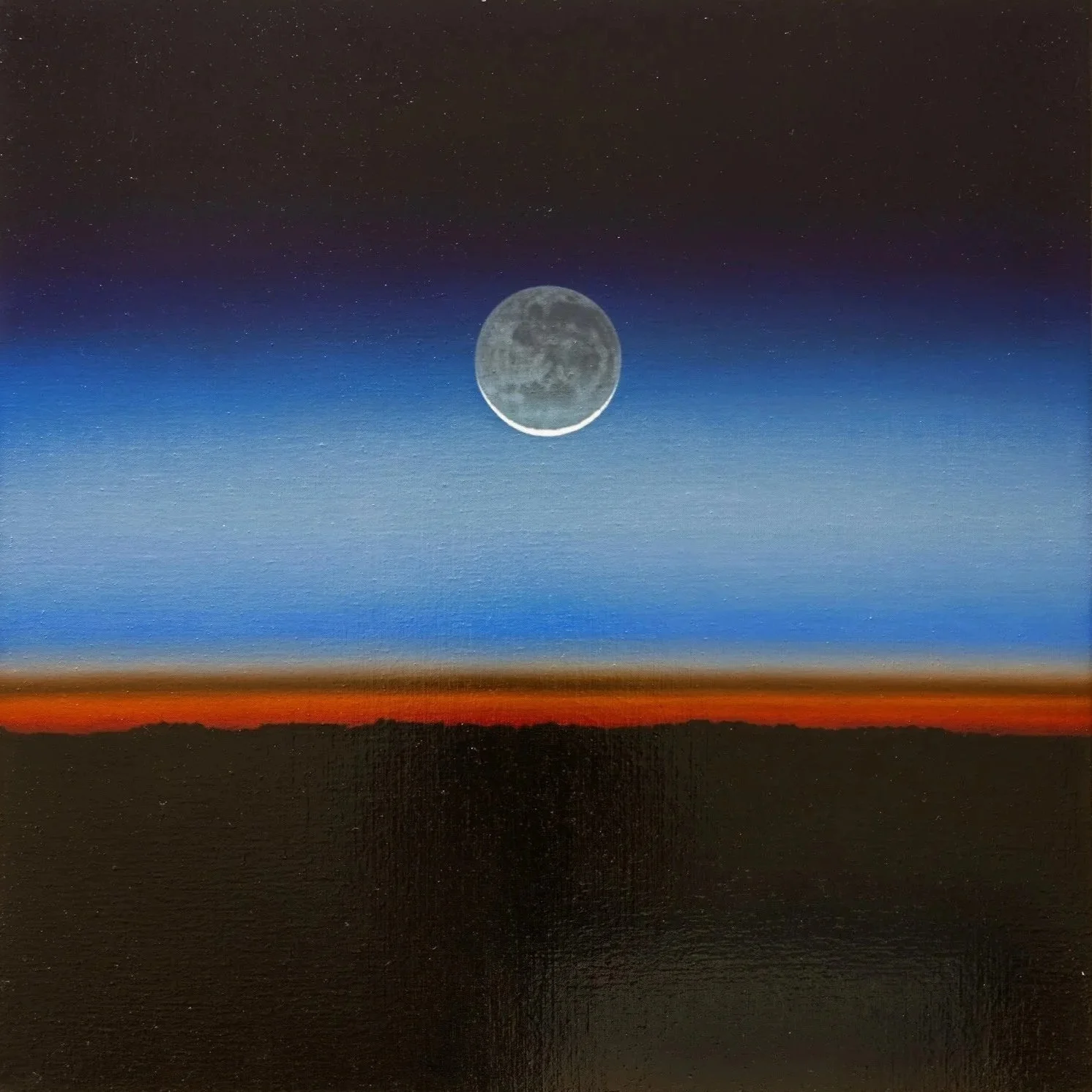
Damian Loeb, Diana and Endymion, 2022. Oil on linen, 36 × 36 in. (91.4 × 91.4 cm). Featured in The Dark Side of the Moon at Acquavella Galleries, Palm Beach. All images courtesy of Acquavella Galleries.
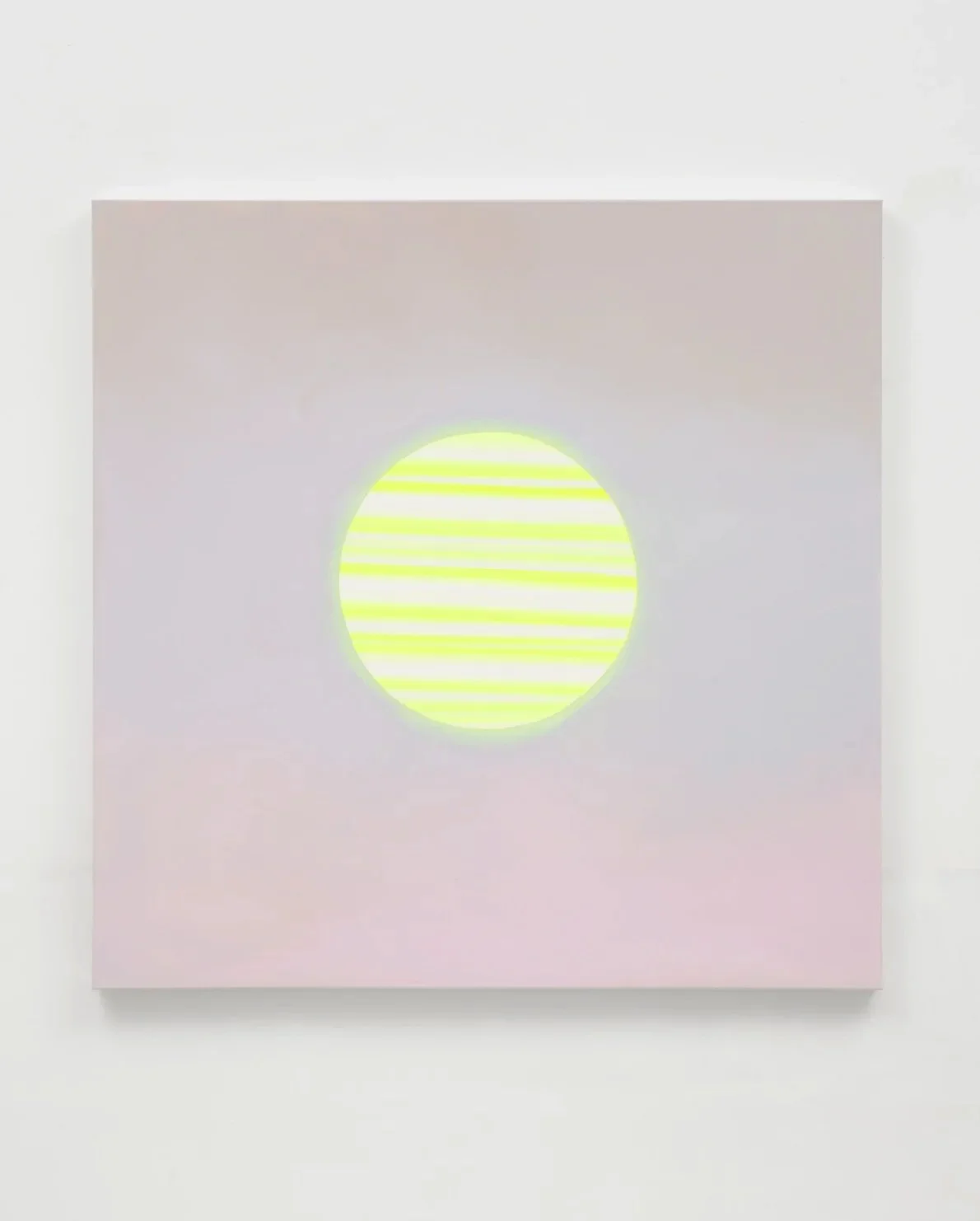
Wanda Koop, Moon Walk #10, 2024. Acrylic on canvas, 48 × 48 in. (121.9 × 121.9 cm). Featured in The Dark Side of the Moon at Acquavella Galleries, Palm Beach. All images courtesy of Acquavella Galleries.
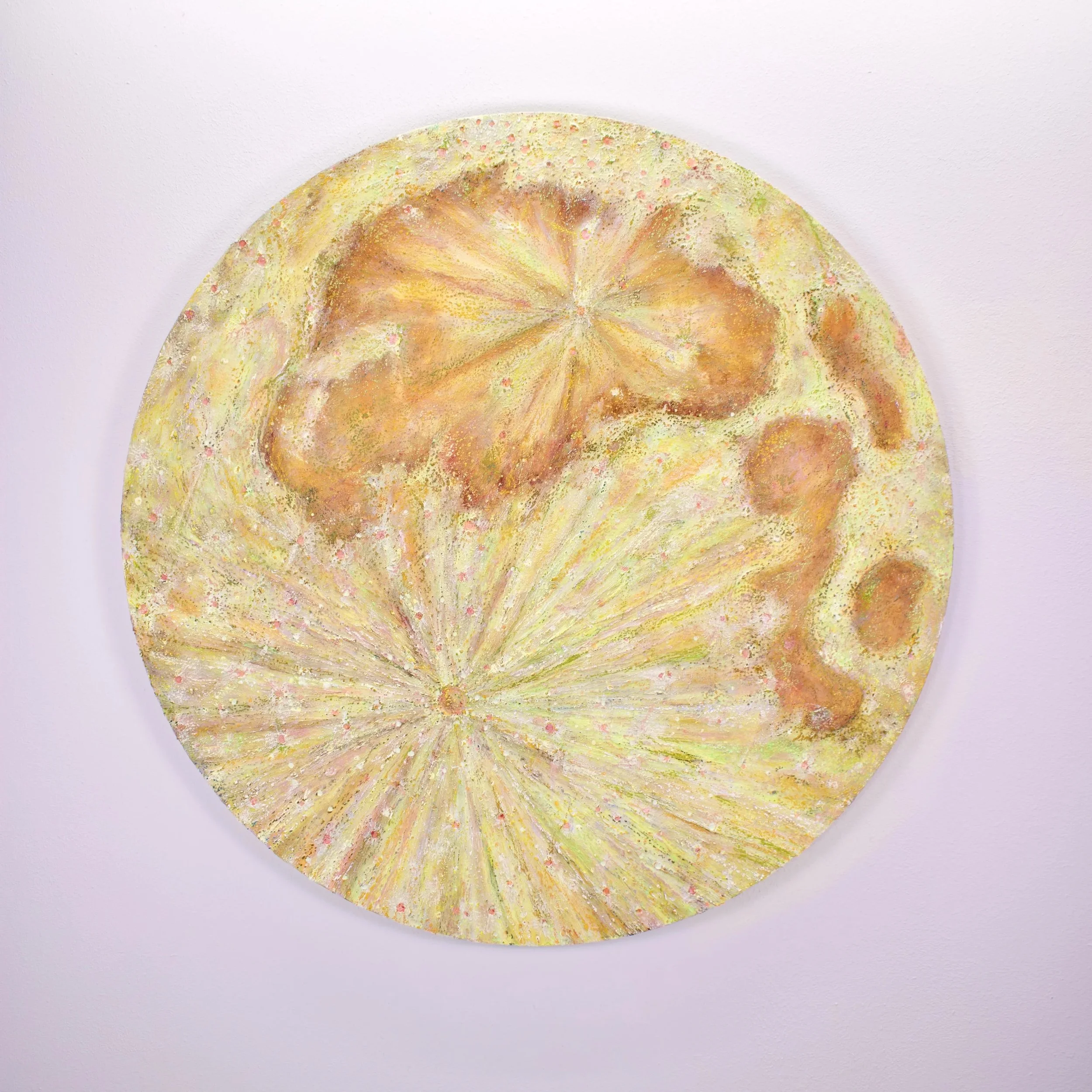
Jon Joanis, Yellow (Mare Undarum), 2026. Mixed media with phosphorescent pigments, 48 in. (121.9 cm) diameter. Featured in The Dark Side of the Moon at Acquavella Galleries, Palm Beach. All images courtesy of Acquavella Galleries.
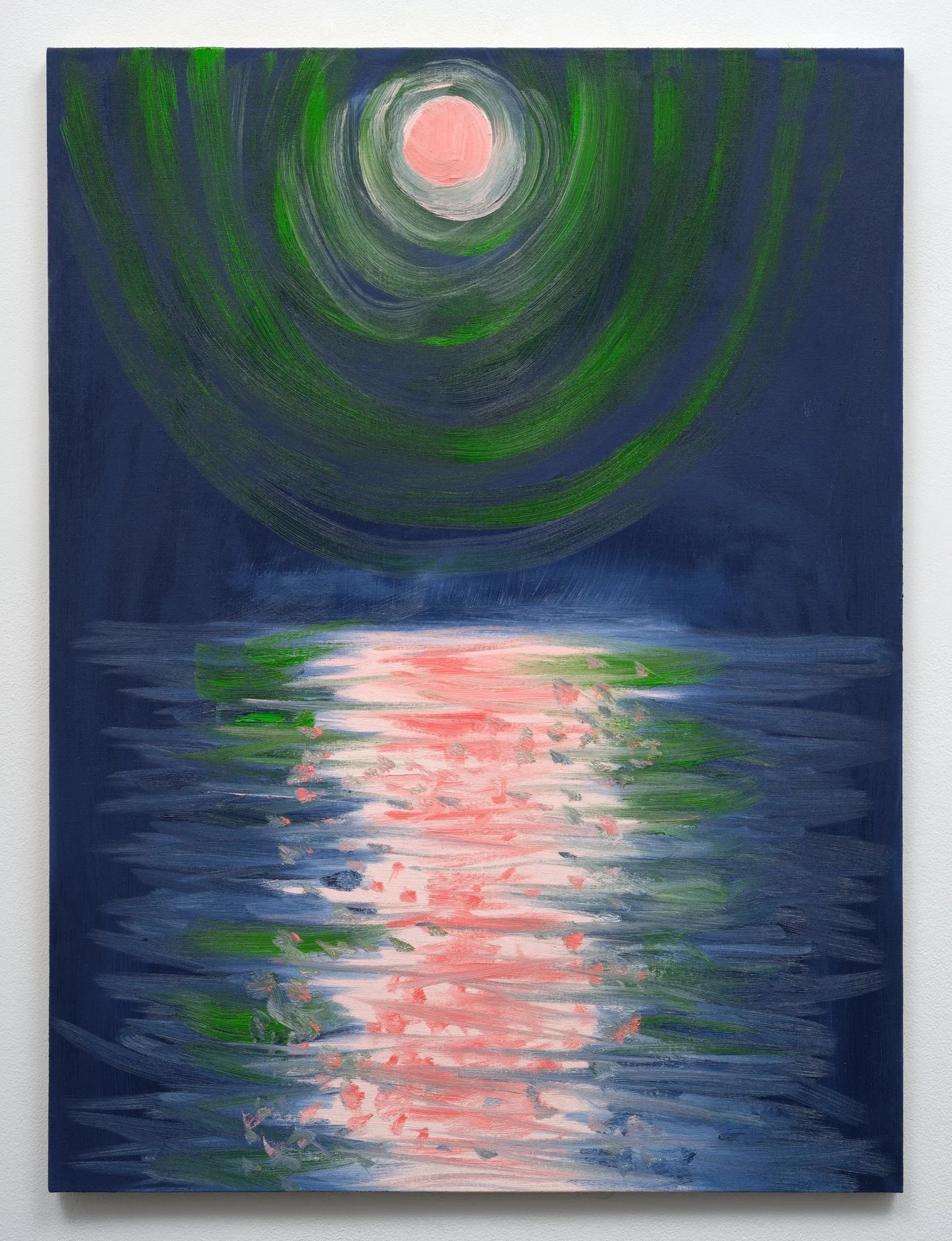
Ann Craven, Moon (April Full, Green Sky), 2025, 2025. Oil on linen, 40 × 30 in. (101.60 × 76.20 cm). Featured in The Dark Side of the Moon at Acquavella Galleries, Palm Beach. All images courtesy of Acquavella Galleries.
His engagement with painting, however, began in childhood, when his grandmother, a librarian, assembled a collection of art books for him. A reproduction of Vincent van Gogh's The Starry Night (1889) adorned his college dormitory at Pratt Institute, where, despite the institutional inheritance of Abstract Expressionism, he gravitated toward figurative painting. Following anatomical studies at Columbia University, he studied under Vincent Desiderio at the New York Academy of Art. There is a particularly gratifying circularity in his recollection of encountering Lucian Freud's monumental paintings at Acquavella as a young artist and subsequently returning to the gallery as a curator.
Equally significant is Bradway's career in publishing. Following two decades at ARTBOOK | D.A.P., he helped establish David Zwirner Books in 2014, contributing to the development of the gallery's publishing imprint over the following three years. Among his projects were Raymond Pettibon's Homo Americanus (2016), which he considers one of the highlights of his publishing career, and Donald Judd Writings (2016), produced in collaboration with the Judd Foundation. His earlier dedication to producing Vincent Desiderio's first monograph, Vincent Desiderio: Paintings (2005), likewise speaks to a longstanding investment in the art book as a vehicle through which an artist's practice can transcend the temporal and geographical limitations of an exhibition.
Perhaps what interested me most in speaking with Bradway was the continuity between these endeavors. Curating, painting, and publishing each involve the organization of visual experience and the establishment of relationships between images, ideas, and their audiences. For those unable to travel, the book may constitute the exhibition itself, much as the books his grandmother brought home afforded him access to a world of geographically distant images. His subsequent career in publishing might be understood, in part, as a continuation of that early experience of cultural transmission.
In anticipation of Art Basel Miami Beach, I spoke with Bradway about the complexities of nocturnal painting, the changing conditions of our apprehension of the landscape, his formative years as a painter, his career in publishing, and his dream of working with Diego Velázquez on the ultimate art book: the artist's own catalogue raisonné. Our conversation returned repeatedly to the possibilities of looking and the enduring capacity of beauty to invite intellectual engagement.
There are perhaps few objects that so readily unite otherwise disparate human experiences as the moon. The conditions under which we encounter it, however, are never entirely the same.
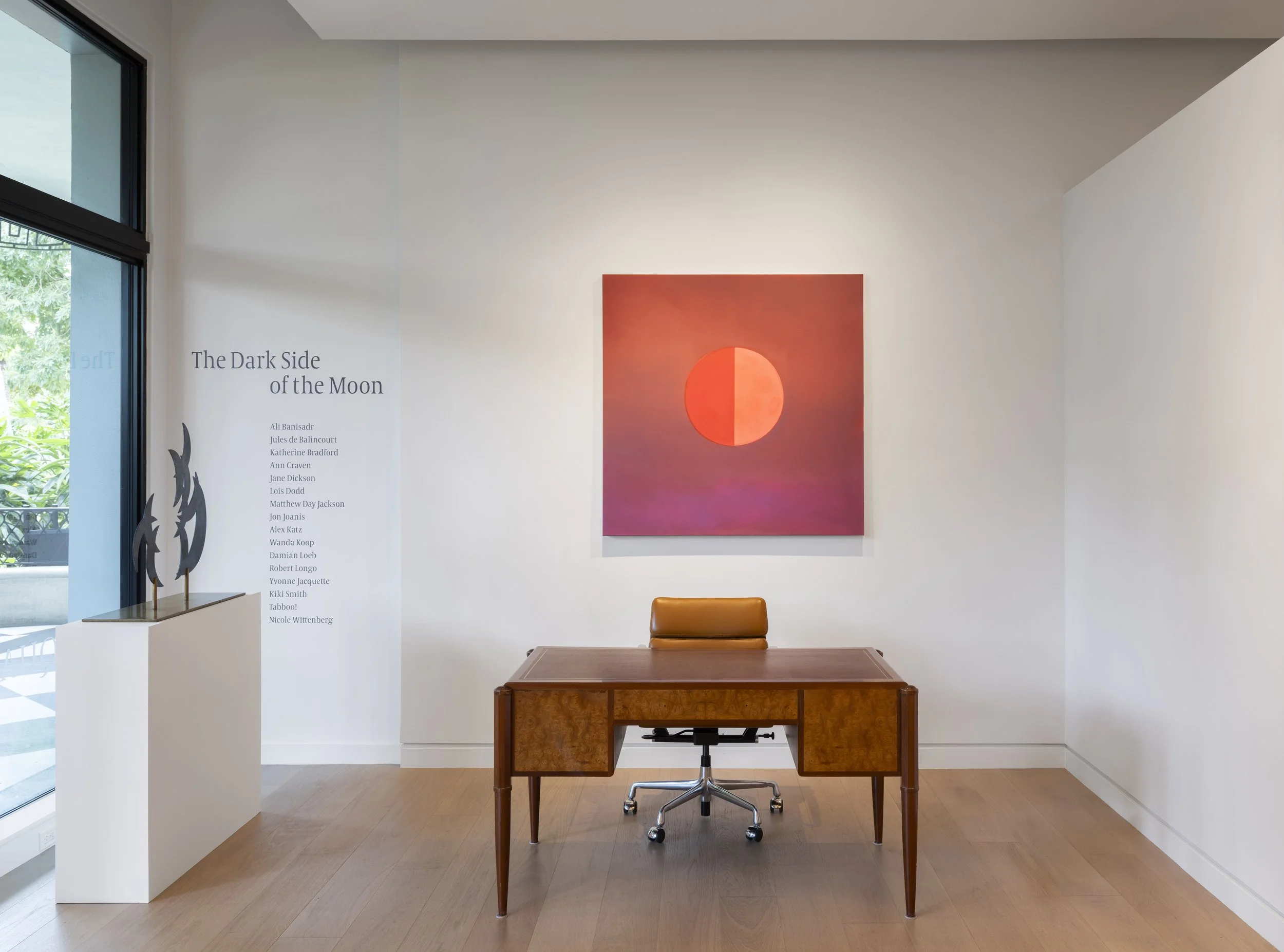
Wanda Koop, Moon Walk #3, 2024. Acrylic on canvas, 48 × 48 in. (121.9 × 121.9 cm). Installation view of The Dark Side of the Moon, guest curated by Todd Bradway, at Acquavella Galleries, Palm Beach, 2026. Photo: Oriol Tarridas. Courtesy of Acquavella Galleries.
INTERVIEW:
AMADOUR: Your exhibition The Dark Side of the Moon is open now at Acquavella Galleries in Palm Beach. How did you first develop your interest in curating?
TODD BRADWAY: For the past ten or so years, I've been focusing a lot of my interests not only on contemporary painting but on the genre of landscape painting. It initially culminated in a two-year research project, which became the book Landscape Painting Now, published by D.A.P. and Thames & Hudson in 2019. That book collected eighty contemporary painters and organized them thematically around six defining characteristics that I was seeing among these contemporary painters. That book was a real labor of love and allowed me to meet many of my heroes, painters who I had looked up to for a long time, like Alex Katz and Lois Dodd, and other contemporary painters like Inka Essenhigh and Damian Loeb. It was a way for me to explore this never-ending genre. I was seeing so much contemporary landscape painting in the galleries, but it was still unspoken in some ways. Although some of the artists were certainly incredibly well known in all the museums and galleries, it seemed like something was being missed. The focus of the book was to tie that together. A couple of years after the book was published, I worked with Acquavella to curate a show called Unnatural Nature: Post-Pop Landscapes. That was in 2022, both in Palm Beach and in their New York gallery on East Seventy-ninth Street. For that show, we focused on one chapter within the book, which was post-Pop landscapes, so anyone from Wayne Thiebaud to Alex Katz to Maureen Gallace and Jules de Balincourt. It was a really amazing experience to be able to bring one chapter of the book to life. As you know well, usually the exhibition comes first, and then the catalog is published to tie into the exhibition. It was a little bit of a dream come true that a book published as a standalone project suddenly became three-dimensional. It was an amazing experience working with Acquavella. Obviously, their spaces are beautiful.
AMADOUR: I wanted to talk about The Dark Side of the Moon. When I first think of this title, I think of Pink Floyd's album The Dark Side of the Moon (1973), but I also think about the musicality of the landscapes you've brought together. How did you come up with this title, and how do the artists you've chosen symbolize the moon for you?
TODD BRADWAY: Obviously, Pink Floyd casts a long shadow, even if you're not a fan of the band. It's evocative of so many things. I was thinking of the title of that album, and I was thinking about the abstract qualities of what that means. We see one side, but the other side is this zone of imagination and memory, darkness, but also possibility. That seemed like a great starting point because when I think about the great contemporary painters who have focused on the moon, and more widely nocturnal paintings, which this would fall into as a wider genre, there are so many facets. The moon is always changing, and I'm interested in telling a bit of a story. With anything I work on, it's about trying to tell a wider story. There are many different types of painting in the show. The moon and the night are the glue. That's the web that ties it together. There's photorealism, we have plein air painting, we have constructed images that are made up of many different sources, and we have experimental materials. Somebody like Jane Dickson, who's painting on AstroTurf, or Jon Joanis, who's using phosphorescent pigments so that the paintings literally glow in the dark. For me, it's about telling a wider story of potential and imagination within this group of artists and this tight group of works. It's the darkness, but it's also the magic, the mystery, and the energy of that potential. That's really what we were trying to do with the show.
AMADOUR: I'm interested in the distinction between painting darkness and painting light within darkness. How do the artists in this exhibition negotiate that relationship?
TODD BRADWAY: I would say for many of them, it's about trying to use light to reveal the side of the moon that faces us. Whether it's Ann Craven going into the landscape at midnight and capturing the moon on the roof of her building, or Nicole Wittenberg doing pastels on-site and then going back to her studio and reflecting on what she witnessed and what she felt, that's really about light revealing either an emotional state, a feeling, or an energy. Obviously, the light that filters through the night is so diverse. It's not one state of light. It's not one color. It's not one feeling. It's not one emotional state. It's not one value. There's a lot of richness, but without the light, you don't have the darkness because you can't actually relate to what it is. You need the light to be able to see within the darkness in the scope of these works that are on view. With somebody like Jon Joanis, these are silhouetted moons [Rose (Mare Nectaris) (2026) and Yellow (Mare Undarum)(2026)]. They're literally moon-shaped panels, and he uses these pigments. For him, it's also this dialogue with day and night because they are incredible surfaces. These paintings are primarily meant to be seen during the day or in a lit gallery space, but when the lights are off, they take on another quality. The other thing I would say is that a lot of these paintings are open narratives in that there are no figures. The narrative is for the viewer to bring to the table. Some of them could be seen as ominous, but in others, there's this kind of open-ended mystery. There are figures, such as in Jules de Balincourt's painting, who are looking up at the moon in this group setting. The viewer's not quite sure what they're encountering, but there's almost a magisterial reverence to the scene. Another example would be Katherine Bradford's yellow tube swimmer. I see this painting and this single figure in a yellow swimming tube under moonlight, and that figure is sort of our guide through the show, leading us through. On one hand, it could be viewed as a fearful situation, especially if you don't know how to swim, to be out in the water in darkness by yourself in a tube. But on the other hand, there's this freedom and this sense of possibility and potential as you're reflecting up at the moon and being led by it to whatever that destination is. I think most of the painters here are using light to illuminate a situation. They're using the lit side. One other painting that comes to mind that is the inverse of that would be Ali Banisadr's Paradise, Paradise Lost, which is a smaller oil on linen, seventeen by fourteen inches. It's a fairly greenish painting, and the viewer is in a forest with a frenzy of brushstrokes, a lot of energy. It's inferred as a nocturnal painting. There's no direct moon that you can see, but the viewer is within this chaotic, energized jungle of brushmarks and expression. That one, to me, seems more like painting into darkness, into a kind of abstract darkness.
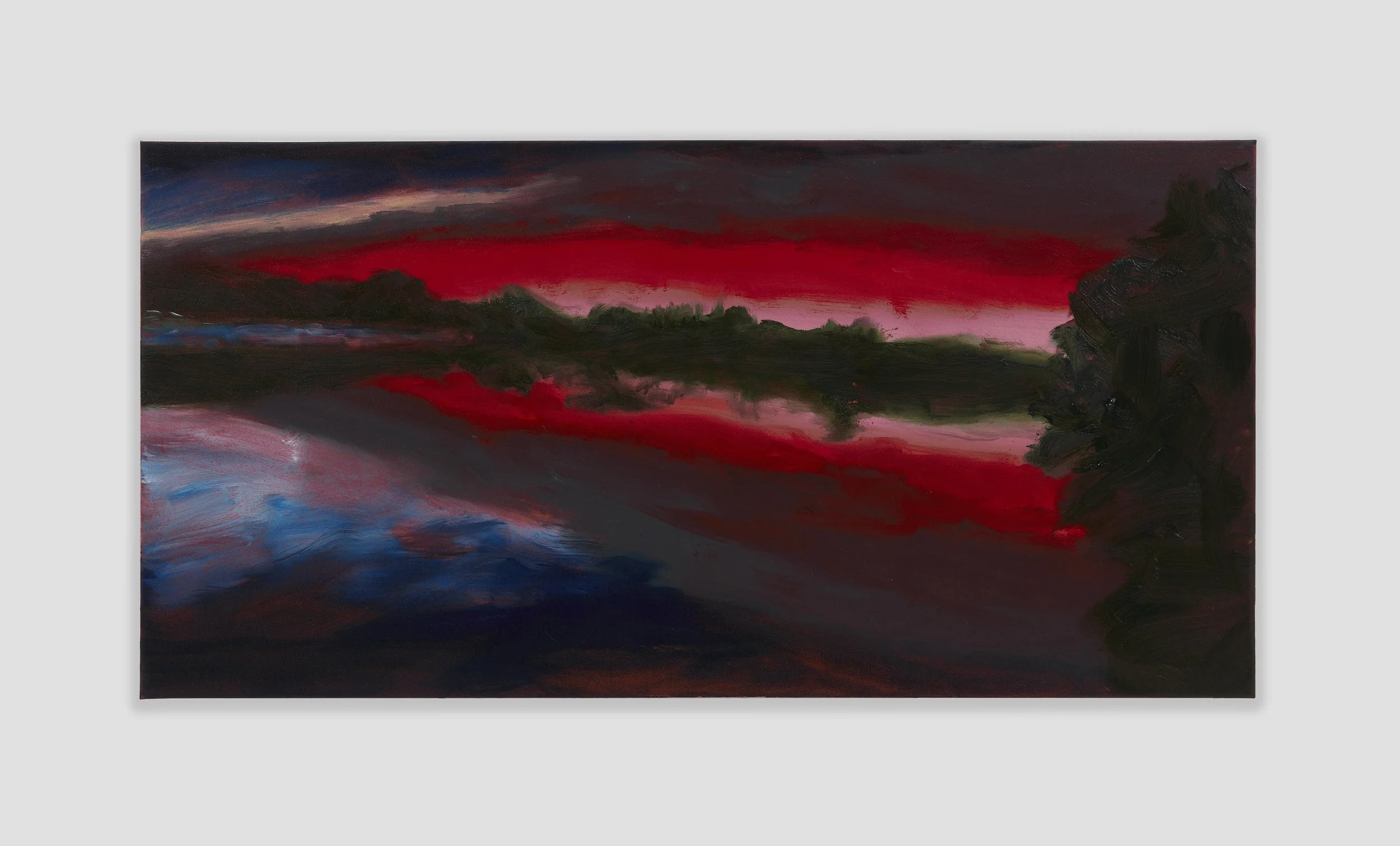
Nicole Wittenberg, Pieces Study 2, 2024. Oil on canvas, 18 × 36 in. (45.7 × 91.4 cm). Featured in The Dark Side of the Moon at Acquavella Galleries, Palm Beach. All images courtesy of Acquavella Galleries.
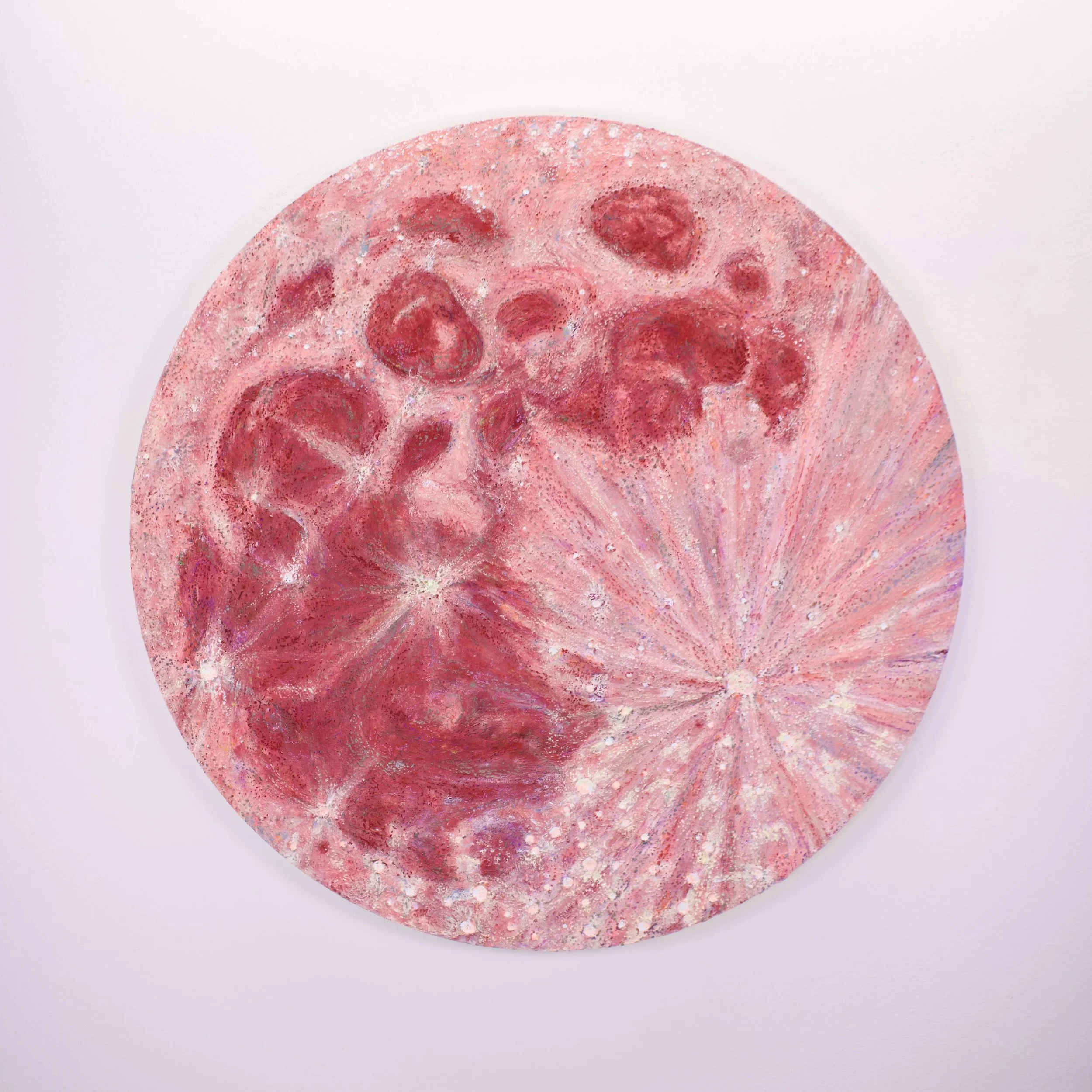
Jon Joanis, Rose (Mare Nectaris), 2026. Mixed media with phosphorescent pigments, 48 in. (121.9 cm) diameter. Featured in The Dark Side of the Moon at Acquavella Galleries, Palm Beach. All images courtesy of Acquavella Galleries.
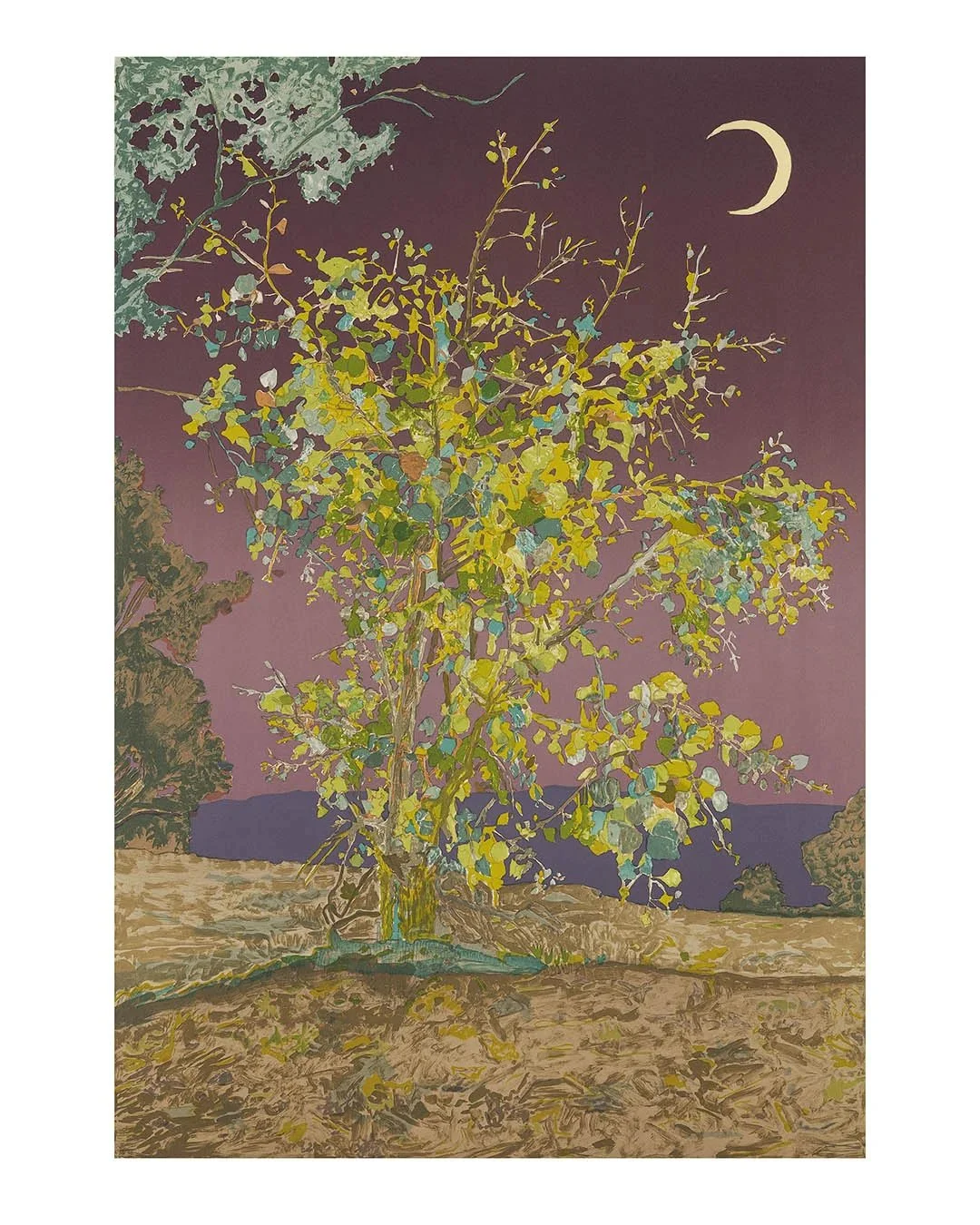
Haley Barker, Desert Poplar, Dusk, 2026. Original lithograph printed on 300 g Vélin d’Arches paper, edition 65 of 75, 38 5/8 × 26 5/8 in. (98 × 67.6 cm). Featured in The Dark Side of the Moon at Acquavella Galleries, Palm Beach. All images courtesy of Acquavella Galleries.
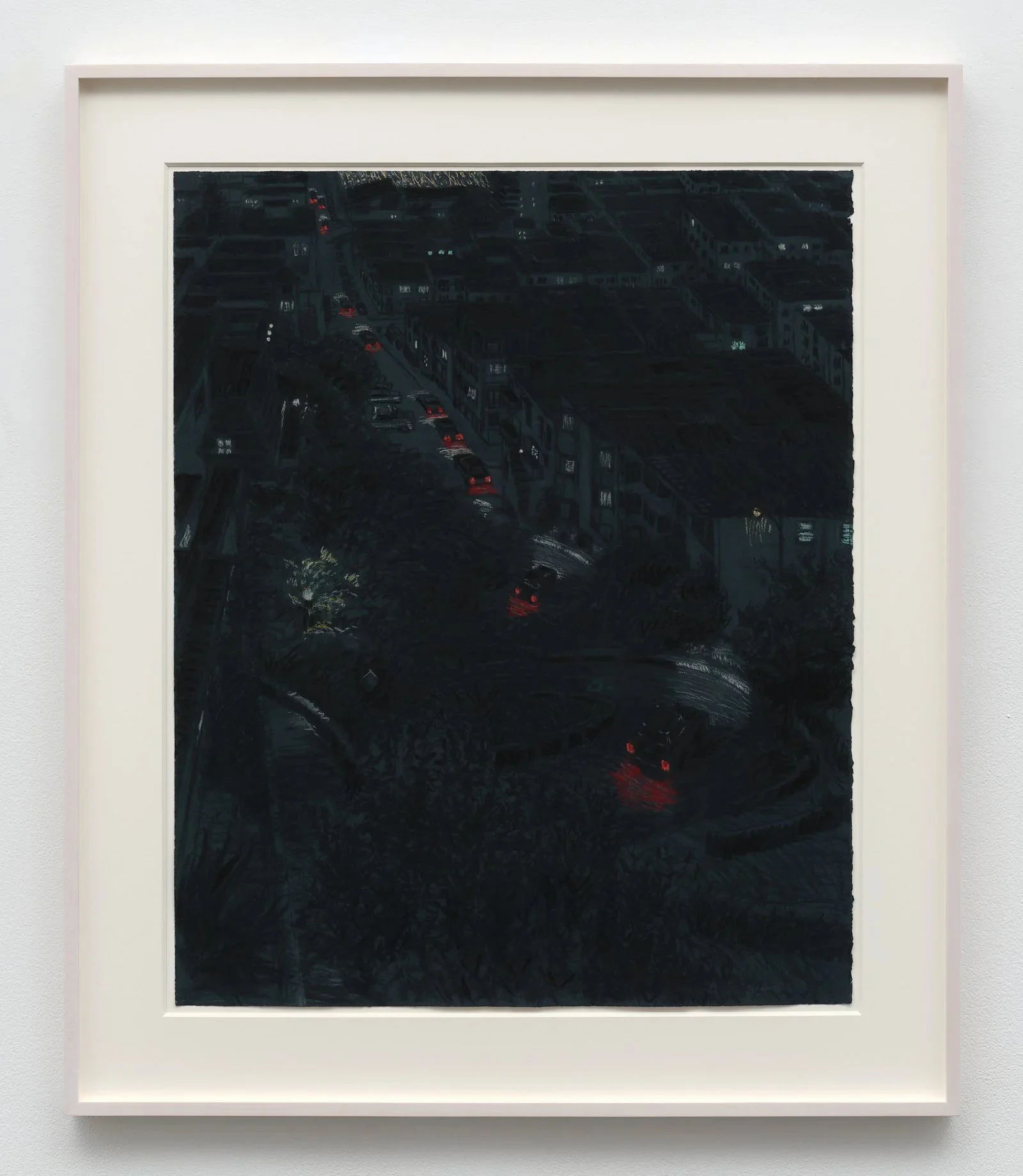
Yvonne Jacquette, Lombard St, San Francisco, 1984. Pastel on paper, 29 3/4 × 24 1/4 in. (75.56 × 61.59 cm). Featured in The Dark Side of the Moon at Acquavella Galleries, Palm Beach. All images courtesy of Acquavella Galleries.
AMADOUR: You've mentioned Caspar David Friedrich, Georgia O'Keeffe, and Goya working within a nocturnal tradition. I was thinking about this generationally, extending to the artists working today and looking at the moon. With increasing light pollution, many people no longer experience the night sky as previous generations did. Do you think nocturnal painting acquires a different significance in this context?
TODD BRADWAY: One strain of what brought me to think about the landscape in a more global way was the way it's shifting under our feet and how there's this sense of loss. I'm in my fifties, and I'm not even experiencing the landscape as I did when I was growing up. I believe that there's this sense of loss, this sense of the awe of the night sky. On the other hand, I live in New York City, and certainly we see almost nothing at night. But having traveled a bit this year to places that aren't quite so populated, it's nice to be reminded that this is a large planet and that there are pockets of the Earth where you can still witness the majesty of the night sky. If you have the luxury of being able to travel and see other things, you can find it. But I think, with the pressures that are on the planet, these momentums that are constantly impacting it, we have to take the time and highlight that which is fleeting and that which we can lose. I think this show does that, not in a heavy-handed way, not in a way that we're lecturing on things. I think a lot of the painting that I'm interested in is slow painting. It's painting that requires the viewer to stop and invest time. Some of it is jaw-dropping in beauty and will pull you in instantaneously, but other paintings require a sense of reflection and finding out where the artist is coming from, so you can really understand that a lot of the sites and locations are charged in emotional ways that tie to the way our landscape is changing. They require that thought and education.
AMADOUR: What do you think painting can communicate about the night sky that photography or cinema cannot?
TODD BRADWAY: Of course, there are examples that contradict this, but painting defies the flatness of photography, generally speaking. I think the paintings in the show are quite expressionistic and about the surface, and they require seeing them in person as opposed to seeing a JPEG. The way the artists touch a canvas is so different from seeing it on a flat screen or the way that a photograph typically functions. With these particular painters, it's also the range of touch. We have somebody like Wanda Koop, who has a work in the show called Moon Walk #3 (2024). It's quite flat, almost Rothko-esque in its abstraction. It's almost like Color Field painting. Then we have somebody like Damian Loeb, who takes these very detailed photographs using his own cameras, works behind the scenes to create a kind of hyperreality within the photograph itself, and then uses that as source material. He paints using these old, art-historical painting techniques of glazes and builds these things over quite a bit of time. Even though his paintings tend to be more photographic, they still require that sensorial, one-on-one experience because they are made by hand. You feel it when you're in front of it in a way that you don't from a JPEG. Or somebody like Jane Dickson, who's for many years been interested in the noir aspect of the night, pulling off highways and abandoned parking lots. We have this really great Houston Street Parking Pier 2 (2022–24), which is an acrylic painting on AstroTurf. She uses the AstroTurf to create resistance, so it's not just a smooth canvas, but it gives her something to fight against and creates a completely different surface quality from a more traditional painting. Not only do you have these mysterious, noir scenes, but it's another telling of Americana. I see a synergy with Ed Ruscha. It's another way of telling it.
AMADOUR: I also think about Edward Hopper's artificial illumination, Albert Pinkham Ryder's moonlit landscapes, or even Whistler's nocturnes when thinking about these works. I have to say, I appreciate an exhibition that is curated around an idea rather than gathering artists based on who they are. I feel that there needs to be more of this, curating based on thinking about something. The moon has always been a subject matter across generations, regardless of cultural reference. I wanted to go back to you. Where did you grow up, and how did you first encounter painting? Do you remember a formative encounter with the moon?
TODD BRADWAY: I grew up in Connecticut, which is where I am today, but I went to Pratt Institute in Brooklyn. I knew from a very young age that I wanted to be in the arts. In my particular case, I wanted to study painting and art history, which is what I ended up doing. At the same time, I've always had one foot in that and one foot in editing and publishing books. My career has been kind of atypical in that way, that I've tried to work in tandem in those two lanes. In the case of the landscape book, that was something that developed out of that strain. It tied over because I'm very passionate about contemporary art and contemporary painting, so everything synergized in that way. My first memory is going to be pretty cliché in a way, but it was probably Van Gogh's The Starry Night (1889). That was probably the first nocturnal painting. I had the postcard in my dorm room, and that was also in the nineties, when painting wasn't quite back to where we are today. Today it's super vibrant, as we can see from the show. It's diverse, and everybody's talking about it within the contemporary art world. But back in the nineties, representational painting, and certainly landscape painting, was not. I was always interested in nineteenth-century art and early twentieth-century modernism. Degas was one of my favorite artists growing up. That's my personal DNA. Later on, when I was in art school, Lucian Freud was one of my favorite artists, and one of my distinct memories of going around New York was going to Acquavella and seeing one of those first shows with the monumental nudes. Having the opportunity to collaborate with Acquavella in this way has been a true dream. I never really would have even thought I would get to that point.
AMADOUR: I know you studied under Vincent Desiderio. How did your formal education as a painter inform your understanding of art history and your work with books?
TODD BRADWAY: I have to go even before studying with Vince. At Pratt, studying art history and painting, it was a school that was rooted in Abstract Expressionism. Most of the faculty was, at that point, second- and third-generation Abstract Expressionists. That was the core. I really believe an artist is going to come to the table with a certain set of emotions and a certain set of interests. I did not really want to go in the direction of abstraction purely, and I really focused on studying the human form, working from the model, and working from more traditional sources. At least as a starting point early on, I just knew I needed that for myself. Going to Columbia and doing anatomical dissections in the tradition of Eakins, that was where my interest was. Later on, I discovered Vince's work at Marlborough Gallery. It was a works-on-paper show, and it was his sense of humanism, paintings of his son Sam, that showed me a different way within contemporary painting. Again, it was my interest in slower painting, a more human painting, but not retrograde. He definitely had more of a modernist, postmodernist approach. I searched him out and studied with him for two years at the New York Academy. Then, because I work a lot in the publishing sphere, I devoted two years of my life to producing his first monograph, Vincent Desiderio: Paintings, which was published in 2005 by D.A.P.
AMADOUR: That's incredible. You also established David Zwirner Books, correct?
TODD BRADWAY: Right. I worked at probably the only, or one of the only, companies that focus on art book distribution, called ARTBOOK | D.A.P. When I started there, it was my first week of college at Pratt. There were maybe four employees at the time, and I worked there for twenty years while I was going to graduate school and doing other things. In 2014, I had colleagues who worked at David Zwirner, and I caught wind that they were starting a publishing imprint within the gallery. Many galleries publish books, but it was clear that they wanted to really set up a publishing house within the gallery and do it seriously, and create books that were not just throwaway gallery catalogs. That really interested me. I went over there and basically worked for three years to set up that structure. We published some fantastic books during that initial period, including one of my favorites, Raymond Pettibon's Homo Americanus (2016), which was probably one of my highlights in publishing, as well as Donald Judd Writings (2016) and a number of other books. Then I left there, and that was around the time that I had this idea for the landscape project. In 2019, the landscape book came out. Basically, it was from D.A.P. to Zwirner to this project, which led to curating.
AMADOUR: Did you actually go to Chinati and Marfa for the Judd book?
TODD BRADWAY: We were very involved with the Judd Foundation, which was in SoHo. For that particular project, it was done pretty much there.
AMADOUR: Not to be prescriptive, but I'm definitely thinking of the Marfa lights right now in relation to this exhibition.
TODD BRADWAY: There's an amazing painter who is not in the show who I love. Her name is Diana Simard, S-I-M-A-R-D. I actually learned about her through Rainer Judd because I think Rainer Judd had posted one of her paintings many years ago. She's based in Marfa, and all she does is that landscape. They have almost a self-taught charm to them. If you're interested in that landscape, she's somebody to look up.
AMADOUR: I love that. Thank you. Do you consider the art book a permanent exhibition in its own right, or do you consider it something that is more of a documentation?
TODD BRADWAY: I think it can be both. I think it lives forever, and it is a documentation of it. But you have to think that most exhibitions are only on view for three months. Some are lucky, and some travel for years, but the majority are only up for a blip. For young students, art historians, and scholars, the book is going to be their experience. That is an exhibition. It just happens to be on a printed page as opposed to a wall. I believe it's multifaceted, and that's why I've devoted my life to it. I haven't cut out that part of my life. I find the book, or really any book, but particularly the art book, to be so valuable. It allowed me to be somebody who made it from a tiny little town in Connecticut.
AMADOUR: Which town?
TODD BRADWAY: Shelton, Connecticut. It's close to New Haven, but it's a very small town with no art scene at all, very little culture. The book is the kind of thing that took me out of that. My grandmother was a librarian at a public library here in the area. She would bring me home these Dover art books and this other masters series from the 1940s or fifties. When I didn't even know I needed it, she built me this library. It's funny how life works in that way.
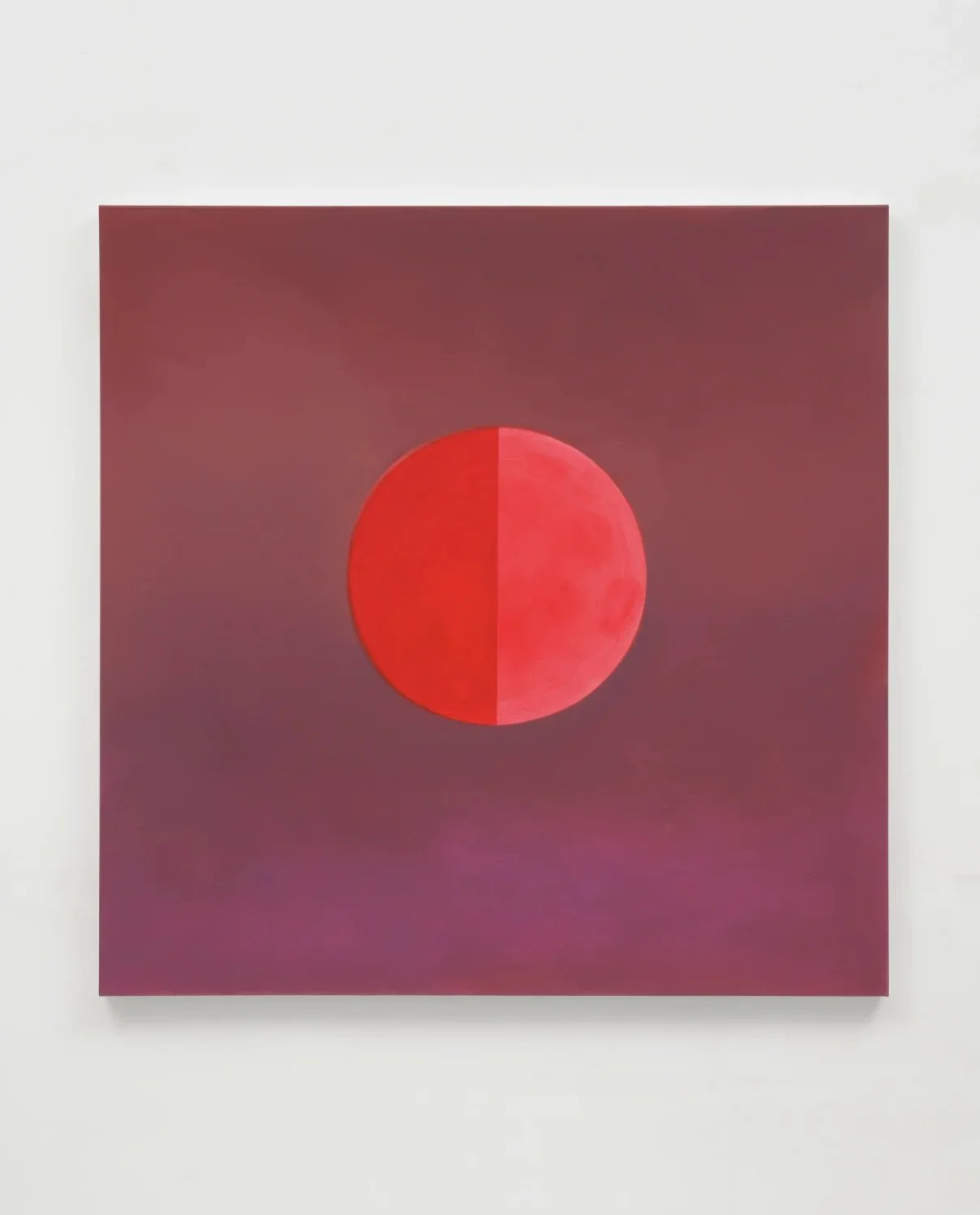
Wanda Koop, Moon Walk #3, 2024. Acrylic on canvas, 48 × 48 in. (121.9 × 121.9 cm). Featured in The Dark Side of the Moon at Acquavella Galleries, Palm Beach. All images courtesy of Acquavella Galleries.
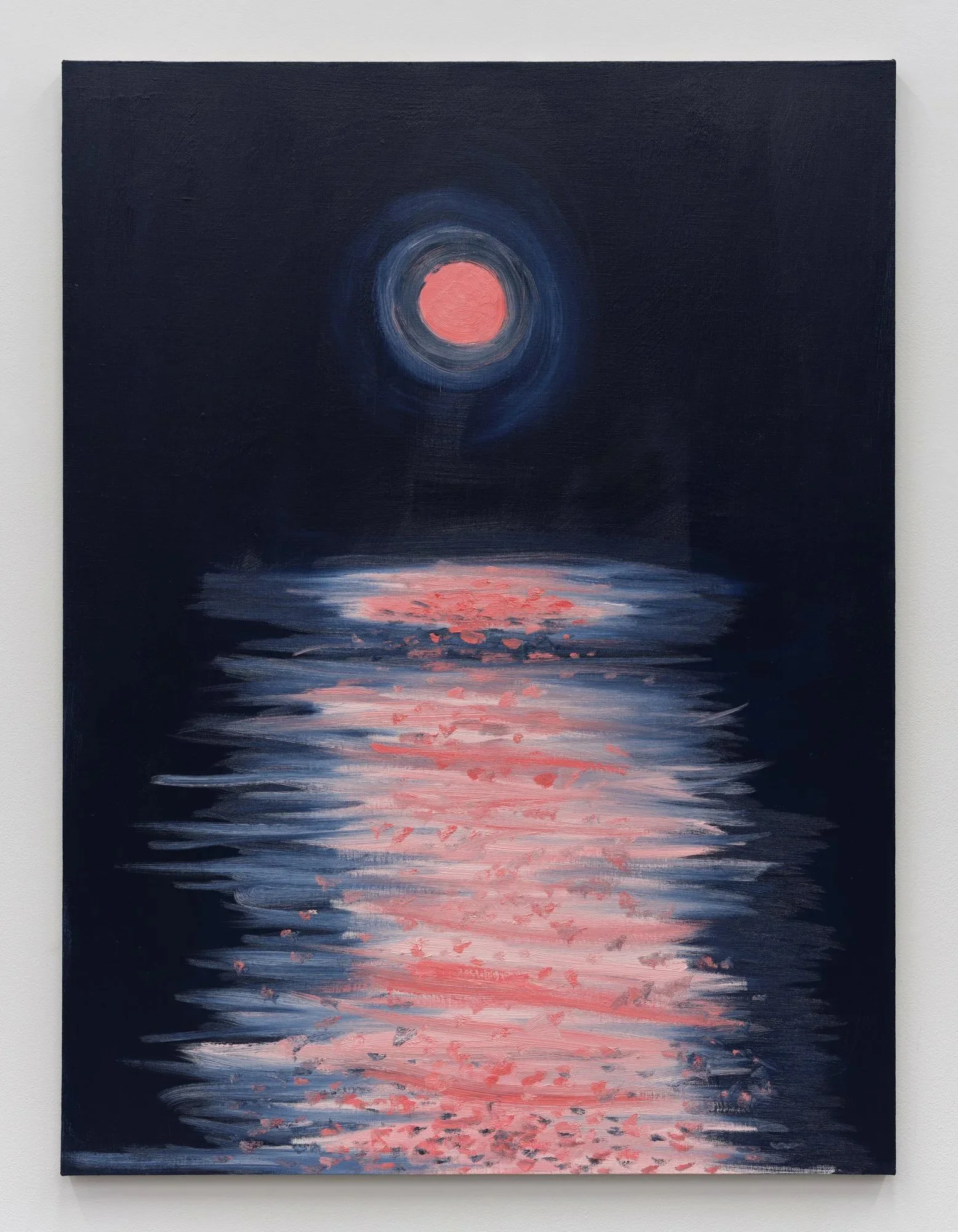
Ann Craven, Moon (Quiet, March, Full, Pink Sparkles), 2024, 2024. Oil on linen, 48 × 36 in. (121.9 × 91.4 cm). Featured in The Dark Side of the Moon at Acquavella Galleries, Palm Beach. All images courtesy of Acquavella Galleries.
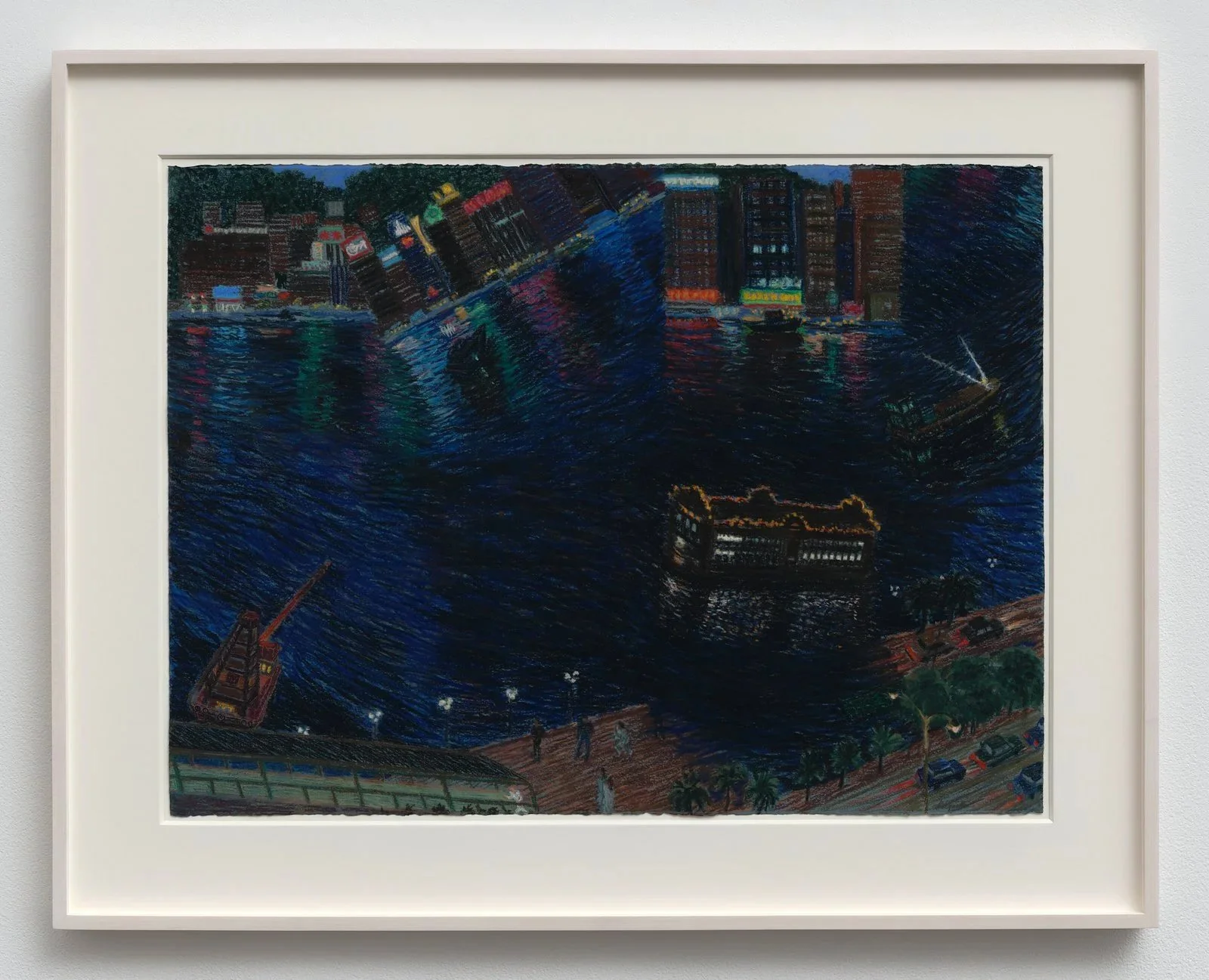
Yvonne Jacquette, Hong Kong Harbor with Floating Restaurant II, 1990. Pastel on paper, 22 1/4 × 30 in. (56.52 × 76.20 cm). Featured in The Dark Side of the Moon at Acquavella Galleries, Palm Beach. All images courtesy of Acquavella Galleries.
AMADOUR: If you could produce any book on any artist without limitation, who would it be?
TODD BRADWAY: From any century?
AMADOUR: Yes, anything.
TODD BRADWAY: If I could go back and work with Velázquez on his own catalogue raisonné, I would jump at that. He's the man of mysteries, the great mystery. Not only would I maybe learn a few of those answers, but I would get to work on the ultimate art book.
AMADOUR: I love that so much. Going back to your grandmother, I think that small towns don't get enough credit, especially in America. Even if somebody doesn't have the visual literacy of somebody who has studied art or been exposed to it, I think that it still trickles in. How do you see your presence within your own community? Are you engaged with your community in Connecticut? And how do you see the social practice of making books?
TODD BRADWAY: I think it's hard to be connected here. A lot of my family has left the area, and my wife, who's also from the same hometown, and I, at this point in our lives, life changes, and people move and pass away. We're not so connected anymore. In terms of the connection within the publishing world, it's surprisingly small, even though it's relatively large.
AMADOUR: It has a large influence.
TODD BRADWAY: It has an incredibly large impact, but there's a limited number of publishers. There are tiers of publishers. You have the largest ones, like Rizzoli, Abrams, and Thames & Hudson, and then you have a smaller group, a mid-tier. Then you have a lot of great independent publishing, the kind of publishers you would see at the New York Art Book Fair, for example, which is one of my favorite fairs in the city, where you see individual artists just making zines to get their message out. The community of publishing is incredibly important to me because publishing is an incredibly important vehicle, even in today's digital age, for artists to get their message out there, to get their word out there. Not every artist will admit this, but I think there's a lot of weight still given to a monograph of their work, to being in that right group show catalog, or to creating an amazing zine that gets their message out in printed matter. You have to speak, you have to publish and speak to your audience, whoever that is. Somebody like Tom Sachs works in the blue-chip sphere, but he also still uses books as a vehicle to get his message out. Marcel Dzama, of course, Raymond Pettibon. There's an interesting painter right now, I don't know if you know her, named Izzy Barber. She does plein air cityscapes, very rugged, very loose, but views that you've never quite seen of the city. It's in the subway, it's on the subway platform. It's gritty painting, very thick, and they're often very tiny. I'm only telling you this because she's been doing these protest zines, and it's been really great to see. She did one about ICE recently. They're very different from her paintings in that they're usually with graphite. They're very faint, but it's almost like graphic reportage. You feel like she probably was there and witnessing it, and then she's bringing that to the viewer. She's publishing them in editions of a hundred or something. Again, that's a landscape painter using the zine as a mode to get their message out to a wider public, but not in a commercial way. It's really because that's what they have to do.
AMADOUR: I think it's amazing what you're doing because we need more literature, we need more literacy, and we need more visual comprehension. As a final question, having put this exhibition together, how do you see its reception and its location? Palm Beach is a very specific place to be putting this show on. Art Basel Miami Beach is coming up, and there's Beth Rudin DeWoody's The Bunker Artspace, among other things. What is the dialogue there that you are hoping to share and see?
TODD BRADWAY: You always have to consider your context and your timing. You can't be blind to where you're placing something. That said, and I'm sure you have, too, I've seen Art Basel many times. You know the scene. I'm pretty stubborn, and I'm working with a gallery that is very much going to do what they feel is within the tradition of what they do, which is at a very high level. We made a show that I think could function in New York. I think it functions in New York, it functions in Palm Beach. We're not shying away from the themes and the feelings and the types of artists that we would show anywhere. I think you have to take into account the sense of scale. The gallery in Palm Beach is not as large as the townhouse space. But the quality of the work, the message of the work, the emotional tenor, I'm not ashamed of beauty. I don't run away from beauty. I think this work has that sense of beauty that will appeal to the type of audience down in Palm Beach. But these are also tough works. These are works that have an intellectual rigor, and they have the painting dexterity and the academic rigor in many cases. They're tougher works, but they balance that out with their approachability. Then you have the theme, which is so universal. It ties together people across the board, no matter what your background is. We all live with the moon. We all reflect on the moon. It reflects us. This is a show built for Palm Beach. It's built for the world. It's not specific to it.
AMADOUR: Thank you so much, Todd.
TODD BRADWAY: Thank you. It's been a real joy.
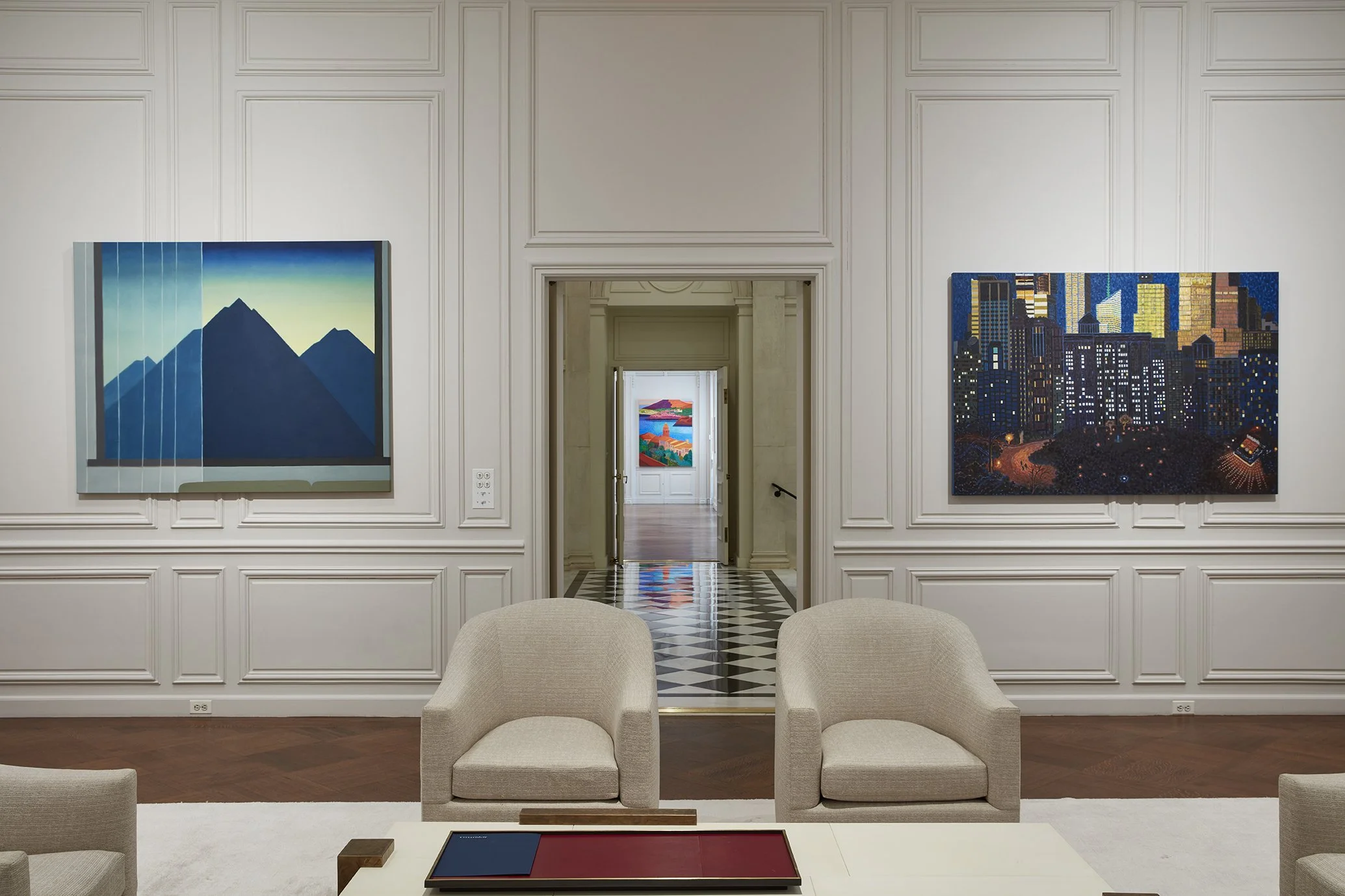
Installation view of Unnatural Nature: Post-Pop Landscapes, curated by Todd Bradway, at Acquavella Galleries, New York, April 21–June 10, 2022. Photo: Kent Pell. Courtesy of Acquavella Galleries.
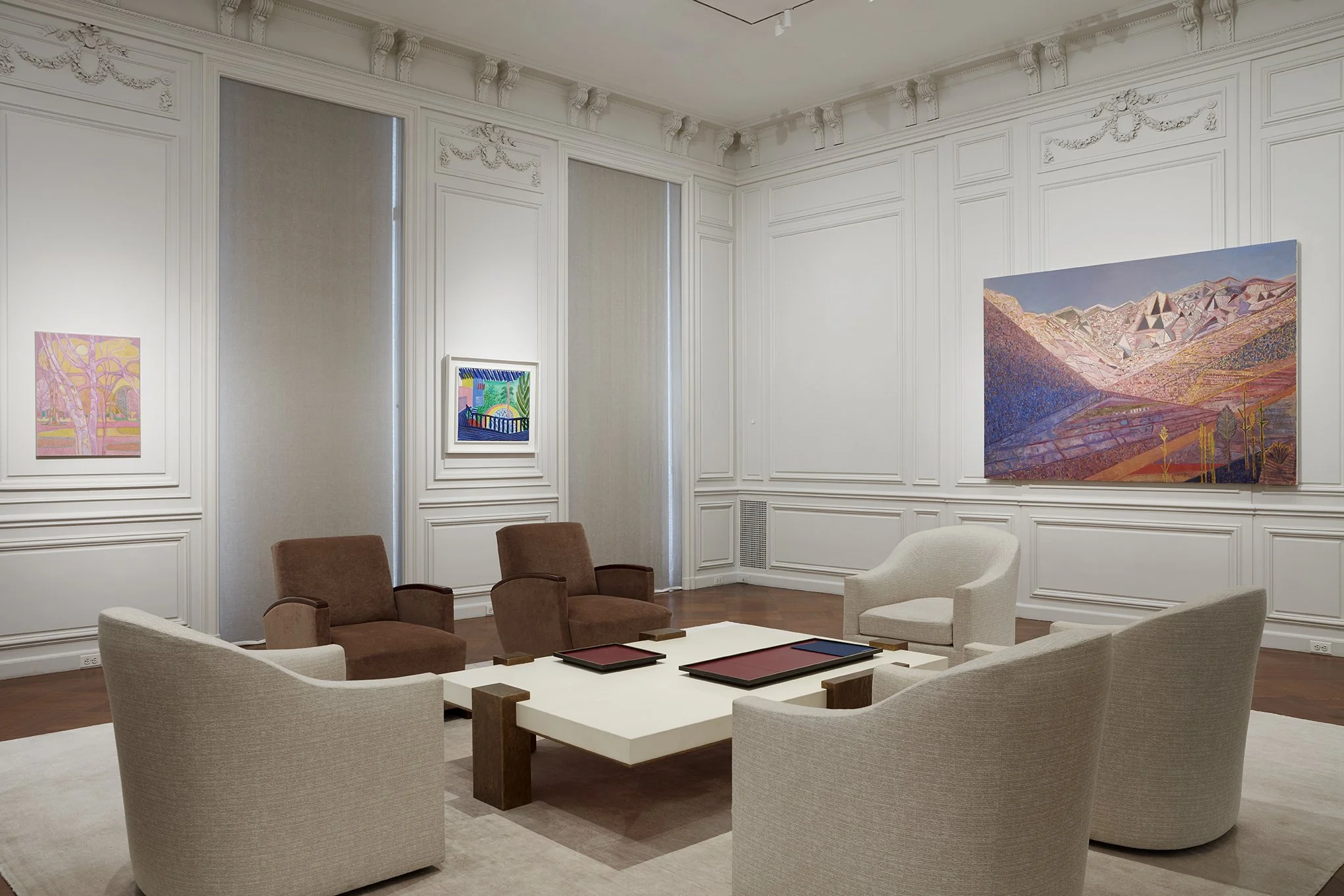
Installation view of Unnatural Nature: Post-Pop Landscapes, curated by Todd Bradway, at Acquavella Galleries, New York, April 21–June 10, 2022. Photo: Kent Pell. Courtesy of Acquavella Galleries.
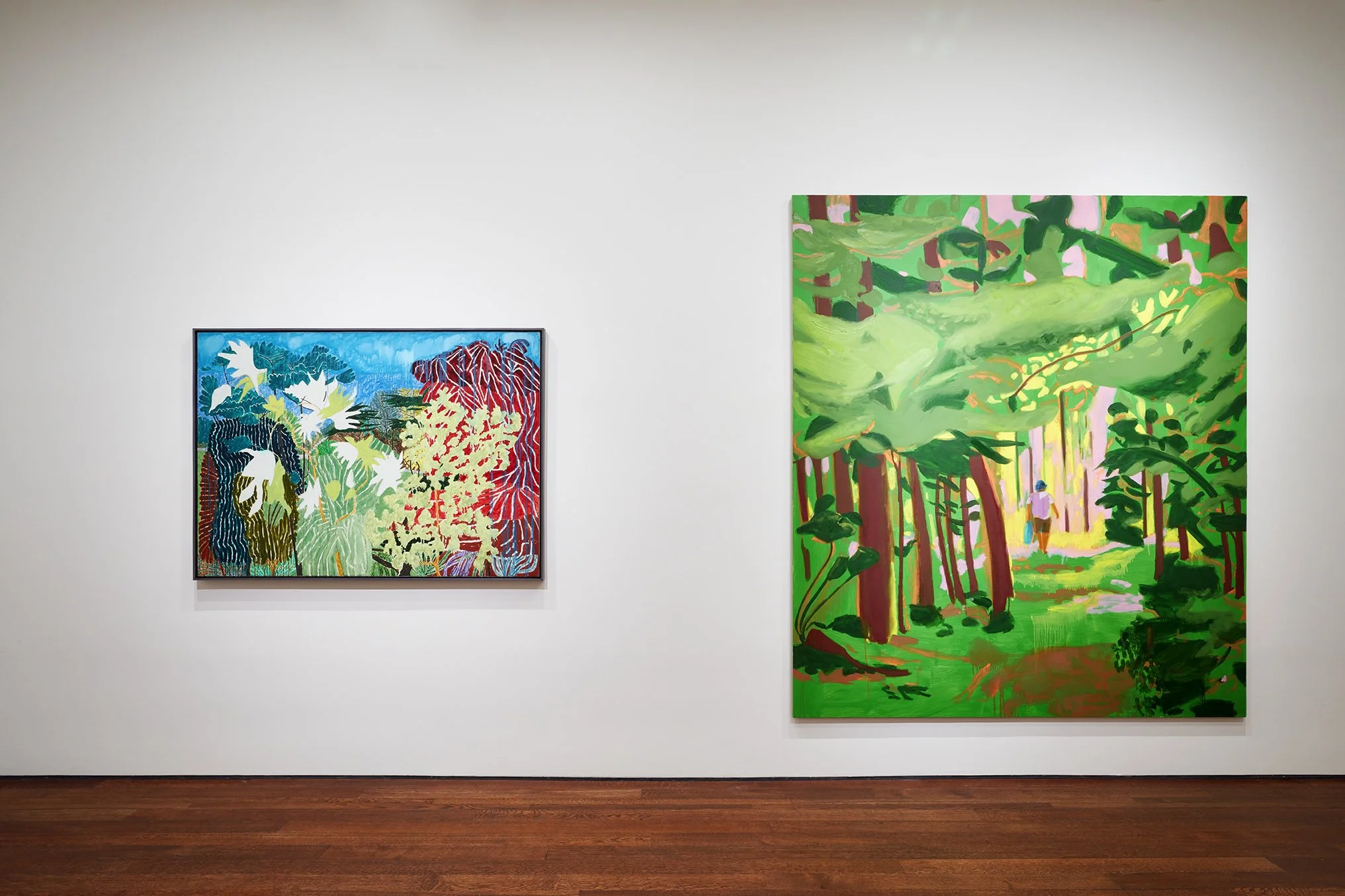
Installation view of Unnatural Nature: Post-Pop Landscapes, curated by Todd Bradway, at Acquavella Galleries, New York, April 21–June 10, 2022. Photo: Kent Pell. Courtesy of Acquavella Galleries.
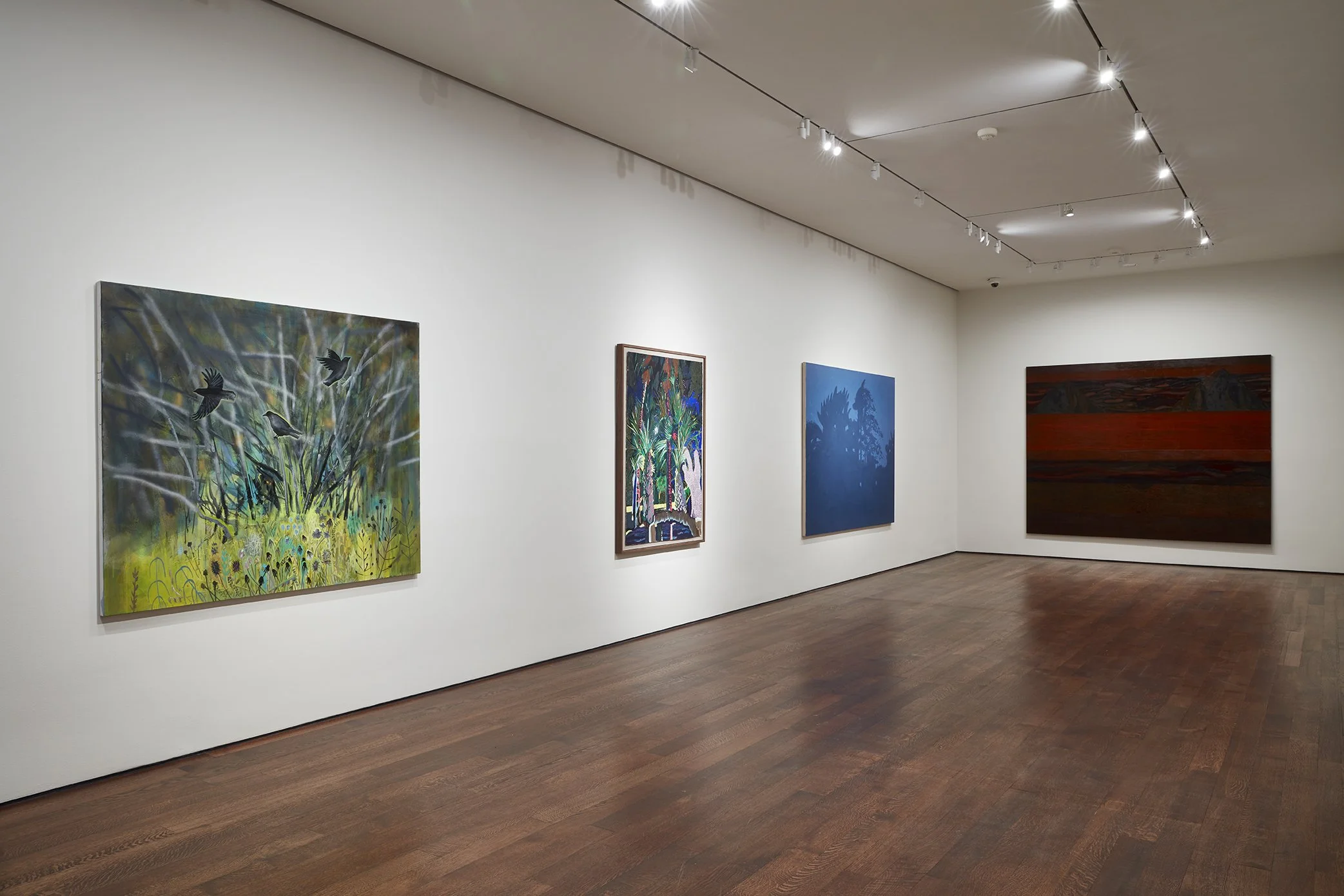
Installation view of Unnatural Nature: Post-Pop Landscapes, curated by Todd Bradway, at Acquavella Galleries, New York, April 21–June 10, 2022. Photo: Kent Pell. Courtesy of Acquavella Galleries.
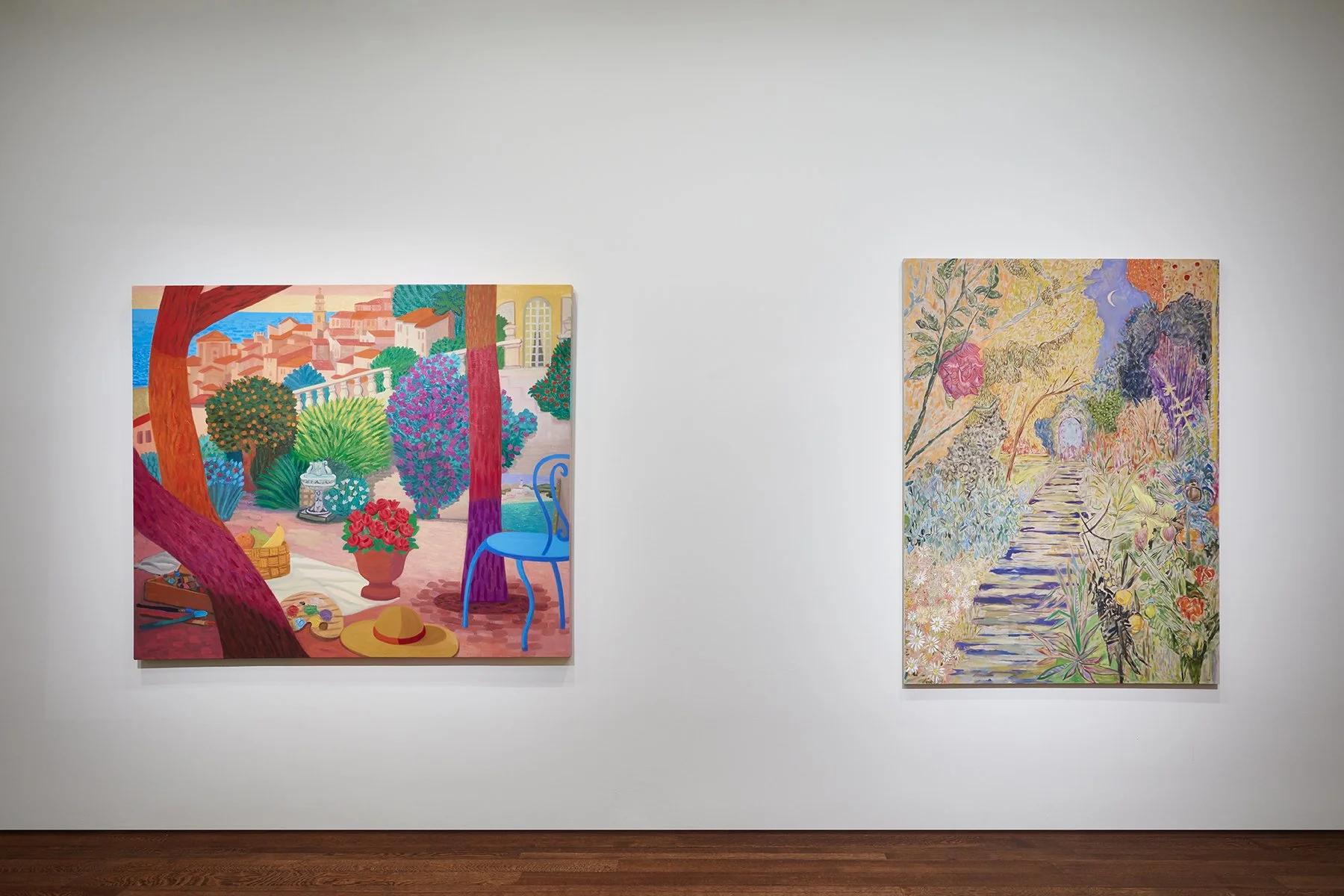
Installation view of Unnatural Nature: Post-Pop Landscapes, curated by Todd Bradway, at Acquavella Galleries, New York, April 21–June 10, 2022. Photo: Kent Pell. Courtesy of Acquavella Galleries.
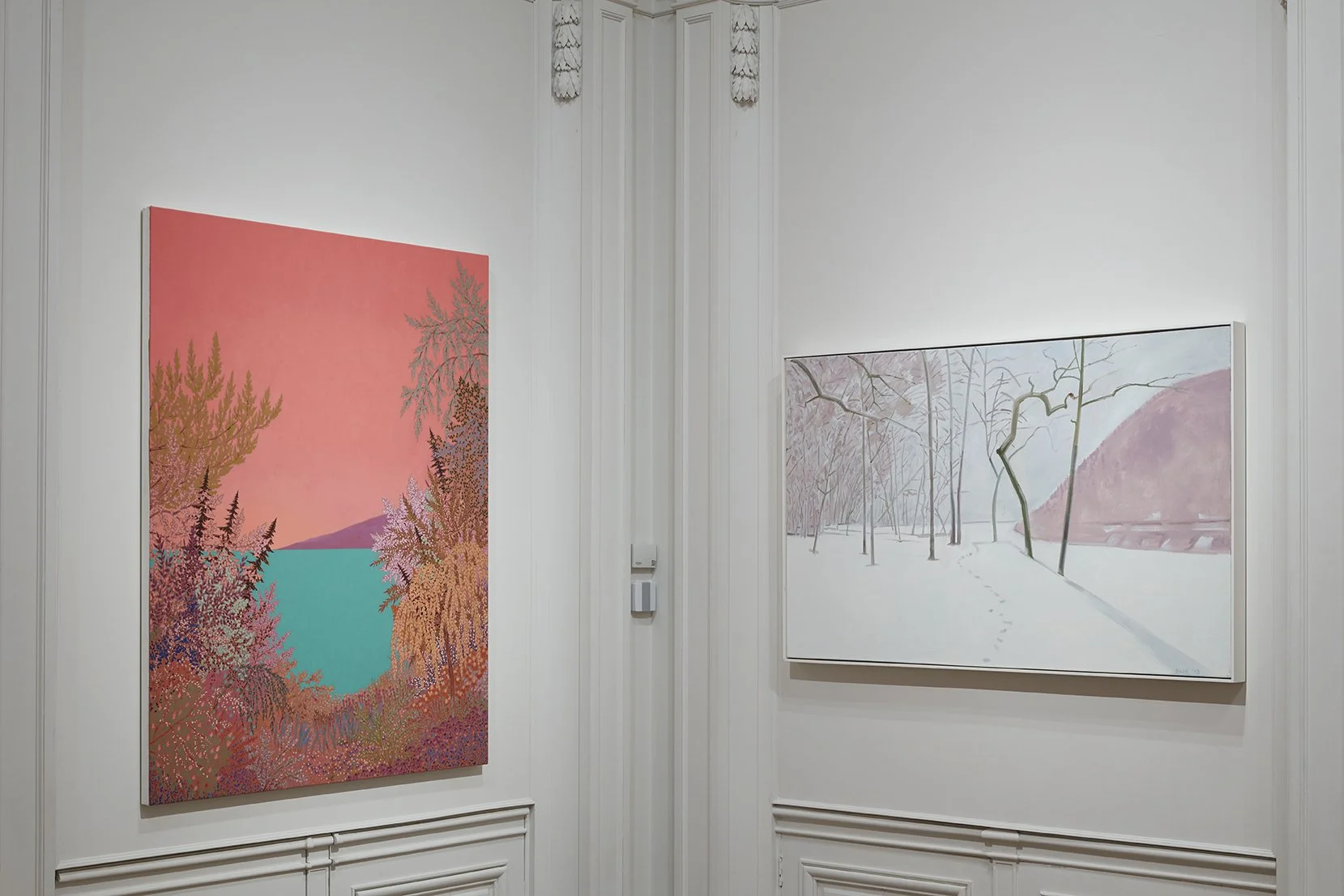
Installation view of Unnatural Nature: Post-Pop Landscapes, curated by Todd Bradway, at Acquavella Galleries, New York, April 21–June 10, 2022. Photo: Kent Pell. Courtesy of Acquavella Galleries.
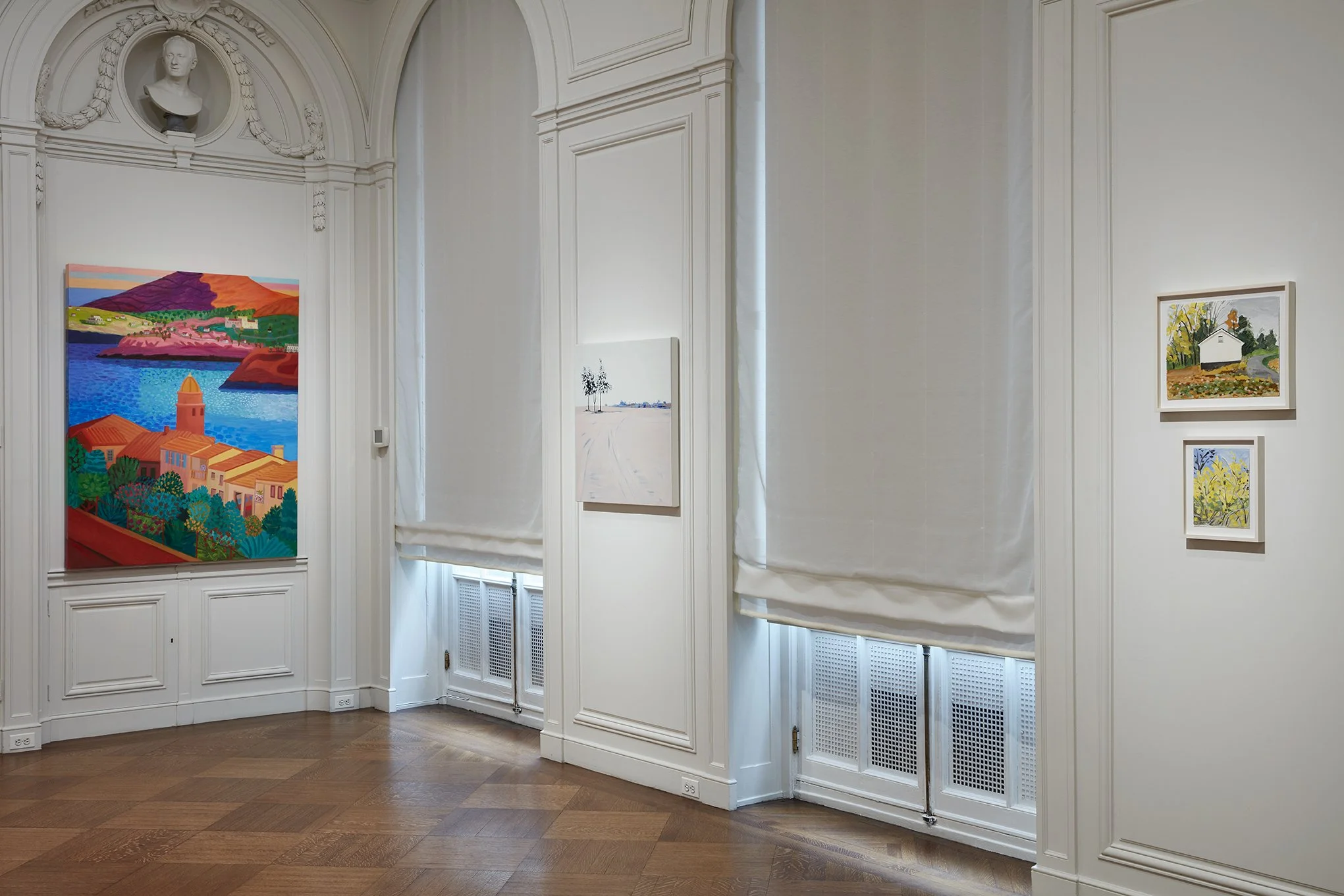
Installation view of Unnatural Nature: Post-Pop Landscapes, curated by Todd Bradway, at Acquavella Galleries, New York, April 21–June 10, 2022. Photo: Kent Pell. Courtesy of Acquavella Galleries.
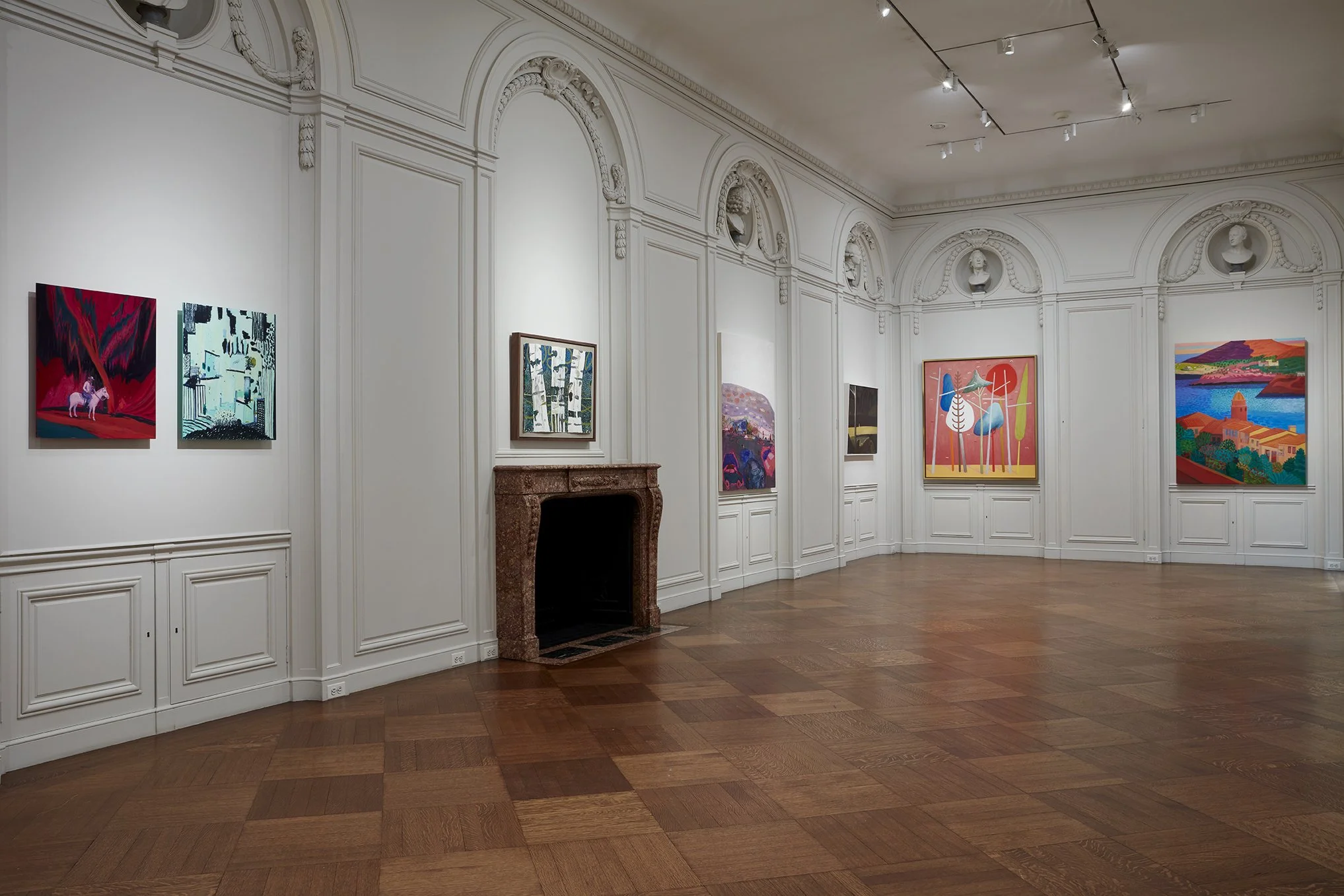
Installation view of Unnatural Nature: Post-Pop Landscapes, curated by Todd Bradway, at Acquavella Galleries, New York, April 21–June 10, 2022. Photo: Kent Pell. Courtesy of Acquavella Galleries.
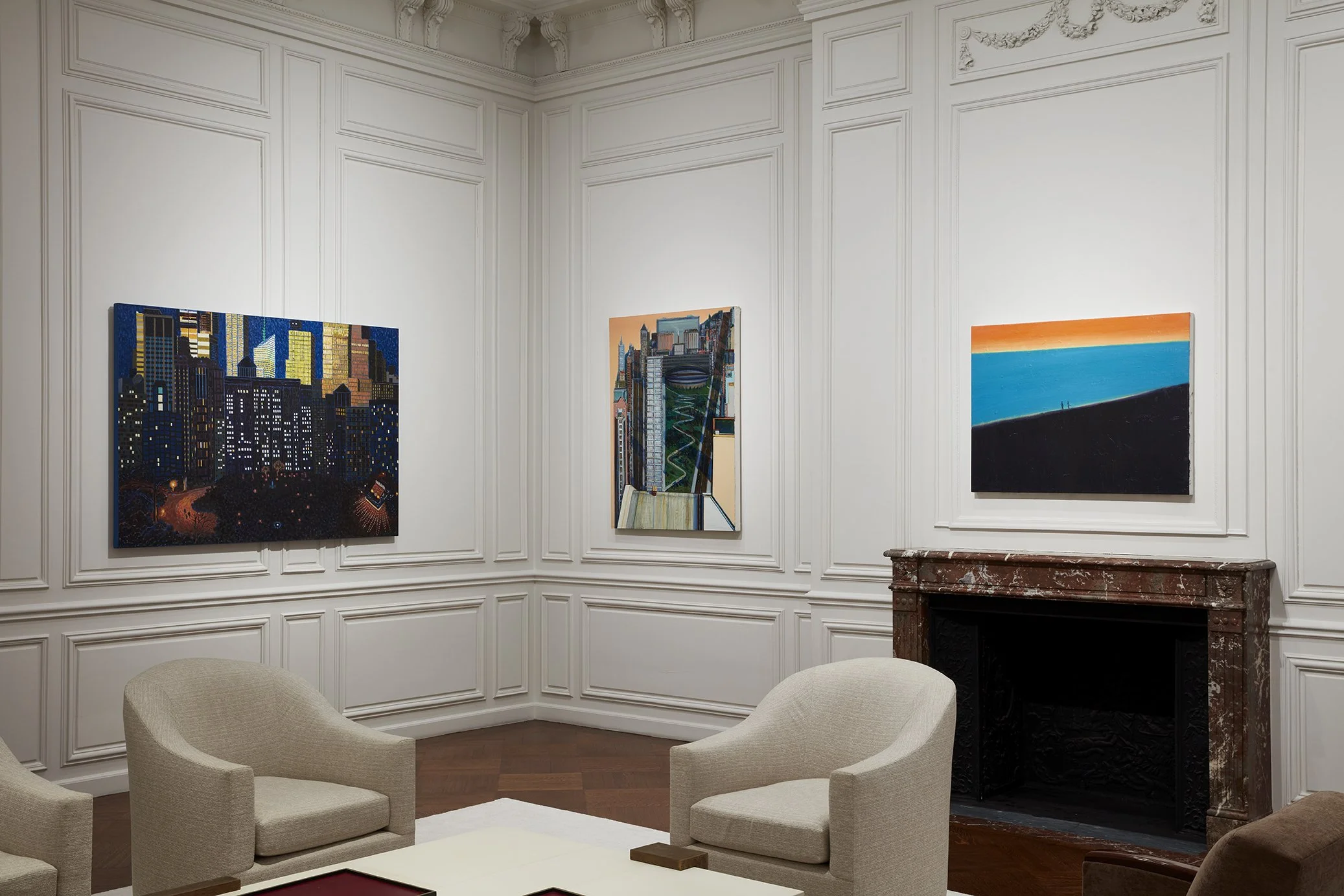
Installation view of Unnatural Nature: Post-Pop Landscapes, curated by Todd Bradway, at Acquavella Galleries, New York, April 21–June 10, 2022. Photo: Kent Pell. Courtesy of Acquavella Galleries.