ALEXIS SMITH AT FRANÇOIS GHEBALY: RAPIDO, CARMEN, MICKEY MOUSE, ORLANDO, AND PATIENCE — AN ESSAY
Alexis Smith, Rapido, 1975. Site-specific installation with one locomotive and three train cars. Train: 1.5 × 2 × 45.75 inches (4 × 5 × 116 cm). Overall installation dimensions variable. Edition of 2 plus 1 AP. Courtesy of the Estate of Alexis Smith and François Ghebaly, Los Angeles, New York. Video: Amadour.
A small train circles an otherwise empty room, moving along the perimeter, disappearing and reappearing in a continuous cycle. There are no passengers waiting to arrive, no station from which to depart, and no landscape beyond the white walls of the gallery. In Rapido (1975), Alexis Smith appropriates an object designed for transportation and recontextualizes it as a vehicle without destination. More than fifty years after its original presentation at the UC Santa Barbara Art Galleries, the model train resumes its journey at François Ghebaly in Los Angeles, tracing the same closed circuit it traveled in 1975.
The train embodies a history that extends far beyond Smith’s installation. In Wales in 1804, Richard Trevithick’s locomotive completed the first successful rail journey, traveling along the Penydarren tramroad with iron and passengers. Although modest by contemporary standards, this journey demonstrated for the first time that steam power could effectively pull a train along rails, inaugurating a transportation system that would recast the nineteenth century. Few inventions so thoroughly encapsulate the human desire to collapse distance or so profoundly alter our understanding of gesture, topography, and duration. In California, the railroad's arrival was similarly transformative. In 1856, the Sacramento Valley Railroad, the state’s first commercial railroad, began carting passengers between Sacramento and Folsom behind a locomotive aptly named Sacramento. What began as a relatively short regional line anticipated the vast adaptation to come: railroads would connect California’s cities and agricultural regions, traverse landscapes previously measured in days or weeks of travel, and ultimately bind the state to the rest of the country through the transcontinental railroad. In a region defined by immense distances, the train did not merely traverse California; it fundamentally reorganized how the state could be inhabited and imagined.

Alexis Smith, Rapido, 1975. Site-specific installation with one locomotive and three train cars. Train: 1.5 × 2 × 45.75 inches (4 × 5 × 116 cm). Overall installation dimensions variable. Edition of 2 plus 1 AP. Courtesy of the Estate of Alexis Smith and François Ghebaly, Los Angeles, New York. Photo: Paul Salveson.
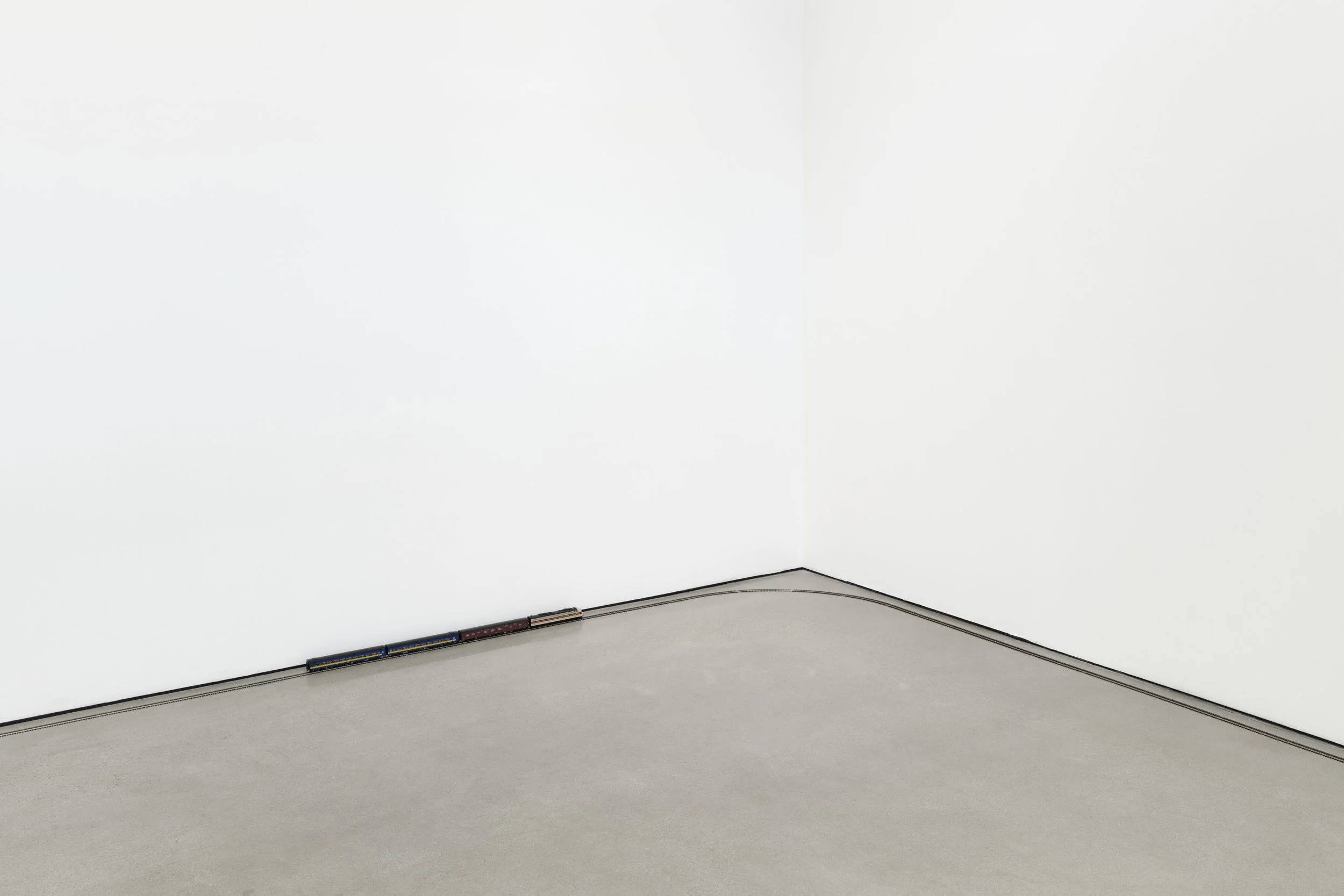
Alexis Smith, Rapido, 1975. Site-specific installation with one locomotive and three train cars. Train: 1.5 × 2 × 45.75 inches (4 × 5 × 116 cm). Overall installation dimensions variable. Edition of 2 plus 1 AP. Courtesy of the Estate of Alexis Smith and François Ghebaly, Los Angeles, New York. Photo: Paul Salveson.
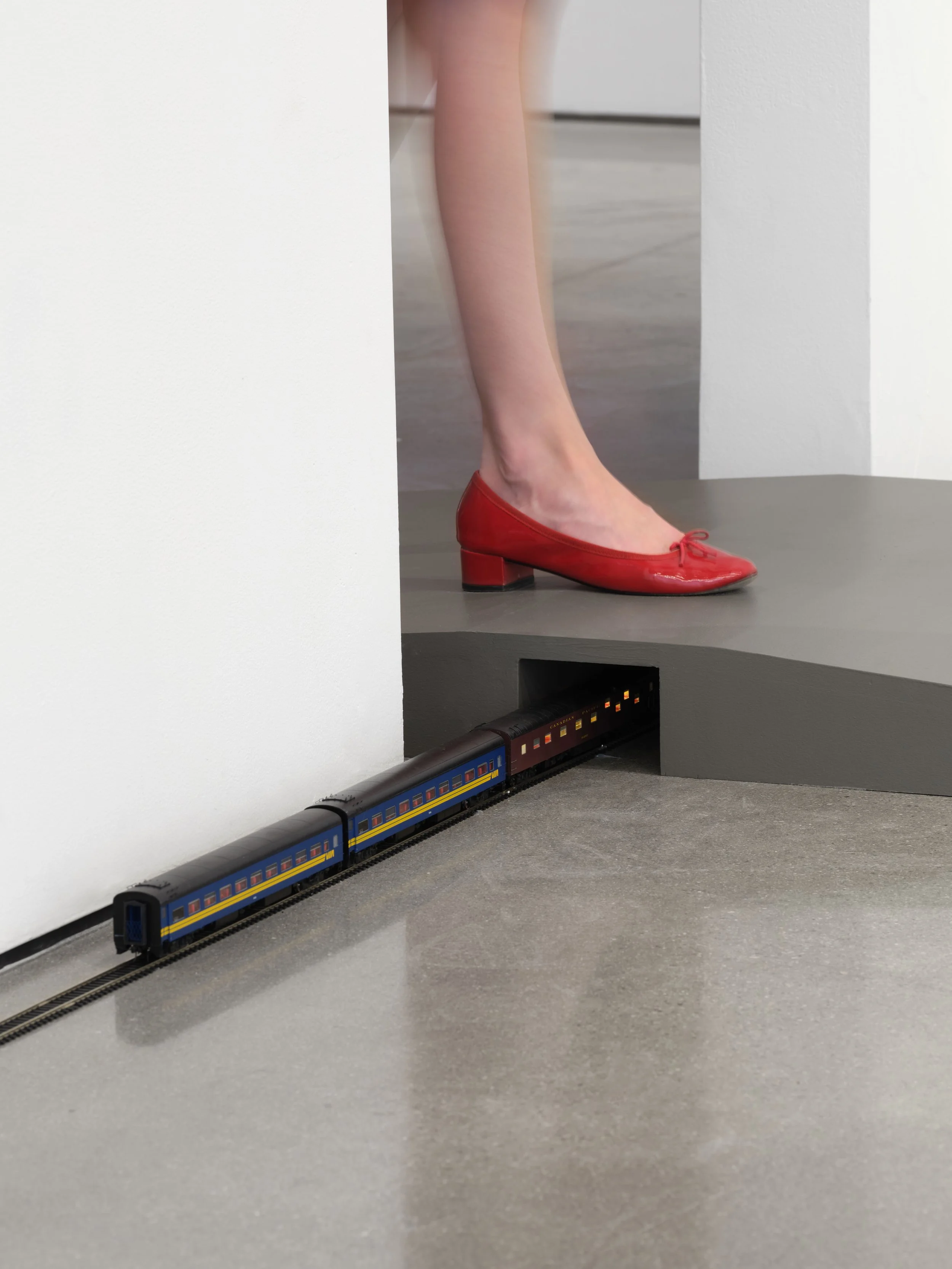
Alexis Smith, Rapido, 1975. Site-specific installation with one locomotive and three train cars. Train: 1.5 × 2 × 45.75 inches (4 × 5 × 116 cm). Overall installation dimensions variable. Edition of 2 plus 1 AP. Courtesy of the Estate of Alexis Smith and François Ghebaly, Los Angeles, New York. Photo: Paul Salveson.

Alexis Smith, Rapido, 1975. Site-specific installation with one locomotive and three train cars. Train: 1.5 × 2 × 45.75 inches (4 × 5 × 116 cm). Overall installation dimensions variable. Edition of 2 plus 1 AP. Courtesy of the Estate of Alexis Smith and François Ghebaly, Los Angeles, New York. Photo: Paul Salveson.
This historical context sharpens the central contrast that gives Rapido its force: Smith miniaturizes a machine that once reorganized cities, landscapes, economies, and our experience of time, reducing it to a small locomotive circulating within the gallery. Yet the train has accumulated too much cultural meaning to remain merely a machine or a model. It can signify progress, industry, migration, spectacle, commodity, memory, or departure, and artists have repeatedly revisited it because these meanings are open to reinterpretation. Jeff Koons approached the train from an almost opposite perspective. In Jim Beam – J.B. Turner Train (1986), he monumentalized a novelty bourbon decanter by casting an entire model train in stainless steel, filling its cars with Jim Beam bourbon and converting the train into an unsoiled object of commodity and desire. Nearly two decades later, Koons conceived Train (2003), an unrealized public artwork that offers an even sharper counterpoint to Rapido. A life-size replica of a 1943 Baldwin steam locomotive would hang nose-down from a monumental construction crane and, several times each day, appear to come alive: wheels turning, whistle sounding, steam billowing, yet the machine itself rendered incapable of travel. If Rapido is diminutive yet endlessly mobile, Koons’s Train is monumental yet permanently arrested. One travels constantly without arriving; the other enacts all the mechanisms of travel while remaining suspended in place. Notably, Koons’s locomotive has now existed for more than two decades primarily as a proposition. A sculpture imagined at elephantine scale remains physically unrealized, while Smith’s nimble, catepillar-like passenger train occupies minimal space and yet transforms an entire room.
My fascination with trains began, in part, with Hayao Miyazaki’s Spirited Away (2001). In one of the film’s most evocative sequences, Chihiro boards a railway that glides quietly across a flooded landscape, surrounded by spectral passengers who gradually depart. The journey appears to suspend, rather than accelerate, time. The train functions as a portal, not only between locations but also between emotional states. I recall being captivated by this as a child, perhaps because trains already held a similar place in my imagination. Growing up in Reno, I remember taking the train west to Truckee with my family, visiting old cemeteries, and watching the railway ascend through Donner Pass at a steepness and scale that seemed almost impossible. The train traversed tunnels, mountains, snow sheds, and dramatic changes in elevation, transforming a familiar landscape into something mysterious. Miyazaki captured that same childhood sensation for me: the possibility that a train might carry you not only somewhere else, but into another version of the world. While these personal memories inform my engagement with Smith’s Rapido, they primarily underscore the work’s success in activating wonder and unfamiliarity in viewers, recalling both individual journeys and the broader cultural meanings of travel. Smith’s Rapido restores that feeling in a new form. Its train is autonomous, disappearing and returning on its own terms, while the small tunnels and passages built into the installation create spaces that visitors can walk over and around, collapsing the distinction between model and architecture. The installation has the logic of something I would have wanted to build as a child and, curiously, still want to build now. Yet Smith reverses the conventional relationship between passenger and world. We do not look through the train window at a passing landscape; instead, we become the landscape. Our bodies remain stationary while the train measures the architecture around us. In this sense, Rapido also recalls Chris Burden’s Metropolis II (2011), another miniature world in which circulation becomes spectacle. Burden constructed a densely populated model city traversed by streams of miniature cars and trains, turning Los Angeles's systems into a kinetic sculpture. However, where Metropolis II overwhelms through accumulation, speed, infrastructure, and congestion, Smith strips the system away almost entirely. Burden presents the entire city; Smith offers a single train. Both works return us to the fascination of observing a wonder-filled world in motion, but in Rapido, we are no longer safely outside the model looking down. Instead, we have grown large enough to stand inside it.

Alexis Smith, Carmen, 1974. Mixed media, 8 pages, two parts. Top: 13.5 × 46.5 × 1.5 inches (34.5 × 118 × 4 cm), framed. Bottom: 13.5 × 29 × 1.5 inches (34.5 × 74 × 4 cm), framed. Overall installed dimensions variable. Courtesy of the Estate of Alexis Smith and François Ghebaly, Los Angeles, New York. Photo: Paul Salveson.

Alexis Smith, Carmen, 1974. Mixed media, 8 pages, two parts. Top: 13.5 × 46.5 × 1.5 inches (34.5 × 118 × 4 cm), framed. Bottom: 13.5 × 29 × 1.5 inches (34.5 × 74 × 4 cm), framed. Overall installed dimensions variable. Courtesy of the Estate of Alexis Smith and François Ghebaly, Los Angeles, New York. Photo: Paul Salveson.

Alexis Smith, Carmen, 1974. Mixed media, 8 pages, two parts. Top: 13.5 × 46.5 × 1.5 inches (34.5 × 118 × 4 cm), framed. Bottom: 13.5 × 29 × 1.5 inches (34.5 × 74 × 4 cm), framed. Overall installed dimensions variable. Courtesy of the Estate of Alexis Smith and François Ghebaly, Los Angeles, New York. Photo: Paul Salveson.
This brings to mind Simone Forti, whom I interviewed alongside art critic and curator Peter Frank in what would become one of Forti’s final interviews. Speaking with them sharpened my understanding of the tactile and kinetic thinking that emerged in art during the latter half of the twentieth century. Alexis Smith fits within this broader intellectual context, and in Rapido, the train itself begins to resemble a dancer. It enters our field of vision, crosses the room, vanishes, and returns; its circuit becomes choreography, and the gallery becomes its stage. This quality places Smith’s work unexpectedly close to Fluxus, where an artwork could exist as an action, an instruction, an interval, or simply the anticipation that something might occur. Fluxus fundamentally challenged the notion that art must be an object; the audience could be essential to completing the work. Artist George Brecht’s Timetable Event (1961), for example, begins with the mundane act of obtaining a railway timetable and interpreting one of its scheduled times as the event's duration: the rigid infrastructure of railway time becomes a score. Wolf Vostell later transformed the train itself into an exhibition with his Fluxus-Zug (1981), a mobile environment traveling between railway stations in West Germany. Rather than requiring an audience to enter a conventional museum, the museum itself moved.
Alexis Smith ultimately turns the train into a kind of wordless instruction. This became clearer to me while visiting Yoko Ono: Music of the Mind at The Broad in Los Angeles, particularly Add Colour (Refugee Boat) (1960/2016), in which visitors are invited to step inside and around a plain wooden boat and use blue markers to alter its surfaces, following Ono’s succinct instruction, “Just blue, like the ocean.” The instruction is simple, but the viewer’s placement is complex: we are positioned within a vessel associated with migration, displacement, and survival and asked to leave a physical trace upon it. Rapido creates an almost inverse situation. We cannot enter or touch the train, and Smith provides no written instruction; instead, the train’s placement and movement establish their own choreography. In this sense, the installation closely resembles music. A rest written into a score is not outside the composition but is performed as part of it, altering the notes that precede and follow.

Alexis Smith, Mickey Mouse, 1974. Mixed media, 21 pages, three parts. Top: 13.75 × 75.5 × 1.5 inches (35 × 192 × 4 cm), framed. Middle: 13.75 × 57 × 1.5 inches (35 × 145 × 4 cm), framed. Bottom: 13.75 × 14.75 × 1.5 inches (35 × 37.5 × 4 cm), framed. Overall installed dimensions: 49.25 × 75.5 × 1.5 inches (125 × 192 × 4 cm), framed. Courtesy of the Estate of Alexis Smith and François Ghebaly, Los Angeles, New York. Photo: Paul Salveson.

Alexis Smith, Mickey Mouse, 1974. Mixed media, 21 pages, three parts. Top: 13.75 × 75.5 × 1.5 inches (35 × 192 × 4 cm), framed. Middle: 13.75 × 57 × 1.5 inches (35 × 145 × 4 cm), framed. Bottom: 13.75 × 14.75 × 1.5 inches (35 × 37.5 × 4 cm), framed. Overall installed dimensions: 49.25 × 75.5 × 1.5 inches (125 × 192 × 4 cm), framed. Courtesy of the Estate of Alexis Smith and François Ghebaly, Los Angeles, New York. Photo: Paul Salveson.

Alexis Smith, Mickey Mouse, 1974. Mixed media, 21 pages, three parts. Top: 13.75 × 75.5 × 1.5 inches (35 × 192 × 4 cm), framed. Middle: 13.75 × 57 × 1.5 inches (35 × 145 × 4 cm), framed. Bottom: 13.75 × 14.75 × 1.5 inches (35 × 37.5 × 4 cm), framed. Overall installed dimensions: 49.25 × 75.5 × 1.5 inches (125 × 192 × 4 cm), framed. Courtesy of the Estate of Alexis Smith and François Ghebaly, Los Angeles, New York. Photo: Paul Salveson.
In the adjoining gallery at François Ghebaly, the train is absent. Instead, works on paper created by Smith in 1974—among the earliest of her career and exhibited publicly here for the first time—are displayed. Yet after engaging with Rapido, it is difficult not to perceive another journey commencing. Originally, Smith did not hang these sheets conventionally on a wall. She arranged them on a felt-topped table in her studio and presented them individually, allowing visitors to move through the works at their own pace. Smith would later describe them as “one-of-a-kind books.” Images, slivers of enunciation, literary references, and visual portmanteaus unfold from one sheet to another. The train has vanished, but its structure persists. Now, the viewer becomes the one in motion.
Of the four works, Carmen (1974) establishes a particularly uncanny relationship to Rapido. Across eight sheets, Smith interweaves Greek mythology, classical sculpture, commercial ephemera, Wagner, and Albert Lewin’s Pandora and the Flying Dutchman (1951), the Technicolor fantasy starring Ava Gardner as Pandora Reynolds and James Mason as Hendrik van der Zee. Set in the fictional Spanish port of Esperanza, the film follows Pandora as she falls in love with Hendrik, who is revealed to be the legendary Flying Dutchman, condemned to sail the oceans until he finds a woman willing to sacrifice her life for his love. The film itself occupies a space between cinema and art: cinematographer Jack Cardiff’s dreamlike imagery has been associated with the landscapes of Giorgio de Chirico, while Lewin, an art collector and friend of Man Ray, involved the artist in the production to create props and photograph the set. Smith further fragments this layered narrative, breaking the large red word “CARMEN” across two sheets into “CAR” and “MEN,” while the doomed voyage continues in smaller type below. Eventually, she arrives at the Dutchman’s curse and the haunting condition of his journey: “To the sea, without aim, without end.” A year before Rapido sent its locomotive endlessly around the gallery, Smith was already constructing a narrative centered on perpetual movement and the impossibility of arrival. The vehicle shifts from ship to train and the medium from page to architecture, but the underlying structure remains: passage becomes repetition, and movement itself becomes the work's condition.

Alexis Smith, Orlando, 1974. Mixed media, 11 pages, two parts. Top: 14.75 × 57.5 × 1.5 inches (37.5 × 146 × 4 cm), framed. Bottom: 14.75 × 48.25 × 1.5 inches (37.5 × 122.5 × 4 cm), framed. Overall installed dimensions variable. Courtesy of the Estate of Alexis Smith and François Ghebaly, Los Angeles, New York. Photo: Paul Salveson.

Alexis Smith, Orlando, 1974. Mixed media, 11 pages, two parts. Top: 14.75 × 57.5 × 1.5 inches (37.5 × 146 × 4 cm), framed. Bottom: 14.75 × 48.25 × 1.5 inches (37.5 × 122.5 × 4 cm), framed. Overall installed dimensions variable. Courtesy of the Estate of Alexis Smith and François Ghebaly, Los Angeles, New York. Photo: Paul Salveson.

Alexis Smith, Orlando, 1974. Mixed media, 11 pages, two parts. Top: 14.75 × 57.5 × 1.5 inches (37.5 × 146 × 4 cm), framed. Bottom: 14.75 × 48.25 × 1.5 inches (37.5 × 122.5 × 4 cm), framed. Overall installed dimensions variable. Courtesy of the Estate of Alexis Smith and François Ghebaly, Los Angeles, New York. Photo: Paul Salveson.
Mickey Mouse (1974) functions as an experiment in signification: how does a mark become a symbol? Smith scatters typewriter characters across the page until letters lose their linguistic meaning and revert to abstract marks. Mickey Mouse operates in the opposite manner. Reduced almost to geometric forms, his silhouette remains instantly recognizable; two circular ears can summon an entire history of popular culture. This recalls René Magritte’s La Trahison des images (1929) (The Treachery of Images), in which the declaration “Ceci n’est pas une pipe” reminds us that an image of a pipe is not the object itself, but a sign we have learned to recognize. Smith approaches the question from the reverse direction: how little information is required before a sign becomes meaningful? In Mickey Mouse, she navigates between marks that have lost their meaning and an image so culturally familiar that it is nearly impossible to empty it of significance.
If Mickey Mouse explores how a symbol becomes recognizable, Orlando (1974) extends that inquiry to the body itself. Across eleven pages, Smith juxtaposes bodies, faces, lips, commercial color samples, fragmented lettering, and references to Virginia Woolf’s Orlando (1928), whose protagonist lives across centuries and changes sex. Throughout the work, names and bodies resist fixed categorization. Smith seems interested in how we name, classify, and interpret appearances, even as bodies elude those categories. Orlando also prompted me to recall Sarah Charlesworth’s April 20, 1978 (1978), which I recently encountered in the exhibition The Expanding Field: MOCA’s Collection from the 1940s to the 1970s at the Museum of Contemporary Art in Los Angeles. Charlesworth reproduced newspapers from around the world, removing the article text and leaving mastheads and photographs to reveal how images of the same event were selected, positioned, and dispersed internationally. The work became unexpectedly personal when I recognized Excélsior of Mexico City among Charlesworth’s newspapers. My great-grandfather, José Valdés Razo, was a journalist and one of the newspaper’s founders, and seeing it there made tangible for me how interconnected newspapers and media already were across national borders. Yet far fewer images competed to define an event: a front page and a handful of photographs could shape how millions understood what had happened. Charlesworth removes the words to reveal how images construct an event; Smith, through faces, bodies, names, and fragments of popular imagery, asks how images construct a person.

Alexis Smith, Patience, 1974. Mixed media, 14 pages, two parts; 14 × 67.5 × 1.5 inches (35.4 × 171.5 × 4 cm) each, framed. Overall installed dimensions variable. Courtesy of the Estate of Alexis Smith and François Ghebaly, Los Angeles, New York. Photo: Paul Salveson.
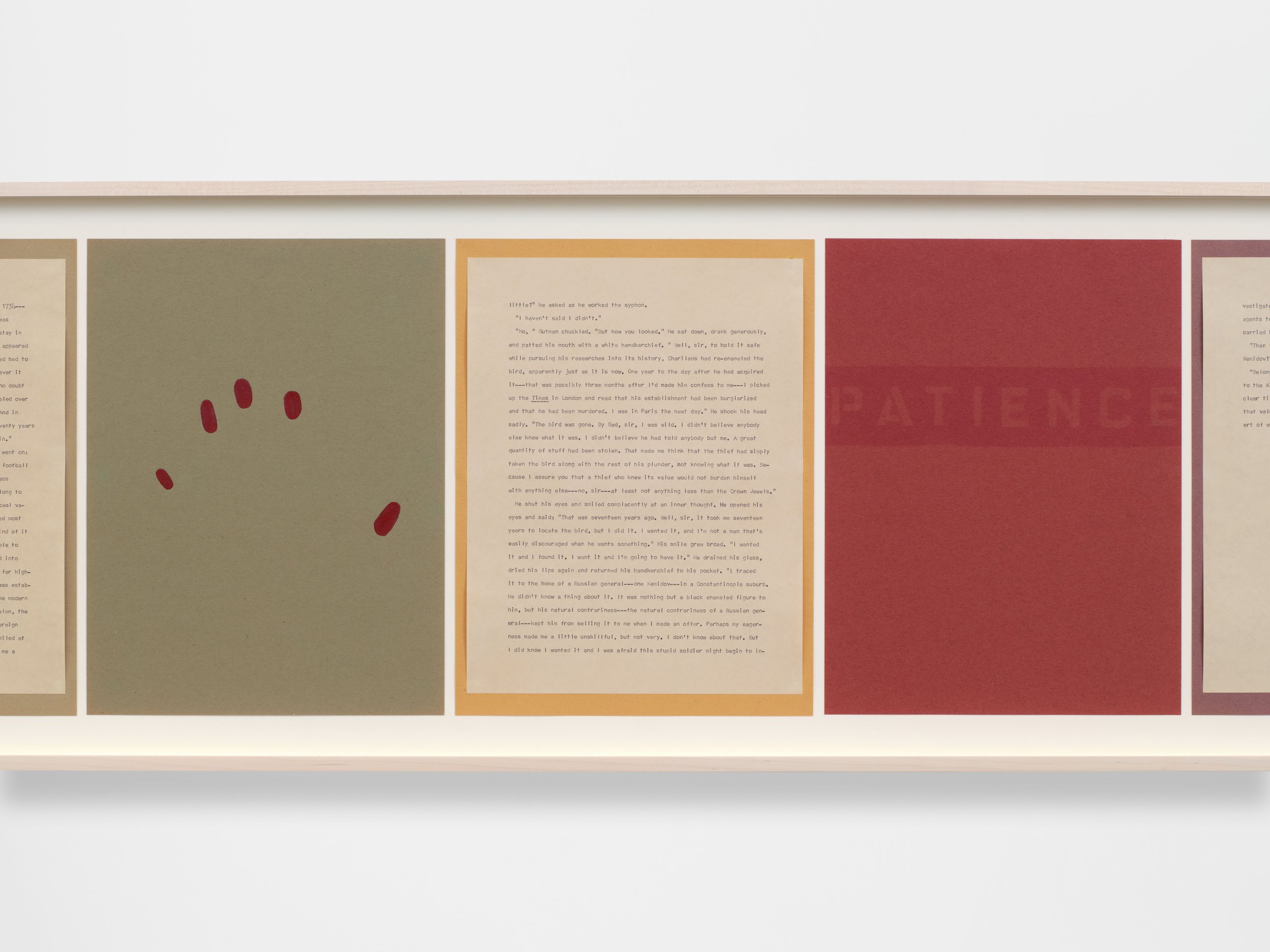
Alexis Smith, Patience, 1974. Mixed media, 14 pages, two parts; 14 × 67.5 × 1.5 inches (35.4 × 171.5 × 4 cm) each, framed. Overall installed dimensions variable. Courtesy of the Estate of Alexis Smith and François Ghebaly, Los Angeles, New York. Photo: Paul Salveson.

Alexis Smith, Patience, 1974. Mixed media, 14 pages, two parts; 14 × 67.5 × 1.5 inches (35.4 × 171.5 × 4 cm) each, framed. Overall installed dimensions variable. Courtesy of the Estate of Alexis Smith and François Ghebaly, Los Angeles, New York. Photo: Paul Salveson.
Patience (1974) turns reading into investigation. Across fourteen pages, Smith fragments Dashiell Hammett’s The Maltese Falcon (1930), following Sam Spade and the pursuit of the mysterious “black bird,” while weaving fiction together with snippets of world history, photographs, fingerprints, and silhouettes of hands. Among these images appears the Temple of Hephaestus in Athens, a place where I have spent considerable time. My own enchantment with it began through the artist Stefanos Schultz, now a dear friend, whom I met during my first visit to Athens in the summer of 2024. Hephaestus, the Greek god of fire, metalworking, and craftsmanship, was cast from Olympus in one tradition and returned, becoming the divine maker whose extraordinary objects populate Greek mythology. Yet Stefanos remembered going to the temple as a child and later casually hanging around it, something I found extraordinary: a monument erected to a god, surviving for millennia as a sacred ancient site, could also become an ordinary place for a teenager to spend an afternoon. That slippage between meanings feels close to Smith’s way of thinking. History, fiction, image, object, and personal memory do not remain in separate systems; they continually enter one another. On that same trip, Stefanos and I visited a sprawling flea market on the outskirts of Athens. Among thousands of objects and vendors, tables piled with old postcards and things whose histories had become detached from their original owners, I could only imagine what Smith might have found there. I left with a tray containing a Menelaus blue morpho butterfly beneath glass, surrounded by hand-carved wood, bought from a refugee vendor along an alley crowded with sellers. It was another object already carrying several worlds within it. In Patience, Smith asks us to encounter things in much the same way: to follow an image beyond where we first found it and discover what else it might contain.
As I write this at 12:49 in the morning, sitting at my desk in my family home in South Reno, I can hear crickets outside and the soft hush of a television my mother has left on in a distant room. I think about sleep, about catching up on the French translation of an interview between Hans Ulrich Obrist and Ettore Spalletti that I have been reading to practice my French, and about my angry Duolingo owl, whom, yes, I somewhat abandoned today. I had a good excuse. I spent the afternoon kayaking with my cousin at Lake Tahoe, stopping to eat a meal on a beach we had paddled to, beside quaking aspens that are still green and a lake so clear it seemed almost transparent. On the drive home, I noticed rock formations jutting from the peaks along I-80, a train passing beside a marshland, a house with a single large window sitting almost impossibly alone amid sage-filled grasslands, and the remains of a broken flume that once carried water through this landscape. None of these things are extraordinary on their own, and perhaps that is precisely what feels extraordinary about them tonight. Life is peculiar in the way its smallest details accumulate into something larger than we can quite see while we are living it. If Alexis Smith and her tiny train have left me with anything, it is a greater appreciation for the ordinary and the small, and for the larger story interlocking it all. I am glad I discovered her, and I am glad I held on long enough to write this essay.

Installation view, Alexis Smith, Rapido, 2026. Courtesy of the Estate of Alexis Smith and François Ghebaly, Los Angeles, New York. Photo: Paul Salveson.

Installation view, Alexis Smith, Rapido, 2026. Courtesy of the Estate of Alexis Smith and François Ghebaly, Los Angeles, New York. Photo: Paul Salveson.